A Marxist critique of higher education – David Harvey interview

A Marxist critique of higher education – David Harvey interview at FreshEd

To celebrate the 100th episode of FreshEd, I’ve saved an interview with a very special guest.

Back in October, I had the privilege of sitting down with Professor David Harvey during his visit to Tokyo. For those who don’t know him, David Harvey is considered “one of the most influential geographers of the later twentieth century.” He is one of the most cited academics in the humanities and social sciences and is perhaps the most prominent Marxist scholars in the past half century. He has taught a course on Marx’s Capital for nearly 40 years. It is freely available online, and I highly recommend it.

You can go online and find all sorts of interviews with David Harvey where he explains his work and understanding of Marx in depth.

For our conversation today, I thought it would be best to talk about higher education, a system David Harvey has experienced for over 50 years. Who better to give a Marxist critique of higher education than David Harvey himself?

David Harvey is a Distinguished Professor of Anthropology at the City University of New York. His newest book is entitled Marx, Capital and the Madness of Economic Reason, which was published last month.

thanks to dmf for the link

Posted in David Harvey, Uncategorized | 3 Comments

In the Shadow of Dictatorship: Foucault in Brazil – Marcelo Hoffman video abstract

In this short video, Marcelo Hoffman discusses his review essay of Heliana de Barros Conde Rodrigues’s book Ensaios sobre Michel Foucault no Brasil: Presença, efeitos, ressonâncias (Michel Foucault in Brazil: Presence, Effects, Resonances). His full review is available online and in the journal Theory, Culture & Society. The book sounds fascinating and is hopefully planned for translation.

Posted in Michel Foucault, Uncategorized | 1 Comment

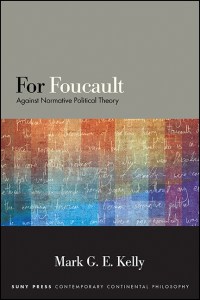
Mark Kelly, For Foucault: Against Normative Political Theory

This book is now published

stuartelden's avatarProgressive Geographies

63676_cov.jpgI shared Mark Kelly’s review of Althusser et al’s Reading Capital: The Complete Edition at the Progress in Political Economy site yesterday.
Mark’s next book,  For Foucault: Against Normative Political Theory is forthcoming in early 2018 from SUNY Press:

Calls for a Foucauldian approach to political thought that is intrinsically resistant to power and subordination to public policy.

This book comprises a series of staged confrontations between the thought of Michel Foucault and a cast of other figures in European and Anglophone political philosophy, including Marx, Lenin, Althusser, Deleuze, Rorty, Honneth, and Geuss. Focusing on the status of normativity in their thought, Mark G. E. Kelly explains how Foucault’s position in relation to political theory is different, and, over the course of the book, describes a distinctive Foucauldian stance in political thought that is maximally anti-normative, anti-theoretical, and anti-political. For Foucault aims to undermine attempts to discern the appropriate form of…

View original post 163 more words

Posted in Uncategorized | Leave a comment

Back to writing in 2018 – Foucault, Canguilhem and Lefebvre

As the blog posts of the last couple of days indicate, I’m back at my desk working. The first writing submitted this year was a 2000 word piece entitled ‘Foucault, Biography, and Posthumous Publications’, destined for the American Book Review. Robert Tally is editing a collection of reviews and essays on ‘critical lives’, mainly relating to twentieth-century theory. I was asked to write a piece on Foucault, despite there not being a new biography to review. I used the absence of any biographies since 1993 (Macey and Miller) as the opening of the essay, mentioned the valuable-but-untranslated work Eribon has done since the first edition of his biography (1989, translated in 1991), and then moved to the main purpose. I discuss the material by Foucault that has appeared in the last twenty or so years, and some of what is in the archive, briefly outlining how this adds substantially to our understanding of his career, if not his life as such. I need to write a more substantial piece on a related theme for another project in the next month or so. I’m also doing some work on The Early Foucault manuscript, mainly following up references and tying up some loose ends following from the archive work in Paris back in December. I then really need to put that aside for a while and work on the Canguilhem manuscript. However the next major task is reviewing a new translation of a book by Henri Lefebvre.

Posted in Canguilhem (book), Georges Canguilhem, Henri Lefebvre, Michel Foucault, The Early Foucault, Uncategorized | 1 Comment

Derek Gregory roundup of forthcoming books on War Stories

Derek Gregory has a very useful roundup of new and forthcoming books on War Stories, including works by Gary Fields, Caren Kaplan, Anna Feigenbaum, Maja Zehfuss and others.

Posted in Caren Kaplan, Derek Gregory, Maja Zehfuss, Uncategorized | Leave a comment

‘Buy a cat, stay up late, don’t drink: top 10 writers’ tips on writing’ in The Guardian

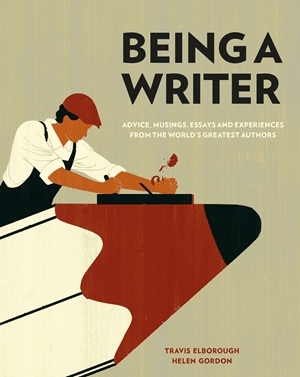
untitled.png‘Buy a cat, stay up late, don’t drink: top 10 writers’ tips on writing‘ in The Guardian from Travis Elborough. Mainly about novels, but much applies to any kind of writing. It comes from their book Being a Writer, published late last year.

Over the past year, Helen Gordon and I have been putting together Being a Writer, a collection of musings, tips and essays from some of our favourite authors about the business of writing, ranging from the time of Samuel Johnson and Grub Street, to the age of Silicon Roundabout and Lorrie Moore.

Researching the book, it quickly became obvious that there isn’t a correct way to set about writing creatively, which is a liberating thought. For every novelist who needs to isolate themselves in a quiet office (Jonathan Franzen), there’s another who works best at the local coffee shop (Rivka Galchen) or who struggles to snatch an hour between chores and children (a young Alice Munro). [continues here]

Posted in Uncategorized, Writing | 1 Comment

Why has submitting a manuscript to a journal become so difficult? A call to simplify an overly complicated process

Why has submitting a manuscript to a journal become so difficult? A call to simplify an overly complicated process – interesting piece at the LSE Impact blog.

It is widely acknowledged that submitting a paper to a journal is a fraught activity for authors. But why should this still be the case? James Hartley and Guillaume Cabanac argue that the process has always been complicated but can, with a few improvements, be less so. By adopting standardised templates and no longer insisting on articles being reformatted, the submission process can quickly be simplified.

The first scientific journal, the Journal des Scavans, was published in Paris in January 1665, hotly pursued by Philosophical Transactions in London in March of the same year. We have come a long way since then – from handwriting to typewriting to electronic submissions.

But some things seem to remain the same. Each submission system creates its own difficulties for authors. And each has its critics. Take, for example, the case of submitting papers to publications of the American Psychological Association. Their “instructions for authors” were first published in six and a half pages in the Psychological Bulletin in 1929. This article was revised in 1944 and 1952 and then book-length revisions were published in 1967, 1974, 1983, 1994, 2001 and 2010. The largest of these editions (2001) contained 29 preliminary pages and 439 pages of instructions. The current 2010 edition initially had to be withdrawn and reprinted because it contained so many errors and confusions. [continues]

Posted in Uncategorized | 1 Comment

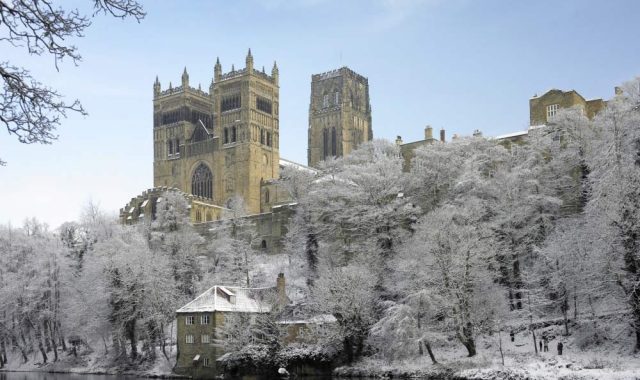
15(!) Interdisciplinary Arctic PhD Opportunities at DurhamARCTIC

cropped-durham-snow1.jpgExciting news from Phil Steinberg at Durham: 15(!) Interdisciplinary Arctic PhD Opportunities at DurhamARCTIC

I am happy to announce Durham University’s success with a £1.05 million, five-year bid to the Leverhulme Trust to fund 15 PhD students in Interdisciplinary Understanding for a Changing Arctic. Although I took the lead with the grant proposal and will be directing the interdisciplinary training programme, I am indebted to input from colleagues from across the university.

To host the programme, and carry on its legacy after the grant ends in 2023, I am presently establishing a new Doctoral Training Centre at Durham: The Durham Arctic Research Centre for Training and Interdisciplinary Collaboration (DurhamARCTIC). While waiting for the bureaucratic wheels at Durham to (slowly) turn, I’ve established a provisional “unofficial” website for the programme at http://durhamarctic.wordpress.com.

Students in the programme enrol in standard, department-based doctoral programmes, but DurhamARCTIC then provides a number of “extras” including interdisciplinary supervision, colloquia, summer schools, etc., as well as dedicated funds for Arctic placements and research. The application deadline for the first cohort, to enter in Autumn 2018, is 2 February 2018. If you’re interested in applying (or if you know someone who might be interested) please see the programme website for more details regarding DurhamARCTIC’s focus, the extra elements it will provide for students, and the application process.

Flyer with more details – DurhamARCTIC 1-page.

Posted in Uncategorized | Leave a comment

2017 in review: round-up of LSE Impact blog top posts on academic writing

2017 in review: round-up of LSE Impact blog top posts on academic writing

I linked to some of these, but this is a useful summary. Lots more links and discussion on writing and publishing here.

Posted in Uncategorized | Leave a comment

AHR Conversation: Walls, Borders, and Boundaries in World History (open access)

AHR Conversation: Walls, Borders, and Boundaries in World History with Suzanne Conklin Akbari, Tamar Herzog, Daniel Jütte, Carl Nightingale, William Rankin and Keren Weitzberg.

Since 2006, the AHR has published nine “Conversations,” each on a subject of interest to a wide range of historians.1 For each the process has been the same: the Editor convenes a group of scholars with an interest in the topic, who, via e-mail over the course of several months, conduct a conversation, which is then lightly edited and footnoted, finally appearing (with one exception) in the December issue. The goal has been to provide readers with a wide-ranging consideration of a topic at a high level of expertise, in which the participants are recruited across several fields and periods. It is the sort of publishing project that this journal is uniquely positioned to undertake.

This year’s topic, “Walls, Borders, and Boundaries in World History,” has an obvious contemporary relevance, most dramatically in the calls to “Build That Wall” that were a shrill trope in the recent U.S. presidential campaign. Beyond this, the specter of building walls, defending borders, and reasserting boundaries haunts political life in many parts of the world, from the wall separating Israel and the Palestinian territories; to the potential redrawing of the boundaries of several nation-states, as regions—Kurdistan in Afghanistan, Catalonia in Spain—attempt to assert their independence; to the oft-heard pleas for borders to be policed or even closed in the face of what seems to be a worldwide refugee crisis. Contemporary public discourse on this subject is usually cast in moral terms: walls are seen as either good or bad; boundaries and borders are viewed either as regrettable obstacles to the virtues of openness and cosmopolitanism or as necessary to keep out things and people deemed undesirable. Our conversation will certainly attend to the contemporary aspects of our topic, but we want to add a historical perspective to thinking about “walls, borders, and boundaries,” while also remaining alert to the methodological and theoretical problems encountered in attempting to make sense of the many different phenomena and experiences evoked by our topic.

Posted in Boundaries, Territory, Uncategorized | Leave a comment