Viewpoint Magazine forum on The Crisis of Marxism – Althusser, Balibar, Poulantzas, Buci-Glucksmann, etc.

The Crisis of Marxism – Asad Haider and Patrick King in Viewpoint Magazine

Leonardo Cremonini, Bassa marea (1957-1958)

Crisis Theory | Asad Haider

In 1977 Louis Althusser gave a famous speech in Venice on “the crisis of Marxism,” a thesis almost as scandalous as that of an epistemological break in Marx’s thought.

The Crisis of Marxism (1977) | Louis Althusser

It is in this profoundly political sense that we are forced today, it seems to me, to speak of a theoretical crisis within Marxism, in order to clarify the ways in which it affects what is called Marxist theory itself: and in particular the fact that a number of apparently infallible principles inherited from the Second and Third Internationals have now been placed in doubt.

Power and Opposition in Post-revolutionary Societies (1977) | Rossana Rossanda

The crisis, moreover, goes beyond the purely political domain and invests the realm of theory itself. It is a crisis of Marxism, which is experienced by immense masses as an unacknowledged reality. Marxism – not as a body of theoretical or philosophical thought, but as the great idealistic force that was changing the world – is now groaning under the weight of this this history.

Marxism as a Finite Theory (1978) | Louis Althusser

I believe that Marxist theory is “finite,” limited: that it is limited to the analysis of the capitalist mode of production, and of its contradictory tendency, which opens up the possibility of the transition to the abolition of capitalism and its replacement by “something else” which already appears implicitly in capitalist society.

State, Party, Transition (1978) | Etienne Balibar

The problems of Althusser’s text and other recent interventions appear to me to lie elsewhere. What does it mean that “the party must be fundamentally outside the State,” with the clarification that it is “through its activity within the masses”? What does it mean to “tear the party away from the state”? Do we not find here an ideal (and idealist) conception of a party?

The Critique of Politics and “Unequal Right” (1978) | Rossana Rossanda

The paradox we are experiencing consists in the fact that today the critique of capitalism and the state is produced in real social conflicts, advances through real political subjects, material practices: here we already move in the zone of the “screen,” beyond the categories inherited and taken from the traditional workers’ movement, in the profile of another which is expressed as a need and seen in clips of experience.

May ’68 and the Crisis of Marxism (1978) | Christine Buci-Glucksmann

It is necessary, then, to modify our relationship to Marxism today, to begin from its lacunas, its points of fragility – to openly confront its forbidden zones, its blind spots, so that this real crisis becomes an emancipatory one, producing other analyses, other political practices.

The State, Social Movements, Party (1979) | Nicos Poulantzas

To modify the balance of power within the state, and furthermore, radically modify the materiality of the state, is only one aspect of a democratic transition to socialism. The other aspect of the process depends on, at the same time, grassroots social movements propelling the spread of spaces of direct democracy: in short for movements to ground themselves in popular struggles that always spill over beyond, and keep a distance from, the state.

After the Other May (1981) | Etienne Balibar

We must start again on the basis of an irreversible pluralism, and look to move past paroxysmal – and today, caricatured – forms that have led up to this critical moment wherein every mass workers’ organization is in upheaval, and replace them in the face of the unresolvable alternative of passivity or ephemeral revolt. No matter its concrete shape, the outcome of the crisis of the party-form depends on the simultaneous transformation of all the organizations of the workers’ movement (none of which have every been purely composed of workers).

Crisis and Dialectic of Parties and New Social Movements in Italy (1981) | Rossana Rossanda

The real question is rather: for those who deny the centrality of the working class, where is the epicenter? For the centrality of the working class is not merely “sociological”: it is an image of the centrality of the modes and relations of production with multiple social and ideological formations which intersect and contradict each other. Or further: in a system without an epicenter, where would movement come from?

(The Right to) Tendencies (1982) | Etienne Balibar

Once we manage to avoid identifying a “political center” and “theoretical” center in advance, from identifying the elaboration of a strategy with the application of a pre-established vision to the course of history, it might be possible to overcome the dilemmas of “democratic centralism” and the “right to tendencies.”

On the Left-Wing Critique of Stalinism (1976) | Christine Buci-Glucksmann

The critique of Stalinist dogmatism from “the left-wing position of theoretical antihumanism” challenges to a form of Marxist theory which supports, guarantees, and illustrates a certain view and practice of class struggle, a certain vision of socialism.

Posted in Etienne Balibar, Karl Marx, Louis Althusser, Nicos Poulantzas, Uncategorized | Leave a comment

On turning down poorly-paid, limited value, academic work

I’ve just turned down another invitation to write an encyclopaedia entry. I agonised about it, and ended up posting about it on my personal Facebook page. The issue was in part the payment – £40 for 2000-2500 words. I’d be less insulted if they wanted it for free. I’d need to write at 400-500 words an hour, with no editing, for this to be minimum wage. (Yes, I’m on a very good salary, but I could only do this outside of regular hours.) It’s a commercial publisher, and the resource would be expensive subscription-only. The other issue was the topic – important to me, but something on which I feel I have done all the introductory work I can already. And also, the point of these things is presumably to have a range of views on the topic. There were a lot of useful replies from friends which helped me to think this through, discussing the insulting and inadequate pay, and whether there was something worthwhile intellectually in writing it. Here’s an edited version of my reply:

I’m sorry but I’m going to decline. I’ve written lots of short introductions on [this topic], including for another encyclopaedia, and I’d just be repeating myself. I’m unsure of the worth of such reference works anyway, and since I don’t have time to write everything I want to write, I’m unwilling to spend time on something I don’t. It might be different if this was either fairly paid, or would be available open access, rather than at high cost. I’m a little reluctant to recommend other people given the low pay for intellectual work, from a commercial publisher, but you might try one of the other authors of books on [this topic].

The commissioning editor wrote back to say thank you for an ‘honest reply’ and said they would raise the payment issue with the senior editors and publisher.

As I was putting together this post I realised I’d written about the same topic on this blog before: On refusing unpaid work (2013) and Work for hire (2012). So, why did I agonise about this one, instead of saying ‘no’ immediately? I’m not entirely sure. I think it’s the sense that someone needs to commission this piece, and they are working through possible contributors. I’m not assuming I was the first to be asked, but my ‘no’ moves this onto another person. As my reply notes, I was reluctant to give specific names – I don’t want to be included in the next request as having recommended them. But in part the issue is the proliferation of such things. This was not open access, but would be an extremely expensive subscription based source. The publisher must calculate that likely sales will cover the costs, and turn a profit, but that’s not to say it has a genuine intellectual or pedagogic purpose.

Relating back to the post I linked to earlier today, Veronika Cheplygina – 5 strategies for saying “no” more often, there is an issue here. It’s easy to say to busy/in demand people – “you should say ‘no’ more often!” But if you take things seriously, deciding how to prioritise, what to accept and what decline, and balancing competing tasks is itself exhausting; not just doing the things you end up with.

So, here are my criteria

  • is it academically interesting or otherwise worthwhile?
    • i.e it forces you to think about something new
    • or it gives you a chance to say something new or different on a familiar topic
    • or to write a popular or introductory summary on something you’ve only ever written about before for a different audience
  • is it going to be widely available at reasonable cost or open access?
  • is it really well paid, such that you could use the money for something useful (i.e. to pay for an archive visit, that really expensive/rare book you want, etc.)?

If none of these are yes, I think I need to say ‘no’ immediately. If there is at least one yes, then it’s worth considering, discussing or negotiating. If you do say ‘no’, but the task is worthwhile, then it might be worth recommending someone who might find it a good opportunity.

Just to be clear: None of this is about the kind of work we need to do as service – review work, PhD examination, etc. It’s about things that are presented to us as an opportunity, but are actually an imposition.

Posted in Publishing, Uncategorized, Writing | 3 Comments

Reflections on academic publishing in Fennia: International Journal of Geography

The new issue of Fennia: International Journal of Geography has a number of reflections on academic publishing. Contributors include Krisi Pauliina Kallio and James Riding, Simon Batterbury, John C. Finn, Simon Springer, and Sara Fregonese. All pieces are available open access.

Posted in Publishing, Uncategorized | Leave a comment

Veronika Cheplygina – 5 strategies for saying “no” more often

Veronika Cheplygina – 5 strategies for saying “no” more often

I’ve written about this issue before, but there is some very good advice here. Here are the headlines, but do read the whole thing.

1. Does it help or hurt my goals?

2. Data, data, data!

3. Keep a list of things you’ve said no to

4. No Committee

5. If it’s not a hell yes, it’s no

It should go without saying, but comments on any such posts mean that it doesn’t: saying ‘no’ is not really about avoiding work, but of deciding what is most important to you and to others, and being strategic about opportunities. If you accept too much work, you’ll end up having to say ‘no’ indiscriminately at a latter stage, or letting people down, or making yourself ill.


Posted in Uncategorized, Universities | Leave a comment

Books received – Titus Andronicus, Sheridan, Lorenzini & Sforzini and Weizman

IMG_3030.JPG

The revised edition of the Arden Third Series, Titus Andronicus, edited by Jonathan Bate; a second-hand copy of Alan Sheridan’s Michel Foucault: The Will to Truth; Lorenzini and Sforzini’s collection Un demi-siècle d’ « Histoire de la folie »; and Eyal Weizman’s Forensic Architecture.

Posted in Eyal Weizman, Michel Foucault, Uncategorized, William Shakespeare | Leave a comment

Hot off the press: Architectural and Urban Reflections after Deleuze and Guattari

A new collection on Architectural and Urban Reflections after Deleuze and Guattari

Keith Harris's avatarMy Desiring-Machines

AURcover

This book collects chapters on urbanism and architecture that first appeared as papers at the refrains of freedom conference in Athens (2015).

From the publisher’s website:

“The post humanist movement which currently traverses various disciplines in the arts and humanities, as well as the role that the thought of Deleuze and Guattari has had in the course of this movement, has given rise to new practices in architecture and urban theory. This interdisciplinary volume brings together architects, urban designers and planners, and asks them to reflect and report on the (built) place and the city to come in the wake of Deleuze and Guattari.”

View original post

Posted in Uncategorized | Leave a comment

The Early Foucault Update 15: Working on Maladie mentale et personnalité and some archival and library work in Paris

Earlier this month I finished working through Maladie mentale et personnalité, which I discussed beginning in the last update, and have drafted a substantial section analyzing the book. I imagine I can only use a fraction of the quotes I took down in my notes, as at the moment it’s a long section. Only then did I go to the valuable secondary literature on the book, including the work of Macherey, Dreyfus, Gutting, Bernauer, the biographies and so on. Initially I was trying to read it without those filters.

This book is often read either in relation to its 1962 version Maladie mentale et psychologie (the version we have in English), or as a summation of a positon Foucault moved beyond, in this chapter I’m trying to read it as a valuable book in its own right. (The other two aspects will be treated elsewhere in my study.) There is a structure to the original argument which I found more compelling on this detailed reading that I’d realised before, and I’m going to try to capture that in my discussion. Of course, it is a book Foucault tries to hide away, compromises to revise in 1962, and then does stop further editions in his lifetime. If it had not been by Foucault, it would doubtless have been forgotten. But it is by Foucault, and for an intellectual history of his formation as thinker it is a crucial source. His Lille and ENS lecture courses from the early 1950s clearly inform it, and the archival traces of those will inform my reading, though they will be treated in detail elsewhere in the book. We also can consult the notes Foucault took from his extensive reading around this topic – as with so much of Foucault’s work, the texts referenced are but a tiny fraction of what he read. But even from the book itself I found things that had evaded me before. Above all it was a far less phenomenological, and far more Marxist text than I remembered.

In the present chapter, I’m reading it in relation to the two texts published in 1957, but likely completed a few years before. These are reprinted in Dits et écrits as texts 2 and 3. The following chapter discusses the work translating and introducing Binswanger, and translating von Weizsäcker. Between these two chapters, I therefore will discuss just about everything Foucault published pre-1961. But there will be five or six chapters of the book discussing that period.

In this work I got caught up in a textual issue concerning “La psychologie de 1850 à 1950”, and also returned to the dating issue concerning Foucault’s translation of Leo Spitzer. There is more about the Spitzer issue here. Essentially, I’m intrigued as to whether Foucault did the translation of Spitzer in the same period as his other translation work – mid-1950s to early-1960s – or almost a decade later. If the former, when seems intuitively more likely, then I should discuss the work in my current book. This has involved quite a lot of library work, but also a number of emails to people who might shed light, if not on the date itself, on how their bibliographies reflect it. They have been extremely generous in their responses, with several useful leads to follow, even if as yet I still do not have a definitive answer.

BNF reading copy

I then had a few days in Paris. The main work was working through some boxes of material in the Foucault archive at the Richelieu site of the Bibliothèque Nationale, but I also did some work with printed sources at the Bibliothèque Sainte-Geneviève and the main Mitterand site of the Bibliothèque Nationale. I was able to resolve a good number of issues with the notes for my book in those libraries – checking references, finding quotations, checking different editions and so on. Some involved microfilm and microfiche, on the archaic BNF machines. Some of this verged on the heroically recondite – which early-20th century French translation of Nietzsche provided the quotation which Foucault’s then-lover Jean Barraqué used for the title of an article? When a PCF editorial was reprinted, what was left out from the original? Was a journal piece by Henri Ey on von Weizsäcker the same as the preface he wrote to the translation which Foucault made? I found one relevant passage when Foucault doesn’t provide a page number – in a 400-page book, in the final chapter. Inevitably resolving these kind of reference issues threw up a number of other ones, but I feel that I made good progress on this work. The rationale for doing this is part my own somewhat obsessive tendencies, but also because of an attempt at being careful. I’m increasingly convinced that some of the issue with the Spitzer dating stems from people copying references for texts they’ve not personally verified. I tend to make the trip across the city to the Mitterand site or the BSG in the evening, since they are open after the archive room at the Richelieu site is closed, but this does make for some long days.

In the archive I returned to a box of materials relating to Foucault’s theses, which holds some fascinating material including his notes for the oral presentation at the defence. This box also includes a partial but hand-corrected copy of his Introduction to Kant’s Anthropology, which was his secondary thesis, though that Introduction has now been published. (Incidentally, though I know of three archives which have this introduction, I’ve never found the manuscript of the translation which accompanied it, though that was published in Foucault’s lifetime.)

I also took a first look at a box with some materials on Nietzsche – not the reading notes which I’ve looked at before and will return to again, but texts on Nietzsche, most of which were either published or delivered as lectures in courses. Among other things this includes Foucault’s presentation on ‘Nietzsche, Freud, Marx’ from 1964 – close to, but not the same as the published version; a version of ‘Nietzsche, Genealogy, History’ in typescript which is in another archive; his 1969-70 course on Nietzsche and genealogy delivered at Vincennes; the SUNY Buffalo lecture from 1970; and the McGill lecture from April 1971 included in Lectures on the Will to Know. I had a reasonable idea what to expect for the most part, but there were still some surprises, including what was for me a big one: some unpublished texts from the 1950s. Although it’s long been known that Foucault’s significant encounter with Nietzsche was in 1953, I only knew of one text he’d reportedly written on him at that time, mentioned by Defert. I found that text, but there is much more here. I’m going to have to say more about Nietzsche in this book than I imagined.

Looking at materials used for lectures, and comparing them to the published versions is slow work but can be revealing. On the one hand, the editors’ ability to decipher cryptic abbreviations and shorthand is impressive, as is their organization of materials which are sometimes lacking page numbers and/or out of sequence. In the later years material has been used for other purposes – parts of Paris lectures taken out to serve as the basis for lectures elsewhere, for example, sometimes with new page numbers, added or dropped material. Apart from the fact that he seems to have kept nearly everything, and it is well organized, Foucault was obviously not working with a future editor in mind. The editors also do invaluable work adding references and contextualizing remarks. But on the other hand, it is clear that there are some significant editorial choices made, and not all of these might have been made by another in their place.

The Nietzsche box took me much longer than I expected, given how interesting its contents were, so again I found my time with the box containing Foucault’s Lille courses was limited. I spent all my time on a single course, which I’d not been able to consult before. I thought I knew what sort of thing it would contain, but I was mistaken. It’s a course almost entirely devoted to a thinker whom Foucault only mentions briefly elsewhere. I’m planning to come back to Paris for a longer visit in late January and it’s clear that I will need to spend much more time with this box. In that visit I’m also hopefully going to take a look at another box that likely contains a copy of what might be the earliest extant piece of academic writing by Foucault.

I’m now going to have to put this book aside for a while. First, I have the copy-editing queries on Shakespearean Territories to deal with, and then I’m taking a proper break over the holidays. In the New Year I have a number of shorter writing tasks to complete, and then will balance this Foucault work with the Canguilhem research and writing. I see the work on these two books as being mutually reinforcing, but the Canguilhem book needs to be the priority until the spring.


The previous updates on this project are here; and the previous books Foucault’s Last Decade and Foucault: The Birth of Power are both available from Polity. Several Foucault research resources such as bibliographies, short translations, textual comparisons and so on are available here. On the related Canguilhem book project, see this page.

Posted in Canguilhem (book), Daniel Defert, Friedrich Nietzsche, Georges Canguilhem, Karl Marx, Michel Foucault, Shakespearean Territories, Sigmund Freud, The Early Foucault, Uncategorized | 2 Comments

The Last Interview of Nicos Poulantzas

The last interview of Nicos Poulantzas in an English translation with introduction at the Legal Form blog.

Peter Gratton's avatarPHILOSOPHY IN A TIME OF ERROR

Here at Legal Formwith a helpful introduction. Poulantzas died just nine days before its original publication on 12 Oct., 1979, in the Italian communist journal, Rinascita.

View original post

Posted in Uncategorized | Leave a comment

The Birth of Austerity: German Ordoliberalism and Contemporary Neoliberalism (2017)

This looks like a very valuable collection which includes some of the foundational texts of ‘Ordoliberalism’, which Foucault discusses in his course The Birth of Biopolitics.

Clare O'Farrell's avatarFoucault News

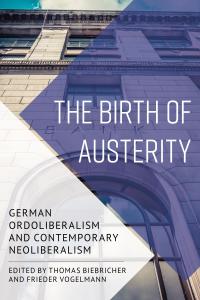
The Birth of Austerity. German Ordoliberalism and Contemporary Neoliberalism
Edited by Thomas Biebricher and Frieder Vogelmann, Rowman & Littlefield.

Publication Date: Sep 2017

Description
Ordoliberalism and the ‘Freiburg School’ have gained traction in contemporary political economy in response to two factors: a rising interest in governmentality studies and the banking, financial and sovereign debt crisis in Europe. In the face of these crises, Germany has assumed a position of quasi-hegemony in the European Union, making decisions about bailouts, the politics of crisis management and the rise of austerity.

This volume gathers together English translations of seminal ordoliberal texts by thinkers ranging from Walter Eucken and Wilhelm Röpke to Franz Böhm, Alexander Rüstow and Hans Grossmann-Doerth. Offering some foundational insights into ordoliberalism, these essays give insight into a field that is much misunderstood outside Germany. The second half of the book comprises of analyses of contemporary issues in light of ordoliberal…

View original post 240 more words

Posted in Uncategorized | Leave a comment

6/13 Revolt: Foucault in Iran (2017)

News of a discussion of Foucault in Iran to be held in New York

Clare O'Farrell's avatarFoucault News

6/13 | REVOLT: FOUCAULT IN IRAN

Daniel Defert (éditeur de Michel Foucault)
Behrooz Ghamari-Tabrizi (University of Illinois at Urbana)
Judith Revel (Université Paris Nanterre)
Moderated by John Rajchman, Daniele Lorenzini, and Bernard E. Harcourt

December 14, 2017 from 6:15 p.m. to 8:45 p.m.
Jerome Greene Annex, Columbia University
(410 West 117th Street, New York)

See also these links
BERNARD E. HARCOURT | INTRODUCTION TO FOUCAULT ON IRAN: REVOLT AS POLITICAL SPIRITUALITY

DANIELE LORENZINI | PERMANENT VIRTUALITIES

Michel Foucault identified in the Iranian uprising of 1978 a modality of religious political revolt and a form of political spirituality that privileged, in the secular realm, expressly religious aspirations. What Foucault discovered in Iran was, in his words, a political spirituality: a mass mobilization on this earth modeled on the coming of a new Islamic vision of social forms of coexistence and equality.

Foucault described the mass mobilization in Iran as an Islamic…

View original post 526 more words

Posted in Uncategorized | Leave a comment