Michel Foucault’s acid trip in Death Valley: Interview with Simeon Wade with great archival photos (updated)

I’ve just heard that Simeon Wade died in October, making this interview even more important. My condolences to Wade’s family.

stuartelden's avatarProgressive Geographies

Boom California has just published an interview with Simeon Wade, conducted by Heather Dundas. If you’ve read the Foucault biographies, you’ll probably know about the acid trip in Death Valley story. James Miller makes a great deal of this, having talked to Simeon Wade who, with his partner Michael Stoneman, took Foucault on the journey. Wade was the originator of the ‘Chez Foucault’ fanzine which I’ve previously discussed and shared on this site.

The interview with Wade is fascinating, though some of its claims need to be taken with caution. The visit took place in June 1975, four months after Surveiller et punir appeared in French, and eighteen months before History of Sexuality volume I was published. That the trip had a profound effect on Foucault may well be true, but that it led him to criticise Bentham for the first time is impossible. And if it had such…

View original post 148 more words

Posted in Uncategorized | Leave a comment

The Struggle to Defend One of the Largest Universities of Brazil

‘The Struggle to Defend One of the Largest Universities of Brazil’ by Esther Arantes, Heliana Conde, and Estela Scheinvar – full statement here. Thanks to Marcelo Hoffman for sending me this.


Posted in Politics, Uncategorized, Universities | Leave a comment

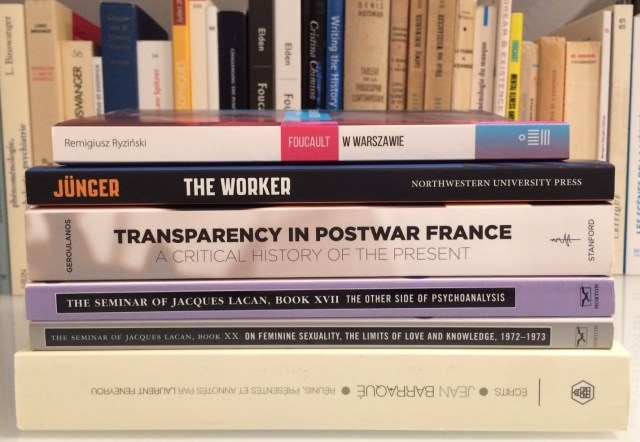
Books received – Ryzinski, Jünger, Geroulanous, Lacan, Barraqué

Books.JPG

Remigiusz Ryzinski’s Foucault w Warszawie, Ernst Jünger, The Worker, Stefanos Geroulanous, Transparency in Postwar France: A Critical History of the Present, two volumes of Lacan’s seminar, and Jean Barraqué’s Écrits. Stefanos kindly sent a copy of his book, and the Jünger translation was a gift from its editor and co-translator, Laurence Paul Hemming. The rest were bought. I’d need help with the Polish text on Foucault’s time in Warsaw, but the references will likely be helpful.

Posted in Jacques Lacan, Michel Foucault, Uncategorized | Leave a comment

Stuart Elden’s Foucault books reviewed and discussed (PAIS News)

Stuart Elden’s Foucault books reviewed and discussed

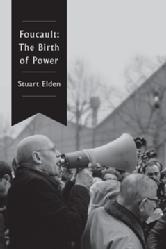
fld.jpgStuart Elden’s two books Foucault’s Last Decade (Polity 2016) and Foucault: The Birth of Power (Polity 2017) have recently been reviewed and discussed in a number of places.

A review of both books can be found in The Nation by Bruce Robbins and in 3am Magazine by Peter Gratton (along with Foucault’s The Punitive Society).

A review of Foucault’s Last Decade by Kurt Borg is in Foucault Studies; and one of Foucault: the Birth of Power at the LSE Review of Books by Syamala Roberts.

He has also taken part in discussions with Dave O’Brien for the New Books in Critical Theory series on both books – Foucault’s Last Decade here and Foucault: The Birth of Power here.

Foucault: The Birth of PowerAmong earlier discussions of the books there is one with Peter Gratton, Eduardo Mendieta and Dianna Taylor in Symposium; and with Antoinette Koleva in Foucault Studies, also in Bulgarian translation in Sociological Problems [Социологически проблеми]. There is also a longer piece about the writing of the books at Berfrois. All the above links are open access.

Stuart is currently writing a book on The Early Foucault, and updates on its research and writing can be found at his blog, Progressive Geographies.


Posted in Foucault's Last Decade, Foucault: The Birth of Power, Michel Foucault, The Early Foucault, Uncategorized | Leave a comment

10 Critical Theory Books That Came Out in October (and Sept.)

10 Critical Theory Books That Came Out in October (and Sept.) at Critical-Theory – Heidegger’s Black Notebooks, Lacan, Bourdieu, Derrida and more.

octobercriticaltheory2017-672x372.png

Posted in Jacques Derrida, Jacques Lacan, Martin Heidegger, Pierre Bourdieu, Uncategorized | Leave a comment

Interview with François Ewald at LARB

Very interesting interview with François Ewald

Peter Gratton's avatarPHILOSOPHY IN A TIME OF ERROR

Here. A good overview of his own intellectual itinerary (the usual story of the ’68er who shifts right) and his relationship to Foucault.

View original post

Posted in Uncategorized | 1 Comment

The Right to the City: A Verso Report – free ebook

Right_to_the_City_cover-49486adf6f36d25a66e04a89210faa01.jpgThe Right to the City: A Verso Report – free ebook

Special eBook collection on the most urgent question of our times: who is the city for?

In 1968, the French Marxist philosopher Henri Lefebvre wrote “Le Droite a la Ville” (“The Right to the City”), which has become one of the most essential texts in radical geography and urban studies. It transformed the way we think about urban life and the right to make and remake our cities, and ourselves. Fifty years on, the question of who is the city is for, and why, is more urgent than ever.

In this special Verso report, some of the most important voices in the current debate on the right to city are gathered to debate what Lefebvre originally intended and what it might mean today within the neoliberal urban world. How these ideas help us to understand the contemporary struggle in housing; how to protest gentrification; the privatisation of public spaces; and the demand for places of self expression, and the security of home. The collection also explores how these ideas can be used in other fields—such as digital space and the Internet of Things.

Contributors include David Adler, Neil Brenner, Bradley Garrett, Andrea Gibbons, Huw Lemmey, David Madden & Peter Marcuse, Andy Merrifield, Anna Minton, Don Mitchell, Rebecca Omonira-Oyekanmi, Nina Power, Dubravka Sekulić, Joe Shaw & Mark Graham, and Alex Vasudevan.

See all our Cities and Architecture reading here.


Posted in Andy Merrifield, Bradley Garrett, Don Mitchell, Henri Lefebvre, Neil Brenner, Nina Power, Uncategorized, urban/urbanisation | Leave a comment

ScholarlyHub.org – a project which is long overdue

Screen Shot 2017-11-07 at 15.36.26This looks a very interesting new initiative – ScholarlyHub.org Given the problems of academia.edu and Researchgate (see my post here and the comments to it, for example), this seems a project which is long overdue.
At ScholarlyHub we believe that a critical attitude does not stop with the platforms we use. Growing threats to open science have made it more crucial than before to develop a sustainable, not-for-profit environment. One that allows you to publish, share, and access quality work without financial constraints; find and work with colleagues in fields you’re interested in; develop research and teaching projects; store datasets securely, and mentor and be mentored in order to improve your work and help others. Above all, we want to foster an environment that meets our needs as individuals and scholarly communities and where we are in control, not myopic political agendas, greedy publishers, or data merchants. We believe that scholarship does little good behind pay walls, that metrified rankings rarely promote innovative research, and that transparent communication is vital to quality scholarship and healthy societies. Therefore we’re taking the best of the new and the best of the tried to create a truly open-access repository, publishing service, and scholarly social networking site, with large scope for members’ initiatives. And it will be run by scholars: not for profit, greater market share, or political kudos, but for their own growth and everyone’s benefit.
Join us, support us, and get involved!

They also have some FAQs, introduced by:

ScholarlyHub will redefine scholarly social networks. It aims to become a member-run and owned, non-profit portal for sharing and improving scholarly communications among scholars and between scholars and the public at large. It seeks to provide a dynamic, multidisciplinary, peer-to-peer, open-access environment that combines traditional and innovative quality control procedures, pre- and post-publication services, and opportunities for network-based collaboration, publication, mentorship, learning and debate. Its successful development will make scholarship across disciplines visible and accessible, foster the sustainable preservation of research and protect scholars’ independence from conglomerate publishers’ market-oriented needs on the one hand and myopic government agendas on the other. In doing so it is guided by these Principles for Open Scholarly Infrastructures.

While the actual configuration of ScholarlyHub will be determined through an ongoing discussion among its members, its ethos is that of an open, not-for-profit global learned society, supported by modest, sliding-scale membership fees. All members have an equal voice and enjoy the site’s full range of services, including personal websites, data storage, in-mail, job and conference wikis, mentorship programs, teaching aids and access to a variety of review protocols. ScholarlyHub will not sell users’ data and will be run for and by its community.

Posted in Publishing, Uncategorized | 3 Comments

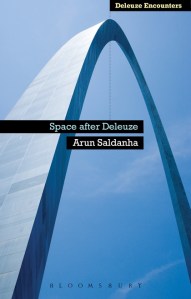
Arun Saldanha, Space after Deleuze – now out with Bloomsbury

9781441111883.jpgArun Saldanha, Space after Deleuze – now out with Bloomsbury, but unfortunately only in a grotesquely priced hardback.

Deleuze’s fondness for geography has long been recognised as central to his thought. This is the first book to introduce researchers to the breadth of his engagements with space, place and movement. Focusing on pressing global issues such as urbanization, war, migration, and climate change, Arun Saldanha presents a detailed Deleuzian rejoinder to a number of theoretical and political questions about globalization in a variety of disciplines. This systematic overview of moments in Deleuze’s corpus where space is implicitly or explicitly theorized shows why he can be called the twentieth century’s most interesting thinker of space. Anyone with an interest in refining such concepts as territory, assemblage, body, event and Anthropocene will learn much from the “geophilosophy” which Deleuze and Guattari proposed for our critical times.

Space After Deleuze is a brilliant and lucid account of the spatial thought of Gilles Deleuze and his sidekick Félix Guattari, that will delight and inspire geographers and philosophers alike. It will be essential reading for everyone who loves Deleuze, thinking, and space. But that’s not all. For as a fossil fuelled and capital addicted humanity hell-bent on suicide continues to torture itself and the world, even the planet itself is screaming out for fresh thinking, a new people, and a new earth. By channelling the geo-communist spirit of Deleuze and Guattari, Arun Saldanha maps out a thinking space that is truly worthy of life on earth – a revolutionary geo-philosophy fit for the Anthropocene. Whereas Michel Foucault once quipped that “perhaps one day, this century will be known as Deleuzian” Arun Saldanha stunningly shows why the whole millennium will have been Deleuzian.” –  Marcus A. Doel, Professor of Human Geography, College of Science, Swansea University, UK,

Space After Deleuze is a welcome invitation to rethink the very notion of ‘space’. Arun Saldanha introduces students of space-geographers, architects and planners-to the geophilosophy of Deleuze and Guattari that is fundamental to this task. The book bravely turns a Deleuzian conception of the ‘dynamic thickness’ of space toward the most pressing social, political and (always) geographic issues of our age.” –  Chris L. Smith, Associate Professor in Architectural Design and Technê, The University of Sydney, Australia,


Posted in Felix Guattari, Gilles Deleuze, Uncategorized | Leave a comment

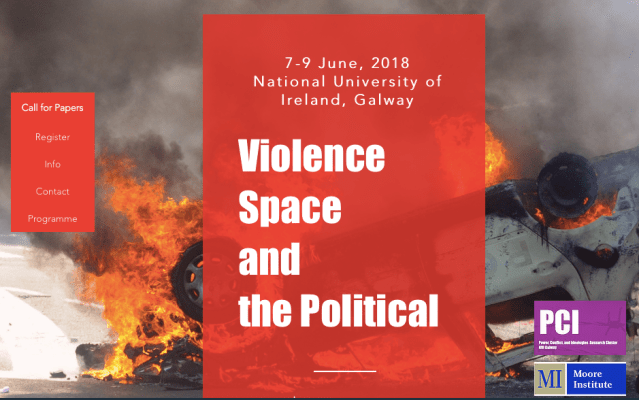
CFP: Violence, Space, and the Political, 7-9 June 2018 National University of Ireland, Galway

Screen Shot 2017-11-07 at 15.24.16

7-9 June 2018

National University of Ireland, Galway.

Call for Papers [deadline 9th February 2018]

Send approx. 250 word abstract to violenceandspace@gmail.com

In this, multi-disciplinary, conference we wish to think through the imbrications of violence, space, and the political. Given that our present conjuncture is one constituted by innumerable sites of apartheid, exclusion, oppression, and indeed, resistance(s), such an interrogation is both crucial and potentially productive in re-thinking questions of power and radical politics. In this zeitgeist the contingency of hitherto relatively stable configurations of power have been rendered visible through the failing allure of liberal democratic politics and the dislocation conjured by, among other things, its attendant ‘spectral dance of capital’ (Žižek, 2008). A void has been rift from which a plurality of discourses have proliferated that seek to address this moment of crises by either caging/bounding or expanding the social. That is, at stake in many contemporary political projects currently gaining traction is the redrawing of frontiers, the very bounds of inclusion and exclusion – from international borders and multilevel governance, to the remaking of frontiers within existing polities. Violence/antagonism, in various iterations, is central to the (re)inscription of these frontiers (Laclau and Mouffe, 1985). Not only evident in ostensibly bellicose projects that seek to uphold, contest, or expand regimes of power through violent struggle, violence is imbricated in an other, perhaps more foundational or ‘originary’ sense (Arendt, 1963; Derrida, 1990). The redrawing of boundaries reconfigures differential relationships of power and propriety, which designate who has the right to speak sovereignly in a given space, who is a worthy and noble victim, and who is not, who is differentially exposed to systemic, symbolic and subjective forms of violence, whose life is ‘grievable’ and whose is not (Butler, 2009). By keeping the question of the spatial in view, both its making and breaking, we keep a focus not only the concrete practices of disruption, the democratic potentialities of space (Dikeç, 2015), new forms of liberation, domination, and property, but also the various spatio-political imaginaries that guide them.

The Power, Conflict and Ideologies Research Cluster at National University of Ireland, Galway invite potential participants from across the disciplinary spectrum to submit papers of 20 minutes duration. This conference may be of interest to those scholars working within, among others, the disciplines of: Social Theory, Political Theory, Feminist and Queer Theory, Philosophy, Sociology, Political Geography, Political Violence, War Studies, Anthropology, and Cultural Studies.

Please submit abstracts (approx. 250 words) to violenceandspace@gmail.com  by the 9th February 2018. The abstract should be submitted as a word/pdf attachment, and contain the authors name, institutional affiliation, and a summary of the proposed paper.

For more info and registration details and fees see:  violencespaceandthepolitical.com

Potential themes that speakers may seek to address:

  • Spaces of Democracy, Emancipation(s), and Resistance
  • Political Violence and Space
  • Vulnerability\Resistance and Spaces of the Political
  • Rethinking Territoriality
  • (De)Coloniality,  Violence, and the Political
  • The Spatial Reproduction of the Collective Subject
  • Lost and New Spatio-Political Imaginaries
  • Precarity and the State
  • Rethinking Sovereignty
  • Histories/Genealogies of Spatial Violence
  • Race, Space and, the Political
  • Communities in Revolt
  • Security and Space
  • Border Politics
  • Property, Violence, and Propriety
  • Technologies, Space, and Power
  • Geographies of Rage
  • Spaces of Populism
  • Queering Space
  • Old and New Colonialisms
  • Rebel Spaces
Posted in Uncategorized | Leave a comment