Citations, references, exhaustion

Alistair Fraser on citations and different practices. The in text vs endnotes is probably never going to be resolved (I much prefer the latter) but consistency within each shouldn’t be impossible. As for students, as long as it is internally consistent, I’m not especially bothered. But inconsistent style just shows a lack of care.

nuimgeography's avatarEye on the World

I don’t exactly dream of a day when all academic outlets agree on one referencing format, but I certainly wish we might get there. I know there are academics who use referencing software – you well-organized (smug?) types – who probably find immense (geeky?) pleasure in quickly putting together a bibliography or tweaking citations. But there is certainly a case to be made for just scrapping all of the variation (the Harvard, Chicago, etc etc styles) and agreeing on one (new) format. I’m exhausted by the whole process. In the bibliography, do I put a period after an author’s initial? When I cite, is a page number preceded by a colon or comma or what? Honestly, can’t we just agree on one style and be done with it? Can’t geographers, at the very least, agree on a Geography style and can’t journal editors sign up to it? [I…

View original post 376 more words

Posted in Uncategorized | Leave a comment

academic selves and academic careers

Some very interesting reflections and suggestions from Gillian Rose about building a career in academia – specifically begins from a discussion about women in Geography, but lessons to be learned more widely.

profgillian's avatarvisual/method/culture

I visited the wonderful Department of Geography at Maynooth University a couple of weeks ago, and I was kindly invited by the Supporting Women in Geography Ireland group there to a discussion session about developing a career as an academic. I was sent a bunch of questions beforehand, which clearly articulated some of the key issues for this group: how to manage multiple demands to do different kinds of academic work, how to manage caring responsibilities with academic work, how to get on…

I don’t usually post about this sort of thing, though I do retweet about women’s experiences of academic life, on occasion. But the invitation and the questions gave me an opportunity to pull together a few thoughts around these topics, and also to reflect on how lucky I’ve been in my career: I’ve (almost) always had supportive line managers, I’ve never been asked to teach to the exclusion…

View original post 823 more words

Posted in Uncategorized | 1 Comment

Interview on Foucault: The Birth of Power at New Books in Critical Theory

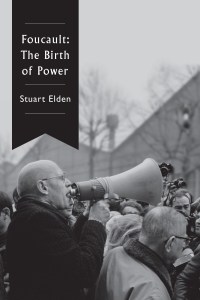
9781509507252.jpgHow did Foucault become a public, political intellectual? In Foucault: The Birth of Power (Polity Press, 2017), Stuart Elden, Professor of Political Theory and Geography at the University of Warwick, follows up his book on Foucault’s Last Decade with research on Foucault’s work from the late 1960s to the middle 1970s. As with Foucault’s work at the time, the book is focused on the emergence of a new understanding of power, alongside detailed engagements with archival materials and the recently published College De France lecture series. The book offers an alternative reading to traditional periodisations of Foucault’s work, suggesting engagements with ancient Greece, ‘repressive’ theories of power, and his public political work, can be rethought to add nuance and depth to current understandings of Foucault’s theories of the ‘productive’ nature of power and the practice of his scholarship. The book is part of Elden’s broader project on Foucault much of which is detailed on his Progressive Geographies blog. The rich and detailed text will be of interest to social theorists, Foucault scholars, and anyone interested in how best to understand the meaning of power.


Thanks to Dave O’Brien for asking the questions – we discussed Foucault’s Last Decade last year – available here.

Posted in Foucault's Last Decade, Foucault: The Birth of Power, Michel Foucault, Uncategorized | Leave a comment

The Priority of Injustice: Arguing With Theory

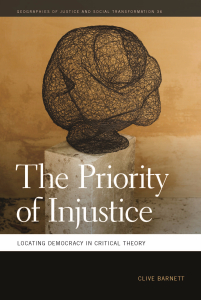
Clive Barnett reflects on his new book – not just in terms of its content, but also the experience of seeing the physical object after working on the text for so long.

Admin's avatarPop Theory

It’s a funny experience, publishing a book – something that one has lived and worked with for perhaps years and invested all sorts of energies into finally comes out, and there is an odd sense of anti-climax (it’s a lot like finishing a PhD). But it’s also odd to actually read one’s own book in proper book form, bound and beautiful, even though The Priority of Injustice is pretty much the only thing I have been reading since at least the summer of 2015. There is a kind of terror involved (what does it read like?), but also a nice experience of affirmation, as you notice that there is maybe something coherent running through the whole thing (although maybe you have to have been reading, writing and editing it for more than two years to actually notice this). So, I have now read my own book, again, cover to cover…

View original post 1,008 more words

Posted in Uncategorized | Leave a comment

James D Boys interview on US foreign policy from Clinton to Trump

James D Boys recently gave a department seminar at Warwick on his forthcoming book Clinton’s War On Terror. While he was visiting, he was interviewed for Warwick Student Union radio.

Henry Riley spoke to American Historian and Foreign Policy expert Dr James D Boys. They discussed everything from Obama’s legacy, Trump and foreign policy so far, the JFK files, the Manafort saga and his new book ‘Clinton’s War On Terror: US Counterterrorism Strategy 1993 – 2001’ which is published by Lynne Rienner and will be released in 2018.


Posted in Politics, Uncategorized | Leave a comment

Where to start with reading Henri Lefebvre? – minor updates to my guide and reissue of Key Writings

9781350041677.jpgI’ve made some minor updates to my guide Where to start with reading Henri Lefebvre?

The key thing added is the reissue of Key Writings, now available in Bloomsbury’s Revelations series.


Posted in Henri Lefebvre, Uncategorized | 1 Comment

Interviews about my Foucault books on New Books in Critical Theory (audio)

I’ve just been interviewed by Dave O’Brien for the New Books in Critical Theory series about Foucault: The Birth of Power. The podcast of that interview should be available shortly and I’ll share when available [update: now available here].

In the meantime, here’s the discussion we had last year about Foucault’s Last Decade – Download (Duration: 47:54 — 21.9MB) or stream at the series website.

0745683916

Why did Michel Foucault radically recast the project of The History of Sexuality? How did he work collaboratively? What was the influence of Antiquity on his thought? In Foucault’s Last Decade (Polity Press, 2016) Stuart Elden, Professor of Political Theory and Geography at the University of Warwick explores these, and many more, questions about the final years in a rich intellectual life. The book combines detailed studies of Foucault’s recently collected lecture series with archival material and his publications, to give an in depth engagement with the changes and continuities in his thought during the last decade. Addressing questions associated with key terms, such as governmentality, as well as confession, the self, power, truth telling, and many other core ideas and themes, the book will be essential reading for anyone interested in this most important of Western thinkers.

Posted in Foucault's Last Decade, Foucault: The Birth of Power, Michel Foucault, Uncategorized | 2 Comments

Bruce Robbins in The Nation reviews Foucault’s Last Decade and Foucault: The Birth of Power

Foucault-Robbins_ap_img

Bruce Robbins in The Nation reviews my two books Foucault’s Last Decade and Foucault: The Birth of Power. It’s a generous and thoughtful review, and while I wouldn’t agree with all of it, I’m very grateful for the review and the exposure.

Posted in Foucault's Last Decade, Foucault: The Birth of Power, Michel Foucault, Uncategorized | Leave a comment

Antonio Gramsci, The Prison Notebooks – exhibition in London

Just a reminder that this exhibition is on just for one more week. I went today and if you’re in London and have even the slightest interest in Gramsci it’s well worth seeing. It is only the notebooks – no other material and minimal other information. But it is the notebooks! And the materiality of these is worth seeing – the organisation of material, his minuscule and very neat handwriting, and little sense of the conditions under which they were filled. There is also an electronic version which you can use to look through the notebooks – the originals are in glass cases and so are fixed on specific pages or the cover.

stuartelden's avatarProgressive Geographies

Antonio Gramsci, The Prison Notebooks – exhibition in London

1-invantonio_gramsci

Exhibition curated by Silvio Pons and Francesco Giasi

Italian Cultural Institute
39 Belgrave Square
London SW1X 8NX

30 October – 10 November 2017
Monday to Friday 10am – 6pm
(closed on Wednesday 1 November)

On the occasion of the 80th anniversary of Antonio Gramsci’s death (1891-1937), the Italian Cultural Institute hosts an exhibition featuring the originals of the 33 Prison Notebooks – that is, the texts written by Antonio Gramsci from 8th February 1929 during his imprisonment – one of the most significant works of Italian and international political, philosophical and literary thinking.

The originals of the Notebooks are exhibited for the first time in the United Kingdom and, more generally, out of Italy. This exhibition aims to renew the link between Gramsci’s thought and British culture, inaugurated by the “dialogue” with Ludwig Wittgenstein through Piero Sraffa, Professor at Cambridge in…

View original post 86 more words

Posted in Uncategorized | 2 Comments

New Book: The Priority of Injustice

Clive Barnett’s new book published

Admin's avatarPop Theory

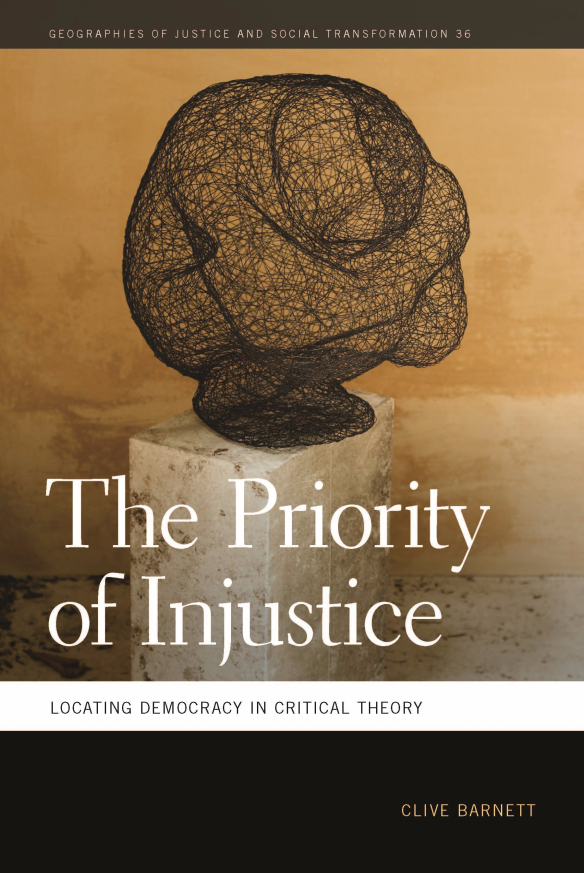
Published today, The Priority of Injustice: Locating Democracy in Critical Theory. You can read more about the book here.

My book is available from most booksellers. If your local store doesn’t have a copy in stock, please ask them to special order it for you. If you don’t have a preferred local store here are a few other ways to buy a copy.

To find an independent bookseller in your area, visit these sites:

UK: https://www.booksellers.org.uk/Home

North America: http://www.indiebound.org/

Shop at these online booksellers:

Book Depository

Amazon

Barnes & Noble

Powell’s City of Books

Exclusive Books

Buy a copy direct from the University of Georgia Press by visiting my book’s page on the website and clicking the buy link:

http://www.ugapress.org/index.php/books/index/priority_of_injustice

View original post

Posted in Uncategorized | 1 Comment