Nick Megoran, Nationalism and Central Asia: A Biography of the Uzbekistan-Kyrgyzstan Boundary

9780822964421Nick Megoran, Nationalism and Central Asia: A Biography of the Uzbekistan-Kyrgyzstan Boundary now out from University of Pittsburgh Press.

Nick Megoran explores the process of building independent nation-states in post-Soviet Central Asia through the lens of the disputed border territory between Uzbekistan and Kyrgyzstan. In his rich “biography” of the boundary, he employs a combination of political, cultural, historical, ethnographic, and geographic frames to shed new light on nation-building process in this volatile and geopolitically significant region.

Megoran draws on twenty years of extensive research in the borderlands via interviews, observations, participation, and newspaper analysis. He considers the problems of nationalist discourse versus local vernacular, elite struggles versus borderland solidarities, boundary delimitation versus everyday experience, border control versus resistance, and mass violence in 2010, all of which have exacerbated territorial anxieties. Megoran also revisits theories of causation, such as the loss of Soviet control, poorly defined boundaries, natural resource disputes, and historic ethnic clashes, to show that while these all contribute to heightened tensions, political actors and their agendas have clearly driven territorial aspirations and are the overriding source of conflict. As this compelling case study shows, the boundaries of the The Ferghana Valley put in succinct focus larger global and moral questions of what defines a good border.

Posted in Boundaries, Territory, Uncategorized | Leave a comment

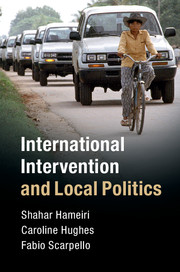
Hameiri, Hughes and Scarpello, International Intervention and Local Politics – now out with CUP

9781108416894Shahar Hameiri, Caroline Hughes, and Fabio Scarpello, International Intervention and Local Politics: Fragmented States and the Politics of Scale, now out with Cambridge University Press.

International peace- and state-building interventions have become ubiquitous in international politics since the 1990s, aiming to tackle the security problems stemming from the instability afflicting many developing states. Their frequent failures have prompted a shift towards analysing how the interaction between interveners and recipients shapes outcomes. This book critically assesses the rapidly growing literature in international relations and development studies on international intervention and local politics. It advances an innovative approach, placing the politics of scale at the core of the conflicts and compromises shaping the outcomes of international intervention. Different scales – local, national, international – privilege different interests, unevenly allocating power, resources and political opportunity structures. Interveners and recipients thus pursue scalar strategies and socio-political alliances that reinforce their power and marginalise rivals. This approach is harnessed towards examining three prominent case studies of international intervention – Aceh, Cambodia and Solomon Islands – with a focus on public administration reform.
Posted in Uncategorized | Leave a comment

Derek Gregory, ‘War at a Distance: the Modern Battlefield’ (video)

War at a Distance: the Modern Battlefield – Derek Gregory lecture, Radboud University, Nijmegen.

In a modern war the battlefield can be anywhere. Drones and aerial bombing mean that there isn’t a clear frontline anymore. Because of this an even larger number of citizens have become part of the battlefield. Learn from geographer Derek Gregory how aerial violence became and remains a key military strategy.

A longer lecture description and a links to the slides can be found on Derek’s site, Geographical Imaginations. Also on that site, a discussion of some recent literature on a range of topics connected to his work.

Posted in Derek Gregory, Uncategorized | Leave a comment

CfP: Political Geologies: Earth Sciences and Subterranean Territorialization (AAG 2018)

CfP: Political Geologies: Earth Sciences and Subterranean Territorialization – Association of American Geographers meeting, New Orleans, Louisiana; April 10-14, 2018

Organizers: Andrea Marston (UC Berkeley); Matt Himley (Illinois State University)

Sponsors: Cultural and Political Ecology Specialty Group; Political Geography Specialty Group

Session Description:

Recent publications have called for geographers to attend to the “verticality” and “volume” of space, including the air, oceans, and subsoil (Weizman 2007, Elden 2013, Adey 2015, Grundy-Warr et al. 2015, Steinberg and Peters 2015). Much of this work has explored volumetric space from a geopolitical perspective, emphasizing the optical techniques used to render space visible, governable, and in some cases marketable. Although perhaps inattentive to the lived experiences of three-dimensional space (Harris 2014), as a corpus this work directs attention to the scientific and technological practices through which volumetric space is known, secured, and exploited, and thus the role of these practices in the making of territory (Bridge 2013).

In this session, we build on this work with a focus on the technosciences of subterranean territorialization, aiming to encompass the political/governmental, economic/commercial, and social/meaningful aspects of territorial production. While attempting to understand earth’s “deep history” and “inner structure,” geological exploration has long been linked to the production of colonial and capitalist spaces (Stafford 1990, Frederiksen 2013). Capitalist expansion relies on metals and fossil fuels buried in the subsoil, and the production of subterranean resources has gone hand in hand with the inventorying of colonial natures and colonized peoples. These interlinked processes have produced “geological landscapes” and cultivated geological senses of regional and national belonging (Braun 2000, Shen 2014). In conjunction with archeology and paleontology, geology provides earthy depth to national historical narratives, while subsoil engineering transforms such “natural inheritance” into promises of future progress. On (and in) the ground, “geologic subjects” (Yusoff 2013) continue to produce and consume the products of the subsoil, through their daily actions rendering these subterranean resources the literal bedrock of capitalist modernity.

We invite papers that explore the sciences and technologies of subterranean territorialization as they relate to questions of governance, exploitation, and belonging. Potential topics include but are not limited to:

• Politics of subterranean knowledge production
• Earth sciences and imperial expansion
• Relationship between colonial ordering of people and subsoil natures
• Earth sciences and state formation/national territorialization
• Role of earth sciences in territorial conflicts
• “Everyday verticalities” (Harris 2014) of the subsoil

Please submit your abstract of no more than 250 words to Andrea Marston (ajmarston@berkeley.edu) and Matt Himley (mdhimle@ilstu.edu) by October 9th.

Note: This session will have a discussant. Presenters will be asked to submit a written paper several weeks before the conference.

Full details here


Posted in Conferences, Uncategorized | Leave a comment

Rosi Braidotti, ‘Are ‘WE’ in this together?’ video of UCL-IAS lecture

Rosi Braidotti, ‘Are ‘WE’ in this together?’ video of UCL-IAS lecture, 21 September 2017

This lecture explores the re-compositions of a vulnerable sense of pan-humanity (‘WE’) in the context of Anthropocenic climate change discussion (‘this’). It will focus on three main considerations: firstly the convergences around the posthuman turn and the shifting understandings of ‘the human’ in contemporary scholarship. Secondly the complex and internally contradictory effects of economic globalization as bio-political, information-driven system, that capitalizes on all that lives. Thirdly, the necro-political governmentality, that instils managed devastation and extinction, through wars and conflicts and the new forms of discrimination they engender on a planetary scale.


Posted in Uncategorized | Leave a comment

Russell Brand and David Harvey, ‘Marxism On The Rise – Can It Really Defeat Capitalism?’ Podcast

david-harvey-russell-brand

Also from David Harvey, and if you can cope with Russell Brand…

Russell Brand and David Harvey, ‘Marxism On The Rise – Can It Really Defeat Capitalism?‘ Podcast

Harvey’s new book is Marx, Capital and the Madness of Economic Reason

Posted in David Harvey, Uncategorized | 1 Comment

David Harvey, ‘Marx, Capital and the Madness of Economic Reason’ – video of LSE talk

David Harvey, ‘Marx, Capital and the Madness of Economic Reason’ – video of LSE talk, 18 September 2017

Download : Audio, Video

Editor’s note: We regret to say that owing to a technical problem the first few minutes of the lecture are missing from the podcast

Speaker(s): Professor David Harvey
Chair: Dr Hyun Bang Shin

Recorded on 18 September 2017

Leading Marxist scholar David Harvey discusses the profound insights and enormous power Marx’s analysis continues to offer 150 years after the first volume of Capital was published. His latest book is Marx, Capital and the Madness of Economic Reason.

David Harvey (@profdavidharvey) is Distinguished Professor of Anthropology at the City University of New York Graduate School and an Honorary Graduate of LSE. His course on Marx’s Capital, developed with students over thirty years, has been downloaded by people from all over the world.

Hyun Bang Shin (@urbancommune) is Associate Professor of Geography and Urban Studies at LSE.

Posted in David Harvey, Uncategorized | Leave a comment

Charlotte Mathieson on REF 2021 & ECRs: the current situation

Charlotte Mathieson on REF 2021 & ECRs: the current situation

If you’re an early career researcher – or even a bit further ahead than that – and based in the UK, this is a really helpful summary of the situation as we currently know it and some good advice. Here’s the opening of the piece:

It is a slightly tricky time to be writing this post: there have been a host of announcements about changes to the REF policy in recent months, weeks, and even days, but much remains undecided, making it difficult to offer advice of the kind that was possible for REF 2014. That said, ECRs (and especially those currently on the job market) are very much living through this uncertainty, and can’t simply wait it out until next summer to make decisions that impact upon careers.

With that in mind, this post is intended as a reflection on the current state of affairs. While I can’t offer anything too concrete, I have tried to clarify, or at least clearly set out, the main areas of uncertainty relating to ECRs, and to give pointers on where to find information and what to look out for as further details are released. I’ve also offered some preliminary advice for ECRs based on what I think can be inferred thus far.

All of this comes with the (big) disclaimer that these are my own opinions only, some areas are still open to interpretation, this is by no means definitive, and this may well yet change: and n.b. that none of the information that has been released is final policy – that will come next year. [continue reading here]

I’m not going to offer substantial thoughts on this in response, since Charlotte outlines things with admirable clarity. Whatever you think of the REF, if you’re in the UK system you have got to work within its restrictions, so being well informed is essential. This piece is a really good place to start, and provides a lot of links to external information.

Posted in Uncategorized | Leave a comment

Daniel Defert on the Foucault-Sartre relation – a 1990 letter

product_9782070720392_195x320This was not a source I knew about before: Daniel Defert, “Lettre à Claude Lanzmann”, Les Temps Modernes, No 531-533, Vol 2, 1990,  pp. 1201-1206.

It’s a short piece in a massive 1400 page collection devoted to Sartre, ten years after his death. Defert was asked for a contribution but replied with a long letter, which he says can be used however the recipient wants. They decided to publish it.

As well as discussing the intellectual disagreements between the two around the publication of Foucault’s Les mots et les choses [The Order of Things], and extending to The Archaeology of Knowledge, Defert says a bit about their overlapping political commitments in the 1970s. I was looking at it because it has a minor point about a 1950s text I’m currently working on, but it would have been a useful source when I was working on Foucault: The Birth of Power. It has barely ever been cited, as far as I can tell, so I thought others might find this useful.

Posted in Foucault: The Birth of Power, Jean-Paul Sartre, Michel Foucault, The Early Foucault, Uncategorized | 1 Comment

Shakespearean Territories – forthcoming with University of Chicago Press in Fall 2018

Shakespearean Territories cover - CopyI am delighted to announce that my book Shakespearean Territories will be published by University of Chicago Press in Fall 2018. I received final approval yesterday, and the book is now in production. I published The Birth of Territory with the press in 2013, and it’s great to be working with them again.

[Update the publisher page is here, with description, table of contents and cover]

The book reads a number of Shakespeare’s plays to examine different aspects of the question of territory – conceptually, historically, and politically. The argument is that while Shakespeare only uses the words ‘territory’ and ‘territories’ rarely, the concept is not marginal to his work. A number of his plays are structured around related issues of exile, banishment, land politics, spatial division, contestation, conquest and succession. Shakespeare was writing at the end of the sixteenth and beginning of the seventeenth century: a time when the modern conception of sovereign territory was emerging. He therefore helps us understand its variant aspects, tensions, ambiguities and limits. In using these plays the aim is to illustrate the multi-faceted nature of territory as word, concept and practice, and to shed light on the way we understand territory and territorial disputes today.

In my previous work on territory, I’ve tried to broaden the way we think about the concept and practice, suggesting different registers for examining it. We can find political and geographical themes in many of Shakespeare’s works, but different plays put an emphasis on themes such as the strategic, the economic, the legal, and technical. Yet Shakespeare is not read just to provide examples of themes I had previously identified. His plays open up new ways of thinking about these questions, providing depth and illustration of these themes at a significant historical juncture. Even more significantly, Shakespeare’s plays highlight aspects which my own previous work insufficiently acknowledged – the colonial, the geophysical and the corporeal. These crucial themes have been highlighted in some critical engagement with my work, and I use Shakespeare to push me further in developing this account of the contested and complicated concept and practice of territory.

Here’s the table of contents:

Introduction: Shakespearean Territories

  1. Divided Territory: The Geo-politics of King Lear
  2. Vulnerable Territories: Regional Geopolitics in Hamlet and Macbeth
  3. The Territories: Majesty and Possession in King John
  4. Economic Territories: Laws, Economies, Agriculture and Banishment in Richard II
  5. Legal Territories: Conquest and Contest in Henry V and Edward III
  6. Colonial Territories: From The Tempest to the Eastern Mediterranean
  7. Measuring Territories: The Techniques of Rule
  8. Corporeal Territories: The Political Bodies of Coriolanus
  9. Outside Territory: The Forest in Titus Andronicus and As You Like It

Coda: Beyond Pale Territories

The story of how this book came to be written might be of interest. Just less than seven and a half years ago, while attending the AAG meeting in Washington DC, the Eyjafjallajökull volcano in Iceland erupted. Like many people, I was unable to fly back to the UK for several days. I ended up staying in Vienna, Virginia, near the Dulles airport, for several days while I waited for a chance to get home. I had hoped to hire a bike, but couldn’t find a place to do so, and I didn’t have my driving licence with me, so apart from some long walks, ended up working much of the time. I had with me relatively few books, but these included the Arden third series edition of King Lear, along with a laptop. I’d been working on a short section on King Lear for The Birth of Territory, but over these several days the section expanded far beyond what would fit in that book. I cut it right back for the book, but still had some material I thought was worth publishing. I presented this work at a conference in New York in 2012, on the invitation of Daniel Hoffman-Schwartz, and this led to it being published in Law and Literature. At the conference I was asked about how the argument related to other of Shakespeare’s plays. I had already begun a piece on Coriolanus, and was thinking about Richard II. This was the germ of the book Shakespearean Territories.

Over the next several years, I worked on Shakespeare in parallel with the writing on Foucault. I presented parts of the work to conferences and department seminars, mainly in the UK, but also in the USA, Canada, Australia and France. I generally began each talk with a broad overview of my work on territory, and the key themes of this work, but then spoke on a different play whenever possible. I therefore built up quite a lot of material around these themes. While at UCL’s Institute of Advanced Studies in 2015-16 I returned to all this writing, and began to shape it more carefully into chapters and a working manuscript. I finished a complete draft in September 2016, just before term began. I deliberately put it to one side, and didn’t look at it again until the New Year. I felt this manuscript needed to be read with fresh eyes. I was pleasantly surprised when I did return to it, reworked it where I thought necessary, and submitted it to review in February.

Two very thoughtful and supportive referees wrote reports, and I tried to address all their concerns and suggestions fully. I made revisions to the text in the first part of the summer. It went back to one reader, who had just a couple of minor suggestions for final work. The book is, I think, stronger for their interventions. It gained a little length in revision, and now comes in just a few words over 125,000. It’s a substantial, but not I think unwieldy, book.

The book is intended to be both a book about Shakespeare for a geography and territory audience; and a book about territory for a Shakespeare audience. There is a bit more about the book, along with links to audio recordings of some lectures, here.

Posted in Shakespearean Territories, Territory, The Birth of Territory, William Shakespeare | 1 Comment