New titles in the Antipode Book Series for 2017

New titles in the Antipode book series

Antipode Editorial Office's avatarAntipodeFoundation.org

So far this year we’ve published three new titles in the Antipode Book Series:

Other Geographies: The Influences of Michael Watts edited by Sharad Chari (University of California, Berkeley), Susanne Freidberg (Dartmouth College), Vinay Gidwani (University of Minnesota), Jesse Ribot (University of Illinois) and Wendy Wolford (Cornell University);

Money and Finance After the Crisis: Critical Thinking for Uncertain Times edited by Brett Christophers (Uppsala University), Andrew Leyshon (University of Nottingham) and Geoff Mann (Simon Fraser University); and

Frontier Road: Power, History, and the Everyday State in the Colombian Amazon by Simón Uribe (University of Antioquia).

In Other Geographies, an international group of distinguished scholars pay homage to and build on the work of one of the most influential thinkers of our time, Michael Watts. Together they show how Watts’ research, writings, teaching and mentoring have relentlessly pushed boundaries, transforming his chosen field of geography and beyond. The book spans an…

View original post 706 more words

Posted in Uncategorized | Leave a comment

Jean Wahl, Transcendence and The Concrete: Selected Writings reviewed at NDPR

9780823273027_26.jpgJean Wahl, Transcendence and The Concrete: Selected Writings is reviewed at NDPR. Although not that well known in English, Wahl was a significant figure in France in the mid-twentieth century, and among other things was one of Foucault’s teachers. His book Human Existence and Transcendence was translated in 2016 and was reviewed at NDPR too.

Posted in Uncategorized | Leave a comment

‘7 things I wish I had done during my PhD’

Some interesting thoughts here – ‘7 things I wish I had done during my PhD‘. Though largely from the perspective of a scientist, there are things here relevant to other disciplines.

Posted in Uncategorized | Leave a comment

Responses to Peter Sloterdijk’s ‘Pseudonymous Politics’ (open access)

A number of responses to Peter Sloterdjk’s ‘Pseudonymous Politics’ are now available to download from New Perspectives here. The original article is also open access here.

Claudia Aradau – Performative Politics and International Relations –

Friedrich Kratochwil – Of Myths, Lies, and Phantasies: Some Critical Remarks on Sloterdijk’s “Pseudonymous Politics”

Barry J Ryan – Platonic Speleology and Peter Sloterdijk’s Theory of Pseudonymous Politics

Sassan Gholiagha – On the Meaning of Democracy: Critique and Counter-Critique

Benjamin Tallis – Names and Roses: The Democratic Potential of Sloterdijk’s Authentic Lies

Posted in Uncategorized | Leave a comment

Thresholds – A pop-up symposium – 22 September 2017, University of York

Thresholds – A pop-up symposium – 22 September 2017, University of York

Thresholds is intended to bring together diverse disciplines including sociology, politics, history, anthropology, women’s studies, critical management, human geography, social policy. The format will be a short papers (10mins) followed discussion.

This event platforms scholars working across the humanities and social sciences around the theme of ‘thresholds’. It explores perspectives on the liminal edges of everyday, organisational and social life. What and who reside beyond or within different types of thresholds? Who has to cross thresholds? What prevents people or things crossing? How does power operate through different thresholds? How do thresholds articulate with limits, extremes, dangers and tipping points? These are just some of the questions explored in this one day symposium.

Thresholds is intended to bring together diverse disciplines including sociology, politics, history, anthropology, women’s studies, critical management, human geography, social policy. The format will be a short papers (10mins) followed discussion.

Organisers: Joanna Latimer, David Beer, Nik Brown, Rolland Munro

Time and Place: 22 September 2017 – 10:30 to 15:30; Berrick Saul Building, The Treehouse – University of York

REGISTER HERE

Supported by: the University of York ‘Culture and Communication’ Research Theme; The Department of Sociology; Science and Technology Studies Unit (SATSU)

Tea/coffee will be served at breaks with a light lunch offered – concluding with a drinks reception

Thresholds Programme (PDF  , 109kb)

Posted in Uncategorized | Leave a comment

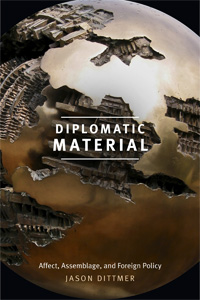
Jason Dittmer, Diplomatic Material: Affect, Assemblage, and Foreign Policy

978-0-8223-6911-0_pr.jpgJason Dittmer’s new book, Diplomatic Material: Affect, Assemblage, and Foreign Policy is out with Duke University Press.

In Diplomatic Material Jason Dittmer offers a counterintuitive reading of foreign policy by tracing the ways that complex interactions between people and things shape the decisions and actions of diplomats and policymakers. Bringing new materialism to bear on international relations, Dittmer focuses not on what the state does in the world but on how the world operates within the state through the circulation of humans and nonhuman objects. From examining how paper storage needs impacted the design of the British Foreign Office Building to discussing the 1953 NATO decision to adopt the .30 caliber bullet as the standard rifle ammunition, Dittmer highlights the contingency of human agency within international relations. In Dittmer’s model, which eschews stasis, structural forces, and historical trends in favor of dynamism and becoming, the international community is less a coming-together of states than it is a convergence of media, things, people, and practices. In this way, Dittmer locates power in the unfolding of processes on the micro level, thereby reconceptualizing our understandings of diplomacy and international relations.

  • “Working at the rich interface of social theory and international relations theory, Jason Dittmer provides a novel and important rereading of diplomatic practice, demonstrating how diplomacy and international relations are profoundly influenced by material and bodily contexts. Diplomatic Material speaks to pressing debates in social theory and international relations, making this important book one of the best in its field.” — Mark B. Salter, editor of, Making Things International 1 and Making Things International 2

    “Jason Dittmer innovatively combines multiple literatures and empirical cases to render familiar issues in novel ways. His engaging writing makes the work accessible to undergraduates. Diplomatic Material will be of interest to those working in diplomacy, assemblage theory, and more-than-human approaches in political geography and international relations.” — Merje Kuus, author of, Geopolitics and Expertise: Knowledge and Authority in European Diplomacy

Posted in Uncategorized | Leave a comment

Genealogy and Political Theory, 29 September 2017, Amsterdam

Workshop: Genealogy and Political Theory, 29 September 2017, 10.00 hrs. – 17.00 hrs.
Campus Roeterseiland, building J/K, room B22 (Valckenierstraat 65-67, 1018 XE Amsterdam)

In recent years, there has been a proliferation of works of and on genealogy by political theorists and historians of political thought. However, with this proliferation comes questions about what exactly genealogy is, how to understand past work on and of genealogy (in particular by Nietzsche and Foucault), how it is connected to other forms of critical inquiry (such as ideology critique), and what its role can and should be in political theorising more broadly.

This workshop brings together scholars working on genealogy to discuss and begin to answer these questions, with a particular focus on the growing contribution of genealogy for helping us to make sense of contemporary political theory and practice.

Programme

  • 10:00 – Professor Bernard Reginster (Brown University), “Nietzsche on Truth and Genealogy”.
  • 11:10 – Coffee Break
  • 11:20 – dr. Janosch Prinz (University of East Anglia) “Combining genealogy and ideology critique in realism in political theory”.
  • 12:30 – Lunch
  • 13:30 – dr. Hugo Drochon (CRASSH, University of Cambridge), TBA
  • 14:40 – dr. Gulsen Seven (Bilkent University), “The relevance of genealogy for political realism”.
  • 15:50 – Coffee Break
  • 16:00 – dr. Paul Raekstad (University of Amsterdam), “On Three Kinds of Genealogy”.
  • 17:00 – End/Drinks.

Registration
It is not necessary to register. However, please do RSVP to P.A.Raekstad@uva.nl by Monday the 25th of September.

Event website

Posted in Conferences, Friedrich Nietzsche, Michel Foucault, Uncategorized | 2 Comments

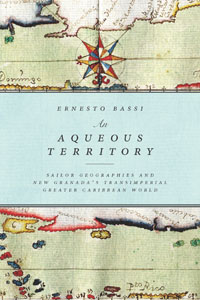
Ernesto Bassi discusses An Aqueous Territory

978-0-8223-6240-1_pr.jpgErnesto Bassi discusses his book An Aqueous Territory: Sailor Geographies and New Granada’s Transimperial Greater Caribbean World at the New Books Network.

Here’s the book description from the Duke UP site:

In An Aqueous Territory Ernesto Bassi traces the configuration of a geographic space he calls the transimperial Greater Caribbean between 1760 and 1860. Focusing on the Caribbean coast of New Granada (present-day Colombia), Bassi shows that the region’s residents did not live their lives bounded by geopolitical borders. Rather, the cross-border activities of sailors, traders, revolutionaries, indigenous peoples, and others reflected their perceptions of the Caribbean as a transimperial space where trade, information, and people circulated, both conforming to and in defiance of imperial regulations. Bassi demonstrates that the islands, continental coasts, and open waters of the transimperial Greater Caribbean constituted a space that was simultaneously Spanish, British, French, Dutch, Danish, Anglo-American, African, and indigenous. Exploring the “lived geographies” of the region’s dwellers, Bassi challenges preconceived notions of the existence of discrete imperial spheres and the inevitable emergence of independent nation-states while providing insights into how people envision their own futures and make sense of their place in the world.

Thanks to dmf for the link

Posted in Uncategorized | 1 Comment

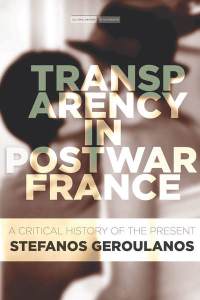
Stefanos Geroulanos, Transparency in Postwar France: A Critical History of the Present – now out with Stanford UP

pid_26751.jpgStefanos Geroulanos, Transparency in Postwar France: A Critical History of the Present is now out with Stanford University Press.

This book returns to a time and place when the concept of transparency was met with deep suspicion. It offers a panorama of postwar French thought where attempts to show the perils of transparency in politics, ethics, and knowledge led to major conceptual inventions, many of which we now take for granted.

Between 1945 and 1985, academics, artists, revolutionaries, and state functionaries spoke of transparency in pejorative terms. Associating it with the prying eyes of totalitarian governments, they undertook a critical project against it—in education, policing, social psychology, economic policy, and the management of information. Focusing on Sartre, Lacan, Canguilhem, Lévi-Strauss, Leroi-Gourhan, Foucault, Derrida, and others, Transparency in Postwar France explores the work of ethicists, who proposed that individuals are transparent neither to each other nor to themselves, and philosophers, who clamored for new epistemological foundations. These decades saw the emergence of the colonial and phenomenological “other,” the transformation of ideas of normality, and the effort to overcome Enlightenment-era humanisms and violence in the name of freedom. These thinkers’ innovations remain centerpieces for any resistance to contemporary illusions that tolerate or enable power and social coercion.

Posted in Uncategorized | 1 Comment

Christopher Watkin, French Philosophy Today now in paperback

9781474425834_1.jpgChristopher Watkin, French Philosophy Today: New Figures of the Human in Badiou, Meillassoux, Malabou, Serres and Latour is now available in paperback.

Contemporary French philosophy is laying fresh claim to the human. Through a series of independent, simultaneous initiatives, arising in the writing of diverse current French thinkers, the figured of the human is being transformed and reworked.

Christopher Watkin draws out both the promises and perils inherent in these attempts to rethink humanity’s relation to ‘nature’ and ‘culture’, to the objects that surround us, to the possibility of social and political change, to ecology and even to our own brains. This comparative assessment makes visible for the first time one of the most important trends in French thought today.

Posted in Alain Badiou, Catherine Malabou, Quentin Meillassoux, Uncategorized | Leave a comment