Charlotte Mathieson on REF 2021 & ECRs: the current situation

Charlotte Mathieson on REF 2021 & ECRs: the current situation

If you’re an early career researcher – or even a bit further ahead than that – and based in the UK, this is a really helpful summary of the situation as we currently know it and some good advice. Here’s the opening of the piece:

It is a slightly tricky time to be writing this post: there have been a host of announcements about changes to the REF policy in recent months, weeks, and even days, but much remains undecided, making it difficult to offer advice of the kind that was possible for REF 2014. That said, ECRs (and especially those currently on the job market) are very much living through this uncertainty, and can’t simply wait it out until next summer to make decisions that impact upon careers.

With that in mind, this post is intended as a reflection on the current state of affairs. While I can’t offer anything too concrete, I have tried to clarify, or at least clearly set out, the main areas of uncertainty relating to ECRs, and to give pointers on where to find information and what to look out for as further details are released. I’ve also offered some preliminary advice for ECRs based on what I think can be inferred thus far.

All of this comes with the (big) disclaimer that these are my own opinions only, some areas are still open to interpretation, this is by no means definitive, and this may well yet change: and n.b. that none of the information that has been released is final policy – that will come next year. [continue reading here]

I’m not going to offer substantial thoughts on this in response, since Charlotte outlines things with admirable clarity. Whatever you think of the REF, if you’re in the UK system you have got to work within its restrictions, so being well informed is essential. This piece is a really good place to start, and provides a lot of links to external information.

Posted in Uncategorized | Leave a comment

Daniel Defert on the Foucault-Sartre relation – a 1990 letter

product_9782070720392_195x320This was not a source I knew about before: Daniel Defert, “Lettre à Claude Lanzmann”, Les Temps Modernes, No 531-533, Vol 2, 1990,  pp. 1201-1206.

It’s a short piece in a massive 1400 page collection devoted to Sartre, ten years after his death. Defert was asked for a contribution but replied with a long letter, which he says can be used however the recipient wants. They decided to publish it.

As well as discussing the intellectual disagreements between the two around the publication of Foucault’s Les mots et les choses [The Order of Things], and extending to The Archaeology of Knowledge, Defert says a bit about their overlapping political commitments in the 1970s. I was looking at it because it has a minor point about a 1950s text I’m currently working on, but it would have been a useful source when I was working on Foucault: The Birth of Power. It has barely ever been cited, as far as I can tell, so I thought others might find this useful.

Posted in Foucault: The Birth of Power, Jean-Paul Sartre, Michel Foucault, The Early Foucault, Uncategorized | 1 Comment

Shakespearean Territories – forthcoming with University of Chicago Press in Fall 2018

Shakespearean Territories cover - CopyI am delighted to announce that my book Shakespearean Territories will be published by University of Chicago Press in Fall 2018. I received final approval yesterday, and the book is now in production. I published The Birth of Territory with the press in 2013, and it’s great to be working with them again.

[Update the publisher page is here, with description, table of contents and cover]

The book reads a number of Shakespeare’s plays to examine different aspects of the question of territory – conceptually, historically, and politically. The argument is that while Shakespeare only uses the words ‘territory’ and ‘territories’ rarely, the concept is not marginal to his work. A number of his plays are structured around related issues of exile, banishment, land politics, spatial division, contestation, conquest and succession. Shakespeare was writing at the end of the sixteenth and beginning of the seventeenth century: a time when the modern conception of sovereign territory was emerging. He therefore helps us understand its variant aspects, tensions, ambiguities and limits. In using these plays the aim is to illustrate the multi-faceted nature of territory as word, concept and practice, and to shed light on the way we understand territory and territorial disputes today.

In my previous work on territory, I’ve tried to broaden the way we think about the concept and practice, suggesting different registers for examining it. We can find political and geographical themes in many of Shakespeare’s works, but different plays put an emphasis on themes such as the strategic, the economic, the legal, and technical. Yet Shakespeare is not read just to provide examples of themes I had previously identified. His plays open up new ways of thinking about these questions, providing depth and illustration of these themes at a significant historical juncture. Even more significantly, Shakespeare’s plays highlight aspects which my own previous work insufficiently acknowledged – the colonial, the geophysical and the corporeal. These crucial themes have been highlighted in some critical engagement with my work, and I use Shakespeare to push me further in developing this account of the contested and complicated concept and practice of territory.

Here’s the table of contents:

Introduction: Shakespearean Territories

  1. Divided Territory: The Geo-politics of King Lear
  2. Vulnerable Territories: Regional Geopolitics in Hamlet and Macbeth
  3. The Territories: Majesty and Possession in King John
  4. Economic Territories: Laws, Economies, Agriculture and Banishment in Richard II
  5. Legal Territories: Conquest and Contest in Henry V and Edward III
  6. Colonial Territories: From The Tempest to the Eastern Mediterranean
  7. Measuring Territories: The Techniques of Rule
  8. Corporeal Territories: The Political Bodies of Coriolanus
  9. Outside Territory: The Forest in Titus Andronicus and As You Like It

Coda: Beyond Pale Territories

The story of how this book came to be written might be of interest. Just less than seven and a half years ago, while attending the AAG meeting in Washington DC, the Eyjafjallajökull volcano in Iceland erupted. Like many people, I was unable to fly back to the UK for several days. I ended up staying in Vienna, Virginia, near the Dulles airport, for several days while I waited for a chance to get home. I had hoped to hire a bike, but couldn’t find a place to do so, and I didn’t have my driving licence with me, so apart from some long walks, ended up working much of the time. I had with me relatively few books, but these included the Arden third series edition of King Lear, along with a laptop. I’d been working on a short section on King Lear for The Birth of Territory, but over these several days the section expanded far beyond what would fit in that book. I cut it right back for the book, but still had some material I thought was worth publishing. I presented this work at a conference in New York in 2012, on the invitation of Daniel Hoffman-Schwartz, and this led to it being published in Law and Literature. At the conference I was asked about how the argument related to other of Shakespeare’s plays. I had already begun a piece on Coriolanus, and was thinking about Richard II. This was the germ of the book Shakespearean Territories.

Over the next several years, I worked on Shakespeare in parallel with the writing on Foucault. I presented parts of the work to conferences and department seminars, mainly in the UK, but also in the USA, Canada, Australia and France. I generally began each talk with a broad overview of my work on territory, and the key themes of this work, but then spoke on a different play whenever possible. I therefore built up quite a lot of material around these themes. While at UCL’s Institute of Advanced Studies in 2015-16 I returned to all this writing, and began to shape it more carefully into chapters and a working manuscript. I finished a complete draft in September 2016, just before term began. I deliberately put it to one side, and didn’t look at it again until the New Year. I felt this manuscript needed to be read with fresh eyes. I was pleasantly surprised when I did return to it, reworked it where I thought necessary, and submitted it to review in February.

Two very thoughtful and supportive referees wrote reports, and I tried to address all their concerns and suggestions fully. I made revisions to the text in the first part of the summer. It went back to one reader, who had just a couple of minor suggestions for final work. The book is, I think, stronger for their interventions. It gained a little length in revision, and now comes in just a few words over 125,000. It’s a substantial, but not I think unwieldy, book.

The book is intended to be both a book about Shakespeare for a geography and territory audience; and a book about territory for a Shakespeare audience. There is a bit more about the book, along with links to audio recordings of some lectures, here.

Posted in Shakespearean Territories, Territory, The Birth of Territory, William Shakespeare | 1 Comment

New titles in the Antipode Book Series for 2017

New titles in the Antipode book series

Antipode Editorial Office's avatarAntipodeFoundation.org

So far this year we’ve published three new titles in the Antipode Book Series:

Other Geographies: The Influences of Michael Watts edited by Sharad Chari (University of California, Berkeley), Susanne Freidberg (Dartmouth College), Vinay Gidwani (University of Minnesota), Jesse Ribot (University of Illinois) and Wendy Wolford (Cornell University);

Money and Finance After the Crisis: Critical Thinking for Uncertain Times edited by Brett Christophers (Uppsala University), Andrew Leyshon (University of Nottingham) and Geoff Mann (Simon Fraser University); and

Frontier Road: Power, History, and the Everyday State in the Colombian Amazon by Simón Uribe (University of Antioquia).

In Other Geographies, an international group of distinguished scholars pay homage to and build on the work of one of the most influential thinkers of our time, Michael Watts. Together they show how Watts’ research, writings, teaching and mentoring have relentlessly pushed boundaries, transforming his chosen field of geography and beyond. The book spans an…

View original post 706 more words

Posted in Uncategorized | Leave a comment

Jean Wahl, Transcendence and The Concrete: Selected Writings reviewed at NDPR

9780823273027_26.jpgJean Wahl, Transcendence and The Concrete: Selected Writings is reviewed at NDPR. Although not that well known in English, Wahl was a significant figure in France in the mid-twentieth century, and among other things was one of Foucault’s teachers. His book Human Existence and Transcendence was translated in 2016 and was reviewed at NDPR too.

Posted in Uncategorized | Leave a comment

‘7 things I wish I had done during my PhD’

Some interesting thoughts here – ‘7 things I wish I had done during my PhD‘. Though largely from the perspective of a scientist, there are things here relevant to other disciplines.

Posted in Uncategorized | Leave a comment

Responses to Peter Sloterdijk’s ‘Pseudonymous Politics’ (open access)

A number of responses to Peter Sloterdjk’s ‘Pseudonymous Politics’ are now available to download from New Perspectives here. The original article is also open access here.

Claudia Aradau – Performative Politics and International Relations –

Friedrich Kratochwil – Of Myths, Lies, and Phantasies: Some Critical Remarks on Sloterdijk’s “Pseudonymous Politics”

Barry J Ryan – Platonic Speleology and Peter Sloterdijk’s Theory of Pseudonymous Politics

Sassan Gholiagha – On the Meaning of Democracy: Critique and Counter-Critique

Benjamin Tallis – Names and Roses: The Democratic Potential of Sloterdijk’s Authentic Lies

Posted in Uncategorized | Leave a comment

Thresholds – A pop-up symposium – 22 September 2017, University of York

Thresholds – A pop-up symposium – 22 September 2017, University of York

Thresholds is intended to bring together diverse disciplines including sociology, politics, history, anthropology, women’s studies, critical management, human geography, social policy. The format will be a short papers (10mins) followed discussion.

This event platforms scholars working across the humanities and social sciences around the theme of ‘thresholds’. It explores perspectives on the liminal edges of everyday, organisational and social life. What and who reside beyond or within different types of thresholds? Who has to cross thresholds? What prevents people or things crossing? How does power operate through different thresholds? How do thresholds articulate with limits, extremes, dangers and tipping points? These are just some of the questions explored in this one day symposium.

Thresholds is intended to bring together diverse disciplines including sociology, politics, history, anthropology, women’s studies, critical management, human geography, social policy. The format will be a short papers (10mins) followed discussion.

Organisers: Joanna Latimer, David Beer, Nik Brown, Rolland Munro

Time and Place: 22 September 2017 – 10:30 to 15:30; Berrick Saul Building, The Treehouse – University of York

REGISTER HERE

Supported by: the University of York ‘Culture and Communication’ Research Theme; The Department of Sociology; Science and Technology Studies Unit (SATSU)

Tea/coffee will be served at breaks with a light lunch offered – concluding with a drinks reception

Thresholds Programme (PDF  , 109kb)

Posted in Uncategorized | Leave a comment

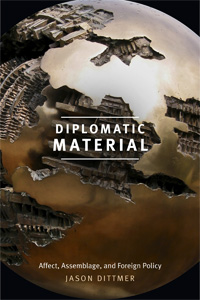
Jason Dittmer, Diplomatic Material: Affect, Assemblage, and Foreign Policy

978-0-8223-6911-0_pr.jpgJason Dittmer’s new book, Diplomatic Material: Affect, Assemblage, and Foreign Policy is out with Duke University Press.

In Diplomatic Material Jason Dittmer offers a counterintuitive reading of foreign policy by tracing the ways that complex interactions between people and things shape the decisions and actions of diplomats and policymakers. Bringing new materialism to bear on international relations, Dittmer focuses not on what the state does in the world but on how the world operates within the state through the circulation of humans and nonhuman objects. From examining how paper storage needs impacted the design of the British Foreign Office Building to discussing the 1953 NATO decision to adopt the .30 caliber bullet as the standard rifle ammunition, Dittmer highlights the contingency of human agency within international relations. In Dittmer’s model, which eschews stasis, structural forces, and historical trends in favor of dynamism and becoming, the international community is less a coming-together of states than it is a convergence of media, things, people, and practices. In this way, Dittmer locates power in the unfolding of processes on the micro level, thereby reconceptualizing our understandings of diplomacy and international relations.

  • “Working at the rich interface of social theory and international relations theory, Jason Dittmer provides a novel and important rereading of diplomatic practice, demonstrating how diplomacy and international relations are profoundly influenced by material and bodily contexts. Diplomatic Material speaks to pressing debates in social theory and international relations, making this important book one of the best in its field.” — Mark B. Salter, editor of, Making Things International 1 and Making Things International 2

    “Jason Dittmer innovatively combines multiple literatures and empirical cases to render familiar issues in novel ways. His engaging writing makes the work accessible to undergraduates. Diplomatic Material will be of interest to those working in diplomacy, assemblage theory, and more-than-human approaches in political geography and international relations.” — Merje Kuus, author of, Geopolitics and Expertise: Knowledge and Authority in European Diplomacy

Posted in Uncategorized | Leave a comment

Genealogy and Political Theory, 29 September 2017, Amsterdam

Workshop: Genealogy and Political Theory, 29 September 2017, 10.00 hrs. – 17.00 hrs.
Campus Roeterseiland, building J/K, room B22 (Valckenierstraat 65-67, 1018 XE Amsterdam)

In recent years, there has been a proliferation of works of and on genealogy by political theorists and historians of political thought. However, with this proliferation comes questions about what exactly genealogy is, how to understand past work on and of genealogy (in particular by Nietzsche and Foucault), how it is connected to other forms of critical inquiry (such as ideology critique), and what its role can and should be in political theorising more broadly.

This workshop brings together scholars working on genealogy to discuss and begin to answer these questions, with a particular focus on the growing contribution of genealogy for helping us to make sense of contemporary political theory and practice.

Programme

  • 10:00 – Professor Bernard Reginster (Brown University), “Nietzsche on Truth and Genealogy”.
  • 11:10 – Coffee Break
  • 11:20 – dr. Janosch Prinz (University of East Anglia) “Combining genealogy and ideology critique in realism in political theory”.
  • 12:30 – Lunch
  • 13:30 – dr. Hugo Drochon (CRASSH, University of Cambridge), TBA
  • 14:40 – dr. Gulsen Seven (Bilkent University), “The relevance of genealogy for political realism”.
  • 15:50 – Coffee Break
  • 16:00 – dr. Paul Raekstad (University of Amsterdam), “On Three Kinds of Genealogy”.
  • 17:00 – End/Drinks.

Registration
It is not necessary to register. However, please do RSVP to P.A.Raekstad@uva.nl by Monday the 25th of September.

Event website

Posted in Conferences, Friedrich Nietzsche, Michel Foucault, Uncategorized | 2 Comments