Séverine Kodjo-Grandvaux, African Philosophies – trans. Matthew B. Smith, Polity, June 2025
For many students of philosophy in the West, philosophy is understood as a discipline stemming from Ancient Greece, embracing the great thinkers of medieval and early modern Europe and continuing through to the present day. To the extent that other philosophical traditions are taken into account, these tend to be selected philosophical traditions of Asia. Rarely is African philosophy considered in this context, even though Africa and the West are deeply interconnected through long histories of colonialism and slavery.
In this important book Séverine Kodjo-Grandvaux argues that a serious engagement with African philosophy is long overdue. She shows that there is a rich tradition of philosophical thought in Africa that addresses issues ranging from the legacies of colonialism to the nature of time, the state, responsibility, identity, dignity and personhood. An engagement with African philosophy also offers a fresh perspective on Western philosophy, prompting us to interrogate ourselves and our own history. Conceptualizing African philosophy becomes a way of conceptualizing the world and of understanding how to know ourselves through the gaze of another.
African Philosophies is not so much a survey of philosophy in Africa but rather an account of how the question of African philosophy emerged in the second half of the 20th century and of what we can learn from a serious engagement with African philosophy today. It will be of great interest to students and scholars in philosophy, in colonial and postcolonial studies and throughout the humanities.
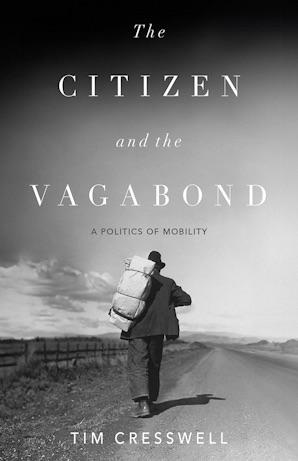
An expansive treatise on the power relations that govern our movement
The Citizen and the Vagabond develops a theoretical approach to the study of mobility and its relationship to the production, maintenance, and transformation of social and cultural hierarchies. Expanding upon his foundational work on the subject, Tim Cresswell examines human movement from around the globe to better understand the various forms of inequality and injustice that shape our lives.
Establishing a framework for movement in terms of rhythm, speed, routes, and friction, Cresswell extends these themes to address the Covid-19 pandemic and subsequent lockdowns, exploring what this turbulent period reveals to us about the politics of mobility. He demonstrates that while flexibility and ease of movement are typically considered markers of personal freedom, increased mobility brings with it new modes of control and surveillance. As he investigates the hierarchies and embodied experiences that emerge amid these tensions, Cresswell employs two figures: the citizen, whose mobility within and across borders is expected and accepted, and the vagabond, whose perpetual mobility is deemed suspect and in need of ordering.
In conversation with the work of theorists such as Mimi Sheller, Zygmunt Bauman, Paul Virilio, Henri Lefebvre, Ivan Illich, and Anna Tsing, Cresswell reaches beyond geography to incorporate insights from the humanities and social sciences. An interdisciplinary intervention into the study of mobility and citizenship, The Citizen and the Vagabond provides a new set of coordinates from which to grasp the shifting dynamics of movement and power.
Between 2011 and 2022 I wrote eleven pieces for the much-missed Berfrois site. Most were reviews of recent books. Although the site closed to new submissions in 2022, I thought the archive would be preserved. I was therefore disappointed to discover recently that a link to one of my pieces was broken, and on checking I found that the whole archive has gone, though much is archived at the Wayback Machine.
I have now posted all my pieces onto Progressive Geographies as an archive of my work. It took a bit of work to find the original Word documents I sent to the site for some of these. The Foucault reviews were important in the process of working for what became my series of books on him; others relate to different publications on Kant and Shakespeare.
Aside from my own work, I’m struck by the ephemeral nature of digital-only material like this. In my own attempts to reconstruct the work of various theorists, and sometimes the histories of journals or publishing ventures, I’ve often sought out some fairly hard-to-find texts. But things in print, somewhere, usually turn up eventually – even if it can require a lot of leg-work between different libraries or patient inter-library loan staff. But this digital record, even quite recent, just seems to have gone. I’m not sure what is on the Wayback Machine is everything. Collectively we need to get better at preserving records like this…
For more pieces in a related vein, see my series of ‘Sunday Histories‘ – one posted every Sunday so far in 2025
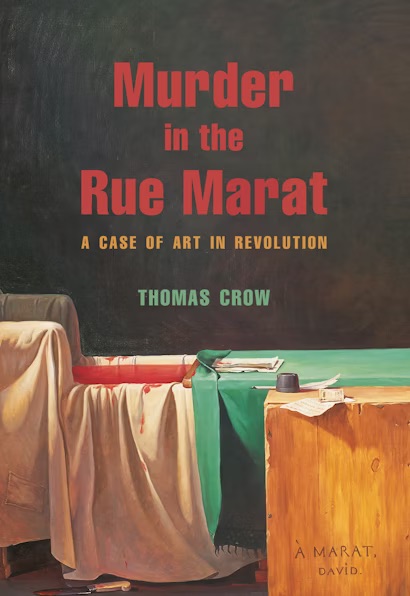
Jacques-Louis David’s The Death of Marat depicts the painter’s friend and fellow revolutionary Jean-Paul Marat collapsed in his bath after being fatally stabbed by a female assassin who stands just outside the frame. In this fascinating book, Thomas Crow traces the radical legacy of a painting that has been called the Pietà of the French Revolution, showing how David’s masterpiece captures the saga of that violent era in the single figure of Marat, and how it reveals itself anew today.
Crow begins by describing how the painting’s enduring power came to the fore during the countercultural tumult of the 1960s, discussing how his vocation as a scholar arose out of his own encounter with the work. He then takes readers back to 1793, telling the story of the painting’s creation through the eyes of David, his subject, and Marat’s charismatic assassin, Charlotte Corday. Charting the history of its impact across more than two centuries, Crow shows how this multilayered portrait surfaced in succeeding waves of political dissent as an enduring talisman of popular insurgency.
Beautifully illustrated, Murder in the Rue Marat is an art historian’s disarmingly personal account of a painting whose hidden complexities bear witness to the promise and peril of revolution in Marat’s time and our own.
The world is never going to make complete sense to us, yet we find that conclusion almost impossible to accept. Can we live, and feel at home, in a world composed at best of incompatible fragments of meaning?
This is the theme that runs through this collection of essays by Raymond Geuss. Drawing on a characteristically wide range of insights from moral and political philosophy, history, and aesthetics, he addresses topics such as knowledge (of self, the world, and others), language, the visual and the auditory, authority, hope, and the success and failure of life projects. He argues that, to get by in our bewildering world, we must embrace the virtue of ‘double vision’: that is, immersing ourselves in and learning the ways of the culture surrounding us, even as we feel alienated from it. Together the essays explore some of the consequences of abandoning the idea of a unitary view of the world, while at the same time trying to avoid quietism.
Seeing Double is a compelling collection of work by one of the world’s most versatile and creative philosophers.
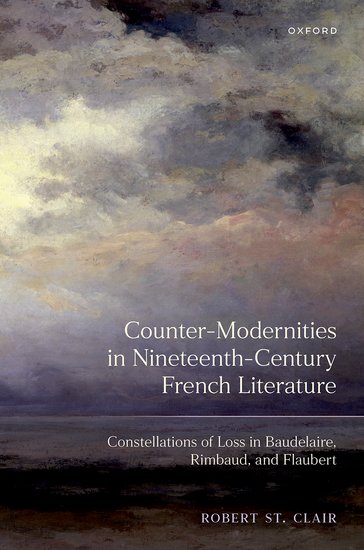
Counter-Modernities in Nineteenth-Century French Literature explores a counterview of modernity in late nineteenth-century French literature (1848-1891). The principal claim of this book is that what we find in the works of Baudelaire, Rimbaud, and Flaubert is a form of ‘writing against the grain’ of history: not the elegant lyricism of history’s victors, but a use of literature against the erasures of past injustices and for those ‘lost futurities’ upon which the order of the present is founded. What we find, in other words, is a critical literary archive of the powerless that persists in contesting the legitimacy of the powerful, which persists in haunting the nineteenth century every bit as much as it does our own achingly out-of-joint present. The story Counter-Modernities seeks to tell is, in other words, about the meaning of loss, and the significance of losers as possible figures of opposition to the dominant order, in nineteenth-century French literature that is also a story about modernity as an aesthetic politics.
What brings together the authors in this study, however, cannot be reduced be the biographical: that is, to the uneven successes, financial hardships, and, in one case, outright failure (i.e., Rimbaud) shared by the authors in the literary market of their lifetime. At stake in this study is not an account of the ironies of literary history, wherein, to gloss Walter Benjamin’s take on Baudelaire, a prior and benighted era sees little of interest in an artist in which a later epoch recognizes the “genius” of modernity. Rather, Constellations of Loss in Baudelaire, Rimbaud, and Flaubert demonstrates how each author in this critical corpus insists on tarrying with history as an experience of irrevocable loss: each lingers with history as a force of negations, and thereby insists on the significance of historical setbacks and political defeats that seem to affect-if not more dramatically wipe out-the collective hopes of entire generations. Each one gives us losers as subjects who matter in the nineteenth century (Baudelaire, Flaubert, Rimbaud), narratives of historical defeat that are as negative as they are meaningful (Baudelaire, Flaubert), or the contours of events whose meanings and narratives are themselves lost (Baudelaire, Rimbaud), whose meanings remain, in other words, perhaps less absent than open-ended: a possible grammar for what may come next, when hope seems lost and dreams dashed. Indeed, as this books shows, it is precisely in its representation of history as a dilemma or undoing of meaningfulness, a problem of legibility and not-knowingness, that we can most fully recognize the formal calling-cards of literary “modernity”: ironic undecidabilities and difficulties, infinite interpretability and the death of the author, the dissolution of previously stable cultural and historical narratives or forms of subjectivity, formal breaks with semantically oriented modes of representation, and so on.
Not Panofsky’s actual dog (who can be seen in the linked file), but a very similar-looking one – CC BY-SA 3.0, from Wikipedia Commons
In the archives of the Institute for Advanced Study at Princeton, there are some papers relating to Erwin Panofsky, the art historian, collected by his second wife Gerda Panofsky (née Sörgel). I was led there by the question of the relation between Pierre Bourdieu and Panofsky, on which I write about here. There is less material than I was expecting – the main Panofsky archives are at the Smithsonian Institution and there are files at the IAS under his own name – but the description mentions some correspondence, and there is a digital file. I was surprised to find this short file is actually all about Panofsky’s dog, Dion. The file is worth a look for curiosity – there is a Greek text about the gift of a dog, with a list of names from the IAS community who had made this gift, including Robert and Kitty Oppenheimer (that image is here). There is also a paw print on paper, the English text of the Greek dedication, a photograph which shows he was an Irish (or Red) Setter, and a letter signed by William (William S. Heckscher – a former student and colleague of Panofsky) about the dog’s premature end. It sounds like he was hit by a car.
There is also a note card, with the printed text of “With Deepest Sympathy” and the handwritten “I meant it really – I am frightfully sorry!” It is signed “EKa”, who is none other than Ernst Kantorowicz. Kantorowicz’s name also appears on the list of those who gifted the dog. Kantorowicz and Panofsky were colleagues at the IAS for many years, and this humanises two figures who can seem rather austere from their writings…
Elizabeth Sears, “The Life and Work of William S. Heckscher”, Zeitschrift für Kunstgeschichte 53 (1), 1990, 107-33. The story of his first meeting with Panofsky is well told in this text.
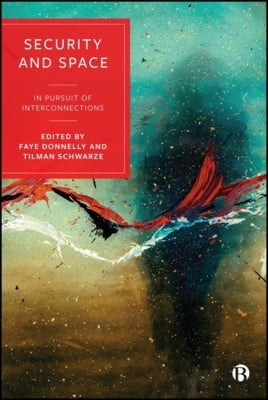
This book brings fresh insights into how social spaces shape the way we experience and understand security. Chapters unite voices from critical security studies, urban geography, criminology and political science to rethink the link between security and space, from neighbourhood crime to global conflict.
By viewing security through a spatial lens, the book uncovers the social, economic and political forces that shape security issues in everyday life offering vital insights for current debates on power, space and security.
In 1967, Pierre Bourdieu translated Erwin Panofsky’s 1951 book Gothic Architecture and Scholasticism into French. The German-born Panofsky is best known for his work in art history, and for developing Aby Warburg’s distinction between iconography and iconology. He was teaching alternate semesters in New York and Hamburg from the early 1930s, but when the Nazis came to power he lost his position in Hamburg because he was Jewish. He made the move to the United States permanently, and held a post at the Institute for Advanced Study in Princeton from 1935 until the end of his life. He gave the second Wibber lecture at Saint Vincent College in Pennsylvania in 1948, and it was this lecture which was published as Gothic Architecture and Scholasticism. It is a short book, probably about 18,000 words including notes, but with extensive illustrations, which adds to its length. For the French edition, Bourdieu added another text, “L’Abbé Suger de Saint-Denis”, a translation of Panofsky’s introduction to a collection of texts by Abbot Suger (the English is at archive.org).
Architecture gothique et pensée scolastique appeared in the series Bourdieu edited for Éditions de Minuit, Le sens commun, and he also contributed a postface to the book. Bourdieu had founded the series the year before. I think the translation was the first book in the series he had not co-authored, though perhaps his postface makes this one count as that too. The following year Bourdieu included an excerpt from his translation of Panofsky in his project with J.C. Chamboredon and J.C. Passeron, Le métier de sociologue: Préalables épistémologiques, recently reedited. There were sixteen years between the English and the French editions of Panofsky, and almost forty more before Bourdieu’s postface was translated into English as an appendix to Bruce Holsinger, The Premodern Condition: Medievalism and the Making of Theory in 2005.
Perhaps the best-known thing about the postface is Bourdieu describing the notion of habitus in relation to Panofsky’s reading of scholasticism:
However, in addition to this, by using the scholastic concept of habitus to designate the culture instilled by school, Panofsky shows that culture is not just a common code, or even a common repertoire of answers to common problems, or a set of particular and particularized forms of thought, but rather a whole body of fundamental schemes, assimilated beforehand, that generate, according to an art of invention similar to that of musical writing, an infinite number of particular schemes, directly applied to particular situations. This habitus could be defined, by analogy with Noam Chomsky’s ‘generative grammar,’ as a system of internalized schemes that have the capacity to generate all the thoughts, perceptions, and actions characteristic of a culture, and nothing else (French pp. 151-52; English, p. 233).
Now what’s interesting is that in the English book, Panofsky might use the concept of habitus, but he does not use the word. Instead, he says that what he is getting at “may be called, for want of a better term, a mental habit—reducing this overworked cliché to its precise Scholastic sense as a ‘principle that regulates the act,’ principium importans ordinem ad actum” (pp. 20-21). There are other uses of “mental habit” in Panofsky’s text, but he does not use habitus. In the French, Bourdieu uses “une habitude mentale” to translate “a mental habit” (i.e. p. 83). It is therefore in his commentary that Bourdieu translates Panofsky’s English “mental habit” as habitus, or rather translates it back into habitus, because thisis the Latin term Panofsky has in mind from the scholastics, with the specific reference being to Thomas Aquinas, Summa Theologica (Part II.I, Question 49). That Latin term was a translation of the Greek hexis. Although best known as a sociologist, Bourdieu did the agrégation in philosophy, attending classes by Étienne Gilson and Maurice de Gandillac, and wrote a thesis on Leibniz, supervised by Henri Gouhier. He was very much at home in this milieu.
Of course, were Bourdieu just adopting this concept of habitus, which he goes on to use much more broadly in his own work, he could have simply done that. Taking up the concept, adding a reference to Panofsky or directly to Aquinas, and moving on. But he chose to translate Panofsky’s work, and write the lengthy postface. There is more to this story than simply a creative use of a concept from one field in another. He says something about the history of these ideas in his own “The Genesis of the Concepts of Habitus and Field”. In 1976, Bourdieu’s Le sens commun series published another book by Panofsky, a collection of his early essays first published in German, La Perspective comme forme symbolique et autres essais. Guy Ballangé edited the translations; Marisa Dalai Emiliani wrote the introduction.
In The Premodern Condition, Holsinger devotes a chapter to the Bourdieu-Panofsky connection, “Indigeneity: Panofsky, Bourdieu, and the Archaeology of the Habitus” (pp. 94-113). Holsinger indicates a few other discussions of Bourdieu’s reading of Panofsky (p. 95 n. 4), but in English, I think his remains the fullest discussion (see also Robbins, The Bourdieu Paradigm, pp. 158-60). In particular, Holsinger stresses Bourdieu’s use of the term from Panofsky, rather than the use of the same Latin word by Marcel Mauss, especially in his essay on “Techniques of the Body” (p. 101). He also indicates that Bourdieu’s postface makes it appear that an extended but not indented quotation from a text by Robert Marichal is actually his own words: “What is most provocative about the inclusion of this sloppily punctuated citation is the tone of archaeological authority it lends to Bourdieu’s explication of Panofsky” (p. 106).
There is, of course, more discussion in French, not least because anyone engaging with this translation of Panofsky was doing it through Bourdieu’s mediation. Michel Foucault wrote a review of Bourdieu’s translation, along with the translation of Panofsky’s Studies in Iconology as Essais d’iconologie, which appeared the same year. Foucault’s review was published in October 1967 in Le Nouvel observateur. The review is reprinted in the first volume of Dits et écrits (text 51, Vol I, pp. 620-23). There is an English translation here. I briefly discussed Foucault’s review in The Archaeology of Foucault (p. 64). I suggested that Bourdieu’s translation and Foucault’s review were “were not the first signs of interest in France”, indicating that Maurice Merleau-Ponty had lectured on him at the Collège de France in 1954-55, now published in L’institution dans l’histoire personnelle et publique (pp. 105-16; and translated in Institution and Passivity, pp. 42-43, 46, 95-99), and that Alexandre Koyré had discussed his reading of Galileo in “Attitude esthétique et pensée scientifique”, published in Critique in 1955. Merleau-Ponty principally focuses on Perspective as Symbolic Form (at the time only available in German); Koyré on Panofsky’s short book Galileo as a Critic of the Arts (which he also reviewed for Revue d’histoire des sciences in 1956). Koyré’s principal criticism is that Panofsky’s title is too limited, and that what he achieves is to show the relation between Galileo’s aesthetic and scientific views – a parallel relation to the book on architecture and scholasticism.
As I said of Foucault’s review:
Foucault begins hesitantly, noting he is “not an art historian” and that these were the first works of Panofsky he had read (DE#51 [Dits et écrits, text number 51, Vol] I, 620). He quickly hits his stride, noting this work can relate to his own, in relation to “the analysis of the relation between discourse and the visible”, and that “the structures of language give their form to the order of things” (DE#51 I, 621). He suggests “Panofsky removes the privilege of discourse”, not seeking to stress art’s autonomy, but rather to describe “the complexity of their interrelation: interweaving, isomorphism, transformation, translation, in short, all that display of the visible and the sayable which characterizes a culture at a moment in its history” (DE#51 I, 621) [Elden, The Archaeology of Foucault, p. 64].
This was the year after Foucault’s Les Mots et les choses had been published, and the parallels between it and the review, whose title was “Les mots et les images”, are striking. Words and things; words and images. The English title of the book was The Order of Things, for reasons I discuss in my book (p. 70), and which I return to, alongside the question of who actually translated the book, here. “Les mots et les images” is also the title of a work by René Magritte, which appeared in La Révolution surrealistein 1929 (you can see that image here). Magritte is of course another person Foucault wrote about, initially in November 1967, and then in a short 1973 book (for a discussion, see The Archaeology of Foucault, pp. 50-55;on the different editions and translations of this text, see here).
There are other discussions. In The Production of Space, Henri Lefebvre discusses Panofsky’s work extremely critically, but in a way which is indebted to Bourdieu’s reading (French pp. 297-302; English pp. 257-61). Ilaria Fornacciari has written a longer discussion of Foucault’s review and the broader reception of Panofsky in France. A few other articles have been published on the relation between Bourdieu and Panofsky, of which I know ones by Jean-Louis Déotte and Paul Pasquali.
Pasquali discusses the background to Bourdieu’s translation, adding some valuable insight into the earlier French engagement with his work. Pasquali indicates that at first look there is no obvious reason why Bourdieu would be interested in Panofsky’s work, nor why they would begin correspondence. They shared neither a discipline nor background, coming from quite different generations – Panofsky was born in 1892 and Bourdieu in 1930. But he explores the lectures Bourdieu would have heard, the journals he would have read and builds an account for why translating Panofsky and corresponding with him does make sense. Panofsky died in March 1968, which meant his correspondence with Bourdieu only lasts for a short time, from December 1966 to June 1967 (“Quand Bourdieu découvrait Panofsky”, p. 702).
Now Pasquali and Étienne Anheim have written a book on the connections, including the Bourdieu-Panofsky correspondence as an appendix. It has been published in Le sens commun series. The correspondence comes from the Fonds Pierre Bourdieu and the personal archives of Panofsky’s second wife, Gerda Panofsky, while the main Panofsky’s archives at the Smithsonian Institution and the Director’s Office files at the IAS in Princeton have no traces (Pasquali, “Quand Bourdieu découvrait Panofsky”, pp. 702-3). The correspondence has letters from Bourdieu in French and Panofsky in English. The tone is formal, largely concerned with issues around the translation including vocabulary choices, images, and rights, especially with the text on Abbot Suger. This was because that essay also appeared in Meaning in the Visual Arts: Papers in and on Art History (1955), and that text was also being discussed for French translation. When that text was translated by Marthe and Bernard Teyssèdre as L’Œuvre d’art et ses significations in 1969, with a slightly different contents and running order, the Suger text was omitted.
Pasquali and Anheim indicate the importance of Bourdieu’s philosophical training and ability with classical languages (Bourdieu et Panofsky, p. 112). Their book, much more extensively than I did, looks at the earlier interest in Panofsky’s work in France, including noting that Merleau-Ponty taught his work in earlier lectures than the course I mentioned (p. 35). They are also good on the editorial process and the production of the book by Minuit, and the parallel work being done for the two books with Gallimard, Essais d’iconologie and L’Œuvre d’art et ses significations. They also note the quite remarkable speed of the project: “The work, which did not exist at the beginning of the month of December 1966, when the sociologist had contacted the historian of art for the first time, was in bookshops only five months later” (p. 101). And, as might have been expected, they also discuss the notion of habitus in some detail (Chapter 5 and 6). They also uncover an annoyed letter from Marichal to Bourdieu about his use of his work without first asking or even informing him, but saying this could be remedied by sending him a copy of the book (p. 159; quoting a letter of 15 December 1967). In the final chapter they discuss some of the subsequent uses of habitus, and some of the responses to Bourdieu’s edition of Panofsky, including unpublished letters by Bourdieu to his critics (Chapter 6). They also mention a criticism by Paul Veyne in his Comment on écrit l’histoire, silently removed from the later reedition of this text (pp. 198-99). They also discuss how Bourdieu was somewhat erased from the later French engagement with Panofsky (pp. 201ff).
In their correspondence, Bourdieu expresses a wish for Panofsky to lecture in Paris, either on the book he has just translated, or another topic, though he mentions that “methodological reflections on iconography and iconology” would be of wide interest (14 April 1967, p. 266; see pp. 101-2). However, this invitation was declined for language and logistical reasons. Panofsky says he does not think his French is good enough, and lecturing in English would reduce the audience. But given other commitments the possible date would also have been August, when he recognises that Paris is deserted (19 April 1967, p. 268). As noted above, Panofsky died less than a year later, and the last letter he sent Bourdieu was in June 1967. It does not appear that Bourdieu and Panofsky ever met in person. Bourdieu and Gerda Panofsky first met when Bourdieu visited the IAS in Princeton in 1970-71 (p. 227).
Towards the end of his postface to Panofsky, Bourdieu invokes Émile Benveniste’s reflections on Ferdinand de Saussure (French p. 167; English p. 242). The point is to suggest a parallel, that just as Panofsky suggests that the art historian is not a mere or “‘naïve’ spectator”, a linguist will “highlight ‘what preliminary operations he performs unconsciously when he approaches linguistic facts’” (Benveniste, “Saussure après un demi-siècle”, p. 38; “Saussure after Half a Century”, p. 34; quoted in Bourdieu, French p. 167; English p. 242). These are interesting references to linguists, again people who might appear some distance from his own work. But in 1969 Bourdieu’s series published Benveniste’s Vocabulaire, and Bourdieu was important in working with Benveniste and Jean Lallot on the final shape that book took. (For a brief note on the English translation’s editor and translator, see here.) Indeed, I think without Bourdieu’s encouragement, that book might not have appeared at all. That’s a longer story which I am trying to reconstruct elsewhere.
Update 15 September 2025: While doing the reading for this post, I chanced upon a little story about Panofsky’s dog and Ernst Kantorowicz, which I briefly tell here.
References
Étienne Anheim and Paul Pasquali, Bourdieu et Panofsky: Essai d’archéologie intellectuelle, suivi de leur correspondance inédite, Paris: Éditions de Minuit, 2025.
Emile Benveniste, “Saussure après un demi-siècle”, in Problèmes de linguistique générale 1, Paris: Gallimard, 1966; “Saussure after Half a Century”, in Problems in General Linguistics, trans. Mary Elizabeth Meek, University of Miami Press, 1971.
Pierre Bourdieu, “Postface”, in Erwin Panofsky, Architecture gothique et pensée scolastique, trans. Pierre Bourdieu, Paris: Minuit, 1967, revised 1970, 133-67; “Postface to Erwin Panofsky, Gothic Architecture and Scholasticism”, trad. Laurence Petit, in Bruce Holsinger, The Premodern Condition: Medievalism and the Making of Theory, Chicago: University of Chicago Press, 2005, 221-42.
Pierre Bourdieu, “The Genesis of the Concepts of Habitus and Field”, trans. Channa Newman, Sociocriticism2, 1985, 11-24.
Pierre Bourdieu, J.C. Chamboredon and J.C. Passeron, Le métier de sociologue: Préalables épistémologiques, Berlin: Mouton, 1968; new edition, Paris: EHESS, 2021.
Yvette Delsaut and Marie-Christine Rivière, Pierre Bourdieu, une bibliographie, Paris: Raisons d’agir éditions, 2022.
Stuart Elden, The Archaeology of Foucault, Cambridge: Polity, 2023.
Marisa Dalai Emiliani, “La Question de la perspective”, trans. J. Ch. Vegliante, in Erwin Panofsky, La Perspective comme forme symbolique et autres essais, ed. Guy Ballangé, Paris: Minuit, 1976, 7-35.
Michel Foucault, “Les mots et les images”, Le Nouvel observateur 154, 25 October 1967, 49-50; reprinted as Dits et écrits, eds. Daniel Defert and François Ewald, Paris: Gallimard, 1994, Vol I, 620-23.
Bruce Holsinger, The Premodern Condition: Medievalism and the Making of Theory, Chicago: University of Chicago Press, 2005.
Alexandre Koyré, “Attitude esthétique et pensée scientifique” [1955], reprinted in Études d’histoire de la pensée scientifique, Paris: Gallimard, 1973, 275-88.
Alexandre Koyré, “Erwin Panofsky, Galileo as a Critic of the Arts…”, Revue d’histoire des sciences 9 (2), 1956, 179-81.
Henri Lefebvre, La Production de l’espace, Paris: Anthropos, fourth edition, 2000 [1974]; The Production of Space,trans. Donald Nicholson-Smith, Oxford: Blackwell, 1991.
René Magritte, “Les Mots et les images”, La Révolution surréaliste 12, 1929, [37–8], reprinted in René Magritte, Écrits complets, ed. André Blavier, Paris: Flammarion, 2009, 60-61 and translated in Selected Writings, ed. Kathleen Rooney and Eric Plattner, trans. Jo Levy, Minneapolis: University of Minnesota Press, 2016, 33-4.
Robert Marichal, “L’Ecriture latine et la civilisation occidentale”, in L’écriture et la psychologie des peoples: XXIIe semaine de synthèse, Paris: Armand Colin, 1963, 199-247.
Maurice Merleau-Ponty, L’institution dans l’histoire personnelle et publique; La Problème de la passivité: Le sommeil, l’inconscient, la mémoire: Notes de cours au Collège de France (1954-1955), ed. Dominique Darmaillacq, Claude Lefort and Stéphanie Ménasé, Paris: Belin, 2015 [2003]; Institution and Passivity: Course Notes from the Collège de France (1954-1955), trans. Leonard Lawlor and Heath Massey, Evanston: Northwestern University Press, 2010.
Erwin Panofsky, Gothic Architecture and Scholasticism: Wimmer Lecture, 1948, Latrobe, Pennsylvania: The Archabbey Press, 1951; Architecture gothique et pensée scolastique, trans. Pierre Bourdieu, Paris: Minuit, 1967, revised edition 1970.
Erwin Panofsky, Galileo as a Critic of the Arts, The Hague: Martinus Nijhoff, 1954.
Erwin Panofsky, Meaning in the Visual Arts: Papers in and on Art History, Garden City, NY: Doubleday Anchor, 1955; L’Œuvre d’art et ses significations: Essais sur les “arts visuels”, trans. Marthe et Bernard Teyssèdre, Paris: Gallimard, 1969.
Erwin Panofsky, Studies in Iconology: Humanistic Themes in the Art of the Renaissance, Boulder, CO: Westview, 1972 [1939]; Essais d’iconologie: Thèmes humanistes dans l’art de la Renaissance, trans. Claude Herbette et Bernard Teyssèdre, Paris: Gallimard, 1967.
Erwin Panofsky, La Perspective comme forme symbolique et autres essais, ed. Guy Ballangé, Paris: Minuit, 1976.
Erwin Panofsky, Perspektive als „symbolische Form“ (1927), in Aufsätze zu Grundfragen der Kunstwissenschaft, eds. Hariolf Oberer and Egon Verheyen, Berlin: Volker Spiess, 1980, 99-167; Perspective as Symbolic Form, trans. Christopher S. Wood, New York: Zone, 1991.
Paul Pasquali, “Quand Bourdieu découvrait Panofsky: La fabrique éditoriale d’Architecture gothique et pensée scolastique (Paris-Princeton, 1966-1967)”, Annales HSS 78 (4), 2023, 699-732.
Derek Robbins, The Bourdieu Paradigm: The Origins and Evolution of an Intelletual Social Project, Manchester: Manchester University Press, 2019.
Abbot Suger, On the Abbey Church of St. Denis and its Arts Treasures, ed. and trans. Erwin Panofsky, Princeton: Princeton University Press, 1946.
This is the 37th post of a weekly series, where I post short essays with some indications of further reading and sources, but which are not as formal as something I’d try to publish more conventionally. They are usually tangential to my main writing focus, a home for spare ideas, asides, dead-ends and possible futures. I hope there is some interest in them. They are provisional and suggestions are welcome. A few shorter pieces in a similar style have been posted mid-week.
The full chronological list of ‘Sunday histories’ is here, with a thematic ordering here.
The seminars at the Columbia University Centre for Contemporary Critical Thought organised by Bernard Harcourt continue with Hegel 13/13. I was able to go to several of the Marx 13/13 series earlier this year, and the larger events are usually live-streamed for those not in New York (or Paris, where some are held).
Here’s part of the description for the Hegel series:
Hegel 13/13 is a multi-year project that explores the historical confrontations with G.W.F. Hegel’s thought, from the nineteenth century to the present, with the aim of developing new critical perspectives and practices for today’s times.
The ambition of this multi-year project is to serve as a catalyst to produce new forms of critique and praxis to address the present political conjuncture….
It is time then, once again, to return to Hegel, not to think with him, but rather, as it has so often been more productive, to think against and beyond him. It is time for another round of agonistic confrontations with Hegel’s writings—The Phenomenology of Spirit (1807), The Science of Logic (1812-1816), the Encyclopedia (1817), and the Principles of the Philosophy of Law (1820).
The multi-year project “Inversions of Hegel 13/13” will begin during the academic year 2025-2026 with preparatory sessions (informal conversations, small seminars, reading groups, and lectures) that will lay the groundwork for a 13/13 public seminar series on the confrontations with Hegel’s writings that have shaped world history. Throughout, the ambition will be to develop a new critical praxis for today.
Lots more, with a list of the planned sessions here – Althusser, Marx, Lenin, Nietzsche, Foucault, Sartre, Kojève, Marcuse, Adorno, Butler etc.. You can’t cover everyone of course, but for me striking there is no mention of Henri Lefebvre, whose engagement with Hegel is important for his reading of Marx and other parts of his work. A short introductory video: