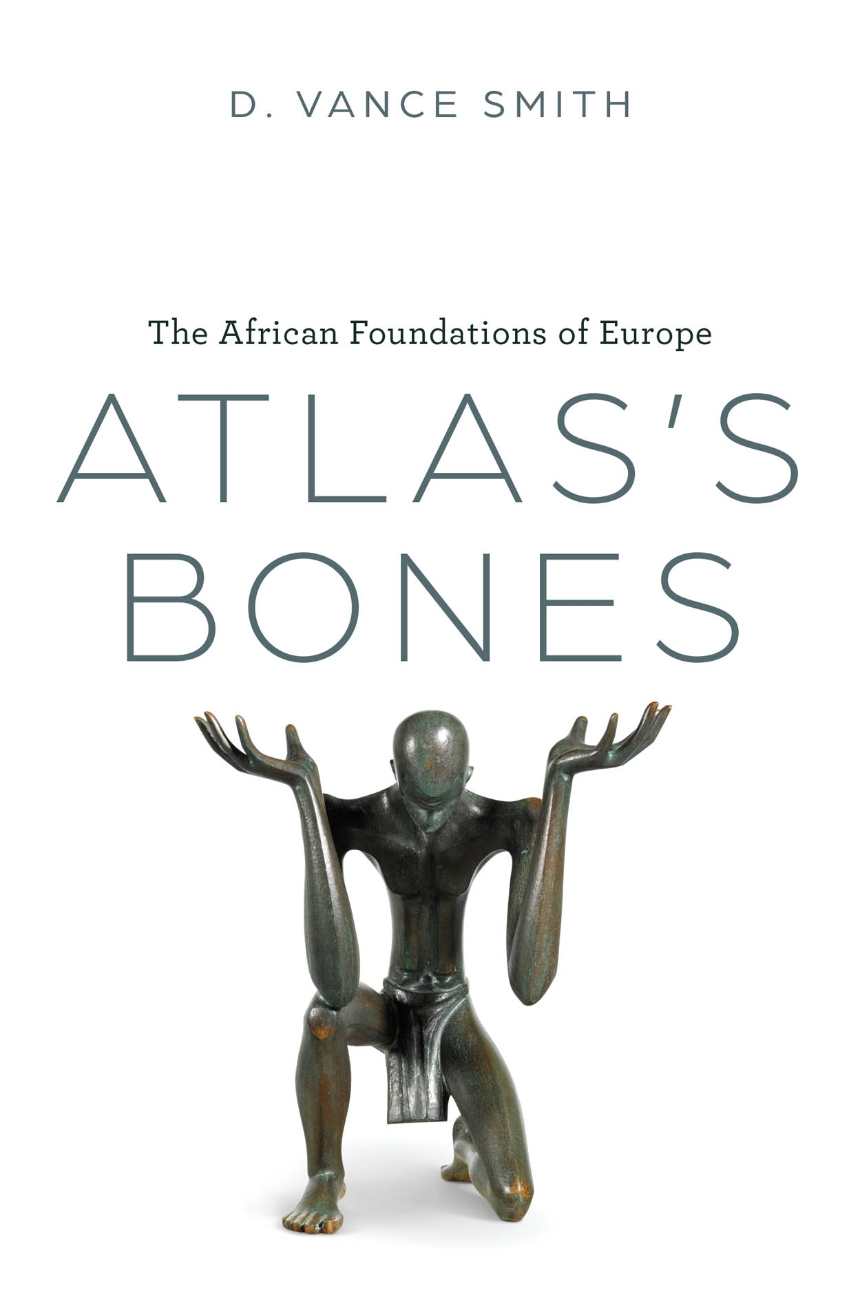
A major new look at Africa’s influence on European culture and how colonization remade Africa in the image of a medieval Europe.
Virgil. Chaucer. Petrarch. These names resonate with many as cornerstones of European culture. Yet, in Atlas’s Bones, D. Vance Smith reveals that much of what is claimed as European culture up to the Middle Ages—its great themes in literature, its sources in political thought, its religious beliefs—originated in the writings of African thinkers like Augustine, Fulgentius, and Martianus Capella, or Europeans who thought extensively about Africa. In fact, a third of Virgil’s Aeneid takes place in Africa. Francis Petrarch believed his most important achievement was his epic Africa; while Geoffrey Chaucer wrote repeatedly about the figures of Scipio Africanus, actually two different men who defeated and destroyed Carthage.
Smith tells the story of how Europe created a false “medieval” version of Africa to acquire resources and power during the era of imperialism and colonialism. The first half of the book, “Reading Africa,” traces Egypt’s, Libya’s, and Carthage’s influence on classical and medieval thinking about Africa, highlighting often ignored literary and legendary traditions, for example, that Alexander the Great named himself the son of an African god. The second part, “Writing Africa,” focuses on how the different cultures of the two great African cities—Carthage and Alexandria—shaped modern literary criticism and political theology and examines the cross-influences of modern anthropology, medieval studies, and colonial law.
Atlas’s Bones firmly re-establishes the significance of Africa in European intellectual history. It will be essential reading for anyone seeking to understand how much of Africa informs our artistic and cultural world.
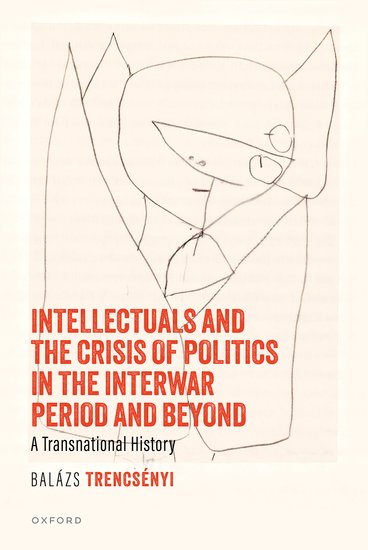
This volume offers a broad-ranging and comprehensive analysis of the history and theory of the political idea of ‘crisis’, from the interwar period through to the present day. It considers how the multiple crises of civilization, capitalism, social cohesion, liberalism, democracy, socialism, and the nation-state were conceptualized; how these spheres of crisis became entangled; and who the intellectuals, politicians and experts were who employed these discourses.
Intellectuals and the Crisis of Politics in the Interwar Period and Beyond maps the range of meanings the term ‘crisis’ has borne and the roles it has performed across disciplines and countries, de-centering the dominant narrative that takes Western European positions and developments as normative. It especially focuses on the historical roots of two key contemporary contesters of liberal democracy: neoliberalism and populism, and presents an innovative analysis of the roots of contemporary illiberalism in Europe.
Bringing these ideas into the present day, Balázs Trencsényi offers ideas on how a reflective and self-critical liberal democratic political position could be defined and defended in our current predicament, which is increasingly compared to the interwar period and is often described as a “polycrisis”.
But Barthes’ preferences were very similar to Foucault’s who succeeded in conducting seminars despite his Collège de France obligation to lecture publicly to anyone who chose to attend. He simply grilled everyone who packed into a large room for the first session, asking why they were there and whether they were willing to engage with a collaborative project, studying the parricide Pierre Rivière’s memoir. The grilling got rid of the unserious or, at least, the timid.
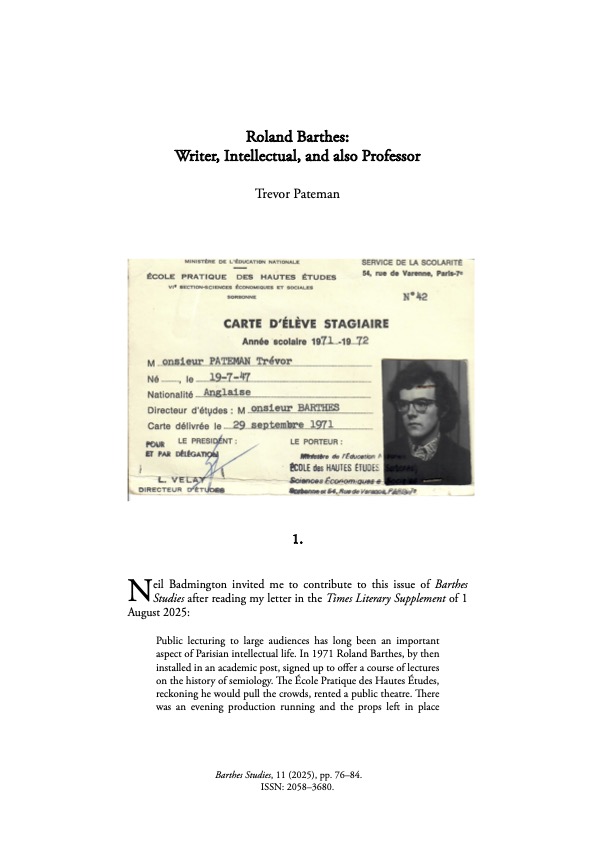
He also mentions attending classes by other French academics, including Derrida, Lacan and Lévi-Strauss, and Jakobson lecturing at the College de France, which I write about here. What a time to be in Paris! The short piece also includes images of a letter and a postcard from Barthes.
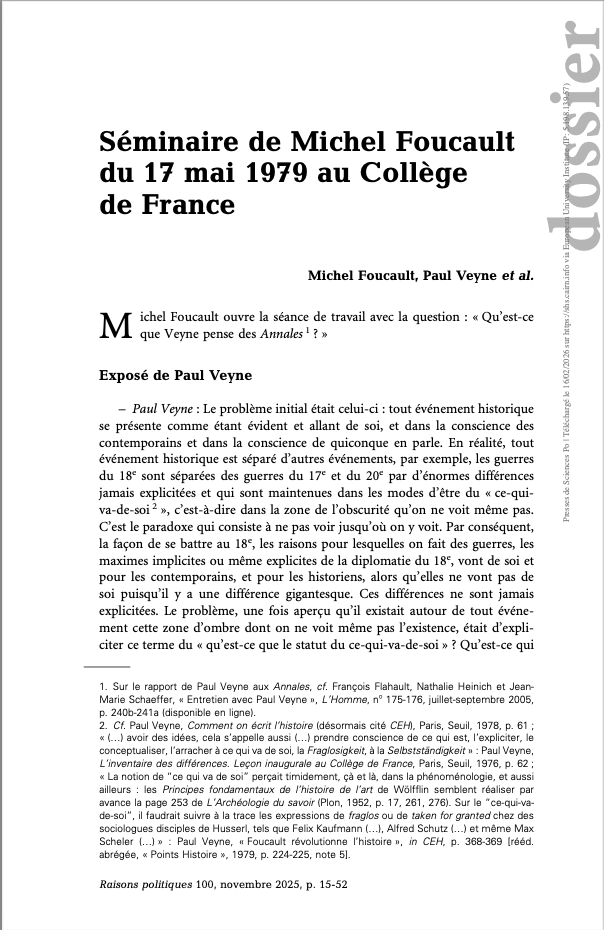
This is very interesting – a seminar discussing Paul Veyne’s “Foucault révolutionne l’histoire”. A presentation by Veyne, response by Foucault and contributions by Alessandro Fontana, François Ewald and an unidentified historian. It’s been transcribed by Michel Senellart and Carolina Verlengia from a recording made by Ewald.
I outline the topics of Foucault’s seminars – those preannounced and the ones actually held – here. The preannounced title for 1978-79 – running in parallel to the lecture course The Birth of Biopolitics – was “Problèmes de méthode en histoire des idées”, but in the report Foucault says “The seminar was devoted this year to the crisis of juridical thought in the last years of the nineteenth century…”
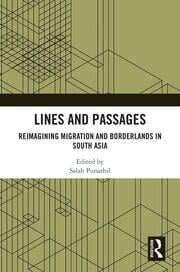
Moving beyond the conventional binary logic of state and society, this book reveals how borderlands emerge as both contested and negotiated terrains shaped by historical legacies and contemporary practices co-produced by the state and people.
Migration across borders has become a more contentious political question in contemporary South Asia than ever, especially in the context of recent populist assertions and migration politics. Going beyond the predominant political narrative, the essays in this book not only engage with everyday life as it unfolds in marriage and kinship relations and ethnic and cultural practices at borderlands but also address critical issues that shape everyday life under socio-political, economic, and legal conditions, such as policing, conflicts and violence, illegality, and other forms of precarity for migrant subjects. This book shows that borderlands are not passive edges of the nation-state but lived, socially vivacious zones where people routinely transgress, reinterpret, and negotiate the meaning of borders.
An important addition to the political anthropology/sociology of migration and borderlands in South Asia, this book will be an invaluable resource to researchers of social and political anthropology, sociology, and South Asian societies. The chapters were originally published as a special issue of Asian Ethnicity and are accompanied by a new discussion essay.
19 February 2026 marks the 10th anniversary of the death of Umberto Eco. I only heard Eco speak once, at a book reading in October 1995 for The Island of the Day Before. Mario Vargas Llosa was the other scheduled speaker, but at the event Salman Rushdie also appeared on stage and did a reading from The Moor’s Last Sigh. This was during the period when he was in hiding due to the fatwa, and his participation could not be preannounced. While I’ve read all Eco’s novels, and love some of them, I wish I’d also heard him speak more as an academic than as a novelist.
Eco is a figure who has long been on the margins of my research, as a friend and colleague of some of those I’m reading. In The Archaeology of Foucault I mentioned one time I know he met Foucault, when Foucault lectured on Manet in Milan (The Archaeology of Foucault, 56). Daniel Defert says this was in November 1967, and there is a video of a discussion involving them both here, about the Italian translation of Les Mots et les choses (The English translation The Order of Things came out in 1970 – see here). (Although Foucault speaks in French, he’s been dubbed into Italian.) The Italian translation of Foucault’s book was made by Emilio Panaitescu, though Louis Althusser had been trying to get Franca Madonia to do it. The translation also included Georges Canguilhem’s appreciative review of the book, originally in Critique (see The Archaeology of Foucault, 86-87 and its references).
At the moment, I am particularly intrigued by Eco’s connections to Roland Barthes, Émile Benveniste, Roman Jakobson, and Jacques Lacan. Eco spoke at some of the same conferences as Benveniste on linguistics and semiotics, and at his memorial event organised by Semiotext(e) and New York University in late 1976. In a more marginal connection, Georges Dumézil gave the opening address at a conference in Palermo in April 1970 where Eco and Italo Calvino were also participants. I wrote about one aspect of Eco’s friendship and collaboration with Thomas Sebeok in an earlier piece in this series – Thomas Sebeok, Umberto Eco and the Semiotics of Nuclear Waste. I also mentioned Eco’s take on the murder of Ioan Culianu in a piece on that tragic story.
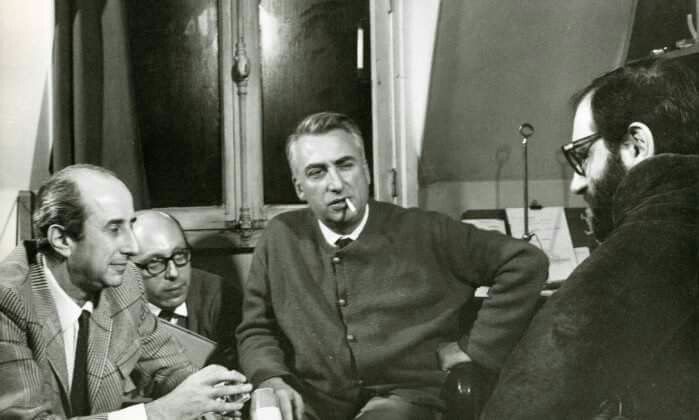
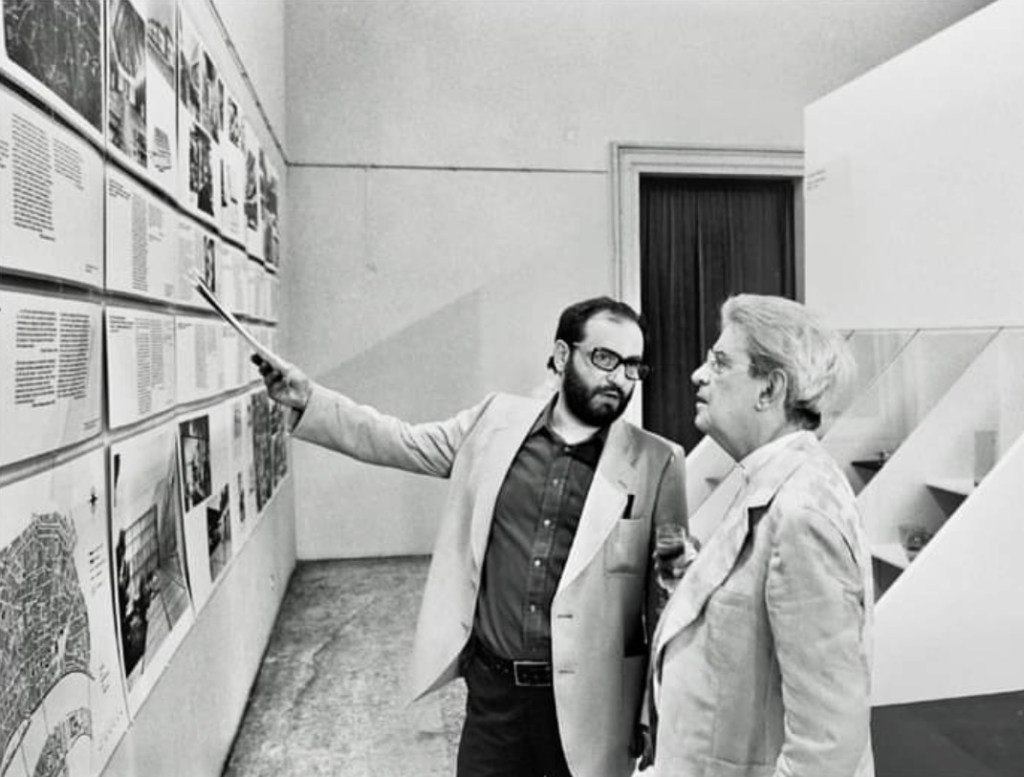
Giulio Macchi, Roland Barthes and Umberto Eco (via Luciene Cristine Vieira on Pinterest)Umberto Eco and Jacques Lacan at the International Gallery of Modern Art, on the Grand Canal in Venice, 1976 (via Lacan Circle Of Australia on X)
Eco was initially a medievalist, with a first book in 1956 on the aesthetics of Thomas Aquinas and a second in 1959 on Art and Beauty in the Middle Ages. He was clear about his transition from medievalist to semiotics: “I had three shocks, all of them around 1963: the ‘pensée sauvage’, by Lévi-Strauss, the essays of Jakobson published by Minuit, and the Russian formalists” (Opera Aperta, Italian introduction to 1976 edition,29, quoted in Proni, “Umberto Eco: An Intellectual Biography”, 8; see Caesar, Umberto Eco,48). La Pensée sauvage was published in 1962, Nicolas Ruwet’s translation of Jakobson’s essays in 1963. It’s interesting that Eco was reading Jakobson in French. I’m not sure of the specific reference for the formalists, as Tzvetan Todorov’s collection did not appear until 1965.
Eco wrote about “The Influence of Roman Jakobson on the Development of Semiotics” in a collection which appeared in 1977. Eco claims that “the entire history of philosophy could be re-read in a semiotic perspective” (p. 39), but only gives a sketch in this piece. He spends more time on the relation of linguistics to semiology, noting that: “Linguists have continued to recognise that, following Saussure, language should have been inserted into a more general framework” (p. 40). Saussure only hinted at this, Eco suggests, and while Louis Hjelmslev could have proposed “a general theoretical framework for a semiotic theory… his theory was too abstract, his examples concerning other semiotic systems very limited and rather parenthetical, and his glossematic jargon impenetrable” (p. 41).
Eco suggests that Jakobson is significant for this development, even though he rarely devoted himself to semiotics explicitly. He suggests “two fundamental essays which outline a semiotic landscape”, though they appear to be on linguistics (p. 42). One was “Language in Relation to Other Communication Systems” (Jakobson, Selected Writings, Vol II, 697-710) and the other simply entitled “Linguistics”, which appeared in Main Trends in the Science of Language and was a revised version of “Linguistics in Its Relation to Other Sciences” (Selected Writings, Vol II, 655-96). For Eco, “This last essay actually is a little treatise on semiotics, under a misleading title… Let me assume that Jakobson has never written a book on semiotics because his entire scientific existence has been a living example of a Quest for Semiotics” (p. 42). He notes that where Jakobson uses “semiotic” the now accepted term is “semiotics” (p. 55 n.1). The rest of this very interesting essay outlines “eight assumptions on which contemporary semiotic research is basically founded”, indicating “how the work of Jakobson has been of invaluable importance in making each of them widely accepted by the scientific milieu” (p. 44). The reading of Jakobson extends far beyond these two texts, and includes his work on literature, art and film. Towards the end he quotes Jakobson approvingly: “the subject matter of semiotic is the communication of any messages whatever, whereas the field of linguistics is confined to the communication of verbal messages” (Jakobson Selected Writings, Vol II, 662, quoted by Eco, “The Influence of Roman Jakobson”, p. 54).
While some elements of Eco’s work connect to Lévi-Strauss, not least in their shared use of Jakobson’s ideas in in a different field, Lévi-Strauss was quite critical, particularly around Eco’s idea of an ‘open work’. For Lévi-Strauss:
There is a remarkable book… The Open Work, whichdefends a formula that I absolutely cannot accept. What makes a work of art a work is not the fact that it is open but the fact that it is closed. A work of art is an object endowed with precise properties, which the analysis has to define. When Jakobson and myself tried to make a structural analysis of a sonnet by Baudelaire, we certainly did not approach it as an open work, in which we could find everything that has been filled in by the following epochs, but as an object which, once it has been created, had the stiffness, so to speak, of a crystal: therefore our function was only to bring into evidence its properties (in P. Caruso ed. Conversazioni con Lévi-Strauss, Foucault, Lacan, 81-82, cited in Farronato, Eco’s Chaosmos, 65-66).
I’ve not found a detailed intellectual biography of Umberto Eco, exploring his connections with philosophers, linguists, semioticians and mythologists. That’s a book I’d really like to read. Giampaolo Proni’s 1988 book chapter is quite good, but only looks at relatively early periods of Eco’s career, and the bibliography of his 2015 piece on Eco and Peirce suggests he didn’t pursue this work elsewhere. Peter Bondanella, Umberto Eco and the Open Text and Michael Caesar, Umberto Eco: Philosophy, Semiotics and the Work of Fiction are good, but do not have much detail on the topics in which I’m interested. Cristina Farronato, Eco’s Chaosmos has a bit more.Douglass Merrell’s study is interesting, but quite superficial on these questions. Rocco Capozzi has some interesting personal comments, but is explicit it is not an “academic essay”. At the Global Public Life site of Theory, Culture and Society, in a piece written shortly after Eco’s death Sunil Manghani has some good reflections on Eco’s legacy and, in particular, his connection to Barthes. Eco’s archives and personal library are being made available at the University of Bologna. A catalogue of some of the antique books from his collection was published in 2022; a foundation has been set up around his work. Surely someone must be working on a biography or intellectual history of Eco and his connections?
As Eco became more famous, as a novelist, columnist and media figure, his work on semiotics and language also became more popular. So, after the earlier The Open Work, A Theory of Semiotics and The Role of the Reader, there is the more accessible The Search for the Perfect Language or Kant and the Platypus. But Eco clearly retained an interest in his early concerns, which come through in different ways in his essays and, of course, his novels. One major late collection of texts, From the Tree to the Labyrinth: Historical Studies on the Sign and Interpretation, demonstrates an enduring interest in these questions. Even the posthumous On the Shoulders of Giants, a collection of late lectures at La Milanesiana, an annual cultural festival, shows his wide-ranging interests in, among other themes, medieval history, language, philosophy and signs.
Peter Bondanella, Umberto Eco and the Open Text: Semiotics, Fiction and Popular Culture, Cambridge: Cambridge University Press, 1997.
Rocco Capozzi, “Umberto Eco: Acute Observer of Our Social and Cultural History”, Italica 93 (1), 2016, 5-22.
Michael Caesar, Umberto Eco: Philosophy, Semiotics and the Work of Fiction, Cambridge: Polity, 1999.
Umberto Eco, Art and Beauty in the Middle Ages, trans. Hugh Bredin, New Haven, Yale University Press, 2002 [1986].
Umberto Eco, The Aesthetics of Thomas Aquinas, trans. Hugh Bredin, Cambridge, MA: Harvard University Press, 1988.
Umberto Eco, Opera Aperta, Milano: Bompiani, third edition, 1976 [1962]; The Open Work, trans. Anna Cancogni, Cambridge, MA: Harvard University Press, 1989.
Umberto Eco, “The Influence of Roman Jakobson on the Development of Semiotics”, in Daniel Armstrong and C. H. van Schooneveldeds. Roman Jakobson: Echoes of his Scholarship, Berlin and Boston: De Gruyter, 1977, 39-58.
Umberto Eco, A Theory of Semiotics, Bloomington: Indiana University Press, 1978.
Umberto Eco, The Role of the Reader: Explorations in the Semiotics of Texts, Bloomington: Indiana University Press, 1979.
Umberto Eco, Semiotics and the Philosophy of Language, Bloomington: Indiana University Press, 1986.
Umberto Eco, The Island of the Day Before, trans. William Weaver, Secker & Warburg, 1995.
Umberto Eco, The Search for the Perfect Language, trans. James Fentress, Oxford: Blackwell, 1995.
Umberto Eco, Kant and the Platypus: Essays on Language and Cognition, trans. Alastair McEwen, London: Secker & Warburg, 1999.
Umberto Eco, From the Tree to the Labyrinth: Historical Studies on the Sign and Interpretation, trans. Anthony Oldcorn, Cambridge, MA: Harvard University Press, 2014.
Umberto Eco, On the Shoulders of Giants, trans. Alastair McEwen, Cambridge, MA: Harvard University Press, 2019.
Umberto Eco and Thomas A. Sebeok (eds.), The Sign of Three: Dupin, Holmes, Peirce, Bloomington: Indiana University Press, 1983.
Stuart Elden, The Archaeology of Foucault, Cambridge: Polity, 2023.
Cristina Farronato, Eco’s Chaosmos: From the Middle Ages to Postmodernity, Toronto: University of Toronto Press, 2003.
Roman Jakobson, Essais de linguistique générale, trans. Nicolas Ruwet, Paris: Minuit, two volumes, 1963-1973.
Roman Jakobson, “Language in Relation to Other Communication Systems” (1968), in Selected Writings II: Word and Language, The Hague: Mouton, 1971, 697-710.
Roman Jakobson, “Linguistics in Its Relation to Other Sciences” (1969), in Selected Writings II: Word and Language, The Hague: Mouton, 1971, 655-96.
Roman Jakobson, Main Trends in the Science of Language, London: Routledge, 1973.
Claude Lévi-Strauss, La pensée sauvage,Paris: Plon/Pocket, 1990 [1962]; Wild Thought, trans. Jeffrey Mehlman and John Leavitt, Chicago: University of Chicago Press, 2021.
Douglass Merrell, Umberto Eco, The Da Vinci Code, and the Intellectual in the Age of Popular Culture, London: Palgrave Macmillan, 2017.
Giampaolo Proni, “Umberto Eco: An Intellectual Biography”, in Thomas A. Sebeok and Jean Umiker-Sebeok eds. The Semiotic Web 1987, Berlin and New York: De Gruyter Mouton, 1988, 3-22.
Giampaolo Proni, “Umberto Eco and Charles Peirce: A Slow and Respectful Convergence”, Semiotica 206, 2015, 13-35.
Charlotte Ross and Rochelle Sibley eds. Illuminating Eco: On the Boundaries of Interpretation, Aldershot: Ashgate, 2004.
Salman Rushdie, The Moor’s Last Sigh, Random House, 1995.
Tzvetan Todoroved. and trans. Théorie de la littérature: Textes des Formalistes russes, Paris: Seuil, 1965.
[updated 1 April 2026 to correct a reference]
This is the 59th post of a weekly series, posted every Sunday throughout 2025, and now entering a second year. The posts are short essays with indications of further reading and sources. They are not as formal as something I’d try to publish more conventionally, but are hopefully worthwhile as short sketches of histories and ideas. They are usually tangential to my main writing focus, a home for spare parts, asides, dead-ends and possible futures. I hope there is some interest in them. They are provisional and suggestions are welcome. A few, usually shorter, pieces in a similar style have been posted mid-week.
The full chronological list of ‘Sunday histories’ is here, with a thematic ordering here.
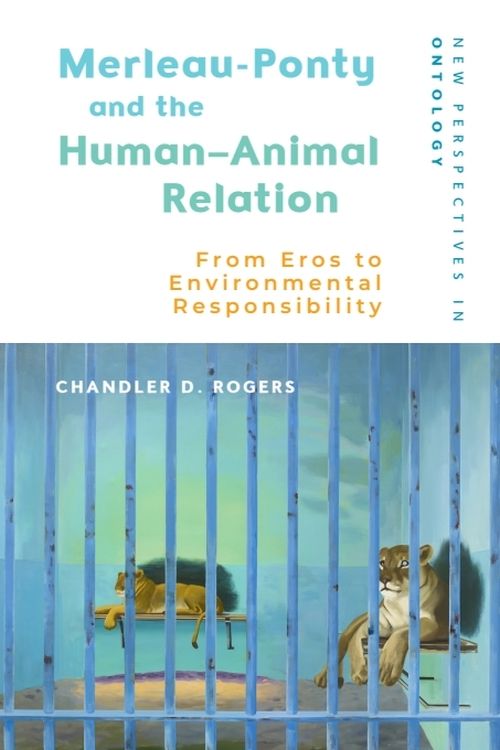
Draws on Merleau-Ponty’s account of the origins of animal desire and extends it, pushing the human-animal relationship toward more explicitly ethical conclusions than Merleau-Ponty himself proposed
Addresses contemporary environmental problems in light of perennial ontological questions about the human place in the cosmos
Offers a hermeneutical reading of Merleau-Ponty’s early works against the backdrop of the overall trajectory of Merleau-Ponty’s thought
Combines relevant insights from phenomenology, environmental philosophy and psychoanalysis in an accessible manner
Highlights two possible routes for ethico-psychological integration of the aggressive drives and instincts: the Nietzschean and the Schellingian
Contemporary environmental crises and general feelings of estrangement from the earth and its creatures can be traced, at least in part, to deficiencies in intimacy. This book begins from Merleau-Ponty’s descriptions of the origins of animal desire, then advocates for transformation of the human-animal relation in a manner that pushes further toward ethical conclusions than did Merleau-Ponty himself. Shifting from analysis first in an aesthetic, then in an ethical, and finally in an ethico-religious register, with contemporary environmental concerns in mind, it charts a path for healing the human-animal relation both within, with respect to one’s own animality, and without, with respect to animals of other species, based on the maturation of desire from eros to environmental responsibility.
Duncan Bell and Douglas Mao, Utopia – Oxford University Press, March 2026
Ideal societies, better worlds, more just and peaceful ways of living: these have long been the stuff of social dreaming. In this compact volume, two leading scholars from different disciplines join to consider the life of utopian imagining within the frame of literature and politics. Duncan Bell, a political scientist and intellectual historian, opens the book with a critical overview of the Anglophone utopian tradition and a fresh definition of utopia. He then shows how the threat of technological annihilation, and the promise of transcendence of human limitations, has shaped utopian and dystopian writing of the last hundred years. Douglas Mao, a scholar of literature, begins the second part of the book by delving into utopian literature’s vexed relation to sentimental feeling, especially as this is signalled by speculation on how inhabitants of utopia themselves would read literary works. He then shows how utopian writing’s orientation to problem-solving puts it into surprising relation with both politics and literature in general. An interview in which the two authors compare their methods and conclusions closes out the book.
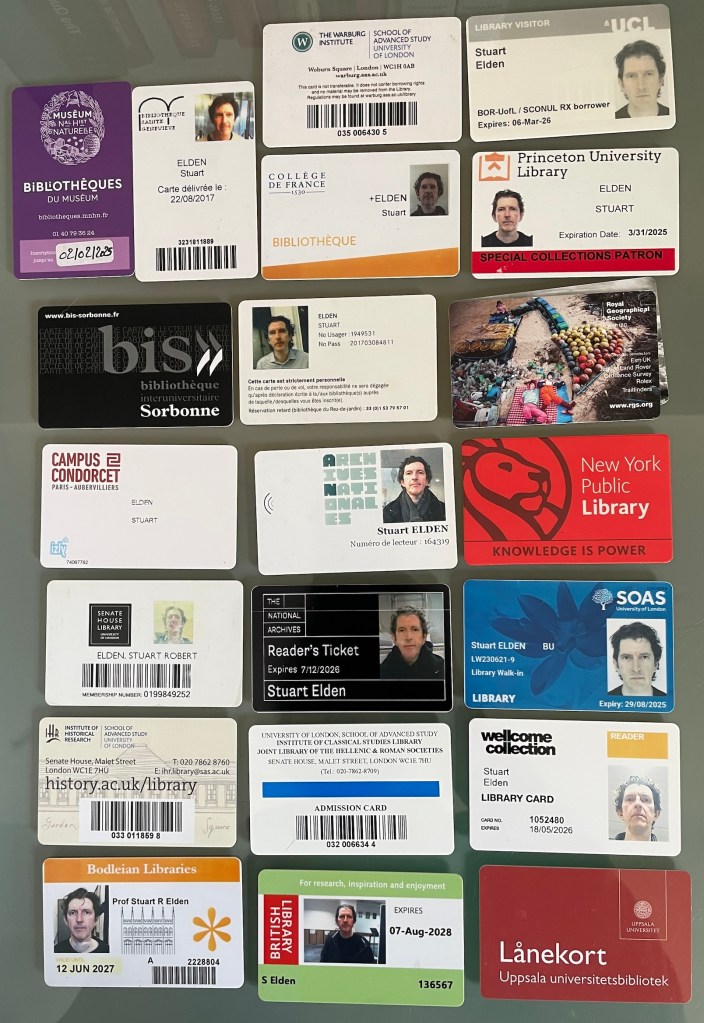
Most of the library cards I’ve used over the years I’ve been working on this project
The draft of the Mapping Indo-European Thoughtmanuscript is slowly coming together. I’ve just begun a Fernand Braudel fellowship at the European University Institute in Florence. My plan was to come here with a complete draft, and to leave with a better one. I nearly managed the first – there were still a few bits which needed to be added, but it was just about there. The purpose of a draft is to exist, since something which exists can be improved. It still needs a lot of work, and I’m hoping the weeks I will be in Florence will allow me to develop it.
I had a few days in Paris in late 2025, where I spent the time moving between the Collège de France and the Bibliothèque nationale. At the Bibliothèque nationale I was going back over some boxes of the Benveniste archive, things which I’d looked at before but mainly with a focus on the Vocabulaire. This time I was interested in the remnants of his teaching, which are patchy but can be interesting. I’m relating them to the short reports published in the Annuaire of the Collège de France, and to some student notes which exist in different places. Some also relate to publications – he sometimes wrote up material from teaching, but also sometimes used publications, recently published or in press, as the basis for lectures. I also looked at a couple of boxes of the Foucault archive relating to his interest in hermaphrodites (on which, see here and here), and one box of the Lévi-Strauss papers concerning his opposition to language reform, which I write about here. I also read some more of the Foucault-Dumézil correspondence, which is in different places. That box also has his correspondence with, among others, Derrida, which led to a couple of pieces about the Foucault-Derrida exchange – here and here.
At the Collège de France, I looked at two boxes of the Georges Dumézil papers relating to very late book projects, one of which was published posthumously as Le Roman des jumeaux et autre essais, since it was almost complete; and another, the planned fourth volume of Mythe et Épopée, whichwas abandoned. I also returned to a couple of boxes of the much smaller Benveniste collection, and asked to see, again, another box they had relating to him. As is often the way, it was the last thing I looked at, on the last day, which was the biggest surprise – a set of notes from a student for a very early Benveniste course. I’d like to get back again and take a more thorough look at this.
The vast majority of the archival work is, however, complete. My Leverhulme fellowship is now over, even with the no-cost extension, and so I am currently without external funding. Any further archival work will therefore be limited – I think I need at least one more week in Paris, and there are a couple of other places I’d like to visit if I can. But there is always more which could be done.
I have also been working in London libraries. I’ve mentioned before the challenges of working at the British Library since the cyber-attack in October 2023, and only in December 2025, more than two years later, were they able to have a full online catalogue and ordering system working. In recent months, an interim catalogue had linked to an online form to request things, but it was clunky and there wasn’t an online way to check if things you’d ordered were actually available. You would get an email to say effectively that they had begun looking for it. Before the new catalogue went online there was a pause of a week when it wasn’t possible to order anything to reading rooms – understandable, and worth it to make the new system work, but it coincided with some days I was planning to be in London. It then was delayed for a week. For me that’s not a huge problem, but I was thinking of what it would have been like for me if a similar pause was in place at the Bibliothèque nationale when I was in Paris, and wondering what this meant for others for whom London is a more involved trip. In November the beleaguered and underpaid staff of the BL were on strike for two weeks, a revised offer was rejected, and the chief executive resigned after less than a year in post. Another strike took place in December, part of the reason for the new catalogue being delayed. A great institution, so valuable for research, education and public access seems to go from one crisis to another. Hetan Shah has written a useful piece about this, though strangely doesn’t mention the staff dispute.
When the library was effectively out of action I used other London libraries, particularly the Warburg Institute which is somewhere I’ve always liked working. But then that was closed for nearly a week after a burst pipe, flooding and damage both to the building and some of the collection. When it reopened, the lower ground floor was inaccessible, and that’s where the periodicals are stored, which is the main thing I needed to consult.
More positively, I returned to various sets of notes and draft text for parts of the book manuscript. They are intended to be interludes between the longer alternating chapters on Benveniste and Dumézil. One is on Mircea Eliade’s decade in Paris after the Second World War, another is one Dumézil’s lifelong parallel career working on Caucasian linguistics and mythology, and a third on Lévi-Strauss’s links to Benveniste and Dumézil. I managed to get these into decent shape with some intense days of work in December and January. Some of this was making decisions about content and structure, and then going with that, moving stuff around and cutting. Nothing is ever completely thrown away, but some things just didn’t fit. I will probably have to be more ruthless with these at a later stage, but they are now parked for this version.
With that attitude, I was then able to edit some long note files into discussions of the importance of Dumézil and/or Benveniste to some more famous names of ‘French theory’ – including Barthes, Kristeva, Derrida, Deleuze and Guattari, Foucault and Lacan. I then moved to a long section on the importance of this work for French classicists – mainly focusing on Vernant, Detienne and Ramnoux, with some reference to others.
At the EUI, I’m now working through each chapter of the draft in sequence, trying to fix things which were unresolved and make lists of what I’ll need to do when back in the UK. Although being in Florence is very nice, and the library here is good, there are inevitably a lot of things which they don’t have.
Some of the long file I’ve drafted a while ago on Roland Barthes didn’t fit this book manuscript, although there is a discussion of his debt to Benveniste in the current draft. So some of the parts I didn’t use became draft material for two linked posts on Roland Barthes and the Question of Territory – Animals, Spaces and Sound and Roland Barthes’s Seminar on the Metaphor of the Labyrinth, which also discusses the presentations in that seminar by Detienne, Deleuze and Rosenstiehl. I have a developed discussion of a 1970 conference on structuralism in draft (which I mention briefly here), and a few other ideas for future posts. Some of the other material I’d drafted or taken notes on for this book might end up being shared in this series, as I make decisions on what I can’t include. I’m not sure how much longer I’ll keep up a weekly rhythm to these posts, but so far I don’t seem to be running out of ideas.
Details the evolution of Hobbes’s political theory in connection with his philosophical materialism
Analyses how Hobbes’s political theory developed in relation to his philosophical system
Sheds new light on the political significance of Hobbes’s concepts of liberty, determinism, right reason, void, conatus, power, imagination and representation
Conceptualises the tension between Hobbes’s materialism and Descartes’s idealism to critique the ideology implicit in mechanical philosophy
Brings together political philosophy, the history of political thought and the history of science to interrogate the political stakes of early-modern science
In this major contribution to our understanding of Hobbes’s political thought, Andrea Bardin contends that it should be analysed in relation to the ‘materialist agenda’ Hobbes was pursuing when confronting Descartes’s project. Bardin pinpoints the changes in Hobbes’s political thought to the intellectual context in which he elaborated his materialist ontology and epistemology. He investigates the classical sources that initially shaped Hobbes’s political thinking, including Thucydides and Aristotle, as well as the broad materialist agenda that Hobbes drew from Bacon and elaborated in opposition to Descartes. He studies Hobbes’s exchanges with his contemporary interlocutors in the Mersenne circle, including Descartes and Gassendi, with whom he discussed first philosophy and natural philosophy. In this way, Bardin vindicates materialist critiques of the idealist foundations of early modern mechanical philosophy.