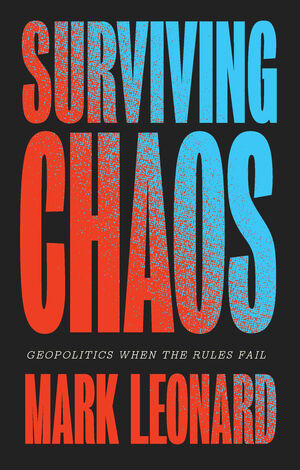
We live in an explosive world. Trump is blowing up political order. Xi Jinping is scrambling the economy. And Putin is redrawing the map of Europe. At a time when every crisis bleeds into the next — from pandemics and wars to climate shocks and AI revolutions — the old rules of global order are collapsing.
Mark Leonard reveals how geopolitics is being rewritten in an age of “Un-Order,” where no one agrees on the rules, and even the concept of order itself is up for debate. Drawing on years of conversations with leaders and thinkers from Beijing to Washington, Leonard argues that we are witnessing a new divide in international politics between the grand “architects” who try to build a stable global system and the nimble “artisans” who adapt, improvise, and survive amidst disruption. China, he shows, has embraced the “artisan’s” mindset while Europe and the West cling to the fading certainties of the “architects”.
Part analysis, part manifesto, Surviving Chaos offers a bold new framework for understanding power in the twenty-first century — and a call for leaders to stop defending yesterday’s world and start learning how to thrive in tomorrow’s.
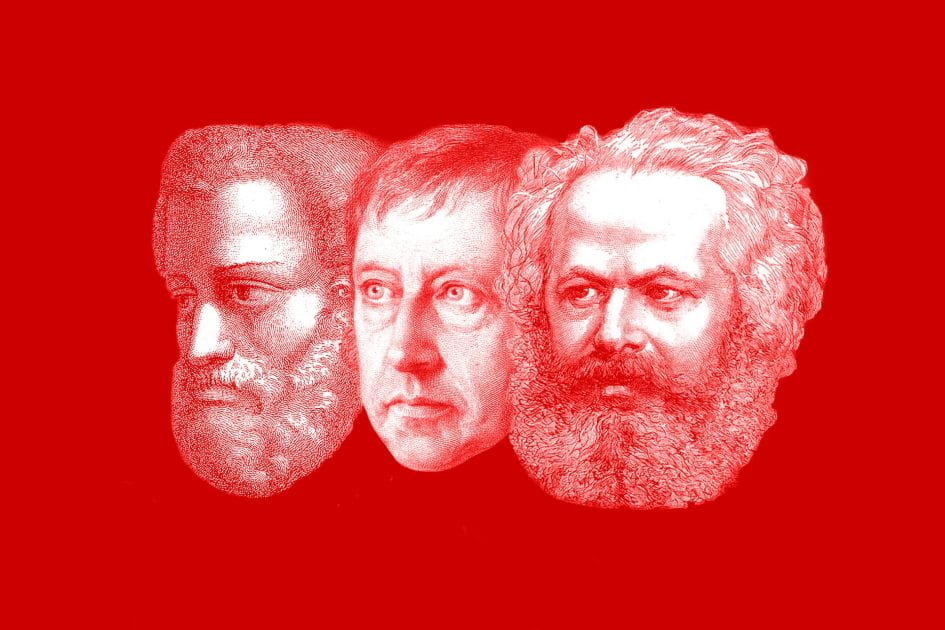
Michael Lazarus is a Lecturer in Political Theory in the Department of Political Economy at King’s College London. He previously served as a Postdoctoral Fellow at Yale University and as a Postdoctoral Research Fellow at the Alfred Deakin Institute. He completed his PhD in Politics at Monash University. Jackson Herndon interviewed him about his new book, Absolute Ethical Life: Aristotle, Hegel, and Marx (Stanford University Press, 2025), in which he argues that Marx premised his critique of political economy upon a resolutely ethical critique of capitalist social relations shaped deeply by Marx’s Aristotelian and Hegelian inheritances. Lazarus weaves an account of this influence together with a critical exegesis of Hannah Arendt’s and Alasdair MacIntyre’s earlier efforts to grapple with the ethical dimension of Marx’s thought. In the process, Lazarus traces this problematic’s significance to the present, foregrounding its salience to tendencies in Marxist thought as well as the conditions of radical politics. The JHI Blog presents an edited transcript of his discussion with Jackson Herndon.
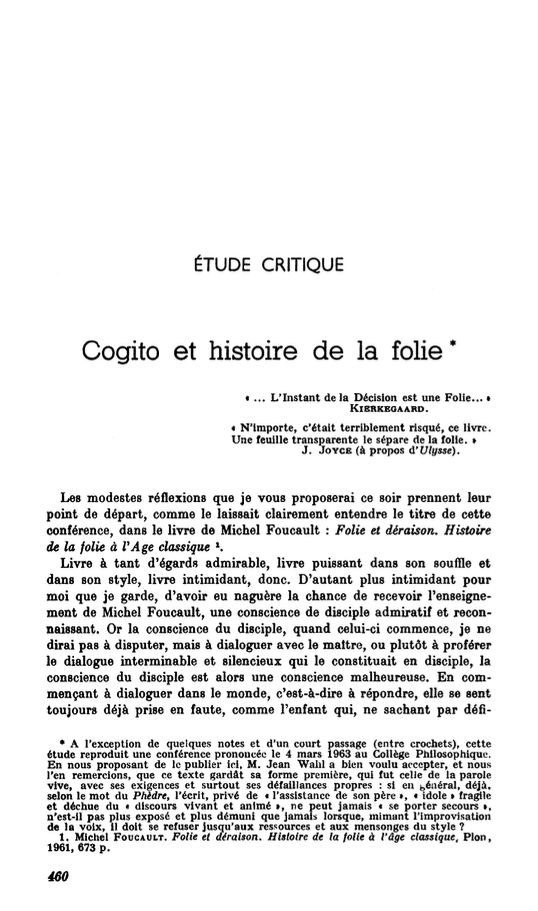
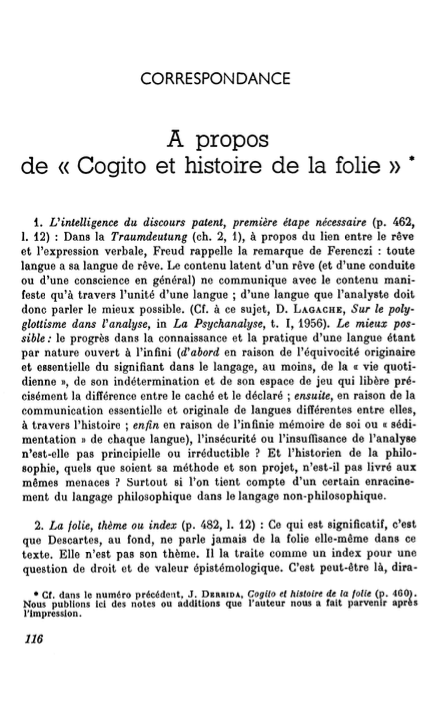
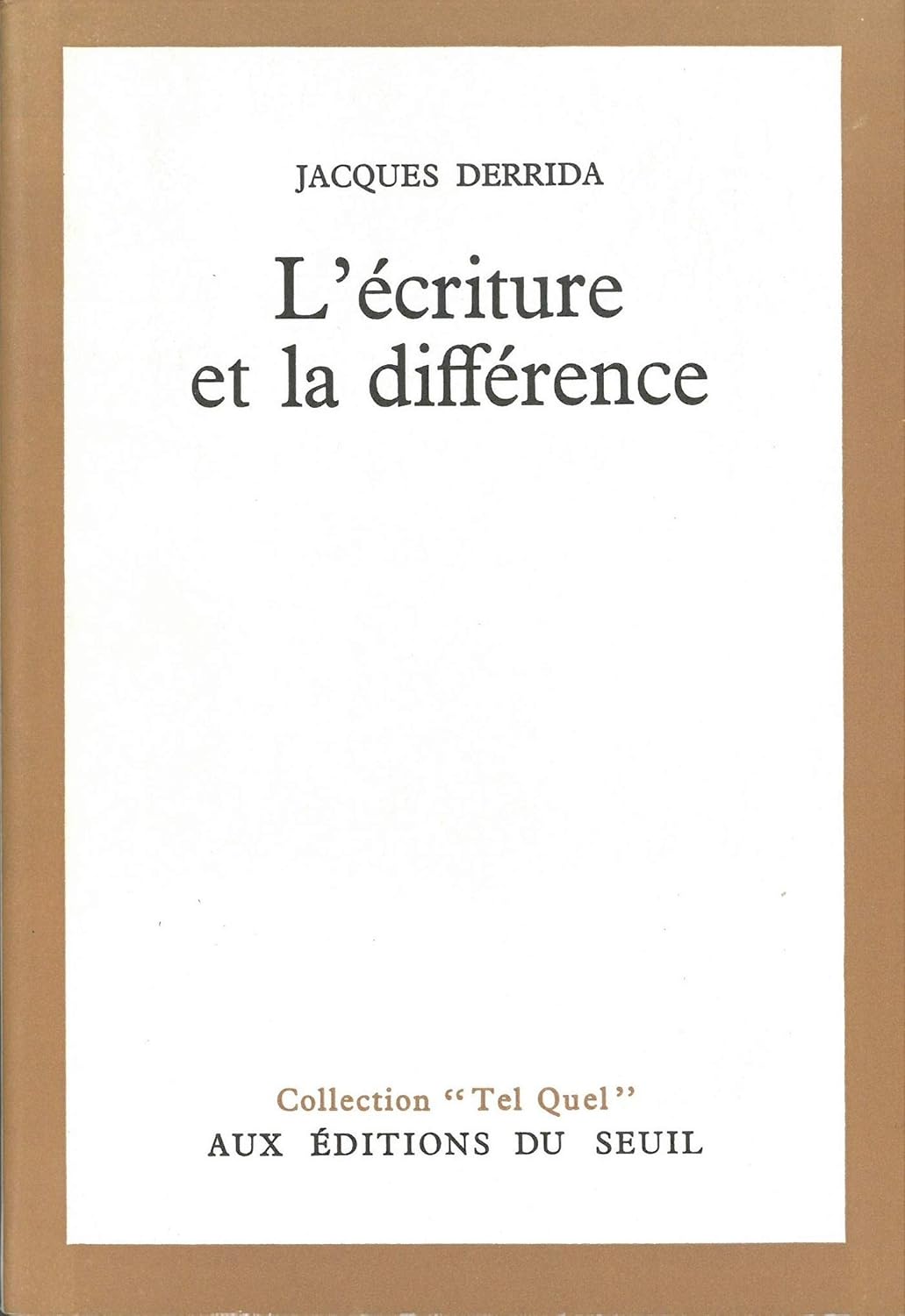
Derrida, “Cogito et histoire de la folie” Derrida, “A propos de «Cogito et histoire de la folie»”Derrida, L’écriture et la différenceThe cover pages of the 1963 article, the 1964 addendum, and the book
There are lots of small changes made by Jacques Derrida to his critique of Foucault between the 1963 article “Cogito et histoire de la folie” and its republication in the 1967 book L’écriture et la différence, translated by Alan Bass as Writing and Difference. As I indicated on Sunday, these changes included the incorporation of six notes first published in a short addendum to the article in 1964.
Note 1 (1964 article, p. 116) = L’écriture et la différence, pp. 53-54 n. 1; Writing and Difference, p. 390 n. 3.
Note 2 (1964 article, pp. 116-17) = L’écriture et la différence, p. 79 n. 1; Writing and Difference, p. 392 n. 15.
Note 3 (1964 article, p. 117) = L’écriture et la différence, p. 81 n. 1; Writing and Difference, p. 392 n. 16.
Note 4 (1964 article, p. 117) = L’écriture et la différence, p. 83 n. 1; Writing and Difference, pp. 392-93 n. 21.
Note 5 (1964 article, pp. 117-18) = L’écriture et la différence, p. 89-90 n. 1; Writing and Difference, pp. 393-94 n. 27.
Note 6 (1964 article, pp. 118-19) = L’écriture et la différence, pp. 90-91 n. 1; Writing and Difference, pp. 294-95 n. 28. Derrida adds “Mais Dieu, c’est l’autre nom de l’absolu de la raison elle-même, de la raison et du sens en général” to the start of the note in 1967.
I discuss the way those notes are integrated into the text here. There is no indication in 1967 that the notes are not in the original 1963 publication – the first footnote about how some notes were not in the lecture is also in the 1963 article.
Beyond the addition of these notes, there are quite a few stylistic changes between the two versions – capitalisation, introductory words to paragraphs or quotations, a few changes of person – je to nous, vous to on – and so on. There are a few substitutions of words. Many of those I couId imagine an author changing at proof stage for one or other text. I don’t intend to list all of those.
The more significant changes are these:
“Cogito et histoire de la folie”, p. 466: “… on ne peut protester contre elle qu’en elle. Ce qui revient à faire comparaître une détermination historique de la raison devant le tribunal de la Raison en général. La révolution contre la raison…”
L’écriture et la différence, p. 59: “… on ne peut protester contre elle qu’en elle, elle ne nous laisse, sur son propre champ, que le recours au stratagème et à la stratégie. Ce qui revient à faire comparaître une détermination historique de la raison devant le tribunal de la Raison en général. La révolution contre la raison…”
Writing and Difference, p. 42: “… that one can protest it only from within it; and within its domain, Reason leaves us only the recourse to strategems and strategies. The revolution against reason…”
Alan Bass translates Derrida’s addition, but omits the phrase “This amounts to bringing a historical determination of reason before the court of Reason in general”. I’d see the additional phrase in 1967 as linked to the next passage, which is probably the most important change beyond the notes.
“Cogito et histoire de la folie”, p. 466: “Un peu comme la révolution anti-colonialiste ne peut se libérer de l’Europe ou de l’Occident empiriques de fait, qu’au nom de l’Europe transcendantale, c’est-à-dire de la Raison, et en se laissant d’abord gagner par ses valeurs, son langage, ses sciences, ses techniques, ses armes ; contamination ou incohérence irréductible qu’aucun cri – je pense à celui de Fanon – ne peut exorciser, si pur et si intransigeant soit-il”.
L’écriture et la différence, p. 59: “On ne peut sans doute pas écrire une histoire, voire une archéologie contre la raison, car, malgré des apparences, le concept d’histoire a toujours été un concept rationnel. C’est la signification « histoire » ou « archie » qu’il eût peut-être fallu questionner d’abord. Une écriture excédant, à les questionner, les valeurs d’origine, de raison, d’histoire, ne saurait se laisser contenir dans la clôture métaphysique d’une archéologie”.
Writing and Difference, pp. 42-43: “A history, that is, an archaeology against reason doubtless cannot be written, for, despite all appearances to the contrary, the concept of history has always been a rational one. It is the meaning of ‘history’ or archia that should have been questioned first, perhaps. A writing that exceeds, by questioning them, the values ‘origin,’ ‘reason,’ and ‘history’ could not be contained within the metaphysical closure of an archaeology.
This passage is discussed by Edward Baring in “Liberalism and the Algerian War: The Case of Jacques Derrida”. Baring translates the 1963 text: Much like “the anticolonial revolution can only liberate itself from factual Europe or the empirical West, in the name of transcendental Europe, that is Reason, and first win with [Western] values, language, sciences, techniques, and weapons; an irreducible contamination or incoherence, that no cry—I am thinking of Fanon’s—can exorcise, however pure and intransigent it may be.” (p. 257; Baring’s addition in brackets). In 1967 Derrida drops the discussion of anti-colonial struggles and replaces it with a stronger criticism of writing a history or archaeology against reason.
“Cogito et histoire de la folie”, p. 469: “(Entzweiung hegelienne).”
L’écriture et la différence, p. 62: “Le dehors (est) le dedans, s’y entame et le divise selon la déhiscence de l’Entzweiung hegelienne”.
Writing and Difference, p. 46: “The exterior (is) the interior, is the fission that produces and divides it along the lines of the Hegelian Entzweiung”.
A useful expansion of what is rather cryptic in 1963 – Entzweiung is usually translated as diremption, as the word is stronger than division and means something closer to forcible separation or splitting or breaking in two.
“Cogito et histoire de la folie”, p. 471: “Pour l’enfermer.
A vrai dire…”
L’écriture et la différence, p. 65: “Pour l’enfermer.
A vouloir écrire l’histoire de la décision, du partage, de la différence, on court le risque de constituer la division en événement ou en structure survenant à l’unité d’une présence originaire; et de confirmer ainsi la métaphysique dans son opération fondamentale”.
A vrai dire…”
Writing and Difference, p. 48: “In order to lock it up.
The attempt to write the history of the decision, division [SE: distribution], difference runs the risk of construing the division as an event or a structure subsequent to the unity of an original presence, thereby confirming metaphysics in its fundamental operation”
Truthfully…”
Alan Bass translates both partage and division as ‘division’ – the first should probably be something different, and I’ve suggested distribution. Derrida’s expansion more clearly links the discussion of Foucault to his wider project of the examination of the metaphysics of presence.
“Cogito et histoire de la folie”, p. 483: “Elle est, pour reprendre une expression que Foucault propose ailleurs, renfermée à l’intérieur de l’extérieur.”
L’écriture et la différence, p. 80: “Elle est, pour reprendre une expression que Foucault propose ailleurs, renfermée à l’intérieur de l’extérieur et à l’extérieur de l’intérieur”.
Writing and Difference, p. 62: “Madness, to use an expression proposed elsewhere by Foucault, is confined to the interior of the exterior and to the exterior of the interior”.
Derrida simply completes the idea that these terms are interrelated.
“Cogito et histoire de la folie”, p. 486: “Tant que le doute ne sera pas levé évidemment”.
L’écriture et la différence, p. 85: “Du moins tant que le doute ne sera pas levé. Car la fin du doute pose un problème que nous retrouverons dans un instant”.
Writing and Difference, p. 67: “at least for as long as doubt remains unresolved. For the end of doubt poses a problem to which we shall return in a moment”.
A minor addition in the revised text.
“Cogito et histoire de la folie”, p. 487: “Il n’y a ni exclusion ni contournement”.
L’écriture et la différence, p. 86: “Elle vaut même si je suis fou. Suprême assurance qui semble ne requérir ni exclusion ni contournement”.
Writing and Difference, p. 67: “It is valid even if I am mad—a supreme self-confidence that seems to require neither the exclusion nor the circumventing of madness”.
The original reads “There is neither exclusion nor circumvention”. The revision stresses the validity of the cogito even for the mad, to justify the point.
“Cogito et histoire de la folie”, p. 487: “Il est tard. Il me faut conclure. Je le ferai dans un style qui, faute de temps, sera, je vous en demande pardon, plus dogmatique”.
In L’écriture et la différence, p. 86/Writing and Difference, p. 68, this comment about it being late and the move to a conclusion in more abbreviated and dogmatic style is deleted. (Derrida goes on for several more pages, so would have kept his audience for quite a while still.) Another comment about the lack of time on “Cogito et histoire de la folie”, p. 490 is also deleted from L’écriture et la différence, p. 91/Writing and Difference, p. 71.
“Cogito et histoire de la folie”, p. 489: “…se rassurer dans l’ordre des raisons pour reprendre possession des vérités abandonnées. C’est ici que l’errance hyperbolique et folle…”
L’écriture et la différence, p. 90: “…se rassurer dans l’ordre des raisons pour reprendre possession des vérités abandonnées. Dans le texte de Descartes du moins, le renfermement se produit à ce point. C’est ici que l’errance hyperbolique et folle…”
Writing and Difference, p. 70: “… are given reassurance within the order of reasons, in order once more to take possession of the truths they had left behind. Within Descartes’s text, at least, the internment takes place at this point. It is here that hyperbolical and mad wanderings…”
A one sentence addition in 1967.
“Cogito et histoire de la folie”, p. 491: “Ne peut-on prendre pour exemple, pour exemple seulement, d’une telle répétition du Cogito cartésien, dans le moment où il échappe encore à l’ordre des raisons, à l’ordre en général et aux déterminations de la lumière naturelle, ne pourrait-on prendre pour exemple d’une telle répétition le Cogito husserlien et la critique de Descartes qu’elle suppose ? Ce serait un exemple seulement car on découvrira bien un jour quel est le sol dogmatique et historiquement déterminé – le nôtre – sur lequel la critique du déductivisme cartésien, l’essor et la folie de la réduction husserlienne de la totalité du monde ont dû se reposer puis déchoir pour se dire. On pourrait refaire pour Husserl ce que Foucault a fait pour Descartes : montrer comment la neutralisation du monde factuel est une neutralisation (au sens où neutraliser, c’est aussi maîtriser, réduire, laisser libre dans une camisole), une neutralisation du non-sens, la forme la plus subtile d’un coup de force. Et en vérité, Husserl associait de plus en plus le thème de la normalité et celui de la réduction transcendantale”.
L’écriture et la différence, pp. 92-93: “Quant au fonctionnement de l’hyperbole dans la structure du discours de Descartes et dans l’ordre des raisons, notre lecture est donc, malgré l’apparence, profondément accordée à celle de Foucault. C’est bien Descartes — et tout ce qui s’indique sous ce nom —, c’est bien le système de la certitude qui a d’abord pour fonction de contrôler, maîtriser, limiter l’hyperbole en la déterminant dans l’éther d’une lumière naturelle dont les axiomes sont d’entrée de jeu soustraits au doute hyperbolique, et en faisant de son instance un point de passage solidement maintenu dans la chaîne des raisons. Mais nous pensons que ce mouvement ne peut être décrit en son lieu et en son moment propres que si l’on a préalablement dégagé́ la pointe de l’hyperbole, ce que Foucault, semble-t-il, n’a pas fait. Dans le moment si fugitif et par essence insaisissable où il échappe encore à l’ordre linéaire des raisons, à l’ordre de la raison en général et aux déterminations de la lumière naturelle, est-ce que le Cogito cartésien ne se laisse pas répéter, jusqu’à un certain point, par le Cogito husserlien et par la critique de Descartes qui s’y trouve impliquée ?
Ce serait un exemple seulement car on découvrira bien un jour quel est le sol dogmatique et historiquement déterminé — le nôtre — sur lequel la critique du déductivisme cartésien, l’essor et la folie de la réduction husserlienne de la totalité́ du monde ont dû se reposer puis déchoir pour se dire. On pourra refaire pour Husserl ce que Foucault a fait pour Descartes : montrer comment la neutralisation du monde factuel est une neutralisation (au sens où neutraliser, c’est aussi maîtriser, réduire, laisser libre dans une camisole), une neutralisation du non-sens, la forme la plus subtile d’un coup de force. Et en vérité́, Husserl associait de plus en plus le thème de la normalité et celui de la réduction transcendantale.L’enracinement de la phénoménologie transcendantale dans la métaphysique de la présence, toute la thématique husserlienne du présent vivant est l’assurance profonde du sens en sa certitude”.
Writing and Difference, pp. 72-73: “As for the functioning of the hyperbole in the structure of Descartes’s discourse and in the order of reasons, our reading is therefore, despite all appearances to the contrary, profoundly aligned with Foucault’s. It is indeed Descartes—and everything for which this name serves as an index—it is indeed the system of certainty that first of all functions in order to inspect, master, and limit hyperbole, and does so both by determining it in the ether of a natural light whose axioms are from the outset exempt from hyperbolical doubt, and by making of hyperbolical doubt a point of transition firmly maintained within the chain of reasons. But it is our belief that this movement can be described within its own time and place only if one has previously disengaged the extremity of hyperbole, which Foucault seemingly has not done. In the fugitive and, by its essence, ungraspable moment when it still escapes the linear order of reasons, the order of reason in general and the determinations of natural light, does not the Cartesian Cogito lend itself to repetition, up to a certain point, by the Husserlian Cogito and by the critique of Descartes implied in it?
This would be an example only, for some day the dogmatic and historically determined grounds—ours—will be discovered, which the critique of Cartesian deductivism, the impetus and madness of the Husserlian reduction of the totality of the world, first had to rest on, and then had to fall onto in order to be stated. One could do for Husserl what Foucault has done for Descartes: demonstrate how the neutralization of the factual world is a neutralization (in the sense in which to neutralize is also to master, to reduce, to leave free in a straitjacket) of nonmeaning, the most subtle form of an act of force. And in truth, Husserl increasingly associated the theme of normality with the theme of the transcendental reduction. The embedding of transcendental phenomenology in the metaphysics of presence, the entire Husserlian thematic of the living present is the profound reassurance of the certainty of meaning.
In 1967 Derrida expands the point about the relation between the Cartesian and Husserlian cogito. There is a sentence replaced with a paragraph, a shared passage (“Ce serait un exemple… réduction transcendantale”, and then another sentence, again linking this to his wider critique of the metaphysics of presence.
“Cogito et histoire de la folie”, p. 493: “… dans la folie et dans la mort. Ce vouloir-dire-l’hyperbole-démonique n’est pas un vouloir parmi d’autres”.
L’écriture et la différence, p. 95: “dans la folie et dans la mort. Au plus haut d’elle-même, l’hyperbole, l’ouverture absolue, la dépense anéconomique est toujours reprise et surprise dans une économie. Le rapport entre la raison, la folie et la mort, est une économie, une structure de différance dont il faut respecter l’irréductible originalité. Ce vouloir-dire-l’hyperbole-démonique n’est pas un vouloir parmi d’autres…”
Writing and Difference, p. 75: “in madness or in death. At its height hyperbole, the absolute opening, the uneconomic expenditure, is always reembraced by an economy and is overcome by economy. The relationship between reason, madness, and death is an economy, a structure of deferral whose irreducible originality must be respected. This attempt-to-say-the-demonic-hyperbole is not an attempt among others…”
I’d also see this addition as linking the specific critique of Foucault to some wider themes of Derrida’s work.
“Cogito et histoire de la folie”, p. 493: “… et aussi une passion première”.
L’écriture et la différence, p. 96: “… est aussi une passion première. Il garde en lui la trace d’une violence. Il s’écrit plutôt qu’il ne se dit, il s’économise. L’économie de cette écriture est un rapport réglé entre l’excédant et la totalité excédée : la diffêrance de l’excès absolu”.
Writing and Difference, p. 75: “…is also a first passion. It keeps within itself the trace of a violence. It is more written than said, it is economized. The economy of this writing is a regulated relationship between that which exceeds and the exceeded totality: the différance of the absolute excess”.
This addition is also important because it introduces some of the key themes of Derrida’s wider project, particularly here the spelling of différance with an ‘a’. This change is significant for the dating of Derrida’s use of this key term: despite some claims, it is not in the 1963 version, and this essay is therefore not its first use. Daniele de Santis has indicated that Derrida’s essay on Antonin Artaud, “La Parole soufflée”, published in Tel Quel in 1965,is the first instance in print, but that it was apparently said in 1959 in a piece on “‘Genèse et structure’ et la phénoménologie”, also first published in 1965. Those essays are included, again with revisions, in L’écriture et la différence in 1967. That book was published around the same time as the use of différance in Speech and Phenomena, and before the 1968 lecture “La Différance” (which is in English both as an appendix to Speech and Phenomena and in Margins of Philosophy).
As I indicated in the previous piece: “It’s often remarked that Foucault took a long time to reply to Derrida’s 1963 critique. It’s less often mentioned that the text he was responding to was not fixed until 1967…”
As with all these textual comparisons, I’m happy to receive corrections for anything I’ve missed. There are lots more comparisons of texts by Foucault listed here.
References
Edward Baring, “Liberalism and the Algerian War: The Case of Jacques Derrida”, Critical Inquiry 36 (2), 2010, 239-61.
Jacques Derrida, ‘Cogito et histoire de la folie’, Revue de métaphysique et de morale 68 (4), 1963, 460-94.
Jacques Derrida, “A propos de «Cogito et histoire de la folie»”, Revue de métaphysique et morale 69 (1), 1964, 116-19.
Jacques Derrida, L’Écriture et la différence, Paris: Seuil, 1967; Writing and Difference, trans. Alan Bass, London: Routledge, 1978.
Jacques Derrida, La Voix et le phenomenon, Paris: Presses Universitaires de France, 1967; Speech and Phenomena, and Other Essays on Husserl’s Theory of Signs, trans. David B. Allison and Newton Garver, Evanston: Northwestern University Press, 1973.
Jacques Derrida, Marges – De la philosophie, Paris: Minuit, 1967; Margins of Philosophy, trans. Alan Bass, Brighton: Harvester, 1982.
Daniele de Santis, “The Double Meaning of différance: Remarks on its First Appearance”, Alter: Revue de phénoménologie 18, 2010, 297-304.
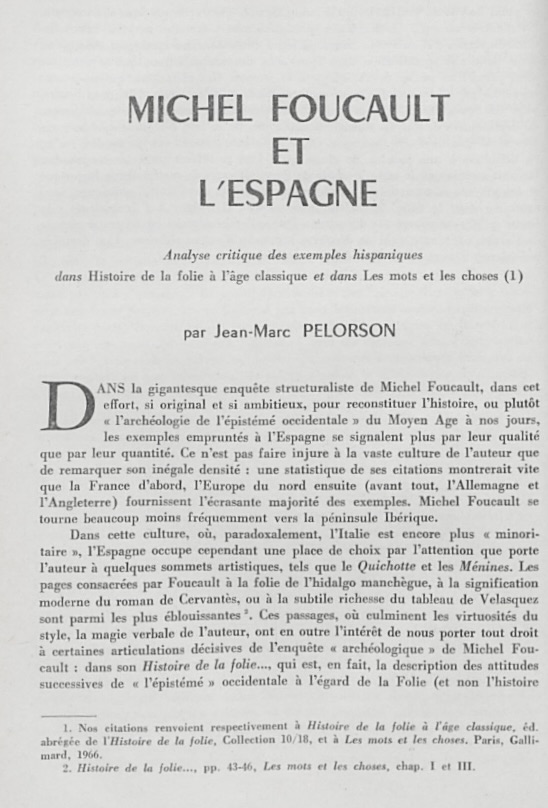
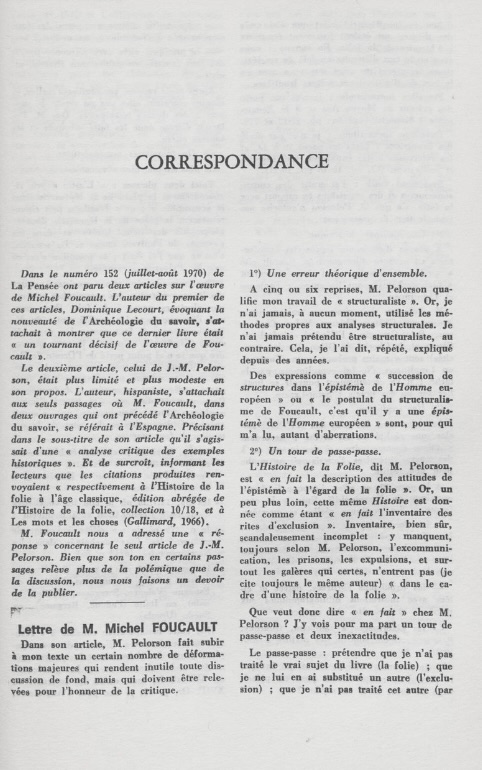
Derrida, “A propos de «Cogito et histoire de la folie»”Pelorson, “Michel Foucault et l’Espagne”“Lettre de M. Michel Foucault”
Two small things I’ve found or noticed recently which shed a little light on Foucault’s engagement with his critics.
1. Jacques Derrida
I have discussed the Derrida-Foucault debate about Foucault’s History of Madness before, most fully in The Archaeology of Foucault (pp. 16-21). I’m not going to repeat that or provide all the references again here. Essentially, Derrida gave a lecture on the book in 1963, “Cogito et histoire de la folie”, which Foucault attended, and Derrida published his critique in the Revue de métaphysique et morale later that same year. Derrida reprinted the text in his book L’Écriture et la différence in 1967, which is translated as Writing and Difference. Foucault eventually responded, first in a text for a Japanese audience, in part because they were going to include Derrida’s text in a journal section on Foucault’s work, and then in a long appendix to the Gallimard edition of Histoire de la folie in 1972. The Tel reedition of that text in 1976 drops the two appendices, but they are included in Dits et écrits (as is a translation of the Japanese response and the book’s original 1961 preface, which was removed from the 1972 version). All these texts by Foucault are translated in the 2006 History of Madness. (I list the various editions of Foucault’s book and outline the differences between them here.)
There are also some differences between the journal version of Derrida’s critique and the book version, one of which is discussed by Edward Baring in an important article “Liberalism and the Algerian War: The Case of Jacques Derrida”, published in Critical Inquiry in 2010. I made use of that article in The Archaeology of Foucault, since it was useful in alerting me that there were differences between the article and the book versions. There are some additional notes in the 1967 version, and some other changes. The most important is the one which Baring focuses on, a change of a passage in the article (p. 466) to the book (p. 59 of the French; pp. 42-43 of the English translation).
In The Archaeology of Foucault I also made use of a few letters between Foucault and Derrida, some of which were quoted by Benoît Peeters in his biography of Derrida, and some of which were included in the Derrida Cahier de l’Herne. Some of Derrida’s letters to Foucault are now accessible in the Foucault archive at the Bibliothèque nationale de France. I was looking at these mainly because of Foucault’s correspondence with Georges Dumézil. But the alphabetical proximity of Deleuze to Derrida and Dumézil gave me a chance to have a look at these too. They confirmed the sense I expressed in The Archaeology of Foucault that any break between Foucault and Derrida was not caused by the 1963 lecture, but came somewhat later. In one instance there was the copy of a letter in Cahier de l’Herne which differed slightly – the publication clearly used the version in Derrida’s archive, as he kept a copy. But seeing these letters also indicated something else, which I had previously missed – and in my defence, so had most previous commentators on this debate.
This was the text, “A propos de «Cogito et histoire de la folie»”, which Derrida published in Revue de métaphysique et morale in 1964, in the first issue after the one which included his original critique. It’s a short text of four pages, and Derrida shared the typescript with Foucault before its publication. An editorial note says: “We publish here the notes or additions which the author made available to us after the printing [Nous publions ici des notes ou additions que l’auteur nous a fait parvenir après l’impression]”.
This is the source of most of the additional notes in the book version. Until now, I’d thought these notes only appeared in the book in 1967. This 1964 piece is rarely cited, presumably because the 1967 book or its translation suffices. One piece which does cite it has some useful discussion of how Derrida revised the piece between 1963 and 1967 – Seferin James, “Derrida, Foucault and ‘Madness, the Absence of an Œuvre’”.
Derrida incorporated these additions into the 1967 book version of this text, though with the exception of note 2 did not include the titles of the notes which appeared in 1964:
Note 1 (1964 article, p. 116) = L’écriture et la différence, pp. 53-54 n. 1; Writing and Difference, p. 390 n. 3.
Note 2 (1964 article, pp. 116-17) = L’écriture et la différence, p. 79 n. 1; Writing and Difference, p. 392 n. 15.
Note 3 (1964 article, p. 117) = L’écriture et la différence, p. 81 n. 1; Writing and Difference, p. 392 n. 16.
Note 4 (1964 article, p. 117) = L’écriture et la différence, p. 83 n. 1; Writing and Difference, pp. 392-93 n. 21. (missing the title of the note)
Note 5 (1964 article, pp. 117-18) = L’écriture et la différence, p. 89-90 n. 1; Writing and Difference, pp. 393-94 n. 27. (missing the title of the note)
Note 6 (1964 article, pp. 118-19) = L’écriture et la différence, pp. 90-91 n. 1; Writing and Difference, pp. 294-95 n. 28. Derrida adds “Mais Dieu, c’est l’autre nom de l’absolu de la raison elle-même, de la raison et du sens en général” to the start of the note in 1967.
The other notes were in the 1963 publication, but as Baring and James indicate, there were other changes between that and the book version. I will follow up this post with a list of the other, most substantive, changes between the 1963 article and 1967 book. [Update: now available here]
It’s often remarked that Foucault took a long time to reply to Derrida’s 1963 critique. It’s less often mentioned that the text he was responding to was not fixed until 1967, though as I’ve indicated here, the additional notes were published in 1964.
2. J.M. Pelorson
In their September-October 1971 issue, the journal La Pensée published a letter from Foucault, in response to a piece by J.M. Pelorson, “Michel Foucault et l’Espagne: Analyse critique des exemples hispaniques dans Histoire de la folie à l’âge classique et dans Les mots et les choses”, which they had published the previous year. I’ve not found much about the author, Jean-Marc Pelorson. Persée says he was a scholar of Spanish, Dean of the Faculty of Letters at Poitiers, and author of a number of reviews in the Bulletin hispanique. He seems to have been predominantly a Cervantes scholar, which would explain his interest in Foucault’s use of Don Quixote in both History of Madness and The Order of Things.
Foucault’s response is reproduced in Dits et écrits in Vol II of the original edition, Vol I of the Quarto reprint, as text 96. This text is curious because the editors of Dits et écrits reproduce the printed version of the letter but note a number of variants in notes, showing the text which Foucault had written before the editors of La Pensée amended it for publication. There are relatively few texts in Dits et écrits where variants are noted – this is usually done for texts published in two different forms in Foucault’s lifetime, though it is far from complete on this (on which, see here).
At the time Dits et écrits was published, editors were following Foucault’s “no posthumous publications” request strictly. In this instance they were following another logic – although the variants hadn’t been published in Foucault’s lifetime, he had very clearly wanted them to be. In English, most of the text is included in “Monstrosities in Criticism”, which appeared in The New York Times Book Review, which also responds to George Steiner, andis itself translated (back) into French as text number 97. There is no separate English translation of text 96.
Of the review in La Pensée, the editors of Dits et écrits say: “This text had been subject to some amendments on the part of M. Foucault, on the request of Marcel Cornu, who nevertheless modified certain terms [Ce texte avait fait l’objet d’atténtuations de la part de M. Foucault, à la demande de Marcel Cornu, qui en modifia néanmoins certains termes]” (editorial note, Dits et écrits, Vol II, p. 209).
Foucault begins in uncompromising fashion: “In his article, Mr Pelorson subjects my text to a number of major distortions which render any substantive discussion pointless, but which must be noted for the honor of criticism”. The last few words replace the original “for purely moral reasons” (p. 209). One of the criticisms is that Pelorson was working with the shorter abridged version of Foucault’s History of Madness, which has long been discussed as a problem in the anglophone reception of Foucault’s work, but its use is more unusual in a French discussion.
Foucault objects to Pelorson’s characterisation of his work as “structuralist”. “But I have never, at any time, used the methods specific to structural analysis [les méthodes propres aux analyses structurales]. I have never claimed to be a structuralist, on the contrary. This I have said, repeated, explained for years [Cela, je l’ai dit, répété, expliqué depuis des années]” (p. 209). Pelorson’s use of some phrases to characterise Foucault are “for those who have read me, so many aberrations” (p. 210).
Some of Foucault’s original language is indeed striking. He repeatedly claims that Pelorson’s argument is full of “mensonges”, lies, which the published version has as “inexactitudes”, inaccuracies. Foucault’s use of “incertitude” is changed to “ignorance” (p. 210 and the notes on that page). There are other changes, but this gives something of the tone. But there is another change which struck me on looking at this text again. The published version has “Un tour de passe-passe”, but the original “Une jonglerie” – difficult to translate either but perhaps “a sleight of hand” and “a juggling trick”.
When La Pensée published the letter, they preceded it with a brief comment.
In issue number 152 (July-August 1970) of La Pensée, two articles on Michel Foucault’s work appeared. The author of the first of these articles, Dominique Lecourt, indicating the novelty of The Archaeology of Knowledge, sought to show that this latest book was “a decisive turning point in Foucault’s work”.
The second article, by J.M. Pelorson, was more limited and modest in its scope. The author, a Hispanist, focused solely on passages in which Foucault referred to Spain in two works which preceded The Archaeology of Knowledge. He specified in the subtitle of his article that it was a ‘critical analysis of historical examples’. He also informed readers that the quotations referred ‘respectively to Histoire de la folie à l’âge classique, an abridged edition of Histoire de la folie, 10/18 collection, and The Order of Things (Gallimard, 1966).
M. Foucault sent us a ‘response’ concerning only J.M. Pelorson’s article. Although its tone in certain passages is more polemic than discussion, we feel it is our duty to publish it (p. 141, not included in the reprint in Dits et écrits).
Foucault’s archive has two letters from Marcel Cornu concerning this response. The first, of 20 May 1971, acknowledges Foucault’s letter, and expresses surprise and upset about the response, especially its tone, and says that the journal would be within its rights to refuse to publish any of it. But on reflection, they will include the letter in the July issue, so that readers can get a sense of the way Foucault engages with a critic, the tone of his response, and the detailed points he raises. A subsequent letter to Foucault from 18 July 1971 says that there was no room for the letter in the July issue, but that it would still appear, despite Foucault’s refusal to moderate the tone. It appears that the changes which the editors of Dits et écrits indicate were made were despite Foucault’s refusal.
It is not surprising, then, that the editors, Daniel Defert and François Ewald, would have recalled Foucault’s reaction to this, and used the opportunity, 23 years later, to rectify the situation. The text they published means they must have had access to the original, unamended letter. Although Foucault’s response was not published until 1971, I suspect that Pelorson is one of the people he has in mind when he wrote a preface to the English translation of The Order of Things in 1970, in which he said:
This last point is a request to the English-speaking reader. In France, certain half-witted ‘commentators’ persist in labelling me a ‘structuralist’. I have been unable to get it into their tiny minds that I have used none of the methods, concepts, or key terms that characterize structural analysis (p. xv).
The French translation of this text – a translation back into French – refers to them as “certains «commentateurs» bornés” (Dits et écrits, text 72, Vol II, p. 13). That’s a fairly literal translation of the English phrase, perhaps closer to “narrow-minded” than “half-witted”. The original French text of the English preface, in Foucault’s archives and still unpublished, has the word bateleurs, jesters or jokers. The dismissive tone, as well as the substance of the claim, is similar to this response to Pelorson. And, as I have indicated elsewhere, Foucault is being unfair to those who relate his work to structuralism, even if by 1970 he is clearly disassociating himself from this mode of thought.
References
Edward Baring, “Liberalism and the Algerian War: The Case of Jacques Derrida”, Critical Inquiry 36 (2), 2010, 239-61.
Jacques Derrida, ‘Cogito et histoire de la folie’, Revue de métaphysique et de morale 68 (4), 1963, 460-94.
Jacques Derrida, “A propos de «Cogito et histoire de la folie»”, Revue de métaphysique et morale 69 (1), 1964, 116-19.
Jacques Derrida, L’Écriture et la différence, Paris: Seuil, 1967; Writing and Difference, trans. Alan Bass, London: Routledge, 1978.
Stuart Elden, The Archaeology of Foucault, Cambridge: Polity, 2023.
Stuart Elden, “Foucault and Structuralism” in Daniele Lorenzini (ed.), The Foucauldian Mind, London: Routledge, forthcoming 2026.
Michel Foucault, The Order of Things: An Archaeology of the Human Sciences, London: Tavistock, 1970. This text has no named translator, but see my discussion here.
Michel Foucault, “Préface à l’édition anglaise”, trans. F. Durant-Bogaert, in Dits et écrits, eds. Daniel Defert and François Ewald, Paris: Gallimard, four volumes, 1994, Vol II, 7-13.
Michel Foucault, “Lettre de M. Michel Foucault”, La Pensée 159, septembre-octobre 1971, 141-144; reprinted in Dits et écrits, eds. Daniel Defert and François Ewald, Paris: Gallimard, four volumes, 1994, Vol II, 209-14.
Michel Foucault, “Monstrosities in Criticism”, Diacritics 1 (1), 1971, 57-60.
Michel Foucault and Jacques Derrida, “Lettres de Michel Foucault et de Jacques Derrida, janvier–mars 1963”, in Marie-Louise Mallet and Ginette Michaud eds., Jacques Derrida: Cahier L’Herne, Paris: Éditions de L’Herne, 2004, 111–16.
Dominque Lecourt, “Sur l’Archéologie et le savoir: A propos de Michel Foucault”, La Pensée 152, août 1970, 69-87.
Benoît Peeters, Derrida, Paris: Flammarion, 2010; Derrida: A Biography, trans. Andrew Brown, Cambridge: Polity, 2013.
J.-M. Pelorson, “Michel Foucault et l’Espagne: Analyse critique des exemples hispaniques dans Histoire de la folie a l’âge classique et dans Les mots et les choses”, La Pensée 152, août 1970, 88-99.
This is the 58th post of a weekly series, posted every Sunday throughout 2025, and now entering a second year. The posts are short essays with indications of further reading and sources. They are not as formal as something I’d try to publish more conventionally, but are hopefully worthwhile as short sketches of histories and ideas. They are usually tangential to my main writing focus, a home for spare parts, asides, dead-ends and possible futures. I hope there is some interest in them. They are provisional and suggestions are welcome. A few, usually shorter, pieces in a similar style have been posted mid-week. I’m not sure I’ll keep to a weekly rhythm in 2026, but there will be at least a few more pieces.
The full chronological list of ‘Sunday histories’ is here, with a thematic ordering here.
Human geography offers answers to some of the most important challenges of our time. To understand contemporary struggles over global economic inequality, forced migration, racial injustice, gender justice, and the climate crisis, we must grasp the ways in which these are fought over and through space.
Human Geography, A Very Short Introduction by Patricia Daley and Ian Klinke explains how the subject can aid a better knowledge of the modern world. It examines the formation of power systems and the ways in which they have been constructed, subverted, and resisted over time. This Very Short Introduction explores the topic through seven spaces that define the present: the colony, the pipeline, the border, the high rise, the workplace, the conservation area, and outer space. In addition, the authors take a critical view of the discipline and its history, but argue for its continuing vitality.
ABOUT THE SERIES: The Very Short Introductions series from Oxford University Press contains hundreds of titles in almost every subject area. These pocket-sized books are the perfect way to get ahead in a new subject quickly. Our expert authors combine facts, analysis, perspective, new ideas, and enthusiasm to make interesting and challenging topics highly readable.
Desert Imaginations traces the cultural and intellectual histories that have informed the prevalent ideas of deserts across the globe. The book argues that Saharanism—a globalizing imaginary that perceives desert spaces as empty, exploitable, and dangerous—has been at the center of all desert-focused enterprises. Encompassing spiritual practices, military thinking, sexual fantasies, experiential quests, extractive economies, and experimental schemes, among other projects, Saharanism has shaped the way deserts not only are constructed intellectually but are acted upon. From nuclear testing to border walls, and much more, Brahim El Guabli articulates some of Saharanism’s consequential manifestations across different deserts. Desert Imaginations draws on the abundant historical literature and cultural output in multiple languages and across disciplines to delineate the parameters of Saharanism. Against Saharanism’s powerful and reductive vision of deserts, the book rehabilitates a tradition of desert eco-care that has been at work in desert Indigenous people’s literary, artistic, scholarly, and ritualistic practices.
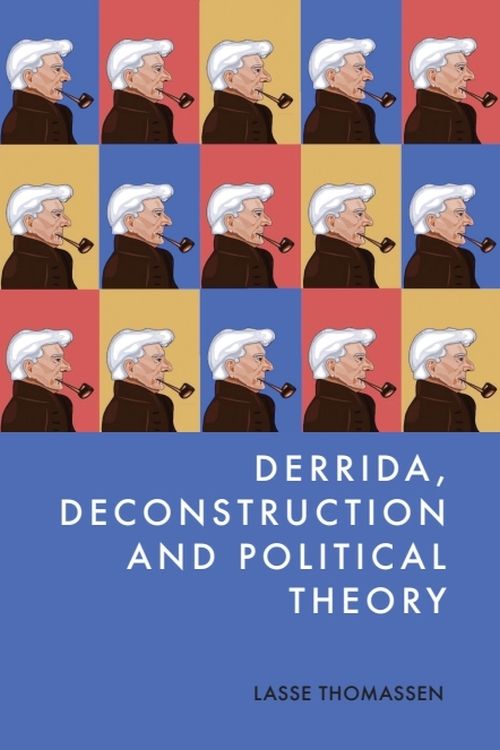
Explores how Jacques Derrida’s deconstruction can help analyse political concepts including justice, democracy, sovereignty, populism and post-truth
The first comprehensive study of deconstruction as political theory, showing Jacques Derrida’s relevance for contemporary political theory
Demonstrates the usefulness of deconstruction for the study of political concepts such as rights, justice, sovereignty, democracy, populism and post-truth
Contrasts a deconstructive approach with other theoretical approaches, including analytic philosophy and critical theory, and with liberal, deliberative, and biopolitical approaches to political concepts
Uses extensive examples from contemporary political phenomena such as Covid-19, Donald Trump’s populism and post-truth
Drawing on the work of Jacques Derrida and other post-structuralists, this book argues for deconstruction as a distinctive way to practice political theory. Lasse Thomassen shows familiar critiques of deconstruction as relativist and apolitical to be misconceived, and argues for deconstruction as a critical approach to contemporary politics and society. In so doing, the book contrasts deconstruction with other approaches to political theory, including analytic philosophy, critical theory, liberalism, deliberative democracy and biopolitical approaches.
Developing the argument around political concepts such as rights, justice, sovereignty, democracy and populism, the book combines the deconstructive readings of these political concepts with extensive engagements with contemporary political phenomena such as 9-11, Covid-19, Donald Trump and post-truth.
Shirin M. Rai is Distinguished Research Professor, Department of Politics and International Studies, SOAS, University of London. She is a Fellow of the British Academy. Rai’s research interests lie in feminist international political economy, performance and politics, and gender and political institutions. She has published widely in these areas, including Gender and the Political Economy of Development (Polity, 2004) Performing Representation: Women Members in the Indian Parliament (with Carole Spary; OUP), 2019; Oxford Handbook of Politics and Performance (2021; co-eds M Gluhovic, S Jestrovic and M Saward). Her latest book is Depletion: the human costs of caring (2024, OUP).
Atmospheric Violence grapples with the afterlife of environmental disasters and armed conflict and examines how people attempt to flourish despite and alongside continuing violence. Departing from conventional approaches to the study of disaster and conflict that have dominated academic studies of Kashmir, Omer Aijazi’s ethnography of life in the borderlands instead explores possibilities for imagining life otherwise, in an environment where violence is everywhere, or atmospheric.
Drawing on extensive fieldwork in the portion of Kashmir under Pakistan’s control and its surrounding mountainscapes, the book takes us to two remote mountainous valleys that have been shaped by recurring environmental disasters, as well as by the landscape of no-go zones, army barracks, and security checkpoints of the contested India/Pakistan border. Through a series of interconnected scenes from the lives of five protagonists, all of whom are precariously situated within their families or societies and rarely enjoy the expected protections of state or community, Aijazi reveals the movements, flows, and intimacies sustained by a landscape that enables alternative modes of life. Blurring the distinctions between story, theory, and activism, he explores what emerges when theory becomes a project of seeing and feeling from the non-normative standpoint of those who, like the book’s protagonists, do not subscribe to the rules by which most others have come to know the world.
Bringing the critical study of disaster into conversation with a radical humanist anthropology and the capaciousness of affect theory, held accountable to Black studies and Indigenous studies, Aijazi offers a decolonial approach to disaster studies centering not on trauma and rupture but rather on repair—the social labor through which communities living with disaster refuse the conditions of death imposed upon them and create viable lives for themselves, even amidst constant diminishment and world-annihilation.
Argues that intoxication was fundamental to German physiological, psychological, and psychiatric research during the nineteenth century.
Intoxicating substances can be found lurking in every corner of modern life, and Matthew Perkins-McVey’s pathbreaking book offers the untold story of how they were implicated in shifting perceptions of embodiment found in the emerging sciences of the body and mind in late-nineteenth-century Germany. Their use in this experimental context gave rise to a dynamic conception of the subject within the scientific, psychological, philosophical, and sociological milieu of the era. The history of the modern biological subject, Perkins-McVey argues, turns on “intoxicated ways of knowing.”
Intoxicated Ways of Knowing identifies the state of intoxication as a tacit form of thinking and knowing with the body. Intoxicants force us to feel, intervening directly in our perceptional awareness, and, Perkins-McVey contends, they bring latent conceptual associations into the foreground of conscious thought, engendering new ways of knowing the world. The book unfurls how intoxicants affected nineteenth-century German science and how, ultimately, the connection between mental life and intoxication is taken up in the works of Friedrich Nietzsche, Max Weber, and Sigmund Freud, bringing the biological subject out of the lab and into the worlds of philosophy, psychoanalysis, sociology, and politics.