Le foucaldien. Open access journal (2017)

New issue of Le foucaldien now available

Clare O'Farrell's avatarFoucault News

Le foucaldien. Open access journal along Foucauldian lines

Volume 3 – Issue 1 – 2017

The peer-reviewed open access journal Le foucaldien publishes interdisciplinary research along the lines of the philosopher and historian Michel Foucault (1926–1984) in English, German, and French. The Internet Encyclopedia of Philosophy credits Foucault with being “the author most frequently cited in the humanities” at the beginning of the 21st century, but his concepts are challenged in emerging fields such as media studies, digital humanities, post-colonialism, new materialism, and science and technology studies. Hence the main focus of Le foucaldien lies on updating and operationalizing Foucauldian approaches in preferably plain language.

View original post

Posted in Uncategorized | Leave a comment

Imagining a territory. Constructions and representations of late medieval Brabant

An outline of an intriguing new research project on the late medieval Duchy of Brabant.

Mario Damen's avatarImagined territories

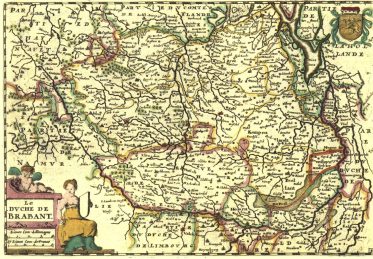
This research-project analyses how the interaction between prince, nobles and urban elites influenced the construction, perception, and representation of a territory. The test case will be the late medieval Duchy of Brabant, which still has historical and territorial significance for many people in present-day Belgium and the Netherlands. To underscore the fluidity and multiplicity of the concept of territory, this project sets out to disentangle the divergent, though sometimes overlapping, conceptions of what exactly Brabant was (or should be) in the eyes of different political actors, in this time before the availability of reliable scale maps. To answer the main research question the project takes a twofold approach. On the one hand, we will define ducal, noble, and urban conceptions of cropped-brabant1.jpgBrabant mainly through administrative sources, particularly those of the fourteenth century that reflect a turning point in the capturing of territory. On the other hand, we will explicate how…

View original post 105 more words

Posted in Uncategorized | Leave a comment

The Early Foucault update 11: Working in the Canguilhem archive at the École normale supérieure and at the Bibliothèque Sainte-Geneviève

I’ve been in Paris again for a few days, this time mainly to work at the Canguilhem archive at the Centre d’Archives de Philosophie, d’Histoire et d’Édition des Sciences (CAPHÉS) at the École normale supérieure. The collection comprises multiple boxes of material, and it’s somewhat daunting to see all of this material catalogued. The material comprises drafts of published pieces, lots of things relating to his various administrative roles, and the notes from his teaching. There is a wealth of material here. One initial thing I did was to examine pieces mentioned by others, in order to verify any quotes, to contextualize them and to read more widely. But I also began to do some work on other interesting looking materials in this collection. I know I will need to come back at least once, as I didn’t complete all this work.


The archive has draft versions of many of his essays, which often originated as talks. He writes out the text longhand, sometimes with amendments or additions in a different ink, and sometimes with old-fashioned cut and paste. But the versions preserved are, generally, fairly clean, fair copies. I imagine there were earlier versions which did not survive. There is usually then a typed copy of each text. It doesn’t seem he was his own typist. For his teaching, the notes he took into the classroom are generally handwritten, often fairly neat. He seems to have written things out in a fuller way than, for example, Foucault did for his lectures. His handwriting is neater too, and in the early years is miniscule. It grows in size over the decades, and in his last years becomes a little shakier. But he was active in events and correspondence until late in life, and he died at the age of 91. There are also lots of pages, scraps, recycled bits of letters or flyers, with notes and bibliographical references.

I haven’t worked through all the interesting materials by any means, but I did find some important things. For example there is an extensive draft of a book that was commissioned, contracted but never published. There is the correspondence preceding its writing with the publisher, and then quite a lot of material for its chapters – many of which also exist in typed versions. But there is no correspondence from the publisher asking where it is, and no explanation of why it was unfinished and unpublished. It’s worth noting that this is a little unusual for him. Canguilhem published books, of course, but he didn’t really write them as books. Three of his books are his theses – he had a doctorate in medicine and in philosophy, for which there were two theses – and the others are collections of essays or talks. While not wishing to diminish the work in these, or their value, I think there is a difference between these and things conceived of as books from the start.

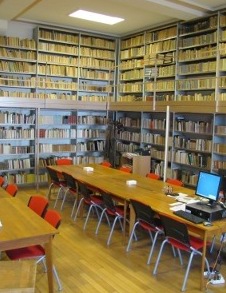
I also knew that the archive had the contents of Canguilhem’s personal library. What I didn’t imagine was that it would be on open shelving in the archive reading room (in the image above, all the books on the lower level are from this collection). Instead of having to order up things that might be useful, I was able to browse through it and discover a whole host of interesting books. Canguilhem has copies of all of Foucault’s major works, along with some less common ones, and many of these have handwritten dedications from Foucault. The collection is also helpful for providing access to some of obscure editions of texts which Canguilhem referenced, so I was able to resolve a number of issues there. I chanced across a copy of Henri Lefebvre’s Logique formelle, logique dialectique, which is also signed and dedicated to Canguilhem. There is a little correspondence between Canguilhem and Lefebvre, concerned with Canguilhem’s role as ‘Inspector General’ of philosophy teaching, and the difficulties that Lefebvre had with getting his post at the CNRS renewed. There are also letters from a large number of other figures including Louis Althusser, Jean Beaufret, Pierre Fougeyrollas, Albert Memmi, Michel Serres and so on.

The Canguilhem archive itself was the main reason I was here, and the work was primarily intended to be for the Canguilhem book, though some of the things in the archive connect directly to the Foucault work as well. The archive includes a copy of Foucault’s secondary thesis on Kant, and various things relating to Canguilhem’s role as rapporteur for Foucault’s thesis. Unfortunately a copy of the 943 page manuscript version of the History of Madness thesis which Foucault sent Canguilhem is not here – and it is not in the Foucault archive either. I anticipated this already, but I had hoped there might be a copy of the version of the History of Madness printed for the thesis defense, but that’s not here either. Canguilhem did have copies of the first Plon edition and the 1972 Gallimard edition, but I have those already. There is however Canguilhem’s report on the thesis. This is published in the second and third edition of Eribon’s biography of Foucault, and translated in Arnold Davidson’s Foucault and his Interlocutors collection.

I’m glad I told the archivist that I was working both on Canguilhem and the early Foucault, because she suggested a different archive held at CAPHÉS was worth a look too. I’ve largely found things by trial and error, methodological plod and searching online in the past, but this is the single most useful suggestion I’ve had from someone else in doing archival work on Foucault. I am sure I would never have thought to consult it otherwise.

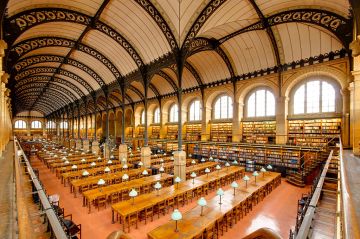
This week the Bibliothèque Nationale was closed, so in the evenings I made use of the Bibliothèque Sainte-Geneviève which is in this same part of Paris, next to the Panthéon. It’s a library for many of the Parisian universities, but also allows public readers. Like the old Richelieu site of the Bibliothèque Nationale, the main reading room is designed by Henri Labrouste, with wonderful  high arched ceilings and exposed ironwork. It gets very busy, and quite noisy, but the collection is extensive. While a lot of material is on open shelves, all the obscure items I wanted had to be ordered up from the store. So I was able to resolve a lot of reference issues and consult some hard-to-find things here too.


One quotation gives the sort of work that reference checking might entail. In the introduction to one of Canguilhem’s books in English translation the translators quote his self-assessment of his relation to Nietzsche. Their reference is to a German article on Canguilhem. That article says it is cited from a chapter in a French book. That chapter says it is cited from a conference proceedings. There, the speaker says it’s something Canguilhem once told him. That’s as good as it is going to get, but it took looking at three additional sources beyond the first to find that out.

Next week I’m off on a kind of writing/cycling retreat – an attempt to take a bit of a break before term starts and also to try to write a bit more of this book. The weather forecast looks grim, so it seems I may be getting a bit more writing than cycling done.


The previous updates on this project are here; and Foucault’s Last Decade and Foucault: The Birth of Power are now both available from Polity. Several Foucault research resources such as bibliographies, short translations, textual comparisons and so on are available here. On the related Canguilhem project, see this page.

Posted in Canguilhem (book), Georges Canguilhem, Henri Lefebvre, Michel Foucault, The Early Foucault, Uncategorized | 2 Comments

London Group of Historical Geographers seminar series autumn 2017

London Group of Historical Geographers seminar series autumn 2017 – details here

Venue: Wolfson Room NB01, Basement, IHR, North block, Senate House unless otherwise stated

Time: Tuesday 17:15

Convenors: Ruth Craggs (King’s College London), Felix Driver (Royal Holloway, London), Innes Keighren (Royal Holloway University of London), Miles Ogborn (Queen Mary University of London)

Autumn Term 2017
Date Seminar details
10 October
17:15
The lonely fieldworker qualified: observations on the emergence of different forms of collaborative projects in ethnographic research.
George Marcus (University of California, Irvine)

IHR Wolfson Room NB01, Basement, IHR
24 October
17:15
Assembling ‘Negroana’: Black history and the limits of universal knowledge.
Jake Hodder (University of Nottingham)

Room 246, Second Floor
7 November
17:15
A million Black Anthropocenes or none.
Kathryn Yusoff (Queen Mary University of London)

IHR Wolfson Room NB01, Basement, IHR
21 November
17:15
Just giving: British charities, decolonisation and development.
Matthew Hilton (Queen Mary University of London)

Venue to be announced
5 December
17:15
Ab Uno Sanguine: Indigenous rights and the Aborigines’ Protection Society in the mid-nineteenth century.
Zoe Laidlaw (Royal Holloway University of London)

IHR Wolfson Room NB01, Basement, IHR
Posted in Uncategorized | 1 Comment

Sur les toits – full film on prison revolts in early 1970s France now available on Youtube

Nicolas Drolc’s excellent film Sur les toits is now available in full on Youtube. It’s a documentary on the prison revolts in early 1970s France, with some references to the Prisons Information Group Foucault co-founded. The film is in French, with English subtitles. As well as some archive footage of Foucault, there are interviews with, among others, Daniel Defert and Serge Livrozet.

As a reminder, there is an open access symposium on the film, following a discussion held at the University of Warwick, in Antipode. The contributions comprise an interview with the director by Marijn Nieuwenhuis and a series of original reflections (from Dominique MoranSophie FuggleAnastasia ChamberlenOliver Davis and Stuart Elden) on both the film and its subject of investigation.

Nicolas Drolc’s latest film is on Serge Livrozet, La Mort se Mérite, and a trailer can be viewed online:

Posted in Michel Foucault, Uncategorized | Leave a comment

Judith Butler interviewed by Aaron Aquilina and Kurt Borg in CounterText

Judith Butler is interviewed by Aaron Aquilina and Kurt Borg in CounterText (requires subscription). It’s a fascinating interview with a particular focus on her interests in literature, especially Kafka, and then moves to a discussion of her career trajectory and relation to poststructuralism and ethics.


Posted in Judith Butler, Uncategorized | Leave a comment

Nicholas de Genova (ed.), The Borders of “Europe”: Autonomy of Migration, Tactics of Bordering

978-0-8223-6916-5_prNicholas de Genova (ed.), The Borders of “Europe”: Autonomy of Migration, Tactics of Bordering now out with Duke University Press.

In recent years the borders of Europe have been perceived as being besieged by a staggering refugee and migration crisis. The contributors to The Borders of “Europe” see this crisis less as an incursion into Europe by external conflicts than as the result of migrants exercising their freedom of movement. Addressing the new technologies and technical forms European states use to curb, control, and constrain what contributors to the volume call the autonomy of migration, this book shows how the continent’s amorphous borders present a premier site for the enactment and disputation of the very idea of Europe. They also outline how from Istanbul to London, Sweden to Mali, and Tunisia to Latvia, migrants are finding ways to subvert visa policies and asylum procedures while negotiating increasingly militarized and surveilled borders. Situating the migration crisis within a global frame and attending to migrant and refugee supporters as well as those who stoke nativist fears, this timely volume demonstrates how the enforcement of Europe’s borders is an important element of the worldwide regulation of human mobility.

Contributors. Ruben Andersson, Nicholas De Genova, Dace Dzenovska, Evelina Gambino, Glenda Garelli, Charles Heller, Clara Lecadet, Souad Osseiran, Lorenzo Pezzani, Fiorenza Picozza, Stephan Scheel, Maurice Stierl, Laia Soto Bermant, Martina Tazzioli

Posted in Boundaries, Uncategorized | Leave a comment

Foucault in Warsaw (2017)

A brief English discussion of a French article about about a Polish book on Foucault’s time in Warsaw. Does anyone have access to the Belgian newspaper in which the article appears?

Clare O'Farrell's avatarFoucault News

Foucault in Warsaw, Durieux.eu blog, 31 August 2017.

 Le Soir spends ample space on an article by Maya Szymanowska about a new Polish publication by sociologist Remigiusz Ryzinski, ‘Foucault W Warszawie’ (Foucault in Warsaw – no translations yet).

In 1955 Michel Foucault arrives in Uppsala, Sweden, where he will work on his doctoral dissertation. But then in October 1958, he moves to Warsaw, Poland, where he is going to direct the Centre de civilisation française at the local university. There he continues working on the manuscript he will  eventually defend in 1961 in Paris as his so-called ‘principal thesis’. It is published originally as ‘Folie et déraison. Histoire de la folie à l’âge classique’.

read more

View original post

Posted in Uncategorized | Leave a comment

Extract from Michel Serres’s The Birth of Physics (open access), with whole book forthcoming

The same issue of Parrhesia also includes an extract from Michel Serres’s The Birth of Physics. The translation is by David Webb, with an introduction by Bill Ross. The entire book is forthcoming in a new edition from Rowman and Littlefield International.

[Update: David tells me he and Bill did the translation together; and co-wrote the book’s introduction – though this excerpt is Bill’s alone]

Posted in Uncategorized | Leave a comment

Nicole Loraux, “War in the Family”, translated by Adam Kotsko (open access)

Nicole Loraux’s essay “War in the Family” has been translated by Adam Kotsko, and is open access in the new issue of Parrhesia. As Adam writes, “This previously untranslated essay is discussed at length in the first half of Agamben’s Stasis”.

Posted in Giorgio Agamben, Uncategorized | Leave a comment