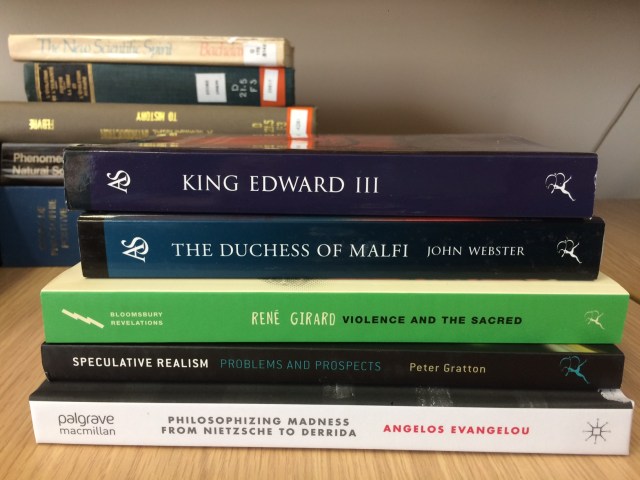
Books received – Evangelou, Gratton, Girard, Webster, Shakespeare?

IMG_2801

Some books received in recompense for review work for Palgrave and Bloomsbury – King Edward III, Webster’s The Duchess of Malfi, Girard’s Violence and the Sacred, Peter Gratton’s Speculative Realism and Angelos Evangelou’s Philosophizing Madness from Nietzsche to Derrida. Although King Edward III has been edited before in Shakespeare series, this is the first version in the Arden Shakespeare. Its authorship is much disputed though it is increasingly being seen as a play by, in whole or in part, Shakespeare. I discuss it alongside King Henry V in one of the chapters of my Shakespeare manuscript, so glad to have this new edition.

Posted in Friedrich Nietzsche, Jacques Derrida, Peter Gratton, Shakespearean Territories, Uncategorized, William Shakespeare | 1 Comment

New Perspectives essay by Peter Sloterdijk on ‘On Pseudonymous Politics: Regarding Implicit and Explicit Misconceptions of Democracy’ (open access)

Screen-Shot-2017-05-15-at-22.35.04-204x300New Perspectives has just published an open access essay by Peter Sloterdijk on ‘On Pseudonymous Politics: Regarding Implicit and Explicit Misconceptions of Democracy’

Editor Benjamin Tallis writes:

‘On Pseudonymous Politics: Regarding Implicit and Explicit Misconceptions of Democracy’ is an intervention into the state of democracy (and its discontents) today and a rejoinder to some of those discontents. Sloterdijk grounds his argument in extensive historical analysis of the ‘pseudonymous’ condition of democracy and identifies four noms de guerre: Oligocracy, Fiscocracy, Mobocracy and Phobocracy. 

This article is a significant intervention into debates in contemporary politics in the context of ‘post-truth’, populism (on the left and right) and the battle for liberal democracy in the Western world and beyond. It treads deliberately onto the turf of Politics and International Relations and is a challenge to scholars in our field.

New Perspectives will therefore also be publishing a collection of responses to Sloterdijk’s article by IR scholars: Claudia Aradau, Friedrich Kratochwil, Barry J Ryan, Sassan Gholiagha and Benjamin Tallis. We also encourage the submission of further responses and articles on related matters in order to continue the conversation. 

This text is a version of the ‘Cardiff Lecture’ delivered by Peter Sloterdijk as the keynote address for the European International Studies Association (EISA) European Workshops in International Studies (EWIS), Cardiff University, Wales, on 7 June 2017. The Cardiff Lecture was made possible by the initiative and perseverance of Christian Bueger and the support – financial and otherwise – of Cardiff University and the Learned Society of Wales, as well as the financial support of the Institute of International Relations Prague, the latter of which paid for the translation of the text from the original German. This translation was made in record time, with no detriment to quality, by Victoria Stiles, who is contactable at v.stiles.education@gmail.com. Additional bibliographical assistance was provided in fine fashion by David Steiner, an intern at the Institute of International Relations Prague.

Posted in Peter Sloterdijk, Uncategorized | 1 Comment

Kostas Axelos in Iran’s Shargh Daily newspaper, with a translation of my interview with him

There is a feature on Kostas Axelos in Iran’s Shargh Daily newspaper (pdf here). It was put together by Sahand Sattari, and includes a translation of my interview with him which appeared in 2005 in Radical Philosophy. The English version of the interview is available here. If you’re interested in finding out more about this interesting but neglected figure, there is a bibliography of Kostas Axelos in English on this site.

Axelos in Iran-page-001.jpg

Posted in Kostas Axelos, Uncategorized | Leave a comment

The Southern Journal of Philosophy – Spindel supplement on Critical Theories of the Present (open access)

Update 1 September 2017: the issue appears to be open access

stuartelden's avatarProgressive Geographies

untitledThe proceedings of last year’s Spindel Conference at the University of Memphis on the topic “Critical Histories of the Present” have now been published in The Southern Journal of Philosophy. Edited by Verena Erlenbusch, it has contributions from Bilge Akbalik, Amy Allen, Shouta Brown, Andrew Daily, Andrew Dilts, Stuart Elden, Bryan Kimoto, Colin Koopman, Jordan Liz, Mary Beth Mader, Ladelle McWhorter, Maia Nahele, Kevin Olson, Tuomo Tiisala, Jasmine Wallace, and Jim Zubko. The issue requires subscription, unfortunately.

[Update 1 September 2017: the issue appears to be open access]

My contribution is entitled ‘Foucault and Shakespeare: Ceremony, Theatre, Politics‘. A preprint is available here. Here’s the abstract:

Foucault only refers to Shakespeare in a few places in his work. He is intrigued by the figures of madness that appear in King Lear, Hamlet, and Macbeth. He occasionally notes the overthrow of one monarch by another…

View original post 420 more words

Posted in Uncategorized | Leave a comment

David Harvey, Marx, Capital and the Madness of Economic Reason – now out

Out today…

stuartelden's avatarProgressive Geographies

9781781258743David Harvey, Marx, Capital and the Madness of Economic Reasonforthcoming in August

Marx’s Capital is one of the most important texts of the modern era. The three volumes, published between 1867 and 1883, changed the destiny of countries, politics and people across the world – and continue to resonate today. In this book, David Harvey lays out their key arguments.In clear and concise language, Harvey describes the architecture of capital according to Marx, placing his observations in the context of capitalism in the second half of the nineteenth century. He considers the degree to which technological, economic and industrial change during the last 150 years means Marx’s analysis and its application may need to be modified. Marx’s trilogy concerns the circulation of capital: volume I, how labour increases the value of capital, which he called valorisation; volume II, on the realisation of this value, by selling it and…

View original post 81 more words

Posted in Uncategorized | Leave a comment

Birkbeck Law Review Annual Conference 2017 – ‘Law and the City: Exploring the Urban Revolution in Critical Legal Studies’

Birkbeck Law Review Annual Conference 2017 – ‘Law and the City: Exploring the Urban Revolution in Critical Legal Studies’

Saturday 16 September 2017, Clore Management Building, Birkbeck, University of London

The Birkbeck Law Review is pleased to announce its 2017 Annual Conference, entitled ‘Law and the City: Exploring the Urban Revolution in Critical Legal Studies’, to be held on Saturday 16th September 2017 at the Clore Management Centre, Birkbeck, University of London.

Almost fifty years ago the French philosopher Henri Lefebvre declared that ‘society has been completely urbanized’. Today, more than half the world’s population live in an urban environment, and it is difficult to ignore the totalising trajectory of global urbanisation. For researchers, analysts and the inquisitive, the nature of collective existence cannot be separated from the urban condition. The urban has without doubt now become a primary domain of debates and struggles concerning social justice, and urbanism has taken on a renewed primacy in contemporary critical theory, social sciences, humanities and beyond. For those engaging in critical legal approaches, engagement with law and society now requires critical engagement with the urban. This conference seeks to explore and connect law’s urban dynamics, and, vice versa, the urban’s legal dynamics.

Law and legality play a significant role in the production of the urban. Legal norms and rules shape the city materially, politically and socially. Law also shapes (and perhaps limits) our conceptions and imaginations of how the city and society should and could be constituted. As the critical legal tradition has continually sought to question and expose the role of law in the production of power and collective life, it is necessary to further our engagement with how law and urbanity intertwine and the form collective urban life takes: interrogating its injustices, problems and potentials, and how law and power shape the city. In other words, it is more important than ever to critically assess and challenge the nature of the urban world we are inhabiting and producing, with a particular focus on the role of law and its dynamics in urban production.

This conference seeks to further these explorations and reflections between law and the urban. It seeks to further pollinate thinking between disciplines, and to encourage engagement with how law and the urban intertwine, exploring the dynamics of power, injustices and potentials in law’s shaping of the city. This conference seeks to address the status and trajectory of critical legal urban scholarship and identify research gaps and further avenues of investigation. It further seeks to bring together scholars, practitioners and activists working on law and urban issues to develop networks and collaborations. We hope you can join us.

Keynote speakers

Andreas Philippopoulos-Mihalopoulos, University of Westminster

Anne Bottomley, University of Kent

Mariana Valverde, University of Toronto

Programme

All panels and talks will take place on Saturday 16th September at Birkbeck College, London, from 09:30 to 17:30, followed by a drinks reception. Full schedule of the day available here. Registration via Eventbright online.

Queries to the Conference Editors: Harley Ronan (h.ronan@bbk.ac.uk) and Hysha Smith (admin@bbklr.org).

Posted in Uncategorized | Leave a comment

David Berliner, How to get rid of your academic fake-self?

Some interesting and good advice from David Berliner, How to get rid of your academic fake-self?

Principle of care:
– Substitute a politics of competition by an ethics of care (for yourself and for others). Science is about collaborative knowledge and not a massacre.

Principle of incompleteness:
– Acknowledge that you have not read everything and that you cannot debate all topics. Learn to say: “I don’t know anything about Derrida. Maybe one day, I will read him, or not”.

Principle of honesty:
– Train yourself to say publicly: “I am not researching anything new at the moment, nor writing”. When a colleague asks you “what are you working on?”, learn to say “I don’t know. I am teaching and that already takes a considerable amount of time. I have nothing to publish right now”.

Principle of irony:
– Always have a big critical laugh at metrics and other tricks of neoliberal evaluations. They only painfully reopen your narcissistic wounds.

Principle of self-preservation:
– Try to avoid – as much as possible – toxic colleagues who never ask you how you are, but only list their own academic achievements and focus on lauding their cv.

If it doesn’t work, double the dose and try again.

David Berliner, anthropologist.

I can’t claim I always follow these, but they are good ideas, and if more people followed at least some of them, then academia would become a much more pleasant place.

[Update: A response from Mathijs van de Sande which points out the challenges for earlier-career academics and the structural context is here. Thanks to Nadim Khoury for this link.]

Posted in Uncategorized, Universities | 1 Comment

The Southern Journal of Philosophy – Spindel supplement on Critical Theories of the Present (open access)

untitledThe proceedings of last year’s Spindel Conference at the University of Memphis on the topic “Critical Histories of the Present” have now been published in The Southern Journal of Philosophy. Edited by Verena Erlenbusch, it has contributions from Bilge Akbalik, Amy Allen, Shouta Brown, Andrew Daily, Andrew Dilts, Stuart Elden, Bryan Kimoto, Colin Koopman, Jordan Liz, Mary Beth Mader, Ladelle McWhorter, Maia Nahele, Kevin Olson, Tuomo Tiisala, Jasmine Wallace, and Jim Zubko. The issue requires subscription, unfortunately.

[Update 1 September 2017: the issue appears to be open access]

My contribution is entitled ‘Foucault and Shakespeare: Ceremony, Theatre, Politics‘. A preprint is available here. Here’s the abstract:

Foucault only refers to Shakespeare in a few places in his work. He is intrigued by the figures of madness that appear in King Lear, Hamlet, and Macbeth. He occasionally notes the overthrow of one monarch by another, such as in Richard II or Richard III, arguing that “a part of Shakespeare’s historical drama really is the drama of the coup d’État.” For Foucault, the first are illustrations of the conflict between the individual and the mechanisms of discipline. The second are, however, less interesting than moments when the sovereign is replaced, not with another sovereign, but with a different, more anonymous, form of power. Yet, in his 1976 Collège de France course, Society Must Be Defended, where he treats the theme at most length, he intriguingly suggests that Shakespearean historical tragedy is “at least in terms of one of its axes, a sort of ceremony, or a rememorialization of the problems of public right.” Foucault was long fascinated by the theatre, and especially its relation to political ceremony. Drawing especially on his 1972 lectures in Paris and a related presentation in Minnesota, this paper asks how we might understand the relation between ceremony, theatre, and politics in Foucault and Shakespeare. Many of Shakespeare’s plays, both histories and tragedies, thus demonstrate the importance of ritual and ceremony, a political theatre. Examining the disrupted ceremony of King Lear, the repeated ceremony of King John, the denial of ritual in Coriolanus, and the parody of the ceremonial in Henry IV, Part One opens up a range of historical, theoretical, and political questions.

As with all the papers, it is followed by a commentary, in this case from the insightful Bilge Akbalik in a piece entitled ‘The Modern Drama of coup d’État and Systems of Discipline: Foucault and Political Ceremony’.

The objective of my comments is to draw attention to the complex relationship between the juridico-political model of sovereignty and disciplinary power in Foucault’s work. I suggest that Elden’s reading of Foucault and Shakespeare opens up new ways to understand contemporary forms of governmentality through a genealogy of political ceremony and theatricality. More specifically, my comments seek to show that an examination of the ceremoniality of coup d’État in connection with what Foucault calls the “democratization of sovereignty” is potentially fruitful for examining modern forms of the government of civil society and counterconduct.

My thanks to Bilge for her commentary, and to Verena for organising the event.

I have a second piece on Foucault and Shakespeare forthcoming, this time in an edited book on Foucault, theatre and performance. That second piece looks at what I call the ‘theatre of madness’. Both pieces link the two main projects I’ve been working on over the past several years.

Posted in Foucault's Last Decade, Foucault: The Birth of Power, Michel Foucault, Shakespearean Territories, The Early Foucault, Uncategorized, William Shakespeare | 2 Comments

How to really ensure ‘no posthumous publications’ – Pratchett vs Foucault

I have never read a Terry Pratchett novel, but he has ensured that no-one will read the ones he left incomplete at his death. The hard-drive of his computer was, according to his wishes, crushed by a steamroller. Story in The Guardian here.

Foucault of course wanted ‘no posthumous publications’, and initially this was strictly followed, then interpreted generously, and is now being entirely contravened (a bit more on that here). Foucault apparently asked Hervé Guibert to destroy the drafts and preparatory materials for the History of Sexuality after his death. He also said various things about destroying drafts himself. It is unclear what, if anything, was actually destroyed, but History of Sexuality volume IV is not the only thing to survive.

Posted in Michel Foucault, Uncategorized | 1 Comment

The 2017 Antipode RGS-IBG Lecture – “Retelling Stories, Disrupting ‘the Social’, Relearning the World” by Richa Nagar

Details of Richa Nagar’s Antipode lecture tomorrow, along with a number of open access papers linked to the topic.

Antipode Editorial Office's avatarAntipodeFoundation.org

The 2017 Antipode RGS-IBG Lecture

Retelling Stories, Disrupting “the Social”, Relearning the World

Richa Nagar (University of Minnesota)

The 2017 Antipode RGS-IBG Lecture will take place on Wednesday 30th August between 16:50 and 18:30 in the Ondaatje Theatre at the Royal Geographical Society (with IBG), 1 Kensington Gore, London, SW7 2AR. The Lecture will be followed by a drinks reception sponsored by Antipode’s publisher, Wiley.

The dominant landscape of knowledge and policy rests on a fundamental inequality: bodies who are seen as hungry or precarious are assumed to be available for the interventions of experts, but those experts often obliterate the ways that the hungry actively create politics and knowledge by living a dynamic vision of what is ethical and what makes the good life. Such living frequently involves a creative praxis of refusal against imposed frameworks. For Nagar, learning from such refusals requires “hungry translations” that are…

View original post 901 more words

Posted in Uncategorized | Leave a comment