Helen Sword in the Times Higher Education on academic writing

9780674737709I’ve mentioned Helen Sword’s book Air & Light & Time & Space: How Successful Academics Write here before. There is a short discussion on this theme from her in the Times Higher Education.

How do successful academics write, and how do they learn to write? What are their daily routines, their formative experiences, their habits of mind? What emotions do they associate with their academic writing? And where do they find the “air and light and time and space”, as the poet Charles Bukowski put it, to get their writing done? These were among the questions that I asked as part of a research project that eventually took me to 45 universities in 15 countries.

Feedback from more than 1,300 academics, PhD students and other researchers from across the disciplines revealed that successful writing is built on a complex and varied set of attitudes and attributes, including behavioural habits of discipline and persistence, artisanal habits of craftsmanship and care, social habits of collegiality and collaboration and emotional habits of positivity and pleasure. [more here]

Posted in Uncategorized | Leave a comment

What Kind of People Do We Want to Be? David Harvey on the Right to the City

Sandro Mezzadra and David Harvey discuss the right to the city in Bologna.

Posted in Uncategorized | 2 Comments

Foucault’s Last Decade and Foucault: The Birth of Power forthcoming in Chinese translation

Foucault-The-Birth-of-Power-cover9780745683911.jpgBoth Foucault’s Last Decade and Foucault: The Birth of Power are now forthcoming in Chinese translation with Beijing Publishing Group.

Both books are also forthcoming in Korean with Nanjing Publishing House.

Posted in Foucault's Last Decade, Foucault: The Birth of Power, Michel Foucault, Publishing, Uncategorized | Leave a comment

Foucault: The Birth of Power reviewed at LSE Review of Books

Foucault-The-Birth-of-Power-coverFoucault: The Birth of Power is reviewed at LSE Review of Books by Syamala Roberts.

In Foucault: The Birth of Power, Stuart Elden outlines how the theorisation of power was the essential tool developed within Foucault’s work and political activities in the early 1970s following his return from Tunisia. Drawing on writings, interviews, lectures and unpublished or newly available manuscripts, Elden offers an indispensable read for those looking to gain further insight into Foucault as a writer, philosopher and activist, recommends Syamala Roberts. [continues here]


Posted in Foucault: The Birth of Power, Michel Foucault, Uncategorized | 1 Comment

A roundup of links on time-management

I’ve been collecting some links on time-management, but not found the rationale for tying them together in something more substantial. So, here are simply the links…

Shannon Mattern, Where does the time go? at Words in Space

Mark Carrigan, Productivity culture, cognitive triage and the pseudo-commensurability of the to-do list

The Value of 10 Minutes: Writing Advice for the Time-Less Academic (Chronicle Vitae)

How I Kept a 373-Day Productivity Streak Unbroken (99u)

Don’t Waste Your Two Golden Hours of Productivity (99u)

The Weekly Review: How One Hour Can Save You A Week’s Worth of Hassle and Headache (Life Hacker)

Nick Blackbourn, Organizing Research and Facilitating Writing: 10 tools in 10 minutes

Thin on Time? Use the “Not To-do” List (99u)

The 12 Stages of Burnout (99u)

Resources

2017 monthly calendar templates

Momentum planners – Productive Flourishing

Try Sanebox for email-management

Posted in Uncategorized | Leave a comment

Primo Levi – Translating and Being Translated

Primo Levi – Translating and Being Translated, translated by Harry Thomas

Posted in Uncategorized | Leave a comment

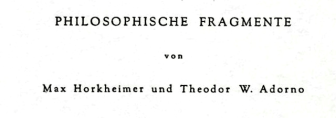
On the Philosophische Fragmente – the original version of Adorno and Horkheimer’s The Dialectic of Enlightenment

untitledJames Schmidt has two fascinating posts discussing the history of the Philosophische Fragmente – the original version of Adorno and Horkheimer’s The Dialectic of Enlightenment. Part I and Part II


Posted in Uncategorized | Leave a comment

Judith Butler “Critique, Crisis, Violence” – video of Bologna lecture

Posted in Judith Butler, Uncategorized | Leave a comment

Figure/Ground interview with Catherine Malabou

Figure/Ground interview with Catherine Malabou:

Dr. Malabou was interviewed by Gerardo Flores Peña. July 25th, 2017.

Catherine Malabou is a professor of philosophy at The European Graduate School / EGS and professor of modern European philosophy at the Centre for Research in Modern European Philosophy (CRMEP) at Kingston University, London. She is known for her work on plasticity, a concept she culled from Hegel’s Phenomenology of Spirit, which has proved fertile within contemporary economic, political, and social discourses. Widely regarded as one of the most exciting figures in what has been called “The New French Philosophy,” Malabou’s research and writing covers a range of figures and issues, including the work of Hegel, Freud, Heidegger, and Derrida; the relationship between philosophy, neuroscience, and psychoanalysis; and concepts of essence and difference within feminism. She is the author of important books as Plasticity at the Dusk of Writing: Dialectic, Destruction, Deconstruction (2009), Changing differences (2011) and most recently Before tomorrow : epigenesis and rationality (2017).

Posted in Catherine Malabou, Uncategorized | 2 Comments

Neil Brenner, Debating Planetary Urbanization: For an Engaged Pluralism – open access working paper

Neil Brenner, “Debating planetary urbanization: for an engaged pluralism,” Working Paper, Urban Theory Lab, Harvard GSD, Summer 2017.

This essay reflects on recent debates around planetary urbanization, many of which have been articulated through strikingly dismissive caricatures of the core epistemological orientations, conceptual proposals, methodological tactics and substantive arguments that underpin this emergent approach to the urban question.  Following brief consideration of some of the most prevalent misrepresentations of this work, I build upon Trevor Barnes and Eric Sheppard’s (2010) concept of “engaged pluralism” to suggest more productive possibilities for dialogue among critical urban researchers whose agendas are too often viewed as incommensurable or antagonistic rather than as interconnected and, potentially, allied.  The essay concludes by outlining nine research questions whose more sustained exploration could more productively connect studies of planetary urbanization to several fruitful lines of inquiry associated with postcolonial, feminist and queer-theoretical strands of urban studies.  While questions of positionality necessarily lie at the heart of any critical approach to urban theory and research, so too does the search for intellectual and political common ground that might help orient, animate and advance the shared, if constitutively heterodox, project(s) of critical urban studies.

Posted in Neil Brenner, Uncategorized, urban/urbanisation | Leave a comment