
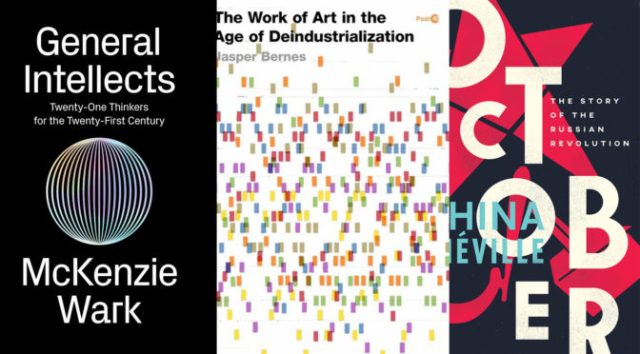
 8 Critical Theory books from May 2017 – another useful roundup from critical-theory.com
Agamben, Miéville, Hite, Derrida, Bernes, Kottman, Anderson, Werk
8 Critical Theory books from May 2017 – another useful roundup from critical-theory.com
Agamben, Miéville, Hite, Derrida, Bernes, Kottman, Anderson, Werk
 My focus for the last several weeks has been the work on Canguilhem, although as I’ve previously noted, I see these two projects as supporting each other. There have been lots of moments when I’ve thought ‘I know that because of my Foucault work’ or ‘that will come in useful when I return to Foucault’. Obviously the two thinkers are distinct, but the intellectual milieu they are within is shared for much of their careers. In terms of Canguilhem’s work, at the moment I think the biggest payoff will be if and when I turn explicitly to Foucault’s Birth of the Clinic and the work on natural history and biology In The Order of Things. But those books both develop out of work first done by Foucault in the 1950s, so I anticipate being able to set that work in a much deeper context.
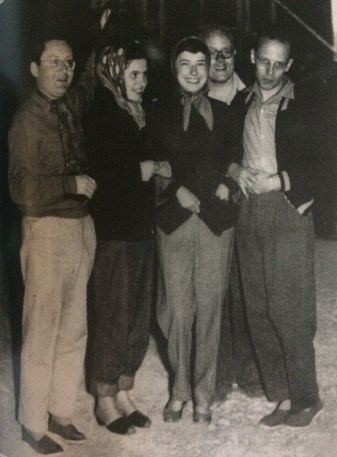
L to R: Barraqué, Marie-Claire-Piganeau, Claudette Fano, Michel Fano, Foucault
I have, however, been doing a bit of work which is explicitly on the Foucault project. One of the things I’ve been exploring is the intellectual relation between Foucault and Jean Barraqué. Barraqué was an important modernist composer, and he and Foucault had a relationship in the early 1950s, which was seemingly quite difficult and ended quite soon after Foucault moved to Uppsala. I’m not really interested in the biographical – if you are, there are indications in the Eribon and Macey biographies. There is also a good biography of Barraqué by Paul Griffiths called The Sea on Fire. But I am interested in the connection between their work. Foucault introduced Barraqué to some of the people he was reading, including Nietzsche, Heidegger and Binswanger, and also, crucially, Hermann Broch’s novel The Death of Virgil. Barraqué set one of Nietzsche’s poems to music, and his great unfinished work was a cycle of compositions around The Death of Virgil. As well as the musical works, which are relatively few – Barraqué died at 45, and the completed compositions fit on a three cd set – Barraqué also wrote quite a lot. He is perhaps best known for his book on Claude Debussy, and his unfinished study of Beethoven’s fifth symphony is also a major work, but there are some early essays which look interesting. Most are collected in Écrits. Foucault only rarely mentions Barraqué, but suggests that the break that he and Boulez made with tonal music was significant – in the same way that modernist works in literature and art also were for him. Foucault wrote about the latter two art forms extensively, of course, but little about music. Yet it was clearly important to him, though his own tastes seemed to have been mainly Mozart and Bach.
I’ve also done a little bit more work on Foucault’s translation, with Daniel Rocher, of Viktor von Weizsäcker’s Der Gestaltkreis. The story of this translation continues to intrigue. I keep looking for a physical copy of this text – I have the German original but have only been able to read the French on microfilm so far. I may take a trip to Oxford in summer, since they seem to have the only library copy in the UK. Second-hand copies have so far proved impossible to find.
As a side-trip from Amsterdam, when the University was closed for a holiday, I had a few days in Paris. These were mainly spent in the manuscripts room at the Bibliothèque Nationale. I continued working through Foucault’s early reading notes on psychology, and also took a look at some writings on painting and literature. Much of what is here has been published – some by Foucault, and some posthumously – but there were a few surprises. Much of this material, as expected, dates from the 1960s, which is after the period I am currently working on. But, if and when I turn to that later period, I now know what is here, and where. Again from the 1960s, there is some interesting material around the theme of madness, developing from the History of Madness, much of which was developed into a sequence of short publications.
One thing that struck me was, on the one hand, how productive Foucault was, and how much material there was, even on themes which might seem familiar. He would frequently write out a new version of a previous talk for a new audience, keeping some of the content and formulations but revising others. But also striking was that he gave the same paper multiple times in different places, some several years apart. It’s long been clear that he took some of his Paris lectures from the Collège de France years on the road with him; but this is from a slightly earlier period. Today, I’d imagine that many of the talks of someone of his stature would be recorded in some form, and circulated online, so making repeating material harder to do. There are lots of questions about the arrangement of the material, little of which is dated or clearly related to the place. Defert’s handwriting is often found, providing indications of where this material was likely to have been presented.
I also had a couple of short evening visits to the Mitterand site of the BnF. This allowed me to sort out a few references in the Foucault and Canguilhem work that I can’t resolve in London.
Back in Amsterdam I gave a public lecture on this work on Foucault, in which I spent the first fifteen minutes talking about the various sources I’d used for the two published books, and the rest of the talk exploring some themes from the research on the early Foucault. There was a good audience and some helpful questions.
I leave Amsterdam this weekend, and head back to a busy month. June is always hard, but this year on top of exam marking, annual reviews, dissertation advising etc. I have two PhD theses to examine and two conferences. One of the conferences is in Stockholm, and I plan to have a couple of days in Uppsala doing a little Foucault research, and I have another trip to Paris in early July, but those may be the only work on Foucault or Canguilhem for a while. In the first part of the summer I have two short pieces to write on terrain, and then need to revise the Shakespeare manuscript.
The previous updates on this project are here; and Foucault’s Last Decade and Foucault: The Birth of Power are now both available from Polity. Several Foucault research resources such as bibliographies, short translations, textual comparisons and so on are available here. On the Canguilhem project, see this page.
Some interesting discussion of ‘to do’ lists
I’m not actually much of a fan of to do lists. They aren’t actually much use, in my view, at getting things done. Like planning your writing with bullet points, to do lists often look more like wish lists by leaving the important stuff out, reducing hours or months of work into one line, without helping you to turn your list into reality… leaving you feeling like a failure at the end of the day, at the end of the month, at the end of the year.
Yeah, right.
However, it’s not always possible to keep everything you need to do in your head, so here are three strategies that have worked for me, one based on place, one based on time, and one based on outlines.
***
1. The post-it note cascade
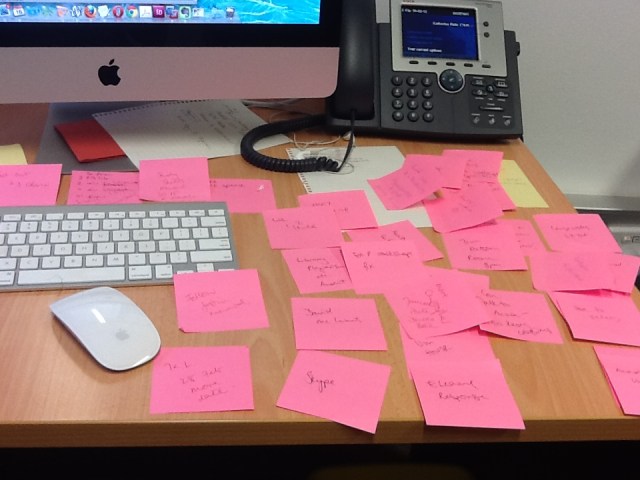
When I was working a lot on web projects…
View original post 1,499 more words
 E-IR interview with Walter Mignolo
– an excerpt from Critical Epistemologies of Global Politics – An E-IR Edited Collection
Available now on Amazon (UK, USA, Ca, Ger, Fra), in all good book stores, and via a free PDF download.
 Susan Sontag on writing – archive interview from the Paris Review. Thanks to James Tyler for the link.
 My 2011 short essay ‘Territory without Borders‘, which originally appeared in the Harvard International Review, has been translated for the May 28, 2017 issue of the Iranian paper Shargh Daily.
My thanks to Sahand Sattari for making the translation. In 2015 he also put together a full-page feature on my 2009 book Terror and Territory in Shargh Daily , which includes a translation of an interview with Exploring Geopolitics, a review of the book, and a short profile of my background, publications and current projects.
(Apologies for the earlier blank post.)
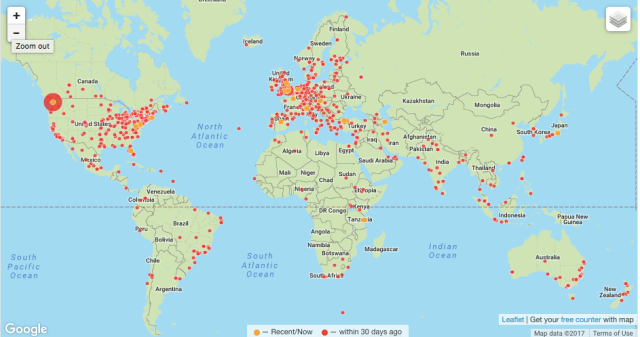
According to WordPress, there have now been just over two million views of Progressive Geographies since the blog started in 2010. The map below shows the geographical spread this month. Many thanks to everyone for reading.
My report on the ICE-LAW workshop on Territory in Indeterminate and Changing Environments, held in Amsterdam on 12 May 2017 is now available on the project website.
 Tomorrow in Amsterdam I’m giving a lecture on my research on the early Foucault:
Public Lecture: Prof. Stuart Elden (University of Warwick), “The early Foucault and the politics of European intellectual history”
Time: Wednesday 31 May, 17.00-19.00, UvA University Library, room: Doelenzaal
Registration: www.accesseurope.org/events/eventdetail/276/-/the-early-foucault-and-the-politics-of-european-intellectual-history
“Algorithmic Governance” – Antipode symposium organised by Jeremy Crampton and Andrea Miller
The following essays first came together at the 2016 AAG Annual Meeting in San Francisco. Jeremy Crampton (Professor of Geography at the University of Kentucky) and Andrea Miller (PhD candidate at University of California, Davis) assembled five panellists to discuss what they call algorithmic governance – “the manifold ways that algorithms and code/space enable practices of governance that ascribes risk, suspicion and positive value in geographic contexts.”
Among other things, panellists explored how we can best pay attention to the spaces of governance where algorithms operate, and are contested; the spatial dimensions of the data-driven subject; how modes of algorithmic modulation and control impact understandings of categories such as race and gender; the extent to which algorithms are deterministic, and the spaces of contestation or counter-algorithms; how algorithmic governance inflects and augments practices of policing and militarization; the most productive theoretical tools available for studying algorithmic data; visualizations such as maps being implicated by or for algorithms; and the genealogy of…
View original post 1,822 more words


