International Law and The Territorial Gains and Losses of Non-State Actors – project report in Diplomat Magazine by Mahmoud Abdou

I’ve mentioned a project on International Law and The Territorial Gains and Losses of Non-State Actors, run by the London Centre of International Law and Practice, before – I spoke at their launch event in London back in October. Mahmoud Abdou has an initial report on the research in Diplomat Magazine.

I’m pleased to say that Mahmoud will be starting a PhD at Warwick on a related topic in October, supervised by Markus Wagner in Law and me.

Posted in Boundaries, Politics, Territory, Uncategorized | 4 Comments

Territory in Indeterminate and Changing Environments – Amsterdam, 12 May 2017

Ice Law ColourA reminder that the first workshop of the Territory sub-theme of the ICE-LAW Project, on Territory in Indeterminate and Changing Environments, will take place at the University of Amsterdam on Friday 12 May 2017.

It will be held in the Bushuis, room E0.14C (Kloveniersburgwal 48, 1012 CX Amsterdam) – please register here

Participants include Luiza Bialasiewicz, Johanne Bruun, Stuart Elden, Juliet Fall, Marieke de Goede, Moriel Ram, Isobel Roele, Rachael Squire, Phil Steinberg and Darshan Vigneswaran. The full programme, abstracts and speaker biographies is available here.

This workshop is co-organised between the ICE-LAW project and ACCESS Europe at the University of Amsterdam. The plan is that the second workshop of this sub-theme is held at Warwick in the autumn. There are other workshops for the other sub-themes, and some sessions at conferences on the project as a whole – details here.

Posted in Conferences, Luiza Bialasiewicz, Philip Steinberg, terrain, Territory, Uncategorized | Leave a comment

Daniel McCormack, Some Lesser-Known Truths About Academe

Daniel McCormack, ‘Some Lesser-Known Truths About Academe‘ in The Chronicle of Higher Education. While this is a US focused piece, there is still much in here to consider for people in, or considering a career in higher education elsewhere. The writer is a post-doc in international politics who has decided to leave the sector.

Asking a professor whether you should pursue a Ph.D. is a little like asking The Rock — aka Dwayne Douglas Johnson, the world’s highest-paid actor last year — whether you should become an actor.

Once you enter a doctoral program, the main problem isn’t necessarily that you can’t finish. I know very few people who left graduate school because they weren’t smart enough to finish — it happens, but it’s rare. More often people leave because they just decide getting a Ph.D. isn’t for them. The truth is: It’s very difficult to understand what academic life is like until you actually try it, and lots of people try it and decide it’s not a good fit.

This, then, is why you should be wary of any advice you receive from professors about graduate school: It’s coming entirely from people who decided that academe was a good fit for them.

Posted in Uncategorized, Universities | 2 Comments

Three potential starting points for reading Thomas Pynchon

Yesterday was Pynchon’s 80th birthday. I’ve read all his books, some a few times, except Against the Day. I started it, got about 200 pages in, didn’t take it with me on a trip and never picked it up again. I should go back to it. All his books are worth the trouble, but Mason & Dixon is an especially wonderful book for anyone interested in geography…

Biblioklept's avatarBiblioklept

image1

Today is Pynchon in Public Day, so here are three books that I think may make good entry points for those interested in, but perhaps unnecessarily daunted by, Thomas Pynchon. My intuition is that many readers’ first experiences reading Pynchon may have been like mine: I read The Crying of Lot 49 as a college assignment, found it bewildering and baffling, and despite understanding almost none of it, I then attempted Gravity’s Rainbow (the key word is attempted (failed will also do in a pinch)).

Many readers start with The Crying of Lot 49 because it’s short. While I like the novel (I wrote about it here), it’s also extraordinarily dense, a box so crammed with jokes and japes that some fail to spring out at full force. Lot 49 is a much better reading experience after you’ve read more of Pynchon.

Lots of readers new to…

View original post 509 more words

Posted in Uncategorized | Leave a comment

Mary Beard – How long can it take to write a paragraph?

Mary Beard – How long can it take to write a paragraph? in the TLS.

Answer: in my case recently about three days, or — more accurately — about three days of repeatedly getting a few lines down on the screen, then either deleting them or transferring them to a separate document rather sweetly entitled ‘bits and pieces’ and starting all over again. (continues here)

Posted in Uncategorized, Writing | Leave a comment

Here Be Monsters: A Punctum Publishing Primer – Eileen Joy on the current state of academic publishing

Here Be Monsters: A Punctum Publishing Primer – Eileen Joy on the current state of academic publishing. Much to think about here.

punctum doesn’t publish books for your grandmother’s tenure and promotion committee, which somehow, through a strange process of zombie-fication, is still operating within the ossifed crevasses of the Groves of Academe and calling the (parting) shots with a thousand (cutting) sneers and impact factors. punctum believes that the only consideration that should be taken into account when assessing a colleague’s or student’s work is whether or not it makes a unique contribution to Thought, regardless of its form, style, subject matter(s), or “place of publication.” We further believe that the job of tenured faculty and administrators in the Public University (among other things like Research and Teaching) should be to improve the Working Conditions of their so-called junior colleagues and students so that unique Thought Acts, and the means and spaces for articulating those, become more possible for more persons. In this scenario, the Public University does not regulate and officiate Thought, but rather creates the hospitable Open Conditions for its creative (and groovy) emergence. [continues here]

Posted in Publishing, Uncategorized | Leave a comment

‘The Rise of Forensic Architecture’ – profile of Eyal Weizman and the agency in Architect magazine

90The Rise of Forensic Architecture‘ – a fascinating  profile of Eyal Weizman and the agency in Architect magazine.

Eyal’s book Forensic Architecture: Violence at the Threshold of Detectability is now available from MIT Press.

Posted in Eyal Weizman, Uncategorized | 1 Comment

Call for applications – Summer School for Critical Palestine/ Israel Studies, Haifa, August 2017

Mada El Carmel, a Palestinian research institute located in Haifa, is organizing a summer school that is supported by the Antipode Foundation. Full details can be found here: http://mada-research.org/en/2017/04/20/mada-summer-school-critical-palestine-israel-studies-august-2017/

Mada Summer School for Critical Palestine/ Israel Studies, Haifa, August 2017

Palestine/Israel is a contested place, suffering from occupation and colonization, while also building solidarity and resistance. It is also the home of a vibrant community of leading critical scholars—Palestinians and Israelis—who engage with the past, present, and future of their lived political realities. However, the current academic climate is dominated by a commodified perception of knowledge, which shuns genuine scholarship out of fear of political implications. In the specific context of Israeli research universities, critical thinking on Palestine/Israel is becoming more and more silenced. This is why we believe that in the current situation, critical scholarship is a political act.

Mada al-Carmel: Arab Center for Applied Social Research invites graduate students, advanced undergraduates, and post-docs, both local and international, to apply for a critical academic research seminar about Palestine/Israel. The seminar will focus on various issues, such as political and legal theory, political geography, culture, and gender. It will take place in Haifa during the first half of August 2017, and will last eight days. The program includes lectures by leading researchers, research workshops, and study tours, all of which are to be held in English.

  • Participation fees: 1500 euros, including accommodation, three meals a day, and tour fees.
  • Participation fee without accommodation: 1000 euros including three meals and tour fees.
  • Participation fees do not include airline tickets.

To submit applications please send the following to summerschool@mada-research.org :

– A cover letter explaining your interest in participating in the seminar, as well as your and research areas.

– A full CV

Deadline:  May 30, 2017

*** The seminar is dependent upon a minimum number of participants.

Full details are available here; you can read more about Mada al-Carmel here.

Posted in Uncategorized | Leave a comment

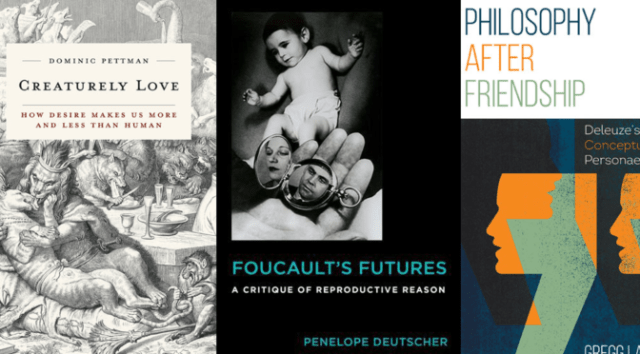
9 Critical Theory books that came out in April

Useful roundup as ever – Deutscher, de Angelis, Lambert, Schmidt, DeLanda and Harman et. al.

april-2017-critical-theory-books-672x372.png

Posted in Uncategorized | 2 Comments

Giorgio Agamben, The Omnibus Homo Sacer – forthcoming in July from Stanford University Press

pid_28469I’d seen a French translation of this, and so was wondering if there would be an English version, and here it is: Giorgio Agamben, The Omnibus Homo Sacer – forthcoming in July from Stanford University Press. 1336 pages, bringing together all the separate volumes. However, while the French is a softcover selling for about €40, the English is a $90 hardback… And you would imagine most people interested in this would already have several of the volumes included within it.

Giorgio Agamben’s Homo Sacer is one of the seminal works of political philosophy in recent decades. A twenty-year undertaking, this project is a series of interconnected investigations of staggering ambition and scope investigating the deepest foundations of every major Western institution and discourse.

This single book brings together for the first time all nine volumes that make up this groundbreaking project. Each volume takes a seemingly obscure and outdated issue as its starting point—an enigmatic figure in Roman law, or medieval debates about God’s management of creation, or theories about the origin of the oath—but is always guided by questions with urgent contemporary relevance.

The Omnibus Homo Sacer includes:

1.Homo Sacer: Sovereign Power and Bare Life

2.1.State of Exception

2.2.Stasis: Civil War as a Political Paradigm

2.3.The Sacrament of Language: An Archeology of the Oath

2.4.The Kingdom and the Glory: For a Theological Genealogy of Economy and Glory

2.5.Opus Dei: An Archeology of Duty

3.Remnants of Auschwitz: The Witness and the Archive

4.1.The Highest Poverty: Monastic Rules and Form-of-Life

4.2.The Use of Bodies

Posted in Giorgio Agamben, Publishing, Uncategorized | Leave a comment