Territory – The Map is Not…

Thanks to dmf for pointing me to this intriguing project: Territory – themapisnot.com

Territory is a literary project about territories and the maps that will always fail to capture them. It’s about the naive dream of objectivity, and how we use the act of representation to both hide and broadcast our subjectivities.

The map has a specific allure. It reduces the complexity of the world to a manageable space, and suggests distant lands are not so distant. In this miniaturized space, it’s easy to envision an entire world. Perhaps too easy—maps often destroy through their creation. They are a barbaric art, or an art used for politics and propaganda.

This is why maps are instruments of both progress and regress. They inspire and enable discovery, but also conquest and colonization. They tell some histories while denying others. They both reveal and conceal the spaces they circumscribe. The map is not the territory, surely, but then why is our world built on so many getting this so wrong?

Territory wants to understand these paradoxes by understanding the maps that inspire them. We invite writers, musicians, and other artists to respond to maps and the fallacies they engender, in turn creating secondary maps. We then present these two maps side-by-side as a means of getting at, but still failing to capture, the underlying territory. We are building an atlas knowing it will be a reduction, an anachronism, a distortion. But we build it anyway.

There are some issues available already, and calls for contributions to two more are listed (though the first date has passed):

Submissions for our upcoming Treasure and Prisons issues are now open. The deadline for Treasure is March 15, 2017 and the deadline for Prisons is June 1, 2017.

What we publish

We’re looking for works of literature, music, and other art that either/or…

  • are about maps and the paradoxes they engender.
  • are maps of some territory.
  • respond to an existing map in some way (i.e. ekphrasis). We find it helpful to think of the relationship between map and map-response in terms of prepositions. For example, you might…
    • construct a narrative that takes place within the map.
    • translate the map from its current medium to another.
    • map the territories outside the map.
    • write about a specific map, which is to say, explore the circumstances, history, and meaning of this particular object.

We want to expand our sense of what a map can be.

For resources, see the Database and Feeds section of our Other Territories page.

Posted in Territory, Uncategorized | 1 Comment

Another critique of academia.edu – at Diggit Magazine

Another critique of academia.edu – ‘The end of Academia.edu: how business takes over, again‘ at Diggit Magazine. See also my post from earlier this year ‘Delete your academia.edu account… (there are other ways to share your work)‘ and the comments to that post for arguments against.


Posted in Publishing, Uncategorized, Universities | 1 Comment

Our Digital Rights to the City

An open access collection of papers on the Digital Rights to the City – which includes Kurt Iveson’s ‘Digital labourers of the city, unite!’ (also at Progress in Political Economy, as linked yesterday).

dmf's avatarDeterritorial Investigations

Meatspace Press

http://meatspacepress.org/#download
“‘Our Digital Rights to the City’ is a small collection of articles about digital technology, data and the city. It covers a range of topics relating to the political and economic power of technologies that are now almost inescapable within the urban environment. This includes discussions surrounding security, mapping, real estate, smartphone applications and the broader idea of a ‘right to the city’ in a post-digital world.”

Should we feed all the data for a given problem to a computer? Why not? Because the machine only uses data based on questions that can be answered with a yes or a no. And the computer itself only responds with a yes or a no. Moreover, can anyone claim that all the data have been assembled? Who is going to legitimate this use of totality? Who is going to demonstrate that the “language of the city”, to the extent that it…

View original post 57 more words

Posted in Uncategorized | Leave a comment

Kurt Iveson, ‘Digital labourers of the city, unite!’ at PPE

Kurt Iveson, ‘Digital labourers of the city, unite!’ at Progress in Political Economy.

For growing numbers of urban inhabitants, smartphones and their mobile apps have become essential tools for everyday life.

In the decade since smartphones first became popularised, many millions of people in cities around the world have grown used to using apps for finding and making our way around the city, for hooking up with friends or potential lovers, for sharing things or thoughts or pictures, for playing games, and for many more things besides.

It may seem as though these apps are working for us – improving our experience of the city. But I think this is to put it the wrong way around – or at least, to tell only half the story. We are also working for the apps. [continues here]

Posted in Uncategorized | 2 Comments

Writing a book on Georges Canguilhem for Polity’s Key Contemporary Thinkers series

Foucault and Canguilhem

Jean Hyppolite, Michel Foucault, Georges Canguilhem, Dina Dreyfus, 1965 (source: Institut national de l’audiovisuel, via Foucault Blog)

As part of my research on the very early Foucault, I’ve been looking at the work of some of his teachers and other inspirations. One of those figures was Georges Canguilhem, who ended up being the rapporteur for Foucault’s doctoral thesis on the history of madness. Canguilhem is a major figure in the history and philosophy of science, best known for The Normal and the Pathological, but author of several other important studies. Many, but by no means all, of his works are translated into English. The links between Canguilhem and Foucault are not quite as straight-forward as are sometimes claimed, with Foucault having written the entire thesis before showing it to Canguilhem, and it’s not clear that Foucault actually attended any classes by him in the early 1950s. Nonetheless Foucault certainly knew his work well, and wrote a preface to the English translation of The Normal and the Pathological. In turn, Canguilhem commissioned accepted Birth of the Clinic for a series he edited, reviewed some of Foucault’s books and was instrumental in getting Foucault at least two of his academic positions. Canguilhem’s influential role in French philosophy generally, not least because of the administrative roles he occupied, is also crucial.

But for many of these thinkers, I am also interested in their own work, beyond whatever influence they had on Foucault. With some of them, like Maurice Merleau-Ponty, there is an extensive secondary literature which I can use to supplement my reading of the primary texts. For others, there is less literature, but they are more minor figures, and so this is perhaps not surprising. But with Canguilhem it struck me as unusual that there was no biography in any language, and that while there was a decent literature in French, there was no single book devoted to his work in English.

Of course, there is some literature on Canguilhem in English, but it tends to be chapters within wider studies, a couple of journal theme issues devoted to his work, or standalone articles. Gary Gutting discusses Canguilhem, alongside Gaston Bachelard, in the opening chapter of Michel Foucault’s Archaeology of Scientific Reason, and Dominique Lecourt’s Marxism and Epistemology pairs a translation of a book on Bachelard with a study of Bachelard, Canguilhem and Foucault. Some of the best literature in English is in the introductions to translations of his work. Aside from Lecourt’s work, the best work in French is by Guillaume Le Blanc and Xavier Roth. But there isn’t a comprehensive study in English, and his influence and importance seems to deserve one. I therefore spoke to my editor at Polity and said that it seemed to me to be a real absence from their Key Contemporary Thinkers series. He said they’d think about it, and later came back to me to say, ‘yes, we think this is a good idea. Will you write it?’

This genuinely wasn’t my intention, and I even had a couple of names in mind as suggestions for such a book. But I did give it a lot of thought, and kept returning to the idea. I do think that in order to write The Early Foucault well I will need to understand the intellectual milieu Foucault was brought up in, and Canguilhem is certainly a central figure there. Foucault’s early interests in psychology, medicine, biology and his work translating Binswanger and von Weizsäcker have several connections to Canguilhem’s interests. In other words, the research I am doing for The Early Foucault would put me in a good position to write a book on Canguilhem. As I did more reading around Canguilhem’s work I became interested in the ongoing project of the Oeuvres complètes, and the rediscovery of some of his earliest works, which are more political and more broadly philosophical. There is also an archive of his papers in Paris, and little of the literature, certainly not in English, makes use of either of these sources. So, for me it would be intellectually worthwhile: it wouldn’t just be an English language book which does the work that has already been done in French; and to understand Canguilhem I would have to read widely in literature I don’t currently know.
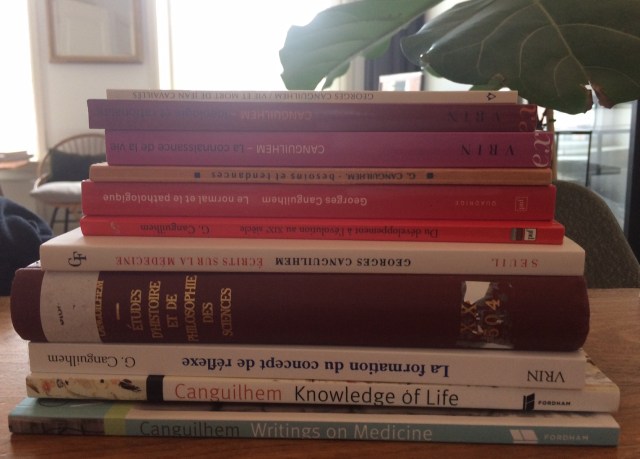
Canguilhem books

So, about a month ago, after quite a bit of initial work, I said that I was potentially interested in doing this and sent Polity a proposal for the project. It went out to review and received three positive reports from readers. I received the news that the book would be contracted for the series, along with the reports, just after I arrived in Amsterdam. I knew the editorial board was meeting on the same day I flew out here.

I took a calculated gamble, given Polity’s initial enthusiasm for the idea, and came here with a pile of books by Canguilhem. I have some of the other English translations as pdfs with me, and the two volumes of the Oeuvres complètes are on their way here. I’ve said before that the Foucault work is not very portable, and that the best place for me to work on it is my home study. I will doubtless do something toward it on this trip. But the Canguilhem work does travel, and so I hope to make a good start on this book while here. The plan is that I write both this book on Canguilhem and The Early Foucault in parallel over the next couple of years.

Posted in Canguilhem (book), Georges Canguilhem, Jean Hyppolite, Maurice Merleau-Ponty, Michel Foucault, The Early Foucault, Uncategorized | 9 Comments

Terrain’s Volume – video of my lecture to the Technologies of Space symposium in Oslo

Terrain’s Volume – video of my lecture to the Technologies of Space: Verticality, Volume, Infrastructure symposium in Oslo in March 2017. The overall introduction is by Liv Hausken; the introduction to my lecture is by Susanne Østby Sather. The version here doesn’t show the images from the powerpoint, unfortunately.

[update: a different version of effectively the same lecture is available – it has the images, but unfortunately the audio quality is poor – caused by a microphone on my jacket – “Towards a Political Theory of Terrain”, Institute of Advanced Study public lecture, Durham University, 6 February 2017 – video. Two other versions of this lecture, in Gießen and in London were also recorded, and I’ll share if/when available.]

One of the other lectures from Oslo, by Mark Dorrian on ‘Archaeologies of the Future’, is also available.

Update 2: the London version of this lecture is now available. This is the best quality version, which includes the images and quotes integrated into the presentation.

Posted in terrain, Territory, Terror and Territory, The Birth of Territory, Uncategorized | 6 Comments

Derek Gregory’s tribute to geography editor John Davey

Derek Gregory has written a nice tribute to geography editor John Davey, who died recently. Davey worked with Edward Arnold and Blackwell, and published David Harvey’s early books, as well as many others, including Derek’s Geographical Imaginations. I didn’t know him in person, but certainly knew of his reputation and the frequency with which he was mentioned in book acknowledgements says something of his considerable status in the field.

Update: Clive Barnett also remembers John Davey here.

Posted in David Harvey, Derek Gregory, Publishing, Uncategorized | Leave a comment

The answer is – Giorgio Agamben

The answer to last night’s question ‘Which one of these social theorists and philosophers have I not heard speak?‘ is Giorgio Agamben. He was supposed to be at a conference I attended, but cancelled, and I’ve never had another chance.

Thanks to those who replied here, on Twitter or Facebook. Gisele O’Connoll came very close with her ‘Can I have two guesses? Agamben or Habermas?’, but when I insisted on just one, went with Habermas. Adam Morton was the first to get Agamben.

Posted in Uncategorized | Leave a comment

Which one of these social theorists and philosophers have I not heard speak?


There is a Facebook meme at the moment, where people list several bands or singers, all but one of which they have seen perform live. But I like Simon Glendinning’s version. So, which one of these social theorists and philosophers have I not heard speak?

  1. Giorgio Agamben
  2. Alain Badiou
  3. Etienne Balibar
  4. Zygmunt Bauman
  5. Seyla Benhabib
  6. Manuel Castells
  7. Wendy Brown
  8. Judith Butler
  9. Jacques Derrida
  10. Umberto Eco
  11. Nancy Fraser
  12. Jürgen Habermas
  13. Stuart Hall
  14. Luce Irigaray
  15. Naomi Klein
  16. Jacques Rancière
  17. Richard Rorty
  18. Gayatri Chakravorty Spivak
  19. Peter Sloterdijk
  20. Cornel West
  21. Slavoj Žižek

Update: the answer is Giorgio Agamben. He was supposed to be at a conference I attended, but cancelled, and I’ve never had another chance.

Posted in Uncategorized | 6 Comments

Deborah Cowen interviewed by Haley Markbreiter at Full Stop

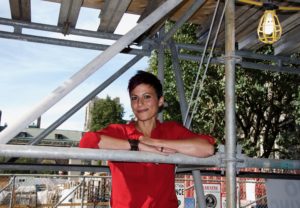
Deborah-Cowen-300x208Deborah Cowen interviewed by Haley Markbreiter at Full Stop:

In my favorite Google Image search result for “Deborah Cowen,” she is posed against scaffolding. The picture, like Cowen, is funny, and to the point: she is, after all, a scholar of logistics and infrastructure…

During our phone call, Cowen often apologized for getting so enthusiastic about “boring” topics like the shipping container. But her analysis of logistics and its relationships to the criminalization of protest and labor strikes, the shift to national security as protection of trade flows instead of the protection of people, and the corporate appropriation of military techniques have wide-ranging and very non-boring effects for surveillance studies, immigrants, and anyone following the infrastructural conflicts around #NODAPL and the water pipes in Flint, MI. [continues here]

Posted in Deborah Cowen, Uncategorized | Leave a comment