Christopher Watkin’s research hacks on conference presentations

Now updated with links to subsequent posts

stuartelden's avatarProgressive Geographies

Research hacks #14: 15 tips on planning and writing a conference paper

Research hacks #15: Tips on delivering a conference paper

Research hacks #16: 20 tips on timekeeping and technology for your conference presentation

Research hacks #17: 15 tips on fielding questions after a conference paper

The rest of this useful series are here.

View original post

Posted in Uncategorized | Leave a comment

Academic Writing – a few links

The Myth of One more Source by Joli Jensen at Chronicle Vitae

Writing Better Won’t Cure Your Academic Woes by Maximillian Alvarez at the Chronicle of Higher Education

Jon Winokour’s Advice to Writers – daily posts of quotes from the past

Finally, the pain – Academic writing tips by Marika Rose at An und für sich

There are several posts from Progressive Geographies about writing and publishing, and a lot more links, archived here.

Posted in Uncategorized | Leave a comment

Bruno Latour, The New Climate in Harper’s Magazine (open access)

GieselbergerFBruno Latour, The New Climate in Harper’s Magazine (open access)

By Bruno Latour, from The Great Regression, a collection of essays edited by Heinrich Geiselberger that will be published next month by Polity. Latour is a philosopher and the author, most recently, of An Inquiry into Modes of Existence. Translated from the French by Andrew Brown.

Ever since the American elections of November 2016 things have become clearer. Europe is being dismembered: it counts less than a hazelnut in a nutcracker. And this time around, it can no longer rely on the United States to fix anything.

Perhaps this is the time to reconstruct a United Europe. Not the same one that was dreamed up after the war, a Europe based on iron, coal, and steel, or the one more recently built on the deluded hope of escaping from history via standardization and the single currency. No — if Europe must reunite, it is because of the grave threats it is facing: the decline of its states that invented globalization; climate change; and the need to shelter millions of migrants and refugees. (continues here)

Posted in Bruno Latour, Uncategorized | Leave a comment

Announcing Radical Philosophy series 2

Good news from Radical Philosophy about their relaunch – here.

Posted in Uncategorized | 1 Comment

London International Boundary Conference, 5-6 June 2017

London International Boundary Conference, 5-6 June 2017 – full details here.

The London International Boundary Conference 2017 will take place on 5-6 June 2017 at King’s College London’s Strand campus, with Technical workshops being held on the mornings of 6-7 June.

The event will provide a unique and multidisciplinary insight into the complex world of international boundary and sovereignty disputes. Speakers and panelists will be among the world’s leading experts and practitioners in the field.

The speakers will examine recent developments in “hotspots” around the world, and discuss new and emerging ideas for the resolution and management of territorial issues from legal, geopolitical, technical, commercial and other viewpoints. The conference will examine how these issues affect such issues as: energy transportation; hydrocarbon and mineral exploration and extraction; migration; indigenous peoples; inter-State boundary and sovereignty disputes.

The London International Boundary Conference will attract all those with an interest in international boundary and sovereignty issues from the governmental, academic, commercial and IGO sectors. Representatives from UK and international media will be attending the Conference. The Conference, which will be a not-for-profit event, will be hosted by the King’s College London (Department of Geography) and Volterra Fietta, the public international law firm.


Posted in Boundaries, Conferences, Uncategorized | Leave a comment

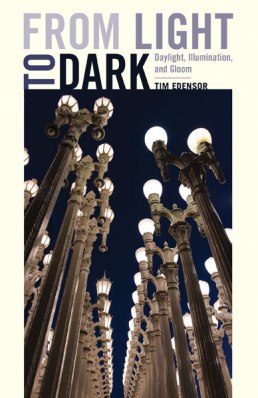
Tim Edensor, From Light to Dark: Daylight, Illumination, and Gloom – now out from University of Minnesota Press

imageTim Edensor, From Light to Dark: Daylight, Illumination, and Gloom – now out from University of Minnesota Press

Light pervades the world, and when it is not light, darkness emerges and is combated by electric illumination. Despite this globally shared human experience in which spaces appear radically different depending on time, season, and weather, social science investigation on the subject is meager. From Light to Dark fills this gap, focusing on our interaction with daylight, illumination, and darkness.

Tim Edensor begins by examining the effects of daylight on our perception of landscape, drawing on artworks, particular landscapes, and architectural practice. He then considers the ways in which illumination is often contested and can be used to express power, looking at how capitalist, class, ethnic, military, and state power use lighting to reinforce their authority over space. Edensor also considers light artists such as Olafur Eliasson and festivals of illumination before turning a critical eye to the supposedly dangerous, sinister associations of darkness. In examining the modern city as a space of fantasy through electric illumination, he studies how we are seeking—and should seek—new forms of darkness in reaction to the perpetual glow of urban lighting.

Highly original and absorbingly written, From Light to Dark analyzes a vast array of artistic interventions, diverse spaces, and lighting technologies to explore these most basic human experiences.

Posted in Uncategorized | 1 Comment

NDPR reviews – Foucault/Derrida, Heidegger on Nietzsche and Nail’s Theory of the Border

9780231171953Three interesting reviews at NDPR

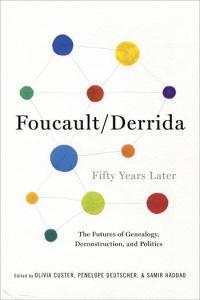
Olivia Custer, Penelope Deutscher, and Samir Haddad (eds.), Foucault/Derrida Fifty Years Later: The Futures of Genealogy, Deconstruction, and Politics by Christopher Penfield – here

Thomas Nail, Theory of the Border by Avery Kolers – here

Martin Heidegger, Interpretation of Nietzsche’s Second Untimely Meditation by Tracy Colony – here

Posted in Boundaries, Friedrich Nietzsche, Jacques Derrida, Martin Heidegger, Michel Foucault, Uncategorized | 4 Comments

Hubert Dreyfus obituary by Sean Kelly

Hubert Dreyfus obituary by Sean Kelly at Daily Nous.

Update: The Berkeley obituary is here.

Posted in Uncategorized | Leave a comment

Can you have too much writing time? – some discussion at Explorations of Style

Can You Have Too Much Writing Time?

A few weeks ago, I received an email from a former student, asking for some advice about managing a summer of writing. With her permission, I am sharing her email and my reflections on our conversation.

Some good advice and discussion at the Explorations of Style blog, which continues into the comments. I shared ‘my sabbatical rules for writing‘ back in September 2015, and they worked quite well for me then. Of course, more time and less time are relative, and small amounts of time can add up to something larger. With any amount of time, the questions are what could be achieved realistically, and how could it be achieved.

The key line for me in this piece is “A generous block of writing time is an opportunity, not a solution.” Of course, it’s a great opportunity, but without some thought, planning and discipline, it may not be what you expect it to be. Much to think about here.


Posted in Publishing, Uncategorized, Writing | Leave a comment

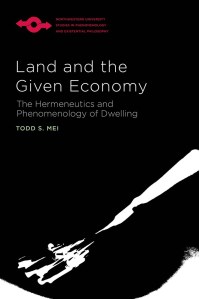
Todd S. Mei, Land and the Given Economy: The Hermeneutics and Phenomenology of Dwelling

land-and-the-given-economyTodd S. Mei, Land and the Given Economy: The Hermeneutics and Phenomenology of Dwelling. Here’s the publisher description:

Alarming environmental degradation makes ever more urgent the reconciliation of political economy and sustainability. Land and the Given Economy examines how the landed basis of human existence converges with economics, and it offers a persuasive new conception of land that transcends the flawed and inadequate accounts in classical and neoclassical economics.

Todd S. Mei grounds this work in a rigorous review of problematic economic conceptions of land in the work of John Locke, Adam Smith, David Ricardo, John Stuart Mill, Karl Marx, Henry George, Alfred Marshall, and Thorstein Veblen.

Mei then draws on the thought of Martin Heidegger to posit a philosophical clarification of the meaning of land—its ontological nature. He argues that central to rethinking land is recognizing its unique manner of being, described as its “givenness.” Concluding with a discussion of ground rent, Mei reflects on specific strategies for incorporating the philosophical account of land into contemporary economic policies.

Revivifying economic frameworks that fail to resolve the impasse between economic development and sustainability, Land and the Given Economy offers much of interest to scholars and readers of philosophy, environmentalism, and the full spectrum of political economy.

The book is reviewed at NDPR by Casey Rentmeester.

Posted in Uncategorized | Leave a comment