I don’t plan to write detailed posts on the work I’m doing on Georges Canguilhem for the book for Polity’s Key Contemporary Thinkers series, unlike the ones which I’ve been writing on the work on Foucault. (More background on this project here.)
Part of the reason for this is that the research and writing for this book are likely to run in parallel with the work for The Early Foucault, and so the updates for the writing of that book will cover some of the material for this one. In addition, because I will be writing a single book on the whole of Canguilhem’s work, and for an introductory series, it will necessarily be a different type of book to the Foucault ones. The Foucault ones are written, as should be obvious, for an audience who already know at least something about Foucault. They are not, and never were intended to be, introductory. They are attempts at answering questions in intellectual history: how did Foucault’s History of Sexuality shift from the thematic version he outlined in the mid 1970s to the chronological version he was working on until his death? How did Foucault move from The Archaeology of Knowledge to Discipline and Punish, and how did his political activism and collaborative research shape that path? How did Foucault come to write the History of Madness and how does this relate to his early teaching, publications and translations? In all, how does the newly available material, both published and archival, shed new light on his work as a whole?
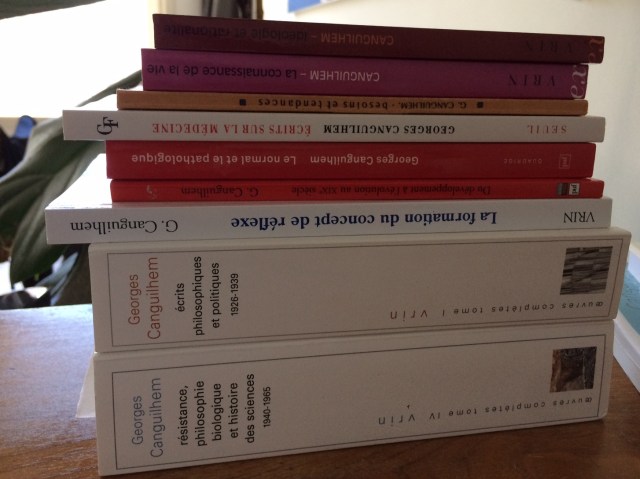
With Canguilhem, while I hope to do some work with the archive, the predominant sources are going to be the works published in his lifetime. With his earliest writings this task is helped immeasurably by the publication of the first two volumes of his Oeuvres complètes – Volume I covers all the published writings from 1926 to 1939; and Volume IV those from 1940 to 1965, with the exception of those which appeared in book form in his life. The books themselves will appear in Volumes II and III – the three theses of The Normal and the Pathological, Knowledge of Life and the untranslated La formation du concept de réflexe aux XVII et XVIII siècles in Volume II; and the collected studies Études d’histoire et de philosophie des sciences, Ideology and Rationality and the collaborative Du développement à l’évolution au XIX siècle in Volume III. While it will be good to have those volumes when they are published, all that material is easy to find in the separately published books. Volume V will comprise shorter writings from 1966 until Canguilhem’s death, and Volume VI will include a bibliography, a biographical essay by Camille Limoges, an index and some administrative texts and aggregation reports. It would be great to have those available soon, while I’m still working on this book, but I’m not counting on it – Volumes I and IV appeared in 2011 and 2015, so the timescale doesn’t seem likely. Volume V would doubtless save me a huge amount of work in tracking down articles and chapters, and some hard-to-find outlets. But as I discovered when working on Foucault, while Dits et écrits is invaluable, I did often find additional things by tracking down the pieces in their original outlets.
This approach of working on the published work, and writing the first book on Canguilhem in English, will mean a different approach. I’m much more concerned with trying to situate the elements of his work in relation to each other, distil some general insights about his approach, provide some context on his formations and legacies and so on. In other words, I won’t be making the same kind of claims about Canguilhem as I was with Foucault. The aim of this book is synoptic and synthetic, not investigative and forensic.
As such, I don’t imagine that the research and writing process will be of much interest to anyone, at least not to the degree I’ve been outlining it with Foucault. However, I did wonder if it might be worth saying just a bit more about Canguilhem and the work I’m doing on him in general terms. So far, I’ve been working through his texts slowly and carefully, taking very detailed notes and beginning to think how these might be arranged. While I’d read all the major works before, I’d never worked on them with this much care. I am mindful of the risk of writing an overtly Foucauldian take on Canguilhem, and so I’ve deliberately avoided The Normal and the Pathological for the moment. I read that book first over twenty years ago, during my PhD, and have still got the notes. But it seems to me that much of the Anglophone work on Canguilhem reads him through the lens of that book, and while I will obviously discuss it at length, I don’t want it to be the book through which I see all the others. While it was his doctoral thesis in medicine, the reflex book was his doctoral thesis in philosophy, with Knowledge of Life the secondary thesis.
I’ve been very impressed with the recent translations of Canguilhem, for the Knowledge of Life and Writings on Medicine. As is my usual practice, all translated texts are dual referenced to the French as well, and I often modify existing translations. This is not because I think my translations are better than the published ones, but that I want to ensure they are consistent, and this can only be done by reworking at least some of them. I began my detailed note taking with Knowledge of Life and Writings on Medicine, partly because they were ones seemingly furthest from the ‘Foucauldian’ Canguilhem, but also because they were the most recent translations. I’ve found almost nothing to fault in the work done here, and the choices seem both justified and likely to shape how I render untranslated material. In the last week I’ve begun working more extensively on Ideology and Rationality and the largely untranslated collection Études d’histoire et de philosophie des sciences.
Ideology and Rationality was the second of Canguilhem’s books to appear in English, translated by Arthur Goldhammer almost thirty years ago. I’m modifying the translations a bit more here. Again, this is hardly because I think I’m better than Goldhammer, but partly due to vocabulary. Milieu has to be ‘milieu’, I think, rather than ‘environment’, for example – in order to be consistent with more recent translations and the contemporary debates about this term. In additional, Goldhammer is perhaps more of a stylised translator than I would be, untangling some of Canguilhem’s knottier sentences and reordering clauses or breaking them into two. His translations doubtless read better in English, but I’d prefer the English to match the French more closely because I’m interested in what I think Canguilhem was trying to say, in the way that he said it, rather than simply what he probably meant. If I want to do the latter, then I will paraphrase; if I want to quote then it is to give his words and constructions. At his best, Canguilhem is a lovely writer (with many texts written to be spoken) with aphoristic and endlessly quotable sentences. At his worst, well let’s just say he’s a representative figure from a particular generation of French thought. I should add that like Foucault at times, and Lefebvre nearly all the time, Canguilhem is another one who is sloppy with his references… Fortunately his editors have often already corrected many of his mistakes.
With many of the other texts I’ll be forced to make my own translations. Parts of Études d’histoire et de philosophie des sciences and the book on the reflex appear in A Vital Rationalist, which was a collection edited by François Delaporte in the 1990s. This was again translated by Goldhammer. But as David Macey noted in a review which appeared in Radical Philosophy in 1996, the collection does not provide full essays or chapters, but instead comprises “edited extracts arranged in thematic order. Sentences and even whole paragraphs have been cut and there is nothing to bring the elisions to the reader’s attention”. Even when most of an essay from the Études has been included, this is often presented in a different order to how Canguilhem published it, with other material inserted into it or a different framing. The references given are not always fully accurate. As Macey continues, the collection suffers too from “the complete abolition of chronology [which] makes it impossible to trace the development of Canguilhem’ s thought… Canguilhem’s work was always characterized by a scrupulous attention to detail: King Cang deserves better than this”. As such, I’ve been using it only very carefully, always in relation to the French source text.
Of course, the links between Foucault and Canguilhem don’t neatly map onto single books, and there are so many links between them that there are common interests almost everywhere you look. All the material on the shift from natural history to biology in The Order of Things, and the discussions in The Birth of the Clinic on anatomy and medicine connect to Canguilhem’s work, and touch on themes which he developed at great length. Canguilhem commissioned the latter book of Foucault’s for a series he edited. This is not a one-way process either: while Canguilhem’s work certainly influenced Foucault’s thinking, Canguilhem regularly draws on Foucault’s work to develop and return to previous themes in his writing. My hunch that working with this level of detail on Canguilhem would be useful for the Foucault work is already paying off; though I suspect it will be of most use for the 1960s Foucault, rather than the 1950s which is my current focus.
I’m at the half way point of my time in Amsterdam, and so far it has felt very productive on this project. The ICE-LAW workshop on Friday was an intellectually stimulating break from this, with a range of really thoughtful papers and some great discussion. A fuller discussion of that will follow on the project website, and I’ll link to it from here. I’ve also been dealing with some of the standard term three things like essay marking and other administration – much done online these days, so being away is no excuse… I’m heading to Paris for a few days later this month to do a bit more archival work on Foucault, before I give my public lecture here on that work (details here). When I get back to the UK I will need to turn to exam marking, some other Warwick things and different research work, so I’m keen to make as much use of the time here to forge ahead with the Canguilhem project.
 A reminder that the first workshop of the Territory sub-theme of the

 ‘
‘