The Complete and Original Norwegian Folktales of Asbjørnsen and Moe, trans. Tiina Nunally – University of Minnesota Press, August 2025

The Complete and Original Norwegian Folktales of Asbjørnsen and Moe, trans. Tiina Nunally – University of Minnesota Press, August 2025

The definitive English translation of the celebrated story collection regarded as a landmark of Norwegian literature and culture—now in paperback

The extraordinary folktales collected by Peter Christen Asbjørnsen and Jørgen Moe began appearing in Norway in 1841. Over the next two decades the publication of subsequent editions under the title Norske folkeeventyr made the names Asbjørnsen and Moe synonymous with Norwegian storytelling traditions. Tiina Nunnally’s vivid translation of their monumental collection is the first new English translation in more than 150 years—and the first ever to include all sixty original tales. 

Magic and myth inhabit these pages in figures both familiar and strange. Giant trolls and talking animals are everywhere. The winds take human form. A one-eyed old woman might seem reminiscent of the Norse god Odin. We meet sly aunts, resourceful princesses, and devious robbers. The clever and fearless boy Ash Lad often takes center stage as he ingeniously breaks spells and defeats enemies to win half the kingdom. These stories, set in Norway’s majestic landscape of towering mountains and dense forests, are filled with humor, mischief, and sometimes surprisingly cruel twists of fate. All are rendered in the deceptively simple narrative style perfected by Asbjørnsen and Moe—now translated into an English that is as finely tuned to the modern ear as it is true to the original Norwegian. 

Included here—for the very first time in English—are Asbjørnsen and Moe’s Forewords and Introductions to the early Norwegian editions of the tales. Asbjørnsen gives us an intriguing glimpse into the actual collection process and describes how the stories were initially received, both in Norway and abroad. Equally fascinating are Moe’s views on how central characters might be interpreted and his notes on the regions where each story was originally collected. Nunnally’s informative Translator’s Note places the tales in a biographical, historical, and literary context for the twenty-first century. 

The Norwegian folktales of Asbjørnsen and Moe are timeless stories that will entertain, startle, and enthrall readers of all ages.

Posted in Uncategorized | Leave a comment

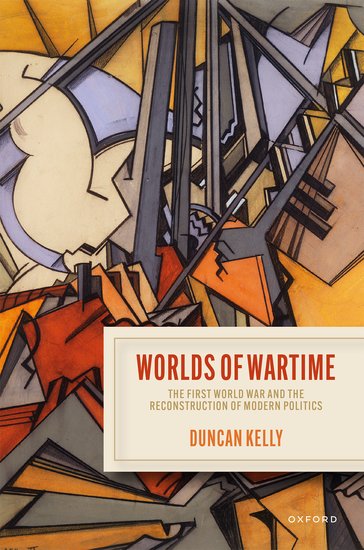
Duncan Kelly, Worlds of Wartime: The First World War and the Reconstruction of Modern Politics – Oxford University Press, November 2025

Duncan Kelly, Worlds of Wartime: The First World War and the Reconstruction of Modern Politics – Oxford University Press, November 2025

A major study, of a massive topic – 784 pages!

The First World War hardly ended with the formal Armistice in Europe on November 11, 1918, amid the continuing violence of blockades and epidemics, amid numerous forms of reconstruction and revolution. Its legacies, in fact, resonate deeply in our present. Nor is it obvious that it only began on July 28, 1914, just a month after the assassination of the Archduke Franz Ferdinand, in Sarajevo. Rather than these formal legal openings and closings, the beginnings and endings of wartime are many, depending upon the questions we ask, and the frames of reference we provide. For many at the time, the outbreak of what would become the First World War was an inevitability, the result of rising tensions over decades, whether due to the dynamics and systems of international politics within Europe, or a result of the competitive logic of imperial politics as practised by Europe outside its borders, rebounding back upon it. This resulted in equally persistent ideas down to our own time, about the inevitability that followed from victory; namely, that to be successful and realistic, modern politics and economics must necessarily be fixed in the form of a democratic nation-state. But this new world of democracy, forged in war, could easily become its own sort of intellectual prison-house, curating and limiting political and economic possibilities just as securely as any form of tyranny. That the tyranny of victory was a danger recognized by many of the leading analysts of the First World War at the time, helped to foster a continued search for ideas that might keep the worlds of politics and economics open to alternative futures, rather than being closed by the force of a few great powers or the presentational fiat of democracy. Those hopes paved the way for the wide variety of anti-imperial, federal, diasporic, and revolutionary forms of political and economic arrangements, which were designed to challenge the seemingly inevitable rise of the nation-state. 

Worlds of Wartime: The First World War and the Reconstruction of Modern Politics provides a new intellectual history of the many and varied ideas about politics and economics that were made, and remade, through wartime and revolution, by political and economic thinkers working across the globe, from the 1880s to the 1930s. Spanning continents, connecting networks of people, power, and possibilities, in new and often experimental ways, the worlds of wartime saw histories of modern politics and economics revised and updated, used as well as abused, in myriad attempts to interpret, explain, understand, explore, and indeed to win, the war. This book takes the measure of a great many of these overlapping visions, and it does so by trying to learn some of the lessons that literary and artistic modernism can teach us about the complexities of political and economic ideas, their contingency and uncertainty, and how they are fixed into focus only at very particular moments. Moving from the stylised narratives of European and American political theory and intellectual history, through to the futurist politics of revolutionaries in Ireland, India, Ottoman-Turkey, and Russia, this book also tracks arguments and strategies for Pan-African diasporic federation, alongside German and American debates about federal pasts and federal futures. From the invention of the world economy, to the reality of multiple war economies, from revolutionary conjunctures to ideas of democracy and climate catastrophe in the Anthropocene today, Worlds of Wartime tells the story of just how strongly modern politics in general, and modern ideas about political and economic possibility, were fixed by the intellectual turbulence wrought during the First World War.

Posted in Uncategorized | Leave a comment

Jeffrey Andrew Barash, The Politics of Historical Interpretation:  Reflections on Ideology and the Perplexities of Political Myth – De Gruyter Brill, August 2025

Jeffrey Andrew Barash, The Politics of Historical Interpretation:  Reflections on Ideology and the Perplexities of Political Myth – De Gruyter Brill, August 2025

This book focuses on political presuppositions animating modern historical reflection in Germany that underwent sharp radicalization in the post-World War I context of the Weimar Republic. It is in this context that a novel polemical use of political concepts, nourished by radical forms of reflection on the historical character of human existence, brought to the fore interpretations of collective mentalities or group perspectives that crystallized in specific conceptions of “ideology” and of “political myth”. By centering analysis on the insight of a variety of twentieth-century thinkers whose works are of central importance for the elucidation of this topic, the author examines different interpretations of the role of reflection on human historicity in the elaboration of this novel polemical use of political concepts. Beyond an historical inquiry into this topic, this work aims to provide a theoretical investigation to elucidate the complex range of significations of the concepts of “ideology” and of “political myth”, the province of each of these concepts in the delineation of group perspectives, and the problematic legacy that the polemical use of these concepts has bequeathed to the contemporary world.

Posted in Carl Schmitt, Ernst Cassirer, Martin Heidegger, Uncategorized | Leave a comment

Don Thomas Deere, The Invention of Order: On the Coloniality of Space – Duke University Press, January 2026

Don Thomas Deere, The Invention of Order: On the Coloniality of Space – Duke University Press, January 2026

In The Invention of Order, Don Thomas Deere retraces the colonial origins of spatial organization in the Americas and the Caribbean and its lasting impact on modern structures of knowledge, power, race, gender as well as understandings of global modernity. The coloniality of space dispossessed Indigenous, African, and mixed populations as it constructed new systems of control and movement. Deere demonstrates how these developments manifested, among other forms, in urban grid patterns imposed during the development of Spanish colonial cities as well as totalizing trade routes crisscrossing the Atlantic. Drawing on a range of thinkers including Enrique Dussel, Édouard Glissant, and Sylvia Wynter, Deere reveals how movement—who travels, who settles, and who is excluded—becomes an essential component of control under colonial rule. Against the violence of spatial reordering, Deere outlines how novel forms of resistance and insurgency geographies still take hold, particularly in the Caribbean, where landscapes remain excessive, eruptive, and uncaptured by the order of modernity.

Posted in Uncategorized | Leave a comment

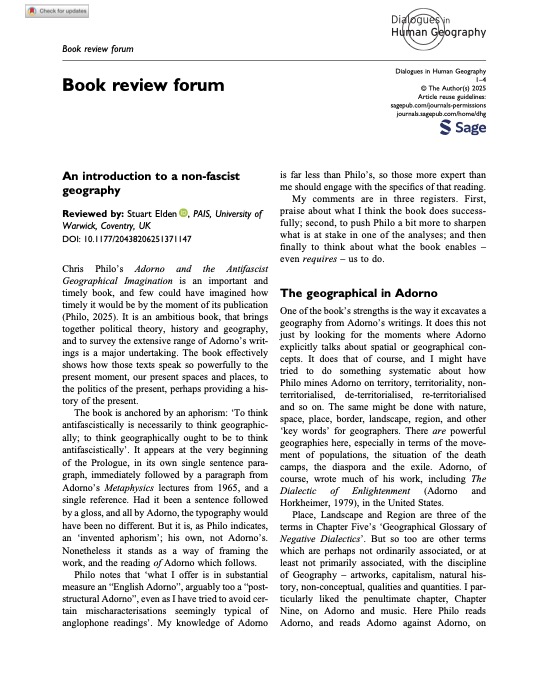
“An introduction to a non-fascist geography” – review of Chris Philo, Adorno and the Anti-Fascist Geographical Imagination

My review, “An introduction to a non-fascist geography“, of Chris Philo, Adorno and the Anti-Fascist Geographical Imagination (Edinburgh University Press, 2025) is now published online first in Dialogues in Human Geography. If you’d like to read it and can’t access through an institution, the preprint is here or please ask me for a copy. It will be part of a review forum with other contributions and a reply by Chris.

Posted in Uncategorized | 3 Comments

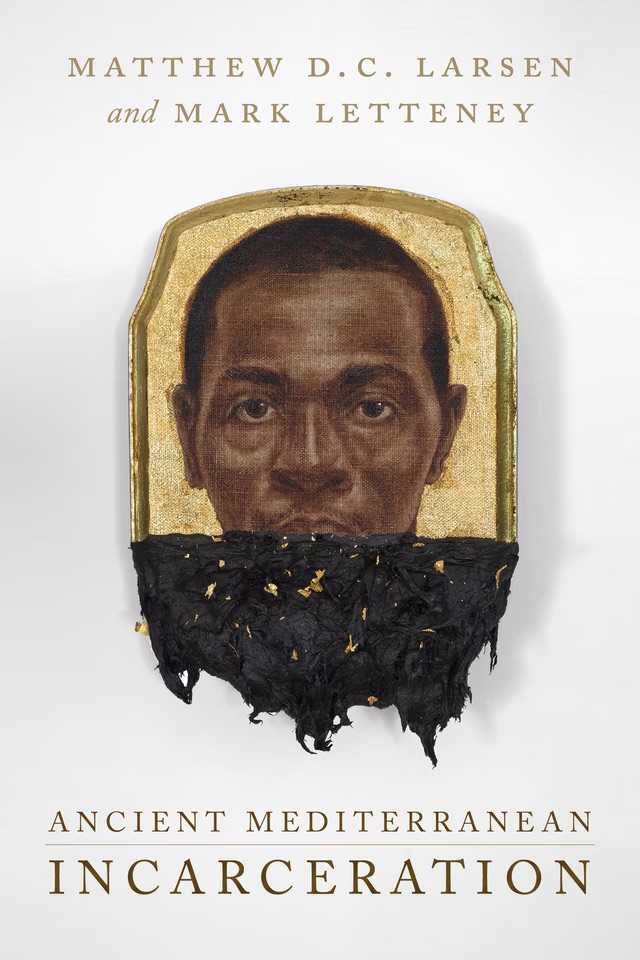
Matthew D.C. Larsen and Mark Letteney, Ancient Mediterranean Incarceration – University of California Press, August 2025 (print and open access) and New Books discussion

Matthew D.C. Larsen and Mark Letteney, Ancient Mediterranean Incarceration – University of California Press, August 2025 (print and open access)

New Books discussion with Michael Motia – thanks to dmf for the link

This book examines spaces, practices, and ideologies of incarceration in the ancient Mediterranean basin from 300 BCE to 600 CE. Analyzing a wide range of sources—including legal texts, archaeological findings, documentary evidence, and visual materials—Matthew D. C. Larsen and Mark Letteney argue that prisons were integral to the social, political, and economic fabric of ancient societies. Ancient Mediterranean Incarcerationtraces a long history of carceral practices, considering ways in which the institution of prison has been fundamentally intertwined with issues of class, ethnicity, gender, and imperialism. By foregrounding the voices and experiences of the imprisoned, Larsen and Letteney demonstrate the extraordinary durability of carceral structures across time and call for a new historical consciousness around contemporary practices of incarceration.

Posted in Uncategorized | Leave a comment

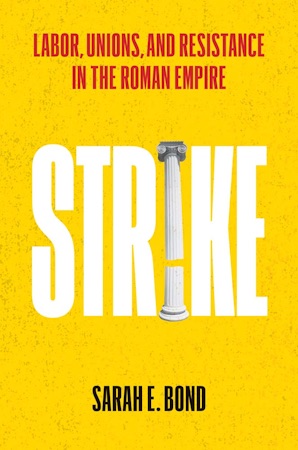
Sarah E. Bond, Strike: Labor, Unions, and Resistance in the Roman Empire – Yale University Press, February 2025

Sarah E. Bond, Strike: Labor, Unions, and Resistance in the Roman Empire – Yale University Press, February 2025

Historian Sarah E. Bond retells the traditional story of Ancient Rome, revealing how groups of ancient workers unified, connected, and protested as they helped build an empire
 
“First-rate. . . . A sterling example of historical revisionism.”—Publishers Weekly
 
From plebeians refusing to join the Roman army to bakers withholding bread, this is the first book to explore how Roman workers used strikes, boycotts, riots, and rebellion to get their voices—and their labor—acknowledged. Sarah E. Bond explores Ancient Rome from a new angle to show that the history of labor conflicts and collective action goes back thousands of years, uncovering a world far more similar to our own than we realize.
 
Workers often turned to their associations for solidarity and shared identity in the ancient world. Some of these groups even negotiated contracts, wages, and work conditions in a manner similar to modern labor unions. As the world begins to consider the value—and indeed the necessity—of unionization to protect workers, this book demonstrates that we can learn valuable lessons from ancient laborers and from attempts by the Roman government to limit their freedom.

Posted in Uncategorized | Leave a comment

Arnault Skornicki, Michel Foucault, the State and the Social Sciences – Springer, September 2025

Arnault Skornicki, Michel Foucault, the State and the Social Sciences – Springer, September 2025

based on La grande Soif de l’État. Michel Foucault avec les sciences sociales (2017)

This book proposes an original reading of Foucault’s political thought. Far from setting aside the question of the State to focus on the relationships of power “from below”, the Foucauldian approach offers a radical anti-substantialist theory of the State. Concepts such as biopolitics, discipline, pastoral power, and governmentality serve as tools for understanding the statization of power relations. Contrary to some of Foucault’s own statements, Skornicki highlights the elective affinities between genealogy and sociology, which enable an in-depth dialogue with Marxism, Max Weber, Norbert Elias, Edward P. Thompson, among others. Unexpectedly, the analytics of power appears thereby as a corrosive and productive science of the State. The author meticulously reconstructs, drawing on Foucault’s extensive body of work, how his famous ‘microphysics of power’ fits into a broader genealogy of the modern State—namely, the processes of political monopolization that have shaped the so-called Leviathan from the Middle Ages to the present. The State thus emerges not as the coldest of all cold monsters, nor simply as a vast apparatus of repression, but rather as both the product and the agent of multiple governmentalities, diverse rationalities, and various religious tendencies—ranging from the modern rule of law to totalitarianism and neoliberal bureaucracy. This is not just a new book about Foucault. It is a book about the State and the enduring possibility of theorizing it—immersed once more in the caustic waters of genealogy.


Posted in Michel Foucault | 1 Comment

Aaron Brice Cummings, Baudelaire’s Bitter Metaphysics: Anti-Nihilist Readings by Fondane, Benjamin, and Sartre – Bloomsbury, September 2024

Aaron Brice Cummings, Baudelaire’s Bitter Metaphysics: Anti-Nihilist Readings by Fondane, Benjamin, and Sartre – Bloomsbury, September 2024

Baudelaire’s Bitter Metaphysics: Anti-Nihilist Readings by Fondane, Benjamin, and Sartre reconstructs a philosophical trialogue that might have been expected to take place between Benjamin Fondane, Walter Benjamin, and Jean-Paul Sartre over their philosophical readings of Charles Baudelaire, an exchange preempted by the untimely deaths of two of the interlocutors during the Nazi holocaust. Why did three of Europe’s sharpest minds respond to the terror of 1933-45 by writing about a long-dead poet? Aaron Brice Cummings argues that Fondane, Benjamin, and Sartre turned to the poet of nihilism’s abyss because they recognized a fact of cultural history that remains relevant today: until sometime in the 2080s, the literary world will have to confront (even if to deny) the two-century window forecast by Nietzsche as the age of cultural and existential nihilism. Accordingly, the author examines the bitter metaphysics latent in Baudelaire’s motifs of the abyss, clocks, brutes, streets, and bored dandies. In so doing, this book confronts the nothingness which modern life encounters in the heart of art, ethics, ideality, time, memory, history, urban life, and religion.

Posted in Uncategorized | Leave a comment

Glyph: Johns Hopkins Textual Studies – Samuel Weber, Deconstruction and the American Reception of French Theory

Several journals played a significant role in introducing so-called ‘French Theory’ to the United States. They would include Yale French StudiesDiacritics, boundary 2 and Semiotext(e)Yale French Studies claims to be “the oldest English-language journal in the United States devoted to French and Francophone literature and culture”, and celebrated 75 years in 2023Diacritics and boundary 2 were founded in 1971 and 1972, and continue publishing today. Semiotext(e) was founded by Sylvère Lotringer in 1974, and shifted more into book publishing over time. I’ve said before that someone looking into the history of theory in the US and its links to the arts more generally could do a lot worse than to make use of the massive Lotringer and Semiotext(e) archives at New York University. I’ve referenced a lot of pieces in MLN (Modern Language Notes) in my pieces on Josué Harari and Eugenio Donato, and the role of organisations such as the Modern Languages Association would be important too. There are other, perhaps less known, journals which play a role, such as SubStanceOctober and a bit later, Social Text (on these journals, see Cusset, French Theory, pp. 62-65). In the United Kingdom, Radical Philosophy, Economy and Society (both founded 1972), Ideology & Consciousness (1977-79), Theory, Culture & Society (1982) and Environment and Planning D: Society and Space (1983) would be important reference points. A fuller study would need to discuss the relation and tension between these and more political journals, especially Marxist ones, who often reacted critically to these voices. 

Here I want to say a little about another interesting journal, much less discussed, which published what was closer to a series of edited books. This was Glyph: Johns Hopkins Literary Studies, which ran for eight issues between 1977 and 1980. Samuel Weber was a constant presence as editor, working with Henry Sussman and Walter Benn Michaels on some issues. The editorial board also comprised Alicia Borinsky, Rodolphe Gasché, Carol Jacobs, Richard Macksey, Louis Marin, Jeffrey Mehlman, Timothy C. Murray, Eduardo Saccone and Marilyn Wyatt. In a retrospective interview about his early career, Weber describes it as a “yearbook”, and though it was biannual, this captures something of its style (“Screen Memories”, p. 279). Inviting contributions they said:

The Editors of Glyph welcome submissions concerned with the problems of representation and textuality, and contributing to the confrontation between American and Continental critical scenes (Glyph, inside cover).

The opening issue contained pieces by young scholars in the United States, and Europeans now teaching in the United States, Paul de Man, Louis Marin and Rodolphe Gasché. Marin taught at Johns Hopkins University from 1974-77; Gasché was a visiting professor there from 1975-78. de Man had taught at Hopkins earlier in his career (1967-70), and had been Weber’s doctoral advisor at Cornell. Weber wrote the first article, “The Divaricator: Remarks on Freud’s Witz”. The first issue was reviewed in Philosophy and Literature by Betty R. McGraw. 

The first issue also included the first English translation of Jacques Derrida’s “Signature Event Context”, translated for the journal by Samuel Weber and Jeffrey Mehlman. (A different translation by Alan Bass later appeared in Margins of Philosophy.) This is a piece about J.L. Austin’s speech-act theory, and John Searle wrote a piece in reply: “Reiterating the Differences: A Reply to Derrida”. Derrida’s long response, “Limited Inc: a b c”, appeared in issue 2 of Glyph, translated by Weber. A special supplement to Glyph 2, an 81-page standalone volume, provided the French text. The editors of the supplement note that “‘Limited Inc’ was initially written in view of this discussion and in anticipation of its translation. But the interest of the debate demanded, in our opinion, that the text also be available in the French version” (inside cover). Derrida’s two pieces in English translation, a newly written Afterword, and a summary of Searle’s piece, were collected in the Limited Inc. book in 1988. Searle did not want his article republished alongside Derrida’s response (“Editor’s Foreword”, Limited Inc., p. vii). Derrida’s French text was reissued by Éditions Galilée in 1990. As far as I’m aware, the only place Searle’s comments are published is in Glyph (available on academia.edu). Weber’s essay, “It”, published in Glyph 4 picks up on this debate.

There are doubtless stories to be told of all the issues, but Glyph 7 published some of the papers from a colloquium on Genre at Strasbourg, including pieces by Jean-Luc Nancy, Friedrich Kittler, Gasché, and Derrida. Derrida’s piece appeared in both French and English in the issue – “La Loi du Genre/The Law of Genre”. (For reasons that are not clear to me, the same English translation also appeared in Critical Inquiryat the same time.) In the Foreword to Glyph 7, Weber says that “the full dossier of the Strasbourg proceedings, including the seminars and discussions as well as all written contributions, can be obtained for sending a check…” (p. vii). The proceedings volume Le genre / Die Gattung / Genre is harder to find today, but there is a copy at the Bodleian library in Oxford. It’s 575 typewritten pages – a thorough record of the event and its discussions.

In issue number 8 of Glyph, Weber announced that the “first phase of the publication comes to an end” (“After Eight: Remarking Glyph”, p. 232). He adds that following a “quite unusual initial popularity (the first two volumes sold about 3500 and 3000 copies respectively)” the interest reduced, with “a sharp drop in circulation (to about 2000 for Glyph 3 at present)” (“After Eight: Remarking Glyph”, p. 232). He asked two sympathetic colleagues for their view as to why this was. One said that the translation of Derrida’s Of Grammatology in 1976 meant that readers could now “get their deconstruction directly from the horse’s mouth”, and there was less need for projects such as Glyph. The other said that “the publication in English of Of Grammatology created a vogue of interest that carried Glyph along with it for a while, until the novelty began to wear off”. Weber notes that it was surprising to him “the extent to which Glyph had become identified with the work of a single writer, Derrida, or more precisely, not with that work as such, but with one aspect of it, with something called ‘deconstruction’” (“After Eight: Remarking Glyph”, pp. 232-33). This is perhaps particularly striking for Weber, whose own essays in the journal were more often concerned with psychoanalysis and Freud than deconstruction and Derrida. His earliest publication, I think, was a co-translation with Shierry Weber of a collection of Adorno’s essays, Prisms, with a short introduction; his first book in 1978 was Rückkehr zu Freud: Jacques Lacans Ent-stellung der Psychanalyse, later translated as Return to Freud: Jacques Lacan’s Dislocation of Psychoanalysis. Simon Morgan Wortham’s account of his career in Samuel Weber: Acts of Reading, discusses some aspects of the Glyph story, but I’m unaware of a more focused history. 

In his piece in Glyph 8 Weber also discusses some of the ways in which deconstruction can be understood, of the need to turn its scrutiny back upon itself, and ends with a closing of this phase of the journal and an opening to future work:

For Glyph, such a transformation can only mean a rethinking and reworking of the institutional context within which this and similar publications operate, with a renewed reemphasis upon the necessity of an inter- or transdisciplinary approach, conceived not as the conjunction or overlapping of existing, established and self-contained disciplines, no even less as their synthetic overcoming in a higher science of textuality, but rather as an attempt to redefine the manner in which such disciplines have determined their boundaries. Such a process will have to comprise both an ‘historical’ and a ‘structural’ component, both of which, however construed as elements of an ongoing process of which the notions of ‘inscription’ and ‘iterability’ have only begun to give us an inkling. That such a task is as imperative today as it will be difficult is one of the less and ambiguous and more urgent lessons of our very brief history (“After Eight: Remarking Glyph”, p. 237). 

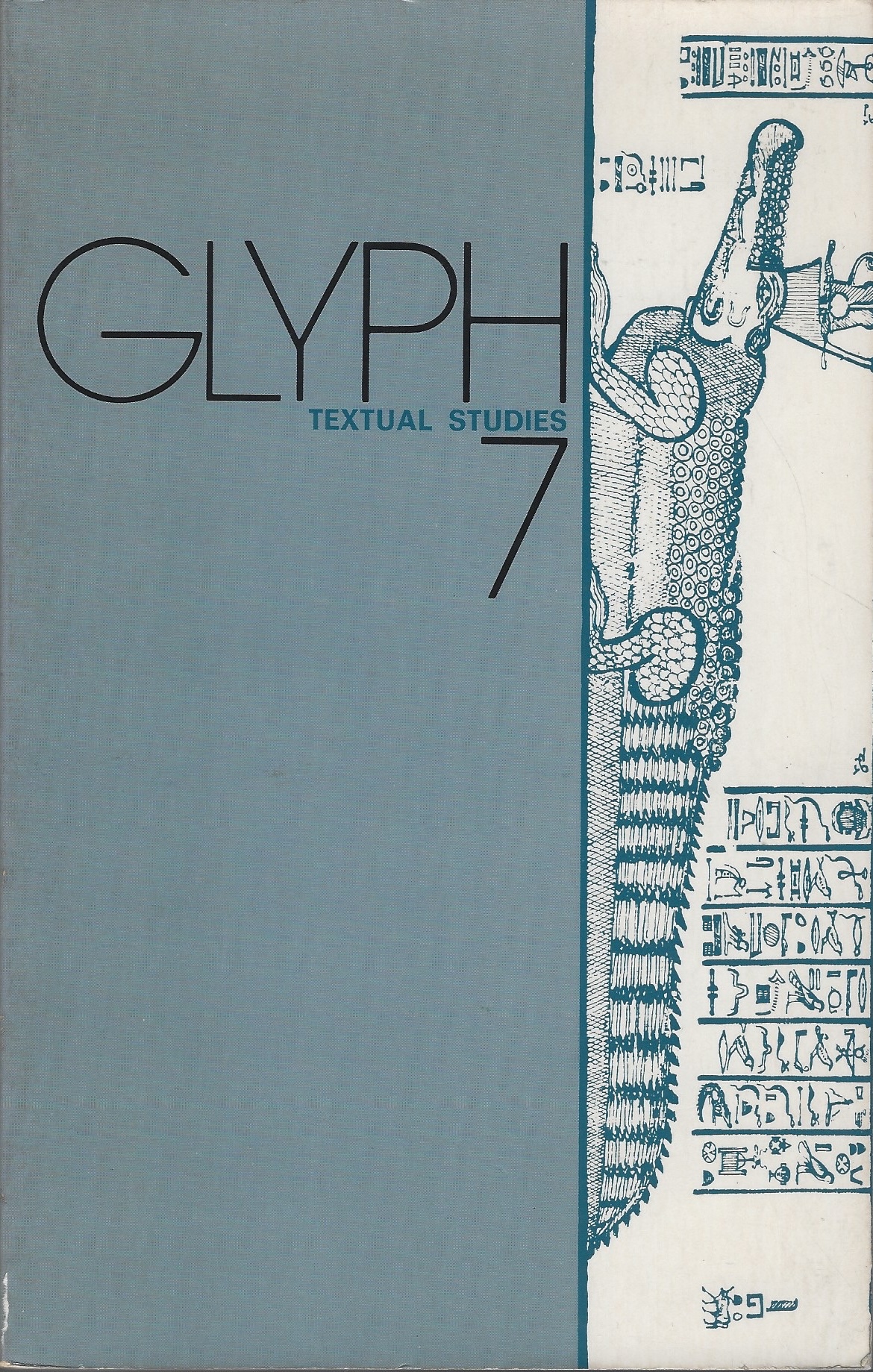
After a few years’ absence, in 1986 Glyph was relaunched as Glyph Textual Studies, now with University of Minnesota Press, with the first volume having the title Demarcating the Disciplines: Philosophy, Literature, Art. It is, again, somewhere between an edited book and a journal issue. Weber wrote the Introduction and a long essay entitled “Caught in the Act of Reading”. The unsigned preface announces:

With publication of this volume, Glyph begins a new stage in its existence. A change in publisher – from Johns Hopkins University Press to the University of Minnesota Press – is accompanied by a change in focus. In the future Glyph will be an annual publication organized around specific issues, of which Demarcating the Disciplines is an initial instance. This shift reflects transformations that have affected the intellectual context in which we are situated. When we first began publishing some eight years ago, our primary concern was with providing a forum in which established notions of representation could be problematized and explored, with particular reference to the specific situation of North American ‘critical theory’. Since this time, the greater currency of such concerns has brough with it new problems and priorities which, we are convinced, can best be articulated by a publication that focuses upon particular questions emerging out of the contemporary critical landscape (p. vii).

The description picks up on the continuity and difference:

In its first incarnation Glyph provided a forum in which established notions of reading, writing, and criticism could be questioned and explored. Since then, the greater currency of such concerns has brought with it new problems and priorities. Setting aside the battles of the past, the new Glyph looks ahead – to confront historical issues and to address the institutional and pedagogical questions emerging from the contemporary critical landscape.

Each volume in the new Glyph series is organized around a specific issue. The essays in this first volume explore the relations between the practice of reading and writing and the operations of the institution. Though their approaches differ from one another, the authors of these essays all recognize that the questions of the institution – most notably the university – points toward a series of constraints that define, albeit negatively, the possibilities for change.

The contributors to this volume were Weber, Derrida, Tom Conley, Malcolm Evans, Ruth Salvaggio, Robert Young, Henry Sussman, Peter Middleton, David Punter, and Donald Preziosi. This new series did not run for more than one issue, but the Preface announces some planned future volumes: “‘The Question of War’, ‘On Kant’s Third Critique’, ‘The Interface of Word and Image’, and ‘In Disregard of Philosophy: Heterological Practices’” (p. viii). A set of intriguing possibilities, never realised in that form. So, a journal of some importance, but which promised even more.

One final question. In the “Notes on Contributors” in issue 2 of the original run, Michael Ryan’s entry says: “He is writing a novel with Gayatri Spivak based on the life of Antonio Gramsci”. Whatever became of that? It could be a little joke among friends, but it’s not completely implausible. 

Glyph

Glyph: Johns Hopkins Textual Studies, 8 issues, 1977-80; supplement to issue 2.

  • Issues 237 and 8 of Glyph are available on archive.org

Glyph Textual Studies [new series] 1: Demarcating the Disciplines: Philosophy, Literature, Art, Minneapolis: University of Minnesota Press, 1986. (On his own website, Weber calls this issue 9.)

Other References

Le genre / Die Gattung / Genre: Colloque international, Université de Strasbourg, 4-8 juillet 1979, Université des sciences humaines de Strasbourg. Groupe de recherches sur les théories du signe et du texte, Strasbourg: Université de Strasbourg, 1980.

Theodor W. Adorno, Prisms, ed. and trans. Samuel and Shierry Weber, Cambridge: MIT Press, 1968.

Johannes Angermuller, Why There is no Poststructuralism in France: The Making of an Intellectual Generation, London: Bloomsbury, 2015.

Warren Breckman, “From the Editors’ Desk Times of Theory: On Writing the History of French Theory”, Journal of the History of Ideas 71 (3), 2010, 339-61. 

François Cusset, French Theory: How Foucault, Derrida, Deleuze, & Co. Transformed the Intellectual Life of the United States, trans. Jeff Fort, Minneapolis: University of Minnesota Pres, 2008.

Jacques Derrida, “Signature Event Context”, trans. Samuel Weber, Glyph 1, 1977, 172-97.

Jacques Derrida, “Limited Inc: a b c …”, trans. Samuel Weber, Glyph 2, 1977, 162-254; the French text was published as a supplement to Glyph 2, Baltimore: Johns Hopkins University Press, 1977.

Jacques Derrida, De la grammatologie, Paris: Éditions de Minuit, 1967; Of Grammatology, trans. Gayatri Chakravorty Spivak, Baltimore: Johns Hopkins University Press, 1976.

Jacques Derrida, “La Loi du Genre/The Law of Genre”, French/English version, trans. Avital Rondal, Glyph 7, 1980, 176-232; “The Law of Genre”, trans. Avital Rondal, Critical Inquiry 7 (1), 1980, 55-81.

Jacques Derrida, Marges de la philosophie, Paris: Éditions de Minuit, 1982; Margins of Philosophy, trans. Alan Bass, Chicago: University of Chicago Press, 1982.

Jacques Derrida, Limited Inc., ed. Gerald Graff, trans. Samuel Weber, Evanston: Northwestern University Press, 1988.

Peter Fenves, Kevin McLaughlin, and Marc Redfield eds. Points of Departure: Samuel Weber Between Spectrality and Reading, Evanston: Northwestern University Press, 2016.

Sylvère Lotringer and Sande Cohen (eds.), French Theory in America, New York, Routledge, 2001.

Betty R. McGraw, “Glyph: Johns Hopkins Textual Studies”, Philosophy and Literature 2 (1), 1978, 128-30.

John R. Searle, “Reiterating the Differences: A Reply to Derrida”, Glyph 1, 1977, 198-208.

Samuel Weber, “The Divaricator: Remarks on Freud’s Witz”, Glyph 1, 1977, 1-27.

Samuel Weber, “It”, Glyph 4, 1978, 1-31.

Samuel Weber, “After Eight: Remarking Glyph”, Glyph 8, 1980, 232-37.

Samuel Weber, “Introduction”, Glyph new series 1, 1986, ix-xii.

Samuel Weber, “Caught in the Act of Reading”, Glyph Textual Studies [new series] 1, 1986, 181-214.

Samuel Weber, Rückkehr zu Freud: Jacques Lacans Ent-stellung der Psychanalyse, Frankfurt am Main: Ullstein, 1978; Return to Freud: Jacques Lacan’s Dislocation of Psychoanalysis, trans. Michael Levine, Cambridge: Cambridge University Press, 1991.

Samuel Weber, “Screen Memories: Samuel Weber in Conversation with Irene Albers and Sima Reinisch”, trans. Jonas Rosenbrück, in Peter Fenves, Kevin McLaughlin, and Marc Redfield eds. Points of Departure: Samuel Weber Between Spectrality and Reading, Evanston: Northwestern University Press, 2016, 269-85.

Simon Morgan Wortham, Samuel Weber: Acts of Reading, London: Ashgate 2003.

Simon Morgan Worthan and Gary Hall eds., Experimenting: Essays with Samuel Weber, New York: Fordham University Press 2007.

Archives

MSS.221, Sylvère Lotringer Papers and Semiotext(e) Archive, New York University, https://findingaids.library.nyu.edu/fales/mss_221/

Samuel M. Weber website, http://hydra.humanities.uci.edu/weber/


This is the 36th post of a weekly series, where I post short essays with some indications of further reading and sources, but which are not as formal as something I’d try to publish more conventionally. They are usually tangential to my main writing focus, a home for spare ideas, asides, dead-ends and possible futures. I hope there is some interest in them. They are provisional and suggestions are welcome. A few shorter pieces in a similar style have been posted mid-week.

The full list of ‘Sunday histories’ is here. That list is chronological; but there is also a thematic list.

Posted in Jacques Derrida, Sunday Histories | 1 Comment