The Slow Professor movement: reclaiming the intellectual life of the university

9781487521851The Slow Professor movement: reclaiming the intellectual life of the university – radio interview with Maggie Berg and Barbara K. Seeber on The Sunday Edition. More on the book here.

//www.cbc.ca/i/caffeine/syndicate/?mediaId=879028291614

Some related links –

How many hours a week should academics work? – Times Higher Education

The challenge of writing in the accelerated academy – The Sociological Imagination

The Daily Routines of Famous Creative People – Podio

Update: for a critique of the slow professor book, see Jana Bacevic, ‘Against academic labour: foraging in the wildlands of digital capitalism‘.

See also A roundup of posts on time management etc.

Posted in Uncategorized, Universities | 4 Comments

Cite Specific: Analyzing Endnotes to Teach Historical Methods

Cite Specific: Analyzing Endnotes to Teach Historical Methods – an interesting exercise by Roxanne Panchasi.

It all started with a desire to have a different kind of conversation with my students about citation, one that wouldn’t be consumed by the details of formatting or the penalties for plagiarism. These are important things, of course, and I try to address them in every syllabus and assignment outline that I put together. You know the section I mean: the clear statement of expectations, the links to resources and policies online, the striking of that balance between helpful guidance and stern warning. But you’ve probably also experienced that section’s shortcomings—or at least wondered if anyone was paying attention as you explained it—when unattributed information showed up in final papers. To provide an alternative that actually works, I’ve developed an in-class exercise called “Xtreme Endnotes,” which I use at the beginning of every historical methods course that I teach.
Posted in Publishing, teaching, Uncategorized, Writing | Leave a comment

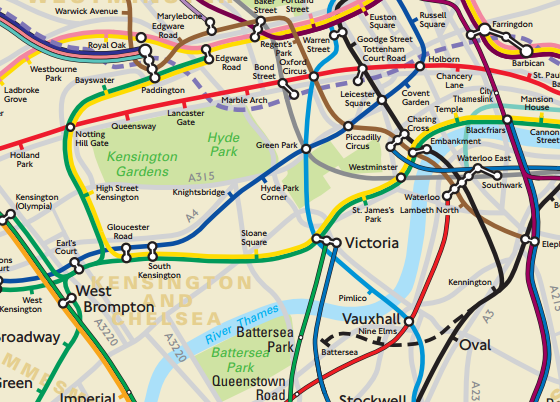
A ‘geographically accurate tube and rail map’ of London

map_crossrail.png

While the standard TFL map is a model of a functional map – all straight-lines and angles – it can sometimes mean that people take journeys that would actually be faster above ground.

So, someone asked TFL for a ‘geographically accurate tube and rail map‘ of London, and this is what they got. Click through for the full thing [pdf], but the part above of central London gives a good idea. It shows the as yet-unopened Crossrail (Elizabeth line) in dotted purple, and the Northern line spur to Nine Elms and Battersea (dotted black).

Posted in Uncategorized | Leave a comment

The Challenges of Research Assessment – report on the REF 2014

The Challenges of Research Assessment‘ – report on the REF 2014. News report in the THE here.


Posted in Politics, Publishing, Uncategorized, Universities | Leave a comment

Livestreaming on boundary2.org: Neoliberalism, Its Ontology and Genealogy: The Work and Context of Philip Mirowski

boundary 2 will livestream its spring conference, Neoliberalism, Its Ontology and Genealogy: The Work and Context of Philip Mirowski on March 17 and March 18, 2017.

The livestream will appear here, where you can also find the conference schedule.

Posted in Uncategorized | 3 Comments

Tragedy and Philosophy – Dennis Schmidt interviewed by Richard Marshall

Tragedy and Philosophy – Dennis Schmidt interviewed by Richard Marshall at 3am Magazine

Posted in Uncategorized | Leave a comment

‘This video ultimately explains why all world maps are wrong’

Projecting a round surface of the Earth on a flat surface is not an easy task. Scientists are trying to find an optimal way to do it for centuries. In fact the most common map projection that we use almost everyday in Google Maps and other mapping services, has been introduced in 1569 by Gerardus Mercator.

Guys from Vox decided to give it a shot and tried to explain the complexity of map projections in a simple way… And they’ve succeeded. This video will ultimately explain you the concept of projections and why all world maps are in fact wrong.


Update: this is also worth a look – The True Size

Posted in Uncategorized | 1 Comment

Architecture’s Environmental Complex: A Review of Felicity Scott’s Outlaw Territories

Ross Exo Adams reviews Felicity Scott’s Outlaw Territories

rossexo's avatarmachines of urbanization

Pre-Publication draft; forthcoming in The Journal of Architecture, Vol 22, No. 2 (March 2017)

Felicity Scott, Outlaw Territories: Environments of Insecurity/Architectures of Counterinsurgency, 560 pages, 104 illustrations, Zone Books, 2016, New York City, ISBN: 1935408739, $39.95 (hardcover).


Reflecting on music culture, the late Mark Fisher spoke of what he called a ‘temporal malaise’ that had beset contemporary society, a term that describes a growing sense that the future, as a category, has disappeared. Late neoliberal, communicative capitalism, he argues, has colonised life in its phenomenological dimensions, an effect of which is to slowly cancel the possibility of perceiving a future. We’re trapped, he claims, in the 20th century; our 21st century cultural experience looks a lot like ‘20th century culture on higher definition screens’.[i]

Reading Felicity Scott’s Outlaw Territories: Environments of Insecurity/Architectures of Counterinsurgency may reaffirm such a claim. Indeed, what is striking about the histories Scott recounts are the…

View original post 2,710 more words

Posted in Uncategorized | Leave a comment

Professor of Political Theory post at University of Warwick

Professor of Political Theory post at University of Warwick – details here.

Posted in Uncategorized | Leave a comment

Some thoughts on Andrew Scott as Hamlet at the Almeida

hamlet_andrew-scott-photographed-by-miles-aldridgeThere were many things I liked about the new production of Hamlet, at the Almeida theatre, starring Andrew Scott. Unfortunately, Andrew Scott wasn’t one of them. I found his Hamlet just too shouty, and ultimately not very sympathetic. There were elements which were good, with his clear grief done well at the beginning. Some of his soliloquies were delivered in a conversational tone. But then it just became too much, with not enough contrast between his ‘antic disposition’ and the norm. I had the sense there was a very good Hamlet in him, but it was just a bit overpowering at present. This was still a preview night, so perhaps it will settle down. In a four-hour production, his vocal volume must have been exhausting for him; it certainly was for me.

Yet even in a play which is so dominated by this character, there were many stronger things. It was a fully contemporary production, in modern dress and with guns rather than swords. The supporting cast was generally excellent. Juliet Stevenson was a very good Gertrude, moving from newly wedded bliss to a dawning realisation of Claudius’s crimes and manipulations. Angus Wright, who I’d previously seen as Agamemnon in director Robert Icke’s Oresteia, was a strong Claudius, more reserved and statesman-like than he is sometimes played. Polonius, Ophelia, and the Ghost were all well done. Switching Guidenstern to a female role, played by Amaka Okafor, gave a different sense to Hamlet’s attachment to his old friends. Of the other key roles, perhaps only Horatio was a little disappointing.

My favourite thing about the production was the use of film. Initially this showed documentary footage of King Hamlet’s funeral, in a news style reporting with Danish subtitles. It then switched to the night watch observing surveillance cameras on multiple screens. The initial engagements with the ghost were over an intercom. The scenes with Fortinbras was also done through film, with the character never actually appearing on stage, but sending video messages and being interviewed on camera. It certainly made the Norwegian army seem more convincing, with footage of troop and artillery manoeuvres. The Mousetrap was done well with an on-stage camera capturing the audience of Claudius and his court on screen. I was less sure about the use of Bob Dylan songs; and the ending was a bit muddled, with the dead characters walking backwards to join the already dead Rosencrantz and Guildenstern at the back of the stage.

Overall this was worth seeing, and I don’t feel that four hours is, in itself, too long. This is a long play, after all, and I was pleased that there were not some of the severe cuts some productions have. Two intervals might be rethought – there is a slightly strange one when Claudius walks out of The Mousetrap, which needed a member of theatre staff to announce the break, and then one only about half an hour later when Hamlet passes the Norwegian army on his way to England. Press night is Monday, so perhaps more will be reworked over the weekend: initial reports and a cancelled first night suggest there have been some changes already.

Just for contrast, there are much more positive reviews here and here. And for my takes on some previous productions, see these posts – Peter Sarsgaard in New YorkBenedict Cumberbatch at the Barbican; and on three productions and three texts.

Posted in Uncategorized, William Shakespeare | 2 Comments