Books received – Greenblatt, Soussloff, Howe, Graham

IMG_1872.JPG

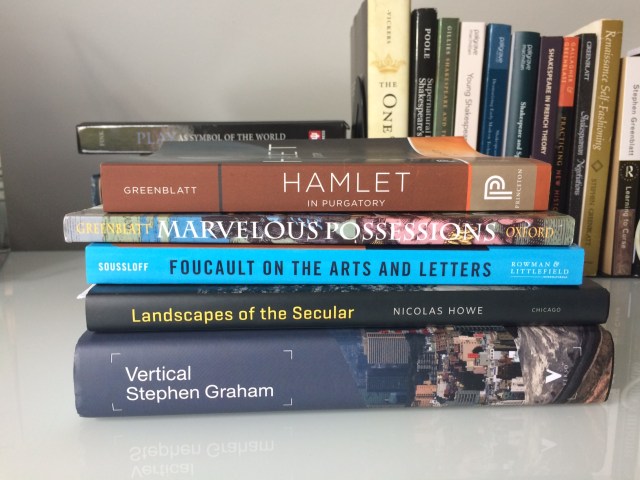
Two second-hand copies of books by Stephen Greenblatt, the new collection Foucault on the Arts and Letters in recompense for review work (30% discount here), and two books sent by publishers – Nicolas Howe’s Landscapes of the Secular and Stephen Graham’s Vertical: The City from Satellites to Bunkers.

Posted in Michel Foucault, Stephen Graham, Stephen Greenblatt, Uncategorized, William Shakespeare | Leave a comment

Early Modern Literary Geographies – call for book proposals for Oxford University Press series

The conference I attended in California last weekend was linked to a book series with Oxford University Press. I’ve shared details of this before, but it was a while ago, and the first volume is now published, so here is the description again.


Early Modern Literary Geographies

Oxford University Press

Series Editors: Julie Sanders, Newcastle University and Garrett A. Sullivan, Jr, Pennsylvania State University.

Influenced by the work of cultural and human geographers, literary scholars have started to attend to the ways in which early modern people constructed their senses of the world out of interactions among places, spaces, and embodied practices.  Early Modern Literary Geographies will feature innovative research monographs and agenda-setting essay collections that partake of this “spatial turn.”  The term “literary geographies” is to be understood capaciously: we invite submissions on any form of early modern writing that engages with the topics of space, place, landscape and environment.  Although English literature is at its centre, Early Modern Literary Geographies will feature scholarship that abuts a range of disciplines, including geography, history, performance studies, art history, musicology, archaeology and cognitive science.  Subjects of inquiry might include cartography or chorography; historical phenomenology and sensory geographies; body and environment; mobility studies; histories of travel or perambulation; regional and provincial literatures; urban studies; performance environments; sites of memory and cognition; ecocriticism; and oceanic or new blue studies.

Advisory Board:

Stuart Elden, Professor of Political Theory and Geography, University of Warwick

Steve Hindle, W. M. Keck Foundation Director of Research, Huntington Library

Bernhard Klein, Professor of English, University of Kent

Andrew McRae, Professor of English, University of Exeter

Evelyn Tribble, Donald Collie Chair of English, University of Otago

Alexandra Walsham, Professor of Modern History, University of Cambridge

Lesley Cormack, Dean of Arts, University of Alberta

Dan Beaver, Associate Professor of History, Penn State University

Steven Mullaney, Associate Professor of English, University of Michigan

Enquiries to: julie.sanders@ncl.ac.uk and gas11@psu.edu

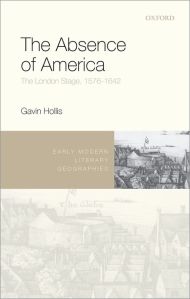
The first volume in the series is Gavin Hollis, The Absence of America: The London Stage, 1576-1642.
9780198734321_450

The Absence of America: the London Stage 1576-1642 examines why early modern drama’s response to English settlement in the New World was muted, even though the so-called golden age of Shakespeare coincided with the so-called golden age of exploration: no play is set in the Americas; few plays treat colonization as central to the plot; a handful features Native American characters (most of whom are Europeans in disguise). However, advocates of colonialism in the seventeenth century denounced playing companies as enemies on a par with the Pope and the Devil. Instead of writing off these accusers as paranoid cranks, this book takes as its starting point the possibility that they were astute playgoers. By so doing we can begin to see the emergence of a “picture of America,” and of the Virginia colony in particular, across a number of plays performed for London audiences: Jonson’s Bartholomew FairThe Staple of News, and his collaboration with Marston and Chapman, Eastward Ho!; Robert Greene’sOrlando Furioso; Massinger’s The City Madam; Massinger and Fletcher’s The Sea Voyage; Middleton and Dekker’s The Roaring Girl; Shakespeare’s The Tempest, and Fletcher and Shakespeare’s Henry VIII. We can glean the significance of this picture, not only for the troubled Virginia Company, but also for London theater audiences. And we can see that the picture that was beginning to form was, as the anti-theatricalists surmised, often slanderous, condemnatory, and, as it were, anti-American.

Posted in Books, Publishing, Uncategorized, William Shakespeare | Leave a comment

Foucault and Shakespeare: The Theatre of Madness

My paper ‘Foucault and Shakespeare: Ceremony, Theatre, Politics’ should appear in The Southern Journal of Philosophy in late 2017, in the Spindel conference supplement. I’ve recently agreed to write a second piece developing out of this work:

Foucault and Shakespeare: The Theatre of Madness

Foucault was interested in Shakespeare from the beginning to the end of his career. Examples from Shakespeare’s plays appear in his earliest works on madness, through 1970s courses looking at the transition from sovereign to disciplinary power, to a reading in his final lectures of 1984 of King Lear’s opening scene as a test of parrēsia. In each Foucault is intrigued by the relation between the theatre as a representation and theatre as a ‘tear in the fabric of the world’. This contribution re-examines Foucault’s work on theatre and madness in the light of new documentary sources, notably Foucault à Münsterlingen, a report of a visit to a Swiss psychiatric asylum in 1954. There, Foucault attended a ‘fête des fous’, a carnival of the mad, a festival with roots back to the Middle Ages. 1954 was the date Foucault’s first two major publications appeared – Maladie mentale et personnalité and the introduction to his translation of Ludwig Binswanger’s Dream and Existence. After 1954 Foucault published very little until The History of Madness in 1961, a book which took a very different approach to these questions, and which led to Maladie mentale et personnalité being comprehensively rewritten as Maladie mentale et psychologie in 1962. Tracing this interest in madness, and the recurrent role of Shakespeare within it, this chapter interrogates the important role that theatre plays in Foucault’s early writing.

I’m not sure yet, but I think I will try to give this as a lecture or two before submission. It is also perhaps the first piece of a larger project on the early Foucault.

Posted in Michel Foucault, The Early Foucault, Uncategorized | Leave a comment

Captured: Documenting Incarceration – Nottingham Contemporary, 4-5 Nov 2016

capturedCaptured: Documenting Incarceration – Nottingham Contemporary gallery, 4-5 Nov 2016

A two-day documentary film event featuring screenings, workshops and Q&A with directors looking at the role of filmmaking in challenging public perceptions of incarceration and detention.

Posted in Conferences, Events, Uncategorized | Leave a comment

The Antipode Foundation’s Scholar-Activist Project and International Workshop Awards, 2017

Funding opportunities from Antipode

Antipode Editorial Office's avatarAntipodeFoundation.org

We’re pleased to announce the fifth year of the Antipode Foundation’s Scholar-Activist Project and International Workshop Awards.

 – Scholar-Activist Project Awards are single-year grants of up to £10,000 intended to support collaborations between academics and students and non-academic activists (from non-governmental organisations, think tanks, social movements, or community/grassroots organisations, among other places), including programmes of action-orientated and participatory research and publicly-focused forms of geographical investigation. They offer opportunities for scholars to relate to civil society and make mutually beneficial connections.

 – International Workshop Awards are single-year grants of up to £10,000 available to groups of radical/critical geographers staging events (including conferences, workshops, seminar series and summer schools) that involve the exchange of ideas across disciplinary and sectoral boundaries and intra/international borders, and lead to the building of productive, durable relationships. They make capacity-building possible by enabling the development of a community of researchers.

Activists (of all kinds) and students as…

View original post 75 more words

Posted in Uncategorized | Leave a comment

Early Modern Literary Geographies conference – audio recording of my Hamlet talk

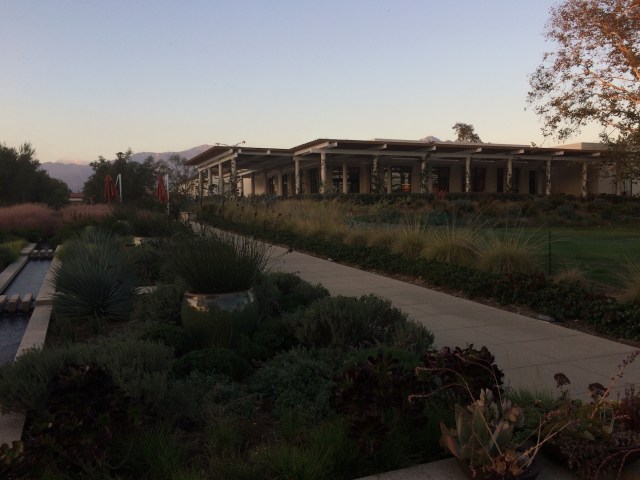
Huntington.jpgI’ve just got home from California after a couple of fascinating days at the Early Modern Literary Geographies conference. This was held in the Huntington Library in San Marino, a superb venue set in glorious grounds. The conference was very useful for me, both in terms of comments and questions on the paper I gave – “Denmark, Norway, Poland: Regional Geopolitics in Hamlet” – and for the ideas and reading suggestions I got from the other papers. There were some other papers on Shakespeare, but also other writers from the period, as well as work informed by history and archaeology. It was a really interdisciplinary mix of people, and fully justified the disruption of trying to do a west-coast conference in term-time. My thanks to Garrett Sullivan and Julie Sanders for organising the conference, and Steve Hindle and Juan Gomez at the Huntington for the logistics and hosting. On the Sunday I met with Efraín Kristal for lunch and a brief tour of the wonderful Norton Simon Museum. Efraín was one of the contributors to the Sloterdijk Now book I edited a few years ago, although we’d not actually met in person.
I understand the conference was filmed and will be made available, but in the meantime the audio recording of my talk is available here.

[Update: the audio recordings of all papers are available on Soundcloud and iTunes. There is a short discussion of the rationale for the conference here.]

Posted in Conferences, Peter Sloterdijk, Shakespearean Territories, Uncategorized, William Shakespeare | 1 Comment

Johannes Angermuller on ‘How do you define yourself as an academic?’

Interesting piece by my Warwick colleague Johannes Angermuller on ‘How do you define yourself as an academic?‘ in The Times Higher.

Researchers should be free from constraints that prevent them from the pursuit of scientific truth – this is an idea that universities all over the world like to pride themselves on. However, even the purest, most basic research is subject to pressures that are never exclusively scientific. Researchers are subject to a number of social constraints as they compete for resources, pursue careers and network with others.

In a nutshell, research is a social practice, and academics often struggle with how they are categorised by others. [continues here]

Posted in Uncategorized, Universities | 1 Comment

Jean-Paul Sartre’s refusal of the Nobel prize for literature

73dbf16a131ae5b0a0acd8cad34ad2ef_1024x1024Bob Dylan’s award of the Nobel prize for literature is obviously all over the news and social media. The New York Review of Books has a translation of Jean-Paul Sartre’s short piece on his own refusal of that award over fifty years ago.

Posted in Jean-Paul Sartre, Uncategorized | Leave a comment

Joe Painter’s appreciation of Doreen Massey in Soundings (pdf)

Joe Painter’s appreciation of Doreen Massey in Soundings is available to download as a pdf here. I’ve added this to the list of obituaries and tributes on this site.

Posted in Doreen Massey, Uncategorized | Leave a comment

A Taxonomy of University Presses Today

An interesting discussion of the different types of university presses – worth a read since not all are the same kind of publisher.

https://scholarlykitchen.sspnet.org/2016/10/13/a-taxonomy-of-university-presses-today/

Posted in Uncategorized | 3 Comments