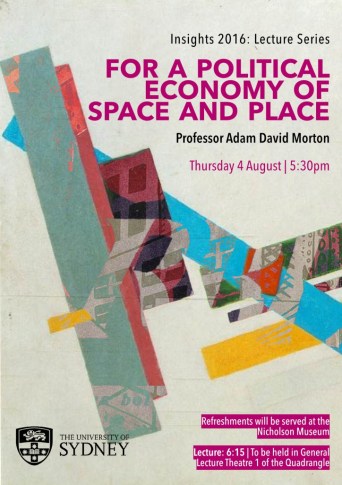
Adam David Morton, For a Political Economy of Space and Place – video and audio

InauguralWebAdam David Morton’s inaugural lecture ‘For a Political Economy of Space and Place’ is available on video and audio.

Under capitalism, how does the state organise space in our everyday lives through the streets we walk, the monuments we visit, and the places where we meet?

The lecture contributes to our understanding of spatial political economy by analysing the different functions of space within capitalism. With a focus on the linkage between architecture and modernity, the simple diffusion of modernist architecture from a Euro-American context to the rest of the world is rejected. Instead, the lecture makes a case for understanding local appropriations, transformations and resistances in making multiple modernities. It does so by focusing on three theoretical departure points, drawing from Antonio Gramsci, Walter Benjamin, and Henri Lefebvre, to reveal modernism’s translation through space and place in the context of peripheral geographies. Drawing on current debates about multiple modernities, the lecture demonstrates how a spatial political economy can help understand modernity within capitalism through the ordering of state space.


Posted in Adam David Morton, Antonio Gramsci, Henri Lefebvre, Uncategorized, Walter Benjamin | 1 Comment

Setha Low, Spatializing Culture: The Ethnography of Space and Place – forthcoming from Routledge

9781138945616Setha Low, Spatializing Culture: The Ethnography of Space and Place – forthcoming from Routledge.

This book demonstrates the value of ethnographic theory and methods in understanding space and place, and considers how ethnographically-based spatial analyses can yield insight into prejudices, inequalities and social exclusion as well as offering people the means for understanding the places where they live, work, shop and socialize. In developing the concept of spatializing culture, Setha Low draws on over twenty years of research to examine social production, social construction, embodied, discursive, emotive and affective, as well as translocal approaches. A global range of fieldwork examples are employed throughout the text to highlight not just the theoretical development of the idea of spatializing culture, but how it can be used in undertaking ethnographies of space and place. The volume will be valuable for students and scholars from a number of disciplines who are interested in the study of culture through the lens of space and place.


Posted in Setha Low, Uncategorized | 1 Comment

Graham Harman and Bruno Latour discussions on waste

Graham Harman and Bruno Latour discussions on waste – conducted by Daniel Fetzner in Cairo (Harman) and Daniel Fetzner & Martin Dornberg in Karlsruhe (Latour). The text of the discussions can be downloaded here. Project website and video here.


Posted in Bruno Latour, Graham Harman, Uncategorized | 2 Comments

David Harvey lecture series in NYC – Marx and Capital: The Concept, The Book, The History

David Harvey lecture series in New York – Marx and Capital: The Concept, The Book, The History. Free and open to the public.

Posted in David Harvey, Karl Marx, Uncategorized | Leave a comment

An open access virtual issue for the 2016 Antipode RGS-IBG Lecture, AbdouMaliq Simone’s “Provisioning the Provisional: Ensemble Work in Yangon”

An open access virtual issue linked to the 2016 Antipode RGS-IBG Lecture, by AbdouMaliq Simone.

Antipode Editorial Office's avatarAntipodeFoundation.org

virtual issues_website banner

The 2016 Antipode RGS-IBG Lecture

Provisioning the Provisional: Ensemble Work in Yangon

AbdouMaliq Simone

Max Planck Institute for the Study of Religious and Ethnic Diversity

Göttingen, Germany

How do lives reach each other, what do they want or need from all the different instantiations of living? How much do particular enactments of living really need to engage all those others taking place in the larger surrounds; how much do they simply need to know that specific ways of doing things are there, somewhere, without necessarily needing to interact with them? When interaction is necessary, how much has to be conceded and recalibrated? In cities where thousands upon thousands of things are going on simultaneously at any given time, how do particular lives know what it is exactly that is relevant to them, that poses serious implications for who they think they are or what they want to be? How far…

View original post 1,217 more words

Posted in Uncategorized | Leave a comment

Early Modern Literary Geographies – 14-15 October 2016

Early Modern Literary Geographies, Huntington library, San Marino, CA, 14-15 October 2016 –  details here or download the programme brochure

The conference is organised around the themes of Body, House, Neighbourhood, and Region. I’ll be speaking in the last of these on “Denmark, Norway, Poland: Regional Geopolitics in Hamlet”. This is part of what I hope will be chapter 2 of my Shakespeare book.

Huntington EMLG Conference Brochure.jpg


Posted in Conferences, Shakespearean Territories, Uncategorized, William Shakespeare | 2 Comments

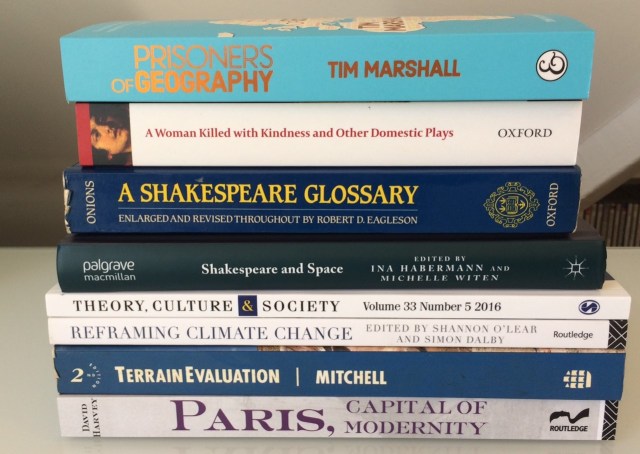
Books received – Marshall, Shakespeare, O’Lear & Dalby, Mitchell, Harvey

IMG_1747

Back from holiday, a mix of recently received books. The Routledge ones are in recompense for review work, as is Shakespeare and Space. The others were picked up second-hand for various projects.

Posted in David Harvey, Shakespearean Territories, Uncategorized, William Shakespeare | Leave a comment

Repo, Jemima 2016 The Biopolitics of Gender, reviewed by Martina Tazzioli

Posted in Uncategorized | 1 Comment

Angharad Closs Stephens – National Atmospheres and the ‘Brexit’ Revolt

Posted in Uncategorized | Leave a comment

Seminar: Tool-boxes and rolling marbles: The far-flung applications of Michel Foucault’s work (2016)

Clare O'Farrell's avatarFoucault News

Clare O’Farrell, Tool-boxes and rolling marbles: The far-flung applications of Michel Foucault’s work (2016)

Date: Tuesday, 30th August 2016, 11:30am-1:00pm
Location:
A Block, Level 3, Conference Room 330
QUT, Kelvin Grove Campus
Brisbane, Queensland, Australia

Entry is free but please register with Eventbrite by Monday, 29th August 5:00pm

PDF Flyer

This paper was originally delivered as a keynote presentation to the Foucault @ 90 conference at Ayr in Scotland in June 2016.

Foucault famously said he was writing for users, not readers. He wanted his books to function as tooI-boxes to be deployed in the most applied of areas – he specifically names educators, magistrates, wardens, and conscientious objectors for instance. He also imagined his books as ‘rolling marbles’ that could be picked up and then sent elsewhere. Some 40 years after Foucault expressed these sentiments about his work, he has become the most cited theorist in the social sciences…

View original post 282 more words

Posted in Uncategorized | Leave a comment