Neil Brenner, Critique of Urbanization – forthcoming

Ca2hLuZWAAAvGNo.png

Neil Brenner, Critique of Urbanization: Selected Essays – forthcoming in Bauwelt Fundamente series.

Urbanization is transforming the planet, within and beyond cities, at all spatial scales. In this book, Neil Brenner mobilizes the tools of critical urban theory to deconstruct some of the dominant urban discourses of our time, which naturalize, and thus depoliticize, the enclosures, exclusions, injustices and irrationalities of neoliberal urbanism. In so doing, Brenner advocates a constant reinvention of the framing categories, methods and assumptions of critical urban theory in relation to the rapidly mutating geographies of capitalist urbanization. Only a theory that is dynamic—which is constantly being transformed in relation to the restlessly evolving social worlds and territorial landscapes it aspires to grasp—can be a genuinely critical theory.

Posted in Neil Brenner, Uncategorized, urban/urbanisation | Leave a comment

Paolo Giaccaria & Claudio Minca (eds) Hitler’s Geographies: The Spatialities of the Third Reich – now published

9780226274423Paolo Giaccaria & Claudio Minca (eds) Hitler’s Geographies: The Spatialities of the Third Reich – now out from University of Chicago Press.

Lebensraum: the entitlement of “legitimate” Germans to living space. Entfernung: the expulsion of “undesirables” to create empty space for German resettlement. During his thirteen years leading Germany, Hitler developed and made use of a number of powerful geostrategical concepts such as these in order to justify his imperialist expansion, exploitation, and genocide. As his twisted manifestation of spatial theory grew in Nazi ideology, it created a new and violent relationship between people and space in Germany and beyond.

With Hitler’s Geographies, editors Paolo Giaccaria and Claudio Minca examine the variety of ways in which spatial theory evolved and was translated into real-world action under the Third Reich. They have gathered an outstanding collection by leading scholars, presenting key concepts and figures as well exploring the undeniable link between biopolitical power and spatial expansion and exclusion.

My 2006 essay on ‘National Socialism and the Politics of Calculation’ (which you can download here) is reprinted in the collection.

Posted in Uncategorized | Leave a comment

Space, Place, and Geographic Thinking in the Humanities (video)

Tim Cresswell lecture on Space, Place, and Geographic Thinking in the Humanities

https://videopress.com/v/k0lWJL5x

tjcresswell's avatarVarve

This is a video of a talk I gave at an event co-organized by Matt Wilson which took place at Harvard a while back… part of a long and concerted effort to talk about geography as much as possible at Harvard. The talk considers long histories of space and place in the humanities as well as the rise of GeoHumanities more recently.

View original post

Posted in Uncategorized | Leave a comment

Philosophy and Revolution: An Interview with G.M. Goshgarian on Althusser in Viewpoint Magazine

Philosophy and Revolution: An Interview with G.M. Goshgarian in Viewpoint Magazine (original French text is here).

Posted in Louis Althusser, Uncategorized | Leave a comment

A chronological list of Agamben’s publications with comments by Adam Kotsko

A chronological list of Agamben’s publications with comments by Adam Kotsko.

Posted in Giorgio Agamben, Uncategorized | Leave a comment

Stern review of Research Excellence Framework

Updated with some links to commentaries at the foot at the post.

stuartelden's avatarProgressive Geographies

Lord Nicholas Stern’s review of the Research Excellence Framework is now available here. For those outside UK higher education, the REF is the means by which academic research is evaluated for league tables and funding.

This independent review makes recommendations on the future operation of the Research Excellence Framework (REF). The review examines how university research funding can be allocated more efficiently so that universities can focus on carrying out world-leading research.

The key recommendations seem to be that –

  • all research active staff should be returned
  • instead of four pieces for all people, an average number (which may be different), with some above and below that number
  • outputs are not portable – in other words, while you can hire someone, publications accepted prior to that date stay with the previous institution.
  • metrics should be used to supplement peer review, not supplant it
  • ‘impact’ should be understood more broadly

There…

View original post 640 more words

Posted in Uncategorized | 1 Comment

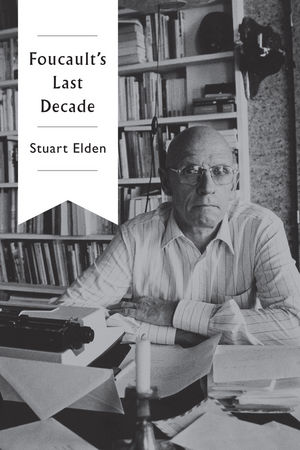
Interview on ‘Foucault’s Last Decade’ at Critical Theory

I’m interviewed over at Critical-Theory.com about Foucault’s Last Decade – the first of a few discussions on the book and its subject matter. Many thanks to Eugene Wolters for the interest in my work and asking the questions in this interview.

0745683916

Michel Foucault died in 1984, at the age of 57, leaving much of his work unfinished. At the time of his death, he was still working on additional volumes of The History of Sexuality series, leaving behind an incomplete fourth volume and countless notes, writings and lectures around the subjects he planned to cover.

Stuart Elden, in his latest book “Foucault’s Last Decade,” meticulously pieces together Foucault’s work in the last 10 years of his life.  Elden draws heavily from Foucault’s lectures at the Collège de France, where many of his ideas were tested and refined, along with archival material and his already published work. “Foucault’s Last Decade” provides an invaluable resource for scholars interested in Foucault’s later work, and the projects he had hoped to undertake. [continues here]

Posted in Foucault's Last Decade, Foucault: The Birth of Power, Michel Foucault, Uncategorized | 3 Comments

Décalages Vol 2 No 1 now published – Althusser and Gramsci

b73d386ec01e0e2e1c06f0542c52d4f5Décalages Vol 2 No 1 now published, with a range of multilingual papers on Althusser, especially focusing on his relation to Gramsci, a couple on the Althusser-Derrida relation and including a new translation of a letter from Althusser on Gramsci.

Posted in Antonio Gramsci, Jacques Derrida, Louis Althusser, Uncategorized | 1 Comment

Stern review of Research Excellence Framework

Lord Nicholas Stern’s review of the Research Excellence Framework is now available here. For those outside UK higher education, the REF is the means by which academic research is evaluated for league tables and funding.

This independent review makes recommendations on the future operation of the Research Excellence Framework (REF). The review examines how university research funding can be allocated more efficiently so that universities can focus on carrying out world-leading research.

The key recommendations seem to be that –

  • all research active staff should be returned
  • instead of four pieces for all people, an average number (which may be different), with some above and below that number
  • outputs are not portable – in other words, while you can hire someone, publications accepted prior to that date stay with the previous institution.
  • metrics should be used to supplement peer review, not supplant it
  • ‘impact’ should be understood more broadly

There are more recommendations, of course, but those seem to me to be the most important. It will take some time to digest. The idea that all research-active staff are returned is good, though there are still ways around this. But it might end some of the game-playing and difficulties of comparison – 66% return at 3.2 vs. 84% at 2.9, etc. The others all make sense (though I benefitted from the portability of outputs in the last submission), and let’s hope the government takes these very seriously. It doesn’t address some much more serious and deeper issues, and there is plenty making that case already. There is also the claim here that there should be no increased administration as a result of the REF and the new Teaching Excellence Framework. Let’s see that happen!

I’ve not seen many assessments of this report yet – please feel free to share links in comments.

Update: the ‘not portable’ idea will be a problem for people wanting to move, since their selling point of pieces accepted will no longer work in their favour. For high-profile hiring this may be the entire point, but it would count against anyone wanting to move, including it seems early career people coming to the end of a fixed-term position.

On looking at paragraphs 69 and 70, it seems that there is a recommendation to reduce the number of outputs assessed – if all research-active staff are assessed, it doesn’t want to increase the number of outputs assessed. ‘This may require the average number of outputs submitted per faculty member to be below 2, depending on the number of research active staff to be submitted.’ A drop to an average of 2, while likely to be applauded by some, could create some other difficulties. If two members of staff submit one and three pieces, respectively, how does workload take account of this?

There is a long standing madness, which I’m sure I’ve mentioned on the blog before, that each output is counted as one piece. So a journal article is one, as is a book. Obviously this bears no relation to the work involved in, or contribution to scholarship of these different types of outputs. In exceptional cases, a single piece of work could be submitted as double-weighted. I tried to make the case that, if anything I ever wrote was to be double-weighted, The Birth of Territory should be. But no, advice was taken and it was submitted as a single item. The argument was that I had more than enough other pieces, so it wasn’t necessary to double-weight it.

The Stern review does make this claim in paragraph 38:

Finding ways to ensure that the REF can encourage researchers to explore big or fundamental problems, in ways that may not deliver a steady stream of papers or a quick monograph; to deliver academically excellent synthesis of evidence and meta-analysis to support policy making; and to develop game changing ideas that, for example, can lead to the development of new disciplines, or that have significant impact outside their discipline, is a priority.

What a ‘quick monograph’ is remains unclear, though I wonder if they mean these increasingly popular short books (Palgrave Pivots, Sage Swifts, Chicago Shorts, Stanford Briefs, Minnesota Forerunners…) I’m not sure those are exactly quick, but they are a different type of output to a more standard length book of c.80-100,000 words.

Edited and translated books still don’t seem to figure as valuable outputs, despite the importance of such work, and the way such work is enabling of other work.

Some further thoughts are at Academic Irregularities and Wonkhe (neither can resist puns on Stern’s name, unfortunately).

Update 2: There is a very good detailed list of responses and other resources here.

Phil Steinberg has some thoughts on impact here; Campaign for the Public University here. More reflections – Martin Eve, Adam Golberg, Paul Kirby, Andrew McRae.

Posted in Politics, Uncategorized, Universities | 2 Comments

Colin Gordon reviews the Cambridge Foucault Lexicon in History of the Human Sciences

Now available open access for the rest of 2016 – http://hhs.sagepub.com/content/29/3/91.full.pdf+html

stuartelden's avatarProgressive Geographies

9780521119214Colin Gordon reviews The Cambridge Foucault Lexiconin History of the Human Sciences (requires subscription). I hope a preprint will appear on Colin’s academia.edu page soon. It’s a very detailed review of a huge work, covering a wide range of the entries – and briefly mentioning my entry on ‘space’ with some nice praise.

Update: Sage have made the essay open access for the rest of 2016.

View original post

Posted in Uncategorized | 3 Comments