Michel Foucault: Discourse Theory and the Archive (2016)

Michel Foucault: Discourse Theory and the Archive conference in Göttingen

Clare O'Farrell's avatarFoucault News

Michel Foucault: Discourse Theory and the Archive
Convention Center at the Historical Observatory; Geismar Landstraße 11, 37083 Göttingen
16 July 2016

See also this link.

This year marks not only Michel Foucault’s 90th birthday, but also the 50th anniversary of the publication of his seminal book Les Mots et les Choses, which made Foucault a prominent intellectual figure throughout Europe. We would like to commemorate this double anniversary with a one-day symposium organised by the Department of British Literature and Culture at Göttingen University in cooperation with the Göttingen Center for Gender studies and the Center for Theory of Culture and Society.

While Foucault has introduced many persistent concepts to the fields of critical, cultural, and literary theory, one that has increasingly attracted attention during the past ten to fifteen years is the archive.

Foucault himself employs the term ‘archive’ ambiguously (cf. Eliassen). Depending on context, the archive…

View original post 380 more words

Posted in Uncategorized | Leave a comment

Foucault Studies: Special Issue on Counter Conduct (2016)

New issue of Foucault Studies now out – all open access.

Clare O'Farrell's avatarFoucault News

View original post 302 more words

Posted in Uncategorized | Leave a comment

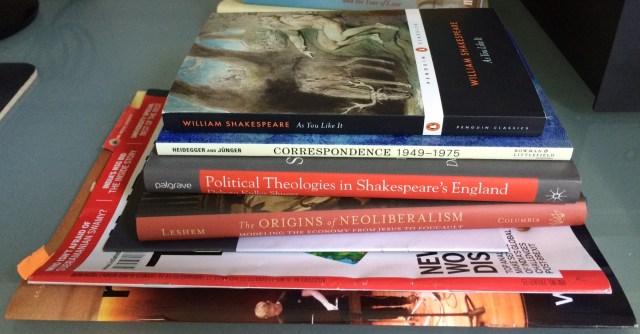
Books received – Shakespeare, Heidegger & Jünger, Leshem, Shuger

IMG_1609

A couple of books for the Shakespeare work, Leshem’s The Origins of Neoliberalism, the Heidegger-Jünger correspondence, the new issue of Radical Philosophy, and the copy of India Today with my piece on the EU referendum (open access here).

Posted in Martin Heidegger, Shakespearean Territories, Uncategorized, William Shakespeare | Leave a comment

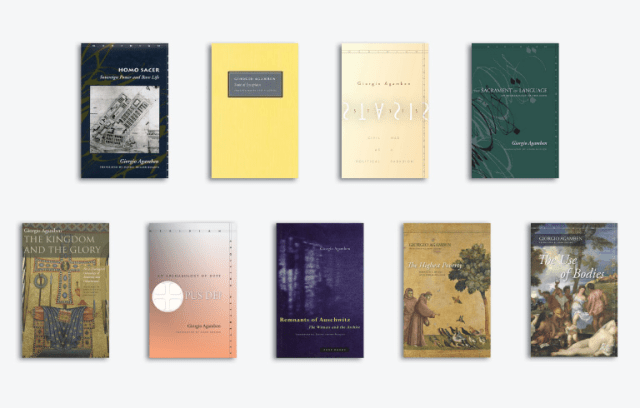
Agamben, Homo Sacer: A Blog Series at the SUP blog

Giorgio Agamben, Homo Sacer: A Blog Series at the SUP blog. Posts by Adam Kotsko, Kevin Attell, Peter Fenves, David Kishik, Alberto Toscano and Lorenzo Chiesa – an all-male lineup, unfortunately.

All nine volumes of the Homo Sacer series, from the inaugural Homo Sacer: Sovereign Power and Bare Life to the final installment, The Use of Bodies published earlier this year. (Two of the nine volumes were published in English by fellow university presses—The State of Exception by University of Chicago Press and Remnants of Auschwitz by MIT Press).

Leading Italian philosopher and political theorist, Giorgio Agamben is perhaps best known for his Homo Sacer project, composed over two decades and launched with the publication of the volume that gave the series its name, Homo Sacer: Sovereign Power and Bare Life. Recruited by Werner Hamacher for Stanford University Press’s Meridian Series, where it appeared in English in 1998, the book signaled a new direction for contemporary political thought.

To celebrate the publication of its ninth and final volume, The Use of Bodies, in English translation, Stanford University Press is hosting a blog roundtable to reflect on the stakes of the series as a whole. The posts that follow will approach Agamben’s work from a variety of intellectual perspectives, approaches that echo the interdisciplinary resonances of this vast and important undertaking.

Image.png

Posted in Alberto Toscano, Giorgio Agamben | Leave a comment

Ingo Farin and Jeff Malpas (eds.), Reading Heidegger’s Black Notebooks 1931-41 reviewed at NDPR

9780262034012Ingo Farin and Jeff Malpas (eds.), Reading Heidegger’s Black Notebooks 1931-41 is reviewed at NDPR by Stephen Mulhall.

Posted in Jeff Malpas, Martin Heidegger | Leave a comment

Jean Baudrillard: From Hyperreality to Disappearance: Uncollected Interviews reviewed

9780748694297Jean Baudrillard, From Hyperreality to Disappearance: Uncollected Interviews, edited by David B Clarke and Richard G Smith, is reviewed at Marx & Philosophy.

Posted in jean baudrillard, Uncategorized | Leave a comment

What is the Urban? Registers of a World Interior – videos

What is the Urban? Registers of a World Interior  – videos from the conference held earlier this year in Iowa. Full playlist here.

Posted in Uncategorized, urban/urbanisation | 3 Comments

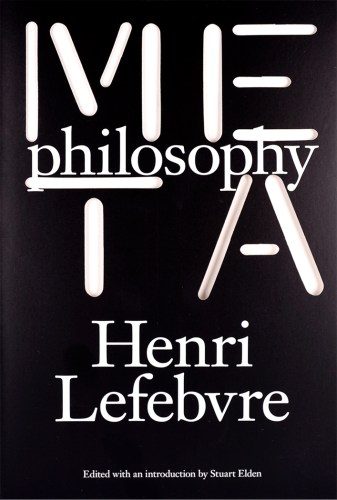
Henri Lefebvre, Metaphilosophy, translated by David Fernbach and edited by Stuart Elden – now available

Meta-Philosophy-front-1050-8aec1b1e7b5b23fdcf86f8eb8e67d2a5Henri Lefebvre, Metaphilosophy, translated by David Fernbach and edited and introduced by me, is now available. The best place to buy is the Verso website – the cheapest place I know online, and with free shipping. The cover is a rather clever cut-out design. There will be an e-book soon, and Verso’s usual practice is to bundle this with physical purchases. (More publishers should do this!)

In Metaphilosophy, Henri Lefebvre works through the implications of Marx’s revolutionary thought to consider philosophy’s engagement with the world. Lefebvre takes Marx’s notion of the “world becoming philosophical and philosophy becoming worldly” as a leitmotif, examining the relation between Hegelian–Marxist supersession and Nietzschean overcoming. Metaphilosophy is conceived of as a transformation of philosophy, developing it into a programme of radical worldwide change. The book demonstrates Lefebvre’s threefold debt to Hegel, Marx and Nietzsche, but it also brings a number of other figures into the conversation, including Sartre, Heidegger and Axelos. A key text in Lefebvre’s oeuvre, Metaphilosophy is also a milestone in contemporary thinking about philosophy’s relation to the world.


We hope that this will be the first in a sequence of translations of Lefebvre’s more theoretical writings, but that is reliant on good sales of this one… It’s currently available for £14 with free shipping, which is good value for an academic book of this length. My reading guide to Henri Lefebvre gives some suggestions of where else to start with his work.
Posted in Henri Lefebvre | 1 Comment

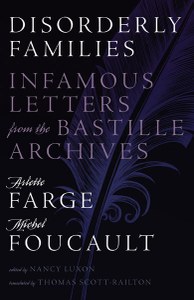
Farge and Foucault, Disorderly Families – forthcoming with University of Minnesota Press

image_miniArlette Farge and Michel Foucault, Disorderly Families: Infamous Letters from the Bastille Archives, forthcoming with University of Minnesota Press, edited by Nancy Luxon and translated by Thomas Scott-Railton. The UMP page says January 2017; Amazon suggests November 2016. There will be a companion book of essays, entitled Archives of Infamy, also edited by Nancy Luxon – more details when available.

Drunken and debauched husbands; libertine wives; vagabonding children. These and many more are the subjects of requests for confinement written to the king of France in the eighteenth century. These letters of arrest (lettres de cachet) from France’s Ancien Régime were often associated with excessive royal power and seen as a way for the king to imprison political opponents. In Disorderly Families, first published in French in 1982, Arlette Farge and Michel Foucault collect ninety-four letters from ordinary families who, with the help of hired scribes, submitted complaints to the king to intervene and resolve their family disputes.

Gathered together, these letters show something other than the exercise of arbitrary royal power, and offer unusual insight into the infamies of daily life. From these letters come stories of divorce and marital conflict, sexual waywardness, reckless extravagance, and abandonment. The letters evoke a fluid social space in which life in the home and on the street was regulated by the rhythms of relations between husbands and wives, or parents and children. Most impressively, these letters outline how ordinary people seized the mechanisms of power to address the king and make demands in the name of an emerging civil order.

Arlette Farge and Michel Foucault were fascinated by the letters’ explosive qualities and by how they both illustrated and intervened in the workings of power and governmentality. Disorderly Families sheds light on Foucault’s conception of political agency and his commitment to theorizing how ordinary lives come to be touched by power. This first English translation is complete with an introduction from the book’s editor, Nancy Luxon, as well as notes that contextualize the original 1982 publication and eighteenth-century policing practices.

Posted in Arlette Farge, Michel Foucault | 3 Comments

CHE Article on Journal Editors and Their Work

Peter Gratton links to a good piece on how journal editors work

Peter Gratton's avatarPHILOSOPHY IN A TIME OF ERROR

Most of this offers good advice (h/t Christina Daigle on FB): don’t have titles that are too punny or silly, really pay attention to your abstract and first couple of pages, realize if you cite someone and we editors need ideas for reviewers, they might be used first, etc. But I would say the first rule is to read the darn journal before submitting–it’s amazing how many desk rejects are just simply because it’s not a fit for what the journal publishes. This below is a bit strong:

Do not — repeat, do not — complain to the editor about the reader reports you receive. (Find a friend, a mentor, or a therapist for that.)

Don’t complain, but you can defend your work without being defensive: give an argument (we try, but don’t always screen well bad reports), but don’t pretend editors won’t roll their eyes when you suggest…

View original post 21 more words

Posted in Uncategorized | 1 Comment