
Critical Theory’s roundup of eight books that came out in June
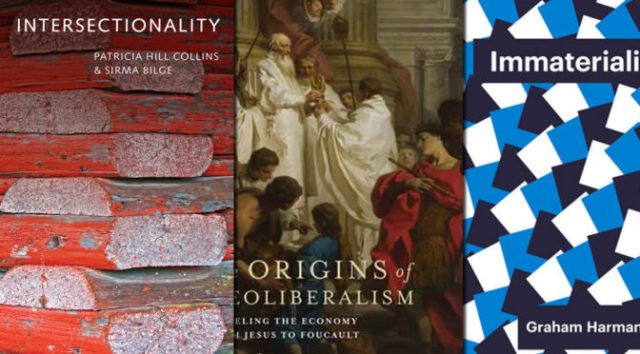
Critical Theory’s roundup of eight books that came out in June
In 2008, Klaus Dodds and I published an article entitled ‘Thinking Ahead: David Cameron, the Henry Jackson Society and British Neo-conservatism‘ in the British Journal of Politics and International Relations (requires subscription, or available here). We wrote the piece in 2007, around the time that Gordon Brown became prime minister, when Cameron was the relatively new leader of the Conservative Party. Here’s the abstract:
The Conservative party under David Cameron’s leadership has embarked on a series of foreign policy initiatives which appear to revise the political right’s traditional reluctance to interfere in third-party conflicts with no obvious British interest. This article looks at whether this shift is substantial through an examination of Cameron’s and William Hague’s foreign policy pronouncements. Its particular focus is to discuss whether the Henry Jackson Society, a group of academics, parliamentarians and journalists, is exercising any influence over Conservative party foreign policy discussion. Finally, we consider how critics including individuals associated with the Henry Jackson Society have evaluated Cameron’s and Hague’s tentative interventionist convictions. It is suggested that the notion that idealism in foreign policy has to be conditioned by realism is actually a reworking of Blair’s foreign policy, especially when applied to overseas intervention.
 The reason I highlight this piece now is that one of the key voices in the early days of the Henry Jackson Society was Michael Gove, then a relatively new MP and advisor to Cameron, and now one of the candidates for Conservative party leader and prime minister. (Gisela Stuart, one of the key Labour voices for the ‘Leave’ campaign, was also a signatory of their founding statement of principles). Gove got quite a lot of attention in our article, not just because of his role in the society, but also because of his book Celsius 7/7, which looked at the 2005 London bombs and wider issues in the war on terror. Gove’s cabinet experience has been in Education and Justice (though he has some strange ideas about the nouns those ministries are concerned with). His foreign policy views have, of late, been largely confined to Europe. But it is worth reconsidering the kind of views he has on wider issues.
Welcome to the Anthropocene – Video of debate with Peter Sloterdijk and Bernard Stiegler (via Philippe Theophanidis)
We no longer live in the Holocene. Welcome to the Anthropocene! For the first time in history it is not nature but man that is the biggest geological force.
Since the industrial revolution earth has entered new territory. By digging up and using large amounts of oil and coals, among others, technology has taken flight. But this has brought us more than progress alone. While climate change persists and plastic waste is accumulating, the consequences for our planet are only now beginning to dawn on us.
What does it mean to live in the Anthropocene? What will this man-made geological era bring us? What problems will we face? And how will we solve them?
These big questions will be discussed by two great thinkers: the German philosopher Peter Sloterdijk and the French philosopher Bernard Stiegler. What is their diagnosis of our current anthropological condition? And what are their speculations for a future of an increasingly globalizing and industrializing humanity on a finite and fragile planet?
Programmer and philosopher Lisa Doeland chairs the debate.
 The Theory, Culture & Society E-Special Issue on John Urry, edited and introduced by Mimi Sheller, is now available.
This e-special issue of Theory, Culture & Society presents key works published by the late British Sociologist John Urry (1946-2016) in the journals Theory, Culture & Society and Body & Society. It serves both to commemorate and to continue Urry’s profound contributions as a social theorist, as a network builder, and as a public intellectual who changed the face of British, and indeed global, social science. The selections range from 1982 to 2014, including articles and introductions to collections, both sole-authored and collaborative pieces. By gathering this portion of his work in one place we seek to make it easily accessible, as well as marking the signal importance of his impact on contemporary social theory.
Table of Contents
Complexity and Social Science
John Urry
Duality of Structure: Some Critical Issues
Theory, Culture & Society, 1982, vol. 1 (2): 100-106Scott Lash And John Urry
Economies of Signs and Spaces
1994John Urry
The Global Complexities of September 11th
Theory, Culture & Society, 2002, vol. 19 (4): 57-69John Urry
The Complexity Turn
Theory, Culture & Society, 2005, vol. 22 (5): 1-14John Urry
The Complexities of the Global
Theory, Culture & Society, 2005, vol. 22 (5): 235-254
Mobilities, Climate Change and Carbon Capitalism
Mimi Sheller and John Urry
Mobile Transformations of `Public’ and `Private’ Life
Theory, Culture & Society, 2003, vol. 20 (3): 107-125John Urry
The ‘System’ of Automobility
Theory, Culture & Society, 2004, vol. 21 (4-5): 25-39Bronislaw Szerszynski and John Urry
Changing Climates: Introduction
Theory, Culture & Society, 2010, vol. 27 (2-3): 1-8John Urry
Consuming the Planet to Excess
Theory, Culture & Society, 2010, vol. 27 (2-3): 191-212John Urry
The Problem of Energy
Theory, Culture & Society, 2014, vol. 31 (5): 3-20
Tourism, Bodies and Nature
John Urry
Cultural Change and Contemporary Holiday-Making
Theory, Culture & Society, 1988; vol. 5 (1): 35-55John Urry
The Tourist Gaze and the `Environment’
Theory, Culture & Society, 1992,vol. 9 (3): 1-26Phil Macnaghten And John Urry
Contested Natures
1998John Urry And Jonas Larsen
The Tourist Gaze
3.0, 2012Phil Macnaghten And John Urry
Bodies of Nature: Introduction
Body & Society, 2000, vol. 6 (3-4): 1-11
 I have a short piece in the new issue of India Today on ‘The legacies of the Leave EU vote’. The piece is available open access.
I was asked to write about this for an international audience, so for UK or other European readers some of the discussion is likely to be quite familiar. Given the fast-moving nature of events, it is hard not to be overtaken by the news – notably it was written before Boris Johnson said he would not run.
Perhaps the distinctive contribution is that I begin thinking about the territorial and boundary implications of this vote. That is a topic which I may explore in future academic work.
Agamben’s Philosophical Lineage, edited by Adam Kotsko and Carlo Salzani – forthcoming with Edinburgh University Press. Early stages of work, but the contents and contributors are here.
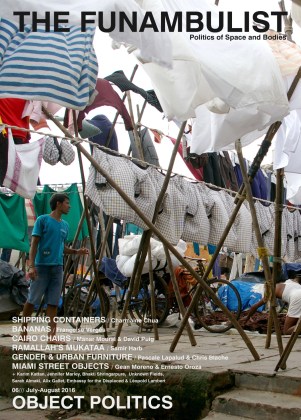 Object Politics – the Sixth Issue of The Funambulist Magazine Now Published
The issue includes guest columns about Native resistance in New Mexico by Jennifer Marley, and about the most recent Palestinian Festival of Literature by Bhakti Shringarpure. The articles of the main dossier are written by Charmaine Chua about the shipping container, Françoise Vergès about the banana, Manar Moursi & David Puig about Cairo’s street chairs, and Pascale Lapalud & Chris Blache (Genre & Ville) about gender and urban furniture in French cities. It also includes a short graphic essay about Ramallah’s Mukataa by Samir Harb and a text about the New Palestinian Museum “without objects” by Karim Kattan. The transcript of a 2014 Archipelago conversation with Miami artists/writers Gean Moreno & Ernesto Oroza examines the systems in which generic objects take place, while the photographic section is a partial report of the most recent Unknown Fields‘ expedition in Rajasthan’s garment factories. The three student projects invent a passport and a backpack for the refugees in Lesvos (Embassy for the Displaced), a kit of facial prosthetics to “trick biometrics” (Alix Gallet) and a bridge countering the segregating effects of the concrete walls of Baghdad (Sarah Almaki).
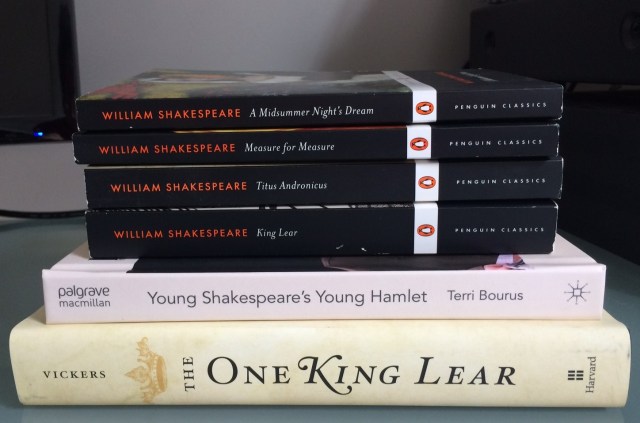
A pile of books for the Shakespeare work – including Terri Bourus’s Young Shakespeare’s Young Hamlet in recompense for review work, and Brian Vickers’s The One King Lear to review.
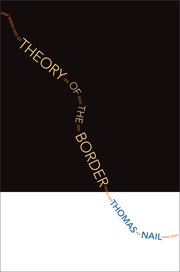 Thomas Nail, Theory of the Border, forthcoming in October 2016.
Despite — and perhaps because of — increasing global mobility, there are more types of borders today than ever before in history. Borders of all kinds define every aspect of social life in the twenty-first century. From the biometric data that divides the smallest aspects of our bodies to the aerial drones that patrol the immense expanse of our domestic and international airspace, we are defined by borders. They can no longer simply be understood as the geographical divisions between nation-states. Today, their form and function has become too complex, too hybrid. What we need now is a theory of the border that can make sense of this hybridity across multiple domains of social life.
Rather than viewing borders as the result or outcome of pre-established social entities like states, Thomas Nail reinterprets social history from the perspective of the continual and constitutive movement of the borders that organize and divide society in the first place. Societies and states are the products of bordering, Nail argues, not the other way around. Applying his original movement-oriented theoretical framework “kinopolitics” to several major historical border regimes (fences, walls, cells, and checkpoints), Theory of the Border pioneers a new methodology of “critical limology,” that provides fresh tools for the analysis of contemporary border politics.
 Out shortly is Behrooz Ghamari-Tabrizi, Foucault in Iran: Islamic Revolution after the Enlightenment. Thanks to Chathan Vemuri for the link.
Foucault in Iran centers on the significance of Foucault’s writings on the Iranian Revolution and the profound mark it left on his lectures on ethics, spirituality, and fearless speech. This interdisciplinary work will spark a lively debate in its insistence that what informed Foucault’s writing was his conviction that Enlightenment rationality has not closed the gate of unknown possibilities for human societies.
Foucault in Iran is a courageous and thought-provoking invitation to understand the Iranian revolution, and Foucault’s reaction to it, in an original way. A splendid work that goes beyond simple binaries, it has no sympathy for the clichéd vocabulary used by Progressivists to describe these events—or to criticize Foucault for his alleged romanticisation of the Iranian revolution.
Talal Asad, City University of New York

