Henri Lefebvre, Metaphilosophy – forthcoming in July from Verso

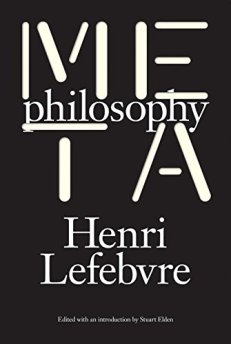
Although it has been a bit delayed, Lefebvre’s Metaphilosophy is now forthcoming from Verso in July 2016. First published in 1965, it was translated by David Fernbach. I edited the text and wrote an introduction.
41lQcLWg6sL.jpg

In Metaphilosophy, Henri Lefebvre works through the implications of Marx’s revolutionary thought to consider philosophy’s engagement with the world. Lefebvre takes Marx’s notion of the “world becoming philosophical and philosophy becoming worldly” as a leitmotif, examining the relation between Hegelian–Marxist supersession and Nietzschean overcoming. Metaphilosophy is conceived of as a transformation of philosophy, developing it into a programme of radical worldwide change. The book demonstrates Lefebvre’s threefold debt to Hegel, Marx and Nietzsche, but it also brings a number of other figures into the conversation, including Sartre, Heidegger and Axelos. A key text in Lefebvre’s oeuvre, Metaphilosophy is also a milestone in contemporary thinking about philosophy’s relation to the world.

Metaphilosophy establishes Lefebvre’s place among the twentieth century’s very greatest Marxist thinkers. Arguing that the idea of philosophy can only be realized by going beyond philosophy itself, Lefebvre opens philosophy up to the concerns of everyday life and love, mass media and synthetics, consumerism and nuclear apocalypse, in a breathtakingly original vision of what truly radical thought might be. First written in French half a century ago, the remarkable challenges that it poses remain as significant as ever. There will not be a more important work of philosophy published this decade.”

Posted in Henri Lefebvre, Uncategorized | 1 Comment

Shakespeare productions in London, Stratford and elsewhere I’m looking forward to…

My occasional retrospective comments on Shakespeare productions in London, Stratford and elsewhere might mean they come too late, and that people who are interested don’t get to see them. I know that some productions can sell out quickly, some months ahead of time – I failed to get tickets to Ralph Fiennes as Richard III at the Almeida just today. So, here’s a list of some of the productions I’m looking forward to over the next few months.

Romeo and Juliet at the Garrick, directed by Kenneth Branagh

Trevor Nunn’s production of King John in Kingston

Cymbeline at the RSC, and then as Imogen ‘reclaimed and renamed’ at the Globe

A number of King Lears – Don Warrington in Birmingham, Timothy West in Bristol, Antony Sher at the RSC, and The Shadow King at the Barbican. Glenda Jackson will also be taking the lead at the Old Vic in the autumn.

Macbeth and The Taming of the Shrew at the Globe, and probably their A Midsummer Night’s Dream, which I will also see at the RSC.

A bit further ahead, Simon Russell Beale as Prospero in The Tempest, and a play I’ve never seen before, The Two Noble Kinsmen, both at the RSC. In early 2017 I also hope to get to Ivo van Hove’s Roman TragediesCoriolanus, Julius Caesar, and Anthony and Cleopatra in a six hour epic at the Barbican; and Hamlet at the Almeida. I was disappointed that the wonderful Scena Mundi had to cancel their run of Othello at St Giles in the Fields.

What have I missed?

Posted in William Shakespeare | Leave a comment

A fairly clear desk as I begin the final revisions of Foucault: The Birth of Power

IMG_1481

A fairly clear desk as I begin the final revisions of Foucault: The Birth of Power

Posted in Foucault: The Birth of Power, Michel Foucault, Uncategorized, Writing | Leave a comment

The Dissonance of Things #6: Logistics – Violence, Empire and Resistance

Laleh Khalili, Deborah Cowen and Charmaine Chua discuss logistics, violence, empire and resistance.

Charmaine Chua's avatarThe Disorder Of Things

EXODUS-IV-Hong-Kong-China-2010
Source: Marcus Lyon

This May, The Dissonance of Things switches out British accents for those of the vaguely North American variety, as I serve as host for our sixth podcast on the topic of logistics and its role in the making of military, capitalist, and imperial relations. I’m joined by our very own Laleh Khalili of the School of Oriental and African Studies, and the wonderful Deborah Cowen of the University of Toronto. Together, we take a look at the increasing ubiquity and prominence of logistics as a mode for organizing social and spatial life. We discuss how this seemingly banal concern with the movement of goods is actually foundational to contemporary global capitalism and imperialism, reshaping patterns of inequality, undermining labor power, and transforming strategies of governance. We also ask: what might a counter-logistical project look like? What role does logistics play in anti-colonial and anti-capitalist struggles across the…

View original post 117 more words

Posted in Uncategorized | 1 Comment

Danger, Crime and Rights: A 1983 Conversation between Michel Foucault and Jonathan Simon – published in Theory, Culture & Society

Danger, Crime and Rights: A Conversation between Michel Foucault and Jonathan Simon” has just been published by Theory, Culture and Society (Online First). The discussion from 1983 was previously only available as a recording in the Bancroft library at UC Berkeley. Katie Dingley transcribed it, I edited it, wrote a brief introduction and Jonathan contributed a revealing commentary at the end.

This article is a transcript of a conversation between Michel Foucault and Jonathan Simon in San Francisco in October 1983. It has never previously been published and is transcribed on the basis of a tape recording made at the time. Foucault and Simon begin with a discussion of Foucault’s 1977 lecture ‘About the Concept of the “Dangerous Individual” in 19th-Century Legal Psychiatry’, and move to a discussion of notions of danger, psychiatric expertise in the prosecution cases, crime, responsibility and rights in the US and French legal systems. The transcription is accompanied by a brief contextualizing introduction and a retrospective comment by Simon.

Berkeley seminar group 2 (colour).jpgJonathan was part of a group of Berkeley students who met with Foucault alongside his lecture course on parrēsia (published as Fearless Speech and recently published in a French critical edition). One photograph of this group, with the cowboy hat they gifted Foucault, can be found in Didier Eribon’s biography. Another photo, taken a few moments later, is published for the first time in this article. Jonathan is two to Foucault’s left. I say more about the group and what they did and had planned with Foucault in Foucault’s Last Decade.

The article requires subscription, but if you cannot access it, please email me for a copy.

Posted in Foucault's Last Decade, Jonathan Simon, Michel Foucault, Theory, Theory, Culture and Society, Uncategorized | Leave a comment

Durham IAS 2017-18 Structure Fellowship is now open – closing date 10th June 2016

Durham IAS 2017-18 Structure Fellowship is now open – closing date 10th June 2016

The Institute of Advanced Study is Durham University’s flagship interdisciplinary research institute, providing a central forum for debate and collaboration across the entire disciplinary spectrum. The Institute seeks to catalyse new thinking on major annual themes by bringing together leading international academics as well as writers, artists and practitioners.

The theme for 2017/18 is Structure, interpreted in its broadest sense – scientifically, symbolically, legally, philosophically, literarily, politically, economically, and sociologically. Applications for the 2017/18 Fellowship will open on 20 April 2016. Up to 20, three-month fellowships (October-December 2017 and January-March 2018), linked to the annual theme. Applicants may be from any academic discipline or professional background involving research, and they may come from anywhere in the world. IAS Fellowships include an honorarium, funds for travel, accommodation, subsistence and costs associated with replacement teaching or loss of salary (where appropriate).

Research

Fellows will contribute to the Institute’s annual theme.The Institute provides its Fellows with a setting that offers them time and freedom to think, away from the demands of their everyday professional lives. By recruiting Fellows from all around the world, the IAS also provides an exciting intellectual environment in which thinkers from diverse cultural and disciplinary backgrounds can exchange ideas. Fellows will engage and forge strong links with at least one department at Durham, and be given the opportunity to deliver papers at events organised to coincide with the annual theme.

Additional Information

Further Particulars

How to Apply

Internal Applications

Posted in Institute of Advanced Study, Uncategorized, Universities | Leave a comment

Levinas conference in Toulouse, July 4-8, 2016

A major Levinas conference on The Neighbour and the Stranger

doctorzamalek's avatarObject-Oriented Philosophy

THE NEIGHBOR AND THE STRANGER

July 4th – 8th, 2016, University Jean Jaurès, Toulouse, France

An international conference under the auspices of the North American Levinas Society (NALS) & Société internationale de Recherche Emmanuel Levinas (SIREL)

Conference organizing committee :Flora Bastiani (France), Erik Garrett (USA), Dara Hill (USA), Nelson Lerias (France), Diogo Villas Bôas Aguiar (Brasil)

As the seventh year is the year of fallow land, this seventh year of the Toulouse International Conference tends to take place somewhere else than in the foothold in the land, somewhere else than in the autochthony, taking under consideration the landless, the undocumented, the migrant that each human being conceals, those that through their misery oblige to reconfigure the rules of living together.

Current affairs have (and for some time now) imposed the ethical problem of most deviant: his difference—which is at the same time unpredictable and inexhaustible.

The stranger appears in…

View original post 274 more words

Posted in Uncategorized | Leave a comment

Guardian Shakespeare Solos – new set of videos

untitled

The final set of films in the Guardian’s Shakespeare Solos series has been released. The five videos feature outstanding actors performing some of the playwright’s best known speeches. Damian Lewis delivers the funeral oration from Julius Caesar, Zawe Ashton gives the “seven ages of man” speech from As You Like It, Riz Ahmed plays Edmund in King Lear, Laura Carmichael is Portia from The Merchant of Venice and Paterson Joseph portrays Shylock.

Posted in Uncategorized, William Shakespeare | Leave a comment

b20 an online journal from boundary 2

Announcing b2o: an online journal!
// boundary 2

In Spring 2016, boundary 2 launched a new website that includes, in addition to the already existing b2 review, new reviews and interventions sections, as well as a new journal. The new journal will publish both full issues, edited by members of the editorial board or guest edited, as well as peer-reviewed and non peer-reviewed individual articles, interviews, short pieces, and other texts. The journal’s focus will be on publishing time-sensitive materials and generating critical online debate.

Posted in Uncategorized | Leave a comment

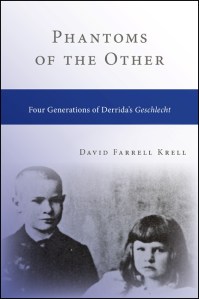
My review of David Farrell Krell, Phantoms of the Other: Four Generations of Derrida’s Geschlecht in Derrida Today

63134_covMy review of David Farrell Krell, Phantoms of the Other: Four Generations of Derrida’s Geschlecht, Albany: State University of New York, 2015 has now been published in Derrida Today (open access) or try here if that doesn’t work.

Posted in David Farrell Krell, Jacques Derrida, Martin Heidegger, Uncategorized | Leave a comment