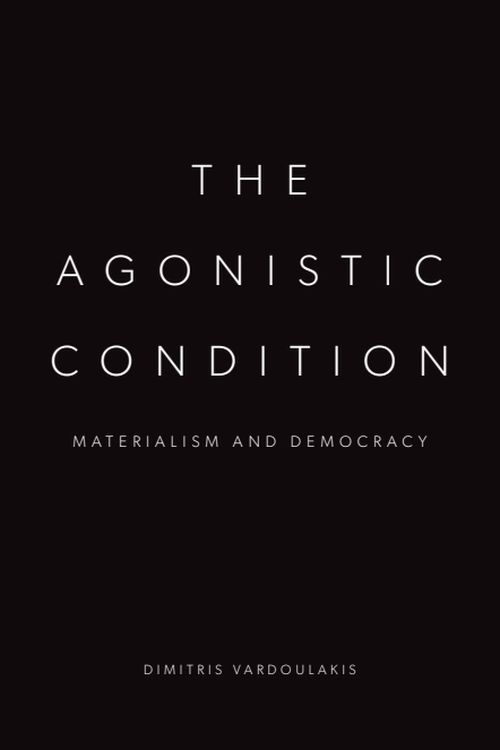
Examines the philosophical background to theories of conflict in political theory and their sources in philosophy
Supplies an engagement of philosophy with political theory
Provides a critique of the critique of instrumental reason
Proposes a new conception of non-representational politics
Political theory influenced by philosophy examines the political as the sphere of human interaction that is distinct from politics, the sphere of political institutions and parties. The political is usually described in conflictual terms, such as Marx’s class struggle, Heidegger’s polemos, Rancière’s dissensus, or the discourse of agonistic democracy.
This book challenges the premise of such constructions of agonism, namely, that the political is essentially distinct from means and ends calculations. He argues that this premise is derived from the critique of instrumental reason, which assumes that utilitarianism is correct that instrumental ends are measurable. This forgets an ancient tradition that describes phronesis as the primary ethical and political virtue because it calculates the good, which is however impossible to measure with any certainty.
The Agonistic Condition shows that a new consideration of phronesis can help political philosophy and theory to develop more robust conceptions of power that better describe the world we live in.
An investigative history of the closure of Harvard University’s geography program in the mid-twentieth century due to homophobia and wider institutional politics.
Let Geography Die tells the little-known and oft-misunderstood story of geographical research and education at Harvard University. In investigative fashion, Alison Mountz and Kira Williams unearth the personal and institutional secrets that drove the sudden closure of Harvard’s geography program at the precise moment that it reached its apex. At the heart of this narrative are the hidden personal lives of the queer men recruited to build the geography program—the same ones who were later blamed for its demise. Chief among these figures is Derwent Whittlesey, who eventually became Harvard’s last lone geography professor, once the program he had so successfully built was closed around him.
The book weaves together several histories at once: the enactment of homophobic policies under McCarthyism designed to purge queer people from university campuses and government offices; a university president with little regard for the social sciences on a personal mission to dissolve geographic education; fierce, if failed, university politicking to rescue and then resuscitate the program; personal queer lives hidden in plain sight on the edge of campus; and two contemporary queer political geographers on a mission to memorialize the queer people blamed for society’s ills.
Let Geography Die exposes the truth behind this important story—as well as its wider haunting of an entire discipline 75 years later—while also restoring the humanity of the central characters involved, especially Derwent Whittlesey.
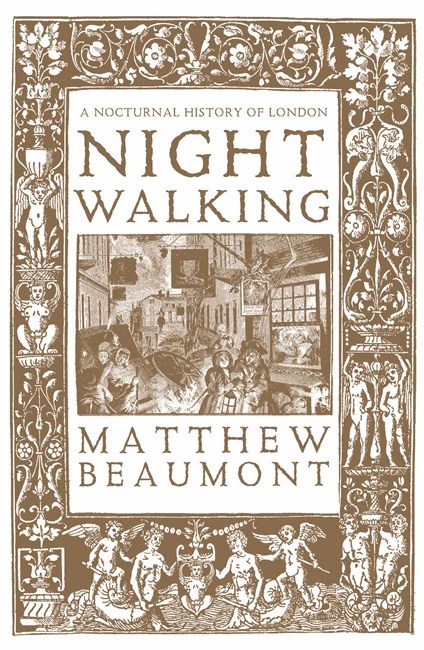
A captivating history of the city at night and the people, writers and workers who inhabit the London darkness
In this brilliant work of literary investigation, Matthew Beaumont shines a light on the shadowy perambulations of poets, novelists and thinkers: the fetid, treacherous streets known to Chaucer and Shakespeare; William Blake and his ecstatic peregrinations; the feverish ramblings of opium addict Thomas De Quincey; and, among the lamp-lit literary throng, the supreme nightwalker Charles Dickens. We discover how the nocturnal city has inspired some and served as a balm or narcotic to others. In each case, the city is revealed as a place divided between work and pleasure, the affluent and the indigent, where the entitled and the desperate rub shoulders.
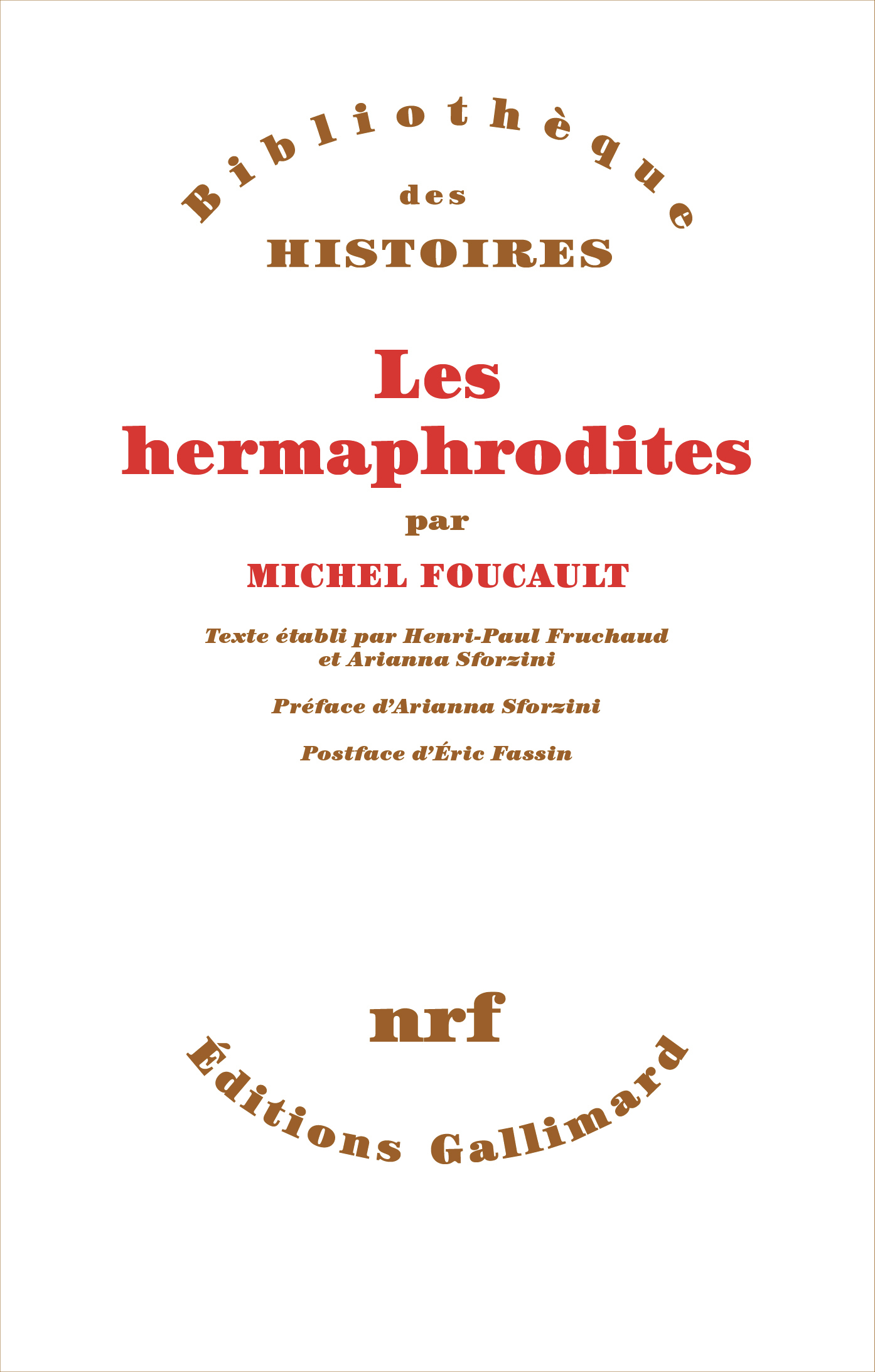
Michel Foucault, Les Hermaphrodites – Gallimard, September 2025, eds. Henri-Paul Fruchaud and Arianna Sforzini, preface by Arianna Sforzini and a postface by Éric Fassin
I’ve shared news of this book before, but the Gallimard site now has a description:
En 1978, Michel Foucault annonce un volume de son Histoire de la sexualité « consacré aux hermaphrodites ». Avec la réorientation de son enquête vers l’Antiquité, il y a renoncé. Demeure dans ses archives ce manuscrit qui aurait pu en faire l’ouverture. À partir de procès échelonnés entre le xvie et le XVIIIᵉ siècle, il met en lumière le passage d’un régime juridique, attribuant un « sexe de décision », à un régime de véridiction, postulant que chaque individu a un seul et « vrai » sexe, qu’il revient à la science médicale de déterminer. C’est aussi le seul écrit dans lequel Foucault élabore la distinction cruciale, à la fois historique et théorique, entre sexe anatomique et sexualité. La préface d’Arianna Sforzini présente cette histoire par une lecture attentive des concepts organisant le texte, tandis que la postface d’Éric Fassin en fait ressortir les enjeux les plus contemporains, en analysant les rapports entre sexualité, sexe et genre.
The book is part of the Bibliothèque des Histoires series, in which several of Foucault’s books appeared, including the four volumes of the History of Sexuality.
France 24 reports on this here. There is a piece by Hocine Bouhadjera about the book at Actualitté.
Spirits of extraction revisits the troubling history of socially reformist, ostensibly anti-racist, Christianity and its role in the expansion of the extractive industries, British imperialism, and settler colonialism. The book explores key moments in the history of Methodism and the evangelical movement. Colonial fears, and the attempt to ‘civilise savages’, were crucial to the movement’s foundation in eighteenth-century industrialising Bristol, England. Through the culture of the Cornish mining diaspora of the nineteenth century, Methodism enmeshed with all the complexity of race and labour-structures of the British empire. At the same time, in Anishinaabewaki/Upper Canda/Ontario, Methodist missionaries laid the foundation of abusive education and racialised ideas of redemption that both enable and sacralise the mining industry. Through these histories of our present, the book theorises the relation of religion and education to racism, modernity, biopower, extractivism, and the geology of race.
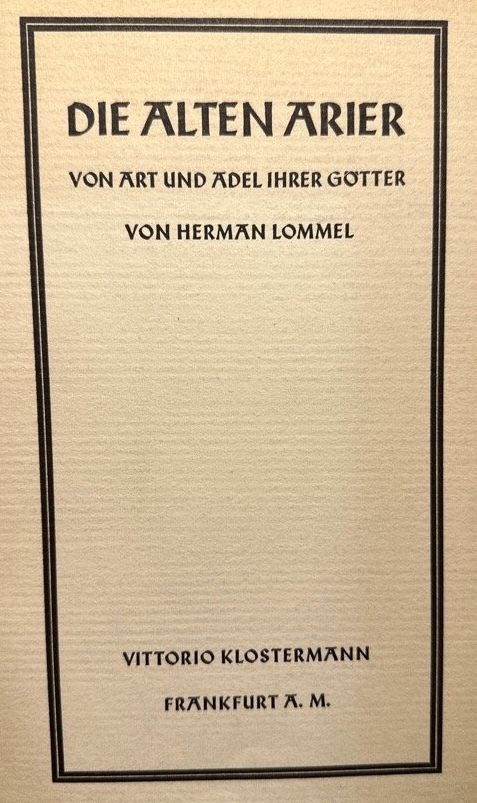
In Mitra-Varuna in 1940, Georges Dumézil mentions the equation of Ahura-Mazdāh and Varuna, which he says was a “hypothesis, long accepted without argument”, but which “has subsequently been hotly disputed – wrongly, in my belief”, and that “on this point I regret being in disagreement with a mythologist of such standing as H. Lommel” (French, p. 109; English, pp. 64-65). This a reference to Indologist and Iranologist Hermann Lommel (7 July 1885-5 October 1968), and specifically to a chapter in his 1935 book Die alten Arier: Von Art und Adel ihrer Götter [The Ancient Aryans: The Nature and Nobility of their Gods], translated into French as Les Anciens Aryans in 1943. Over thirty years later, Dumézil praised Lommel’s 1939 analysis of the relation between the Indian sorcerer Kāvya Uśanas and the Iranian king Kavi Usan, which he builds upon in a detailed analysis in the second part of the second volume of his Mythe et épopée series, a part translated as The Plight of the Sorcerer.
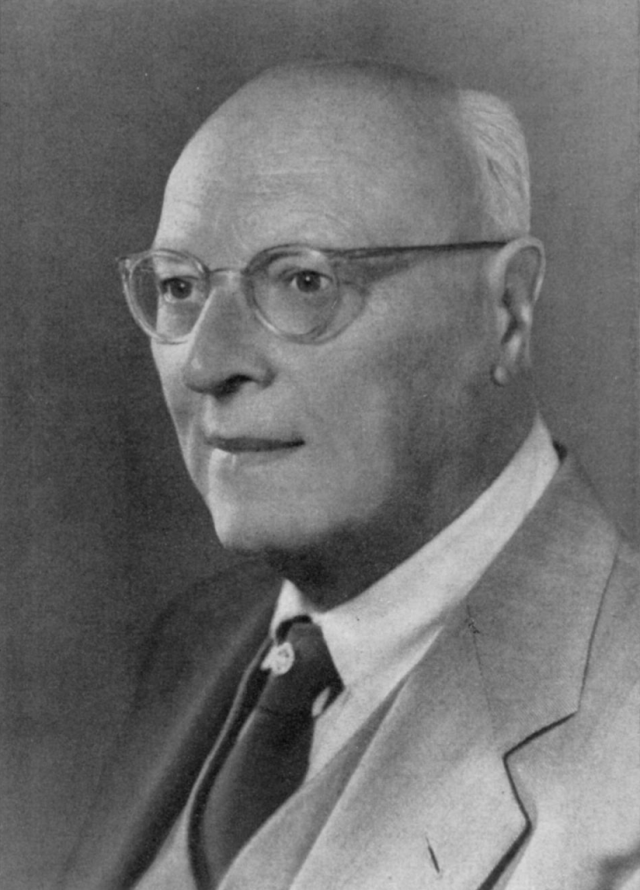
Herman Lommel
Lommel is an interesting figure. Extraordinarily, his mother was G.W.F. Hegel’s granddaughter, while his father was the physicist Eugen von Lommel. In his helpful Encyclopædia Iranica entry on Lommel, Rüdiger Schmitt notes his training at Göttingen by “Jacob Wackernagel (Indo-European), Hermann Oldenberg (Indology), and Friedrich Carl Andreas (Iranian studies)”, which puts him in a similar lineage to the one later followed by Walter Bruno Henning (on whom, see here).
After teaching for a few years in Göttingen, Lommel was a Professor at the Goethe University in Frankfurt am Main between 1917 and 1950, where he held a chair in Indo-European studies. Lommel was the German translator of Ferdinand de Saussure’s Cours de linguistique générale in 1931. Schmitt suggests that he “was one of the first German linguists who perceived the importance of the epoch-making work… and therefore translated it into German (1931) at a time when such translations were not yet common at all”. Roman Jakobson though is highly critical of Lommel’s translation, describing it as “frankly bad, sacrificing all theoretical finesse to the desire to Germanise Saussurean terminology and phraseology at all costs” (Selected Works, Vol VIII, 398).
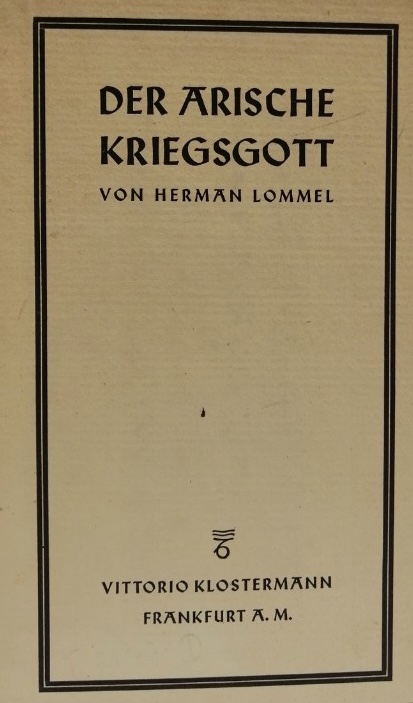
Lommel is best-known for his work on Zoroastrianism. This includes his translations of Avestic texts – the Yašts in 1927 and the posthumous edition of the Gathas. He is also known for his own books on the topic, particularly his 1930 book Die Religion Zarathustras. As well as Die alten Arier, Dumézil praises his 1939 Die arische Kriegsgott [The Aryan God of War] in his own treatment of the warrior function (The Destiny of the Warrior, pp. xii-xiii). Die alten Arier was the first volume of a series edited by Lommel, “Religion und Kultur der alten Arier”, but as far as I can tell, the only other volume in that series was his own Die arische Kriegsgott.
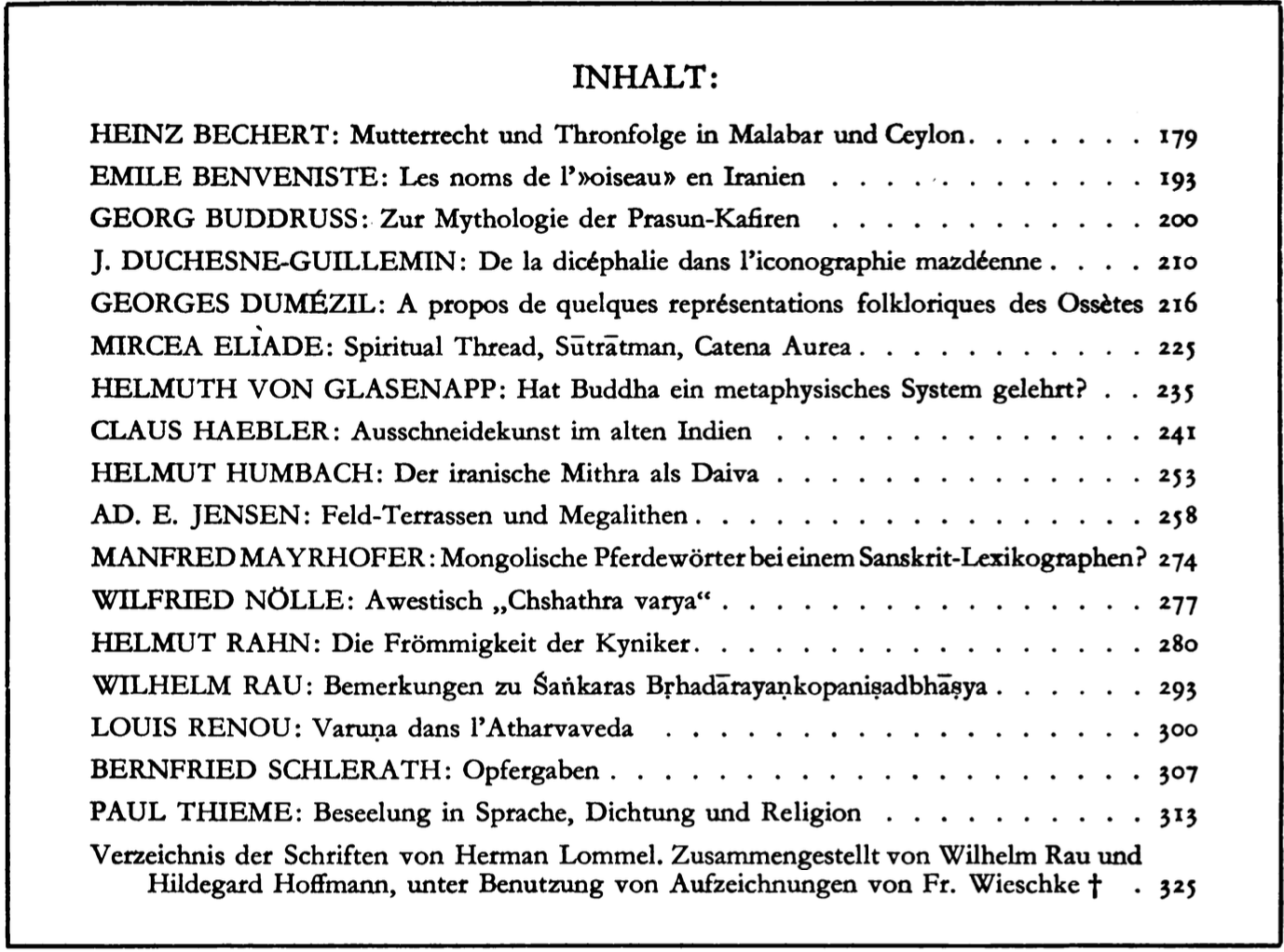
Table of contents of the Lommel Festgabe
The dating of Lommel’s focus on the Aryan is noteworthy, and certainly does not seem to have disadvantaged him, though I know of no links between him and the Nazi regime. His position at Göttingen seems to have been continuous through the Nazi period and the Second World War. The beginning of Die alten Arier notes the context: “We speak a lot in the present of Aryans, but we rarely think of the ancient Aryans, to whom this name in its proper sense applies and which are the origin of the very word” (p. 7). If he had left it at that, perhaps that would be defensible. But he continues:
We become profoundly aware of the origin and character of our people [Herkunft und Art unseres Volkes] and their rank among the peoples of humankind [unsere Stellung unter den Völkern der Menschheit]. But we must also, especially if we wish to adopt the name of Aryans for ourselves, become aware of what links us to the ancient Aryana and know their spiritual character (p. 7).
In the first chapter of the book, Lommel relates Aryan to what is called Indo-German in Germany (p. 19), which the French translation glosses as what is known as Indo-European elsewhere (p. 26). That is an equation which raises a host of issues. He goes on to limit Aryan to “Indo-European Indians and Iranians [die indogermanischen Inder und die Iraniene]” (p. 20). Other writers in this period, however, used “Aryan” without the accusations that such work today would produce. Jules Bloch’s linguistic study L’Indo-Aryen du Véda aux temps modernes dates from 1934, for example, and was translated into English as Indo-Aryan: From the Vedas to Modern Times in 1965, shortly after his posthumous Application de la cartographie à l’histoire de l’Indo-Aryen. Bloch was a colleague of Émile Benveniste at the École Pratique des Hautes Études and the Collège de France, and like Benveniste lost his teaching positions because they were Jewish. In contrast to Benveniste, who spent part of the war in exile in Switzerland, Bloch taught in Lyon and Toulouse during the war, due to the support of Vichy education minister and classics scholar Jérôme Carcopino. Both Bloch and Benveniste were reinstated in their Paris positions after the Liberation.
The Swedish academic Stig Wikander’s 1938 doctoral thesis Der arische Männerbund, only recently translated as The Aryan Männerbund, is different example. It is a book which is in dialogue with Benveniste and Louis Renou, Dumézil and Lommel, among others. It dates from the same year as what Dumézil would call his breakthrough to understand trifunctionalism, and Wikander is critical of Dumézil’s earlier work, particularly here his book on centaurs: “as often with him, the attempt shows a correct understanding of the mythological problem, but in the execution of his theses he rarely manages to come to entirely convincing results” (Der arische Männerbund, p. 100; The Aryan Männerbund, pp. 152-53). Dumézil would also be very critical of his own early work, reformulating it all in the light of trifunctionalism. He references Der arische Männerbund frequently, while Wikander builds on the trifunctional approach in his study of the Mahāhbhāta, in an essay Dumézil though very highly of and translated into French. They had a long-standing correspondence. (Benveniste, incidentally, reviewed Wikander’s book quite critically.)
Wikander’s focus in Der arische Männerbund was on the Indian and Iranian traditions, and was something of a development in those areas of Otto Höfler’s 1934 book KuItische Geheimbünde der Germanen. Höfler’s politics are relatively well-known since he was a member of Heinrich Himmler’s SS Ahnenerbe. The politics of Wikander have been questioned, with Mihaela Timuş saying that “Wikander’s private correspondence as well as his articles published in Swedish journals before the war provide concrete testimony on his ambiguous position on the Nazi political, as well as academic, situation”.
After the war, Benveniste, Dumézil and Mircea Eliade all contributed to Lommel’s Festschrift for his 75th birthday in 1960, which appeared both as a book and as a special issue of the journal Paideuma: Mitteilungen zur Kulturkunde(open access). Other contributors included Jacques Duchesne-Guillemin, Renou, and Paul Thieme. His work was quite widely discussed. Benveniste especially makes use of Lommel’s translations of the Yašts, both in publications and teaching. He references him most regularly in his early The Persian Religion. (He also challenges his interpretation of the meaning of próbata in his Vocabulaire, but that’s a quite specific point not particularly relevant to this post.)
One way of perhaps marking the distinctions between these writers is that it is one thing to talk of an Indo-Aryan language, another to project that onto a people, and another to suggest an idealised racial profile with contemporary parallels. Bloch does the first; Lommel the second, at best; Höfler most fully embraces the third. Wikander is, I think, uncomfortably between the second and third positions. Dumézil almost never uses the term ‘Aryen’, except for a few instances in 1941, as detailed by Cristiano Grottanelli. That is something I will discuss in more detail elsewhere.
References
Émile Benveniste, The Persian Religion According to the Chief Greek Texts, Paris: Librarie Orientaliste Paul Geuthner, 1929.
Émile Benveniste, “Stig Wikander – Der arische Männerbund…”, Bulletin de la Société Linguistique de Paris 39 (2), 1938, 42-43.
Jules Bloch, L’Indo-Aryen du Véda aux temps modernes, Paris: Adrien Maisonneuve, 1934; Indo-Aryan: From the Vedas to Modern Times, trans. Alfred Master, Paris: Adrien-Maisonneuve, 1965.
Jules Bloch, Application de la cartographie à l’histoire de l’Indo-Aryen, eds. C. Caillat and P. Meile (Cahiers de la Société Asiatique, XIII), Paris, Imprimerie Nationale, 1963.
Georges Dumézil, Heur et malheur du guérrier, Paris: Presses Universitaires de France, 1969; The Destiny of the Warrior, trans. Alf Hiltebeitel, Chicago: University of Chicago Press, 1970.
Georges Dumézil, Mitra-Varuna: Essai sur deux représentations indo-européennes de la souveraineté, Paris: Gallimard, second edition, 1948 [1940]; Mitra-Varuna: An Essay on Two Indo-European Representations of Sovereignty, trans. Derek Coltman, ed. Stuart Elden, Chicago: HAU, 2023.
Georges Dumézil, Mythe et Épopée II: Types épiques indo-européens: un héros, un sorcier, un roi, Paris: Gallimard, 1971, 133-238; The Plight of the Sorcerer, ed. Jaan Puhvel and David Weeks, Berkeley, University of California Press, 1986.
Cristiano Grottanelli, “Dumézil’s Aryens in 1941”, Zeitschrift für Religionswissenschaft 6, 1998, 207-219.
Otto Höfler, KuItische Geheimbünde der Germanen, Frankfurt-am-Main: Verlag Moritz Diesterweg, 1934.
Roman Jakobson, Selected Writings, The Hague: Mouton & Co, nine volumes, 1962-
Herman Lommel, Die Yäšt’s des Awesta, Göttingen: Vandenhoeck & Ruprecht/Leipzig: J.C. Hinrichs’sche Buchhandlung, 1927.
Herman Lommel, Die Religion Zarathustras nach dem Awesta dargestellt,Tübingen: J.C.B. Mohr, 1930.
Herman Lommel, “Kāvya Uçan”, in Mélanges de linguistique offerts à Charles Bally, Geneva: Georg & Cie, 1939, 209-14, reprinted in Kleine Schriften, ed. Klaus Ludwig Janert, Wiesbaden: Steiner, 1978, 162-67.
Herman Lommel, Die alten Arier: Von Art und Adel ihrer Götter,Frankfurt am Main: Vittorio Klostermann, 1935; Les anciens Aryens, trans. Pierre Beauchamp, Paris, Gallimard, 1943.
Herman Lommel, Die arische Kriegsgott, Frankfurt am Main: Vittorio Klostermann, 1939.
Herman Lommel, Die Gathas des Zarathustra, ed. Bernfried Schlerath, Basel/Stuttgart: Schwabe & Co, 1971.
Herman Lommel, Kleine Schriften, ed. Klaus Ludwig Janert, Wiesbaden: Steiner, 1978.
Ferdinand de Saussure, Grundfragen der allgemeinen Sprachwissenschaft, ed. Charles Bally and Albert Sechehaye with Albert Riedlinger, trans. Herman Lommel, Berlin and Leipzig: Walter de Gruyter & Co., 1931.
Bernfried Schlerath (ed.), Festgabe für Herman Lommel zur Vollendung seines 75. Lebensjahres am 7. Juli 1960 von Freuden, Kollegen und Schülern, Wiesbaden: Kommissionsverlag Otto Harrassowitz, 1960; also published as Paideuma: Mitteilungen zur Kulturkunde, 7 (4/6), 1960, https://www.jstor.org/stable/i40014729
Stig Wikander, Der arische Männerbund: Studien zur indo-iranischen Sprach- und Religionsgeschichte, Lund: Ohlsson, 1938; The Aryan Männerbund: Studies on Indo-Iranian Language and Religious History, trans. Tom Billinge, Sanctus Arya Press, 2024.
Stig Wikander, “Pāṇḍavasagan och Mahābhāratas mystiska förutsättningar”, Religion och Bibel 6, 1947, 27-39; “La Légende des Pândava et la substructure mythique du Mahābhārata”, trans. Georges Dumézil, in Dumézil, Jupiter Mars Quirinus IV: Explication de textes indiens et latins, Paris: Presses Universitaires de France, 1948, 37-53, with commentary 55-100.
This is the 31st post of a weekly series, where I post short essays with some indications of further reading and sources, but which are not as formal as something I’d try to publish more conventionally. They are usually tangential to my main writing focus, a home for spare ideas, asides, dead-ends and possible futures. I hope there is some interest in them. They are provisional and suggestions are welcome.
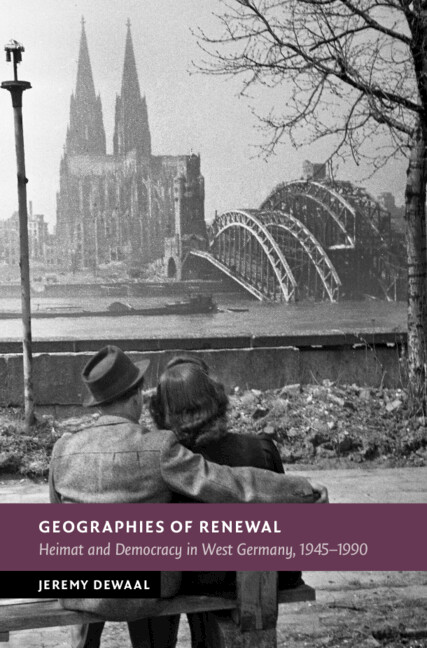
The term ‘Heimat’, referring to a local sense of home and belonging, has been the subject of much scholarly and popular debate following the fall of the Third Reich. Countering the persistent myth that Heimat was a taboo and unusable term immediately after 1945, Geographies of Renewal uncovers overlooked efforts in the aftermath of the Second World War to conceive of Heimat in more democratic, inclusive, and pro-European modes. It revises persistent misconceptions of Heimat as either tainted or as a largely reactionary idea, revealing some surprisingly early identifications between home and democracy. Jeremy DeWaal further traces the history of efforts to eliminate the concept, which first emerged during the Cold War crisis of the early 1960s and reassesses why so many on the political left sought to re-engage with Heimat in the 1970s and 1980s. This revisionist history intervenes in larger contemporary debates, asking compelling questions surrounding the role of the local, the value of community, and the politics of place attachments.
Considers Heimat as actual places of home, providing a new perspective from works which have focused on Heimat as a literary or cinematic trope
Situates debates surrounding Heimat within broader scholarly questions about home and place attachment
Draws on a wide range of sources, and a diverse range of local and regional case studies
The People’s Two Powers revisits the emergence of democracy during the French Revolution and examines how French liberalism evolved in response. By focusing on two concepts often studied separately-public opinion and popular sovereignty-Arthur Ghins uncovers a significant historical shift in the understanding of democracy. Initially tied to the direct exercise of popular sovereignty by Rousseau, Condorcet, the Montagnards, and Bonapartist theorists, democracy was first rejected, then associated with the idea of rule by public opinion by liberals throughout the nineteenth century. This redefinition culminated in the invention of the term ‘liberal democracy’ in France in the 1860s. Originally conceived in opposition to ‘Caesarism’ during the Second Empire, the term has an ongoing and important legacy, and was later redeployed by French liberals against shifting adversaries – ‘totalitarianism’ from the 1930s onward, and ‘populism’ since the 1980s.
Provides a chronological and contextual approach to the emergence of modern democracy and liberalism in France
Identifies an overlooked conceptual distinction between public opinion and popular sovereignty
Explains how, when, and why the term ‘liberal democracy’ was invented, and how it was historically redeployed against shifting opponents
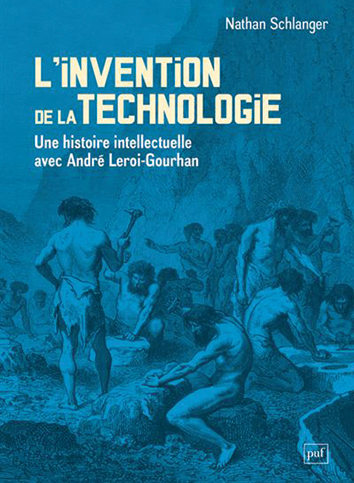
What is technology? How and why did techniques – including materials, tools, processes and products – become central subjects of study in anthropology and archaeology? In this book, Nathan Schlanger explores the invention of technology through the work of the eminent ethnologist and prehistorian André Leroi-Gourhan (1911–1986), author of groundbreaking works such as Gesture and Speech. While employed at the Musée de l’Homme in Paris, Leroi-Gourhan initially specialized in ethnographic studies of ‘material civilizations’. By the 1950s, however, his approach broadened to encompass evolutionary and behavioral perspectives from history, biology, psychology and philosophy. Focused on the material dimensions of techniques, Leroi-Gourhan’s influential investigations ranged from traditional craft activities to automated production. They also anticipated both the information age and the environmental crisis of today. Schlanger’s study offers new insights into the complexity of Leroi-Gourhan’s interdisciplinary research, methods, and results, spanning across the 20th century social sciences and humanities.
Andy Hines ed. University Keywords – Johns Hopkins University Press, September 2025
How American universities operate as social and economic engines that shape society beyond their traditional educational roles.
University Keywords gathers, contextualizes, and develops original understandings of 27 key terms that define the study and operation of the American university today. Editor Andy Hines and the book’s contributors invite readers to rethink the university beyond its public image as a space of learning and understand how it also operates as a real estate powerhouse, a hedge fund, a debt machine, and even a crisis-producing entity embedded in the broader American economy…