Foucault’s 1982 lectures in Toronto and Kingston – were you there? A request for help

In June 1982 Foucault gave a sequence of lectures in Toronto. At the end of June he gave a guest lecture at Queen’s University, Kingston, Ontario, adapting one of the Toronto lectures for that audience. These lectures are being prepared for publication, and the editors would like to hear from people who attended, know someone who attended, or who have other information about the events.

There are transcripts of the lectures in archives in Berkeley and Caen, but these are incomplete and there is conflicting information about what, exactly, Foucault said there and what was said elsewhere when similar lectures were delivered. Any help would be greatly appreciated.

If you can help, please either comment here, or contact Clive Thompson directly.


Posted in Michel Foucault, Uncategorized | 1 Comment

CFP: Radicalism in Theory and Practice – Hong Kong, 6-8 December 2016

CFP: Radicalism in Theory and Practice – Hong Kong, 6-8 December 2016:
Call for Papers. Posted on behalf of Wing-Shing Tang

For the 8th Meeting of East Asian Regional Conference in Alternative Geography (EARCAG)

Radicalism in Theory and Practice

This is the eighth meeting of East Asian Regional Conference in Alternative Geography. Its objective is to provide a forum for scholars from all parts of the world to discuss critically geographical issues of East Asia (and its related areas).

Like elsewhere, we have recently observed a proliferation of activism and social movements in East Asia. As the backdrop, one could not forget about the activism against the construction of the Narita airport, the student movement in Gwangju and the student demonstration outside Tiananmen Square in Beijing. More recent examples include the strike launched by dismissed temporary workers and labour unions of the supermarket chain owned by E-Land Group; hunger strikes of family members of the victims of Sewol Ferry disaster in Seoul; the Sunflower Protests in Taiwan; the protests against moral and national education in Hong Kong; the Umbrella Movement in Hong Kong; and demonstrations outside the Japanese National Diet in response to the enactment of the 2015 legislation for Peace and Security in Japan.

The issue is that these activisms and social movements have seldom been meticulously documented and analysed. Even more serious is that in understanding these events, there is a tendency to draw on theories and concepts popular in the West. This is especially the case for more recent events such as the Sunflower Protests and the Umbrella Movement. These events are usually conceived as no different from the jasmine revolution in Tunisia or the lotus in Egypt: in this view, it is all about democratisation for late-coming countries to be modelled on their more advanced counterparts. According to Andy Merrifield, especially in his new books The Politics of Encounter and The New Urban Question, occupy movements across the world are the manifestation of the new urban question. People gather together to develop a new social contract by the politics of encounter. Deep in his formulation is the prevalence of capitalism and capital logics. Is this the case? Is East Asia another variegated capitalism?

We believe that the world consists of many inter-connected parts. Accordingly, activity and social movements in East Asia would have their emergence both rooted in the region and interrelated with the world. It is the objective of this conference to make sense of the theory and practice of these activism and social movements in East Asia. This would involve researchers from a broad range of disciplines and of practitioners and activists, joining hands in the conference. They could contribute by deciphering the contexts and processes of development leading to the emergence of activism and social movements in their specific region or country, interrogating them conceptually and addressing the possible policy implication of these events.

The objective of this conference is to understand the theme issue of activism and social movements, and other geographical issues. We are interested in the following papers:

  • socio- and politico-economic developments leading to activism and social movements
  • knowledge production breeding as well as deterring activism and social movements
  • on activists, their mobilities and their networks
  • on utopianisms
  • articulations and spaces of capitalism in East Asia
  • geo-politics of capitalism and socialism in East Asia
  • political ecology of the region
  • any other relevant alternative geographical topics

Language: English
Date: 6th – 8th December, 2016 (with a post-conference field trip to the Pearl River Delta region starting 9th December)
Venue: Department of Geography, Hong Kong Baptist University

Submission of Abstracts

Abstracts of not more than 500 words should be sent to earcag@hkbu.edu.hk before 15th Februrary, 2016.

Organised Sessions

Those planning to organise a session please send the title and description of the session, and the papers in it, to earcag@hkbu.edu.hk by 15th February, 2016
Registration Fee

  • Participants from the OECD member countries, Taiwan, Singapore and Hong Kong (US$150 (faculty), US$70 (students))
  • Participants elsewhere (US$70 (faculty), US$35 (students))

Accommodation

Participants can stay at the NTT Guest House, Hong Kong Baptist University.
Organising Committee

Amirah Buang (National University of Malaysia, Malaysia)

Byung-doo Choi (Daegu University, South Korea)

Jim Glassman (University of British Columbia, Canada)

Chu-joe Hsia (Nanjing University, China)

Jinn-yuh Hsu (National Taiwan University, Taiwan)

Fujio Mizuoka (Hitotsubashi University, Japan)

Toshio Mizuuchi (Osaka City University, Japan)

Bae-gyoon Park (Seoul National University, South Korea)

Wing-Shing Tang (Hong Kong Baptist University, Hong Kong)

Programme Committee

Wing-Shing Tang, Department of Geography, Hong Kong Baptist University (e-mail: earcag@hkbu.edu.hk)



Posted in Conferences, Uncategorized | Leave a comment

Top posts on Progressive Geographies this week

  1. Foucault on Writing; Making Time for Writing
  2. Theory, Culture & Society E-Special Issue: Fiction & Social Theory – edited by David Beer
  3. Causes of deaths in Shakespeare’s plays visualised
  4. Foucault: the Birth of Power Update 9 – restructuring the drafts of Chapters Four and Six
  5. Benedict Anderson tributes
  6. Michel Foucault on refugees – a previously untranslated interview from 1979
  7. Foucault on Frans Hals, The Regents and the History of Madness
  8. Remembering Edward Soja (1940-2015)
  9. Annotated bibliography of Foucault’s texts on heterotopia at Heterotopian Studies
  10. Where to start with reading Henri Lefebvre?
Posted in Uncategorized | 1 Comment

Foucault books received – including his first book Maladie mentale et personnalité

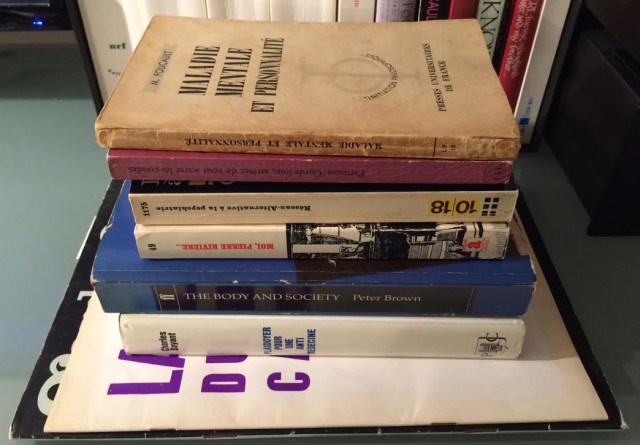
And these are the recent Foucault project books received – all bought second-hand. Most of these connect in some way to the work of the Groupe Information Asiles or Groupe Information santé, with the exception of a copy of the original edition of Moi, Pierre Rivière and Peter Brown’s The Body and Society.

The real find was a copy of Foucault’s first book, from 1954, Maladie mentale et personnalité. He refused a reprint and eventually agreed to amend the first part and completely rewrite the second, as Maladie mentale et psychologie in 1962. That’s the version in English translation. I’d never before found a second-hand copy for anything less than £100, sometimes much more, or it was listed as the 1954 edition but was really the 1962 one or later reprints. It’s not even easy to find in libraries, though there is a pdf of the text alone (i.e. typed, not a scan) here.

Foucault books.jpg

Posted in Michel Foucault, Uncategorized | Leave a comment

Books received – Cockburn, Benjamin, Agamben, Skornicki, GeoHumanities

IMG_1203

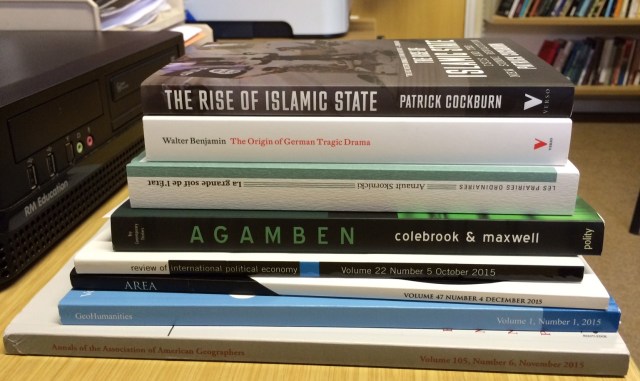
Some recent books – Patrick Cockburn’s The Rise of Islamic State and Walter Benjamin’s The Origins of German Tragic Drama, which I bought in the Verso sale; Arnault Skornicki, La grande soif de l’État. Michel Foucault avec les sciences sociales, which I was kindly sent by the author; and Claire Colebrook and Jason Maxwell, Agamben which I’d pre-ordered from Polity in recompense for review work. The rest are journal issues, including the launch issue of GeoHumanities.

Posted in Giorgio Agamben, Michel Foucault, Uncategorized, Walter Benjamin | Leave a comment

Annotated bibliography of Foucault’s texts on heterotopia at Heterotopian Studies

Annotated bibliography of Foucault’s texts on heterotopia at Heterotopian Studies.

Posted in Uncategorized | 1 Comment

Foucault: the Birth of Power Update 9 – restructuring the drafts of Chapters Four and Six

Foucault: The Birth of Power is taking shape. The first half of this book is comprised of three chapters: Measure, Inquiry, Examination. These treat, in order, Lectures on the Will to Know, Théories et Institutions Pénales, and The Punitive Society, along with related publications. If those courses, and analyses, can be seen as the progressive development of concepts and tools, the second half of the book looks at how they were put into practice, in analyses of Madness, Discipline and Health. The idea is that each of these chapters looks at lectures, publications and activism together around those themes.

IMG_0123.JPG

GIS, CERFI and related documents and reports on health and mental illness

Chapter Six, which discussed Foucault’s work with the Groupe Information Santé (GIS), collaborative research projects at the Collège de France and with CERFI, and the 1974 lectures on medicine in Rio, was becoming much too long. Some major restructuring was needed. This became easier as I started to edit Chapter Four into shape. Chapter Four was mainly a discussion of the Psychiatric Power course, but now it is much more generally about the early 1970s work on psychiatry, of which that course is only one part. I ended up moving the whole discussion of Foucault’s early Collège de France seminars to this chapter, as well as the brief discussion of the Groupe Information Asiles (GIA). The early seminars are on penal psychiatry, and result in the I, Pierre Rivière volume. I’d initially used the discussion of the seminars to lead into a broader discussion of collaborative research, but I think the theme fits better with the treatment of psychiatric power in Chapter Four. I also added a brief discussion of a 1973 lecture on antipsychiatry, published in the Cahier L’Herne; and posted a little here on Frans Hals, The Regents and the History of Madness – a painting added to the 1972 edition of the book.

Foucault was one of the founders and major participants in the Groupe d’Information sur les prisons (GIP), played a lesser but significant role in the GIS, and had limited involvement with the GIA. David Macey claims the GIA “was founded and functioned without any help from Foucault”, though I think there is a little more to say than that. Foucault only had peripheral direct involvement with the GIA, but they worked with the GIS and with the Comité d’action prisonniers (CAP) – a kind of successor group to the GIP.  Ideally I’d talk about the GIP first, then the GIA as the first group that based itself on the model, and then the GIS. But the order I want to discuss the substantive topics of psychiatry, prisons and health mean that the GIA discussion will need to come before the GIP part. The alternative would be to talk about Discipline and Punish before Psychiatric Power, but that doesn’t work for more important reasons; or to separate the activist work from the academic treatment of the related issues, which I want to resist. So a brief discussion of the GIA before the GIP seems the least bad option. I’ll keep thinking about this.

Sorting out Chapter Four, and incorporating the material from Chapter Six meant that both chapters now exist in pretty good draft form. Chapter Six works much better with the parts removed. Chapter Five on prison activism and Discipline and Punish will be the next, and final, chapter to draft. I’ve already collected lots of documentary material for this chapter, and spent some more time in the British Library newsroom recently, mainly tracking down petitions Foucault signed in Le Monde and news reports on activities of the GIP and related groups. So I think I have most of the raw material and resources I need, but now have to shape it into some order.


As I’ve said before, Foucault’s Last Decade is now available to pre-order. For more information on these two books, see the descriptions here. Audio and video recordings relating to them are here; and a full list of the updates I’ve been posting on the process of writing here. Some translations, bibliographies, scans and links are available at Foucault Resources.

Posted in Foucault's Last Decade, Foucault: The Birth of Power, Michel Foucault | 2 Comments

Theory, Culture & Society E-Special Issue: Fiction & Social Theory – edited by David Beer
Fiction_coverTheory, Culture & Society E-Special Issue: Fiction & Social Theory – edited by David Beer

This special issue brings together a range of articles from the Theory, Culture & Society archive that directly explore the relations between fiction and social theory. Each article develops a different perspective on these relations yet they all share a common interest in probing at the different ways in which fiction can enrich and provoke our conceptual imaginations. These articles ask how theory can be used to understand or illuminate fiction, whilst also considering how theory can be extended, challenged or informed by fictional resources. The selected articles can be viewed in terms of three overlapping approaches. First, there are those that use fiction to extend the imagination of social theory. Second, are the articles that use fiction as a documentary resource and platform for theorizing. And, finally, there are those articles that use theory to reanimate and re-examine fictional forms. In exploring these three intersecting branches this e-special issue helps illustrate the different ways in which fiction and social theory might interweave in our thinking. The articles gathered here provide frameworks, ideas and resources through which the reader can continue to think imaginatively and creatively about the social world.

Posted in Theory, Culture and Society, Uncategorized | Tagged | 1 Comment

Shiloh Krupar, ‘Operational Banality: medical geographies of administration and the biopolitical grotesque’ – Neil Smith lecture video

Shiloh Krupar, ‘Operational Banality: medical geographies of administration and the biopolitical grotesque’ – second Neil Smith lecture video. Thanks to Derek Gregory for the link.

Neil Smith Lecture Nov 2015 from University of St Andrews on Vimeo.

Posted in Uncategorized | Tagged , | 1 Comment

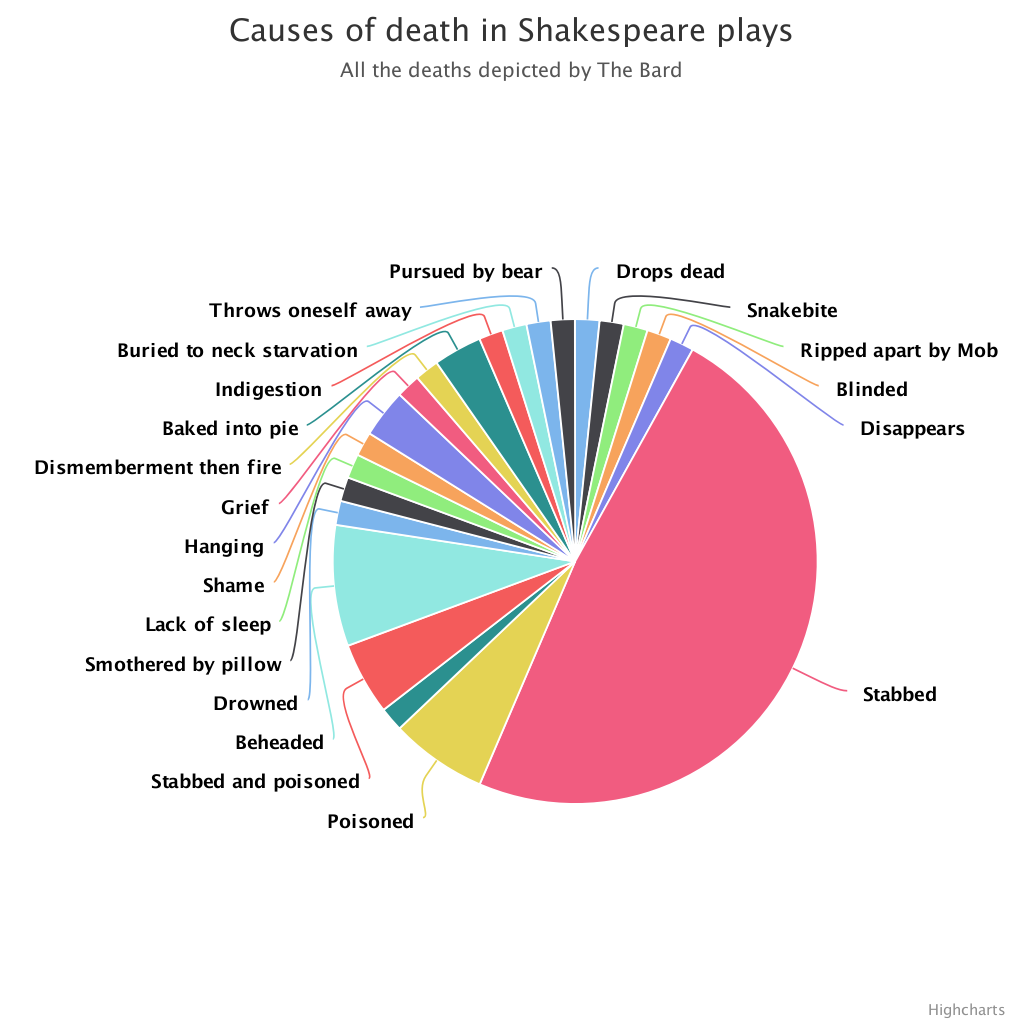
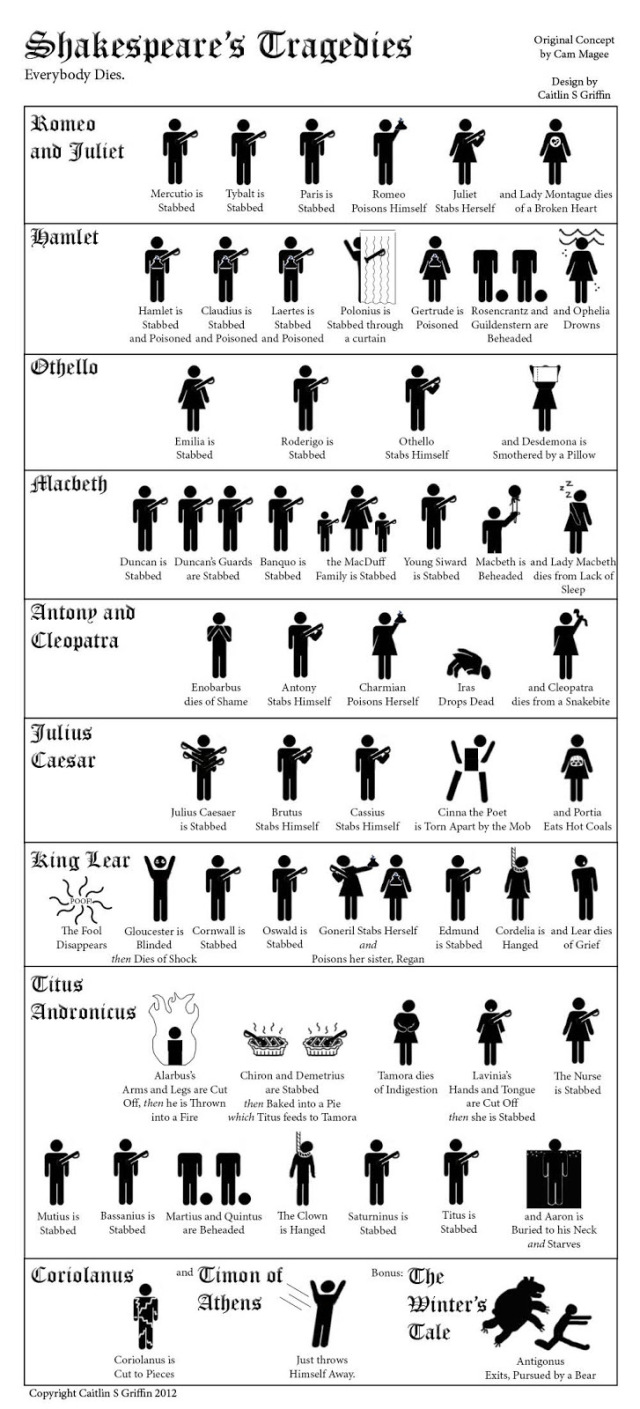
Causes of deaths in Shakespeare’s plays visualised

Thanks to Murray Low for sharing this graphic

Attachment-1

Here’s another one, which I’ve shared on the blog before (from Biblioklept)…

tragedies-2

Posted in Uncategorized, William Shakespeare | 1 Comment