
 Pierre Macherey, ‘The Productive Subject‘ in Viewpoint magazine – an interesting discussion of Foucault’s relation to Marx.
[Update: a French version is here]
Pierre Macherey, ‘The Productive Subject‘ in Viewpoint magazine – an interesting discussion of Foucault’s relation to Marx.
[Update: a French version is here]
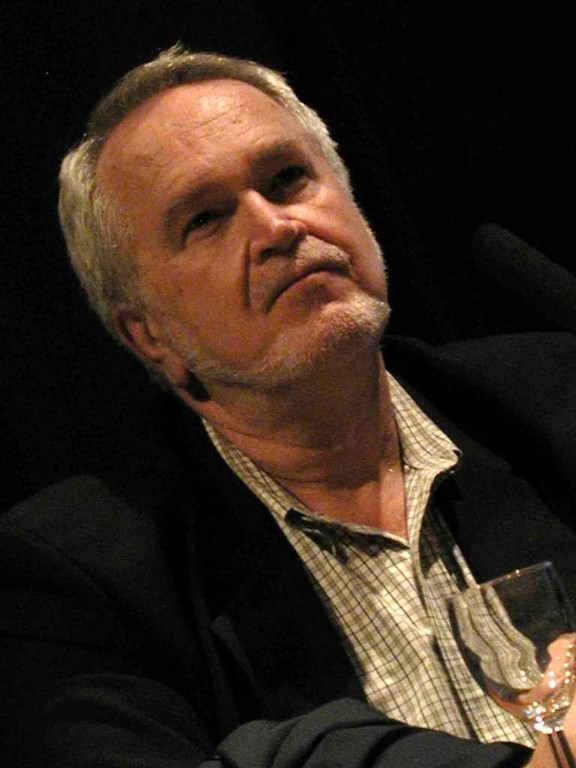 Murray Low has passed on the sad news of the death of Edward Soja. I first heard him talk on Postmodern Geographies in 1995 – this would have been work that ended up in Thirdspace – and the talk really motivated me to examine the spatial aspects of Foucault and Lefebvre. A review of Thirdspace was my first academic publication. I only met Ed a few times, but he was always very kind to me, despite the criticisms I’d made of his readings of those thinkers.
We first met at a Foucault conference in Dublin, and when he realised who I was (I think I must have self-identified when asking a question), he almost literally grabbed me at the next break, we headed outside and talked for over an hour, missing the next session, while he smoked furiously.
We met again at the 2007 San Francisco AAG, when Derek Gregory organised some sessions on his work. I talked about ‘The Political Organisation of Space’, his very interesting 1971 AAG report on territory and territoriality. Some of my ideas on territory that I developed over the next several years stem from my critically appreciative reading of this piece of his work. As I say in The Birth of Territory “it remains one of the best single pieces written about territory”.
I was at UCLA for a quarter in 2007, teaching in the Geography department, so I got to see Ed a few times, and saw him present on what became Seeking Spatial Justice. I remember one long lunch with him, and Neil Brenner, Jing Tsu and I had a lovely evening with him at his home and a local restaurant in Mar Vista.
The last time I saw him was at an AAG in Washington, DC, the year I won the Globe book award for Terror and Territory. Ed was with Allen Scott, and they both congratulated me, Ed almost crushing me with a bear-hug.
I thought of him the other day, when I heard he’d been awarded the Vautrin Lud prize (sometimes colloquially known as Geography’s Nobel). I really wish I’d made the effort to contact him to congratulate him – I was thinking I’d do it at the time of the ceremony. My sincere condolences to his family, friends and colleagues.
I’ll be giving a talk with the title of ‘The Territories and Majesty of Shakespeare’s King John’ twice over the next couple of weeks.

This lecture will discuss Shakespeare’s play King John around two themes – the question of majesty and that of territories. Majesty is a continual concern throughout the play, described as ‘borrowed’, ‘banished’, ‘resembling’, ‘dangerous’ or ‘the bare-picked bone’. John is seen as a usurping monarch, denying Arthur his rightful inheritance, but by the end of the play majesty has been so diminished by events it is perhaps worth very little. But what is that majesty over? Among other things, it is the lands of the kingdom. King John is one of only a handful of Shakespeare’s plays in which the word ‘territories’ appears. There is one mention in the opening scene, and one in the final act. The first of these had caused editors much confusion, because it is used with a definite article – ‘the territories’ – rather than a possessive ‘his’, ‘her’, ‘its’ or ‘their’ territories. What might this mean, and what might it indicate? Thinking about these questions of majesty, land, and territories, the talk will discuss how King John and contemporary play The Troublesome Reign of King John anticipate the dual themes of domestic disorder and foreign conquest found in Shakespeare’s other history plays.
Tuesday 3rd November, 4pm, Sidelights on Shakespeare seminar, Graduate Space, 4th Floor, Humanities (annex), University of Warwick
Monday 23rd November, 6pm, IAS Talking Points seminar, Common Ground, University College London – with responses by Professor Helen Hackett, Department of English and Dr James Kneale, Department of Geography
The talks are both open to all, through free pre-registration is requested for the UCL one.
I’ve been working on the talk over the past couple of weeks, developing a few notes I had on the play into a presentation, but it’s already becoming much more than that. Initially I’d intended on there being a section on King John in a chapter on the history plays in the planned Shakespeare book, but I now think there is enough here for a chapter on just this play. I’ll also be giving a more general talk on this project at Cambridge University on 25th November – details to follow.
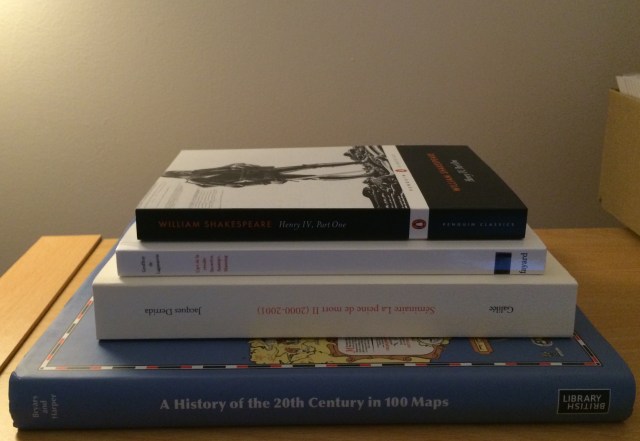
The Penguin edition of Henry IV, Part One, Geoffrey de Lagasnerie’s L’art de la revolt: Snowden, Assange, Manning, Derrida’s Séminaire: La peine de la mort II (2000-2001), and Tom Harper and Tim Bryars, A History of the 20th Century in 100 Maps.
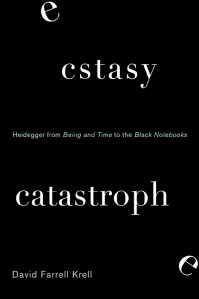 David Farrell Krell’s Ecstasy, Catastrophe: Heidegger from Being and Time to the Black Notebooks is reviewed at NDPR.
This latest book by the distinguished scholar, translator, and author David Farrell Krell is a compilation of three different texts. Part I presents four Brauer Lectures he delivered at Brown University (2014) on Heidegger’s early thinking on the human being’s “ecstatic temporality.” Following is a brief “Interlude” in which he reflects on the vice of “polemical” criticism and the virtue of “giving oneself over” to a text in interpreting it. Part II is an extended essay on Heidegger agonistes as this emerges in the recently published Schwarze Hefte (Black Notebooks). Krell has insightful and suggestive things to say in each, but the three parts do not fit well together. [continues here]
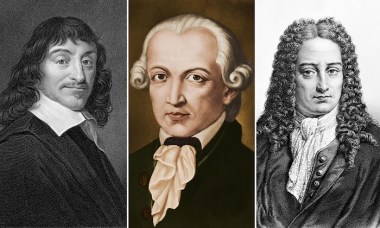 Which philosopher would fare best in a present-day university? – a discussion in The Guardian by Lloyd Strickland. If you know Lloyd’s work – which I do – then the answer is not surprising…
Critical-theory.com rounds up some recently published books – Golder, Adorno and Lenk, Nealon, King, Withers, Coombs, Barthes and Holub.
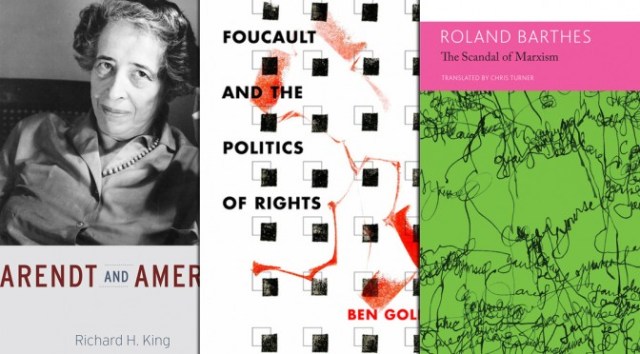
Now with a link to the commentary on the lecture of 12th January 1972.
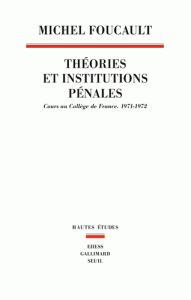 Barry Stocker has been making a series of posts on Foucault’s Théories et institutions pénales lecture course, which appeared earlier this year – an English translation is likely to be a couple of years away, since The Punitive Society has just come out, and Subjectivity and Truth will be the next one.
Dates below are those of Foucault’s lectures, with links to Barry’s posts on them.
24th November, 1971 – includes a useful discussion of the notion of a parlement
1st December, 1971 – part one; part two; part three
I’ll add further links as they become available.
My review of the course was published at Berfrois earlier this year.
A quiet week on the blog – working on proofs of an article and book, writing a lecture, planning some other ones, so mainly concentrating on those things…
As I’ve said here before, for the 2015-16 academic year I am a Senior Research Fellow at University College London’s new Institute of Advanced Studies. As a reminder, the deadline for the first round of applications to have a post here, as a visiting fellow is 31 October 2015. Full details here.
We welcome applications from scholars at all stages of their careers to be Visiting Research Fellows (non-stipendiary) at the Institute of Advanced Study and spend time with us for a period between three months and one year.
We will provide desk space, membership of the IAS community and Common Ground, access to UCL resources including the library, full participation in IAS events (e.g. seminars, workshops and conferences) and a framework in which you can present your research and participate in a research community. In return, we ask that you make a case as to why being at UCL will be beneficial for you and how, in turn, you will contribute to the IAS.
If you wish to apply, please complete this application form and e-mail it to Catherine Stokes.
Please note that we will issue further calls with deadlines of 31 January and 31 March 2016.


