
The Funambulist launch in London – Léopold Lambert introduces his new project, with contributions by Reina Lewis and Andreas Philippopoulos-Mihalopoulos. The event is free but places are strictly limited – book here.

The Funambulist launch in London – Léopold Lambert introduces his new project, with contributions by Reina Lewis and Andreas Philippopoulos-Mihalopoulos. The event is free but places are strictly limited – book here.
Now published
Nick Vaughan-Williams, Europe’s Border Crisis: Biopolitical Security and Beyond – forthcoming from Oxford University Press.
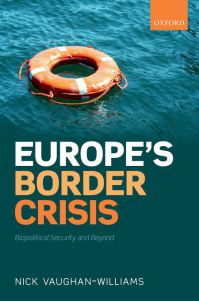
Europe’s Border Crisis investigates dynamics in EU border security and migration management and advances a path-breaking framework for thought, judgment, and action in this context. It argues that a crisis point has emerged whereby irregular migrants are treated as both a security threat to the EU and as a life that is threatened and in need of saving. This leads to paradoxical situations such that humanitarian policies and practices often expose irregular migrants to dehumanizing and lethal border security mechanisms. The dominant way of understanding these dynamics, one that blames a gap between policy and practice, fails to address the deeper political issues at stake and ends up perpetuating the terms of the crisis.
Drawing on conceptual resources in biopolitical theory, particularly the work of Roberto Esposito, the book offers an alternative diagnosis of the…
View original post 123 more words
Yesterday evening I went to a talk at the Royal Academy of Arts, London on the Ai Weiwei exhibition they have there for the next few months. This was a special event for bloggers and instagrammers, as opposed to more traditional media. The talk, given by one of the Royal Academy’s art historians, and delivered without notes, was informative and insightful. We then had access to the exhibition which is open late on a Friday evening. The exhibition is a powerful selection from Ai Weiwei’s work, which ranges from the large to the enormous. I was particularly struck by the room taken over by several tonnes of straightened steel rods commemorating the 2008 Sichuan earthquake, entitled Straight; the large-sculpture made from remnants of his destroyed Shanghai studio; and the porcelain cameras surveilling a porcelain field of grass, within which was a child’s pushchair. The surveillance of Ai Weiwei and his family. There is also a dramatic representation of his time in captivity in 2011, with the guards standing right next to him as he slept, showered, ate and used the toilet.
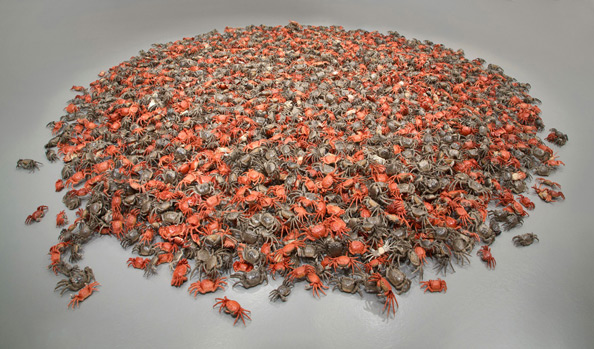
The word for ‘harmonious’ – much used by the Beijing regime, and now a byword for censorship – is a homonym of ‘river-crab’, so another porcelain project was thousands of crabs in a great mound, but with a few escaping. I’m often lost with appreciating contemporary art, and others have captured why this is such an important show far better than I can, but this was a powerful and moving exhibition. Several of the pieces can be seen in the RA’s online gallery here, but these only give a limited sense of what they are like in situ. The scale of the exhibits somehow managed to overcome the crowds that filled the vast galleries of the Royal Academy. Well worth seeing if you can get to London…
 Barry Stocker has been making a series of posts on Foucault’s Théories et institutions pénales lecture course, which appeared earlier this year – an English translation is likely to be a couple of years away, since The Punitive Society has just come out, and Subjectivity and Truth will be the next one.
Dates below are those of Foucault’s lectures, with links to Barry’s posts on them.
24th November, 1971 – includes a useful discussion of the notion of a parlement
1st December, 1971 – part one; part two; part three
I’ll add further links as they become available.
My review of the course was published at Berfrois earlier this year.
 I’ve made some minor updates to the reading guide ‘Where to start with reading Henri Lefebvre?‘ The updates are a link to the Verso page for the forthcoming translation of Metaphilosophy and links to two recent collections Understanding the City: Henri Lefebvre and Urban Studies and Urban Revolution Now.
In further news, Marxist Thought and the City will appear in late 2016 with University of Minnesota Press. Robert Bonnano is the translator, and I’ll be writing a brief foreword.
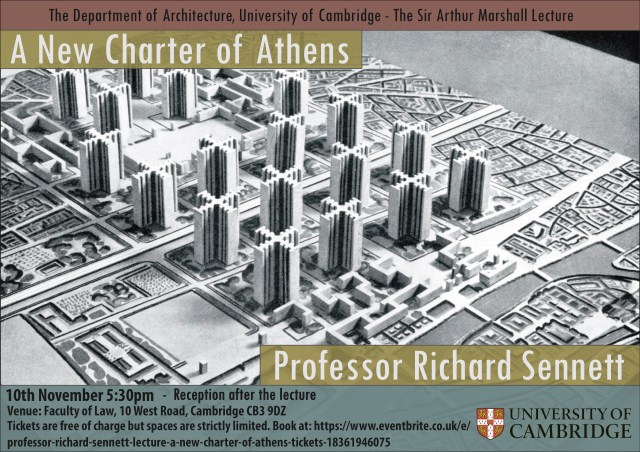
A NEW CHARTER OF ATHENS, by RICHARD SENNETT, 10 NOVEMBER, 5:30 PM
Sir Arthur Marshall Lecture, hosted by the Department of Architecture at the University of Cambridge where Professor Sennett is Sir Arthur Marshall Visiting Professor in Urban Design. The lecture will be held at the Faculty of Law, West Road, Cambridge. There will be a reception afterwards.
The title of the lecture is ‘A New Charter of Athens’ and Richard has written the following about it:
‘Next year sees the opening of Habitat III, the environmental congress held every twenty years by the United Nations. For this event, a manifesto is being prepared about the design of cities. It aims to replace the guidance given by Le Corbusier and others nearly a century ago, in document they called “The Charter of Athens.” The new Charter of Athens addresses issues emerging in the 21rst Century about environmental crises, the uses of technology and big data, and the challenge of social inclusion. The lecture serves as an introduction to this modest proposal.’
This promises to be a significant milestone in contemporary urban thinking. There is no charge for tickets, but places must be booked in advance.
Unfortunately for me this clashes with a seminar I am giving at the LSE on Foucault’s collaborative projects.
Alex Jeffrey on the recent Afghan hospital bombing and international humanitarian law.
Reports are suggesting that on 3rd October a US AC130 gunship fired on an Afghan hospital in the city of Kunduz, killing 12 staff members and 10 patients and wounding many more (while the precise figures are unclear at the moment estimates suggest around 37 people). While NATO, the Afghan Government and the US military have all stated they will launch inquires, the international humanitarian NGO Medecins Sans Frontieres (MSF) that ran the hospital is calling for an independent investigation, claiming the attack is a violation of international humanitarian law (IHL). This desire for independence is perhaps understandable, considering that since the hospital bombing the US military have released four different accounts of the circumstances surrounding the attack, while there is also a long history of the use of inquiries/investigations to delay public scrutiny of military or political decisions (see criticisms of the UK’s Iraq War Inquiry). But the desire for…
View original post 593 more words
Today at 1pm I’ll be giving a lecture to the Landscape Urbanism Programme at the Architectural Association, London: “Territory – Political Technology, Volume, Terrain”, (abstract and details). I understand that the talk will be recorded and made available online. The lecture will range from my work on territory in Terror and Territory and The Birth of Territory, through to the work on volume and terrain I’ve been developing in the last few years. It will be quite visual, with some of my photos from the US-Mexico, Israel-Lebanon, and Swaziland-South Africa borders, as well as several images from the West Bank, Jordan valley and some from the Golan, like the one below. There is also an image of Mont Ventoux, since my interest in terrain is not just geo-strategic, and I may try to find room for a little Shakespeare. It’s the last talk on my previous territory work I’m scheduled to deliver – future talks, at least for a while, are on Foucault and Shakespeare.

News of an recently published book on Foucault, Jameson and Baudrillard.
 Michael James Rizza The Topographical Imagination of Jameson, Baudrillard, and Foucault, Noesis/The Davies Group, 2015
Notice on author’s blog
An interview with the author, Michael James Rizza, in Hyperrhiz 12
This in-depth discussion of several canonical theorists — Fredric Jameson, Jean Baudrillard, and Michel Foucault — traces the trajectory of their ideas from one text to the next. It focuses on how these theorists attempt to avoid the problem of representation, as well as humanist subjectivity, even as they imagine the external situations that shape individual identity. Although the author offers in-depth overviews, he does not simply rehearse the theories, such as many introductions to theory do. Instead, he excavates the topographical imagination that results from seeking to constitute the subject from without, from its external situation. He draws forth the organizing figure of each theorist’s spatial thinking—Jameson’s Marxist dialectical levels, Baudrillard’s double spiral of the symbolic and the…
View original post 236 more words


