2016 Symposium CfP: “Spatializing Sovereignty”

Call for papers for a conference in Berkeley in March 2016 from the Society for Radical Geography, Spatial Theory, and Everyday Life.

Society for Radical Geography, Spatial Theory, and Everyday Life's avatarSociety for Radical Geography, Spatial Theory, and Everyday Life

We are pleased to announce the theme of our 2016 symposium, “Spatializing Sovereignty,” which will be held at UC Berkeley on Friday, March 4, 2016 and feature keynote addresses by Dr. Mishuana Goeman, Associate Professor of American Indian Studies and Gender Studies at UCLA, and Gelare Khoshgozaran, writer and multi-disciplinary artist. Please find our call for papers and presentations below!

2016 Symposium CFP: “Spatializing Sovereignty”

Featuring keynote addresses by:
Dr. Mishuana Goeman, Professor of American Indian Studies and Gender Studies, UCLA
and Gelare Khoshgozaran, Writer and Multi-disciplinary Artist

UC Berkeley
March 4, 2016

While sovereignty is often defined in terms of the bounded nation-state, this symposium convenes to examine competing, overlapping, and “nested sovereignties” (Simpson 2014). How is the spatiality of sovereignty felt, practiced, embodied, inhabited, or imposed at various scales? We might consider how the thousands of missing and murdered Indigenous women in Canada and the U.S. lay bare logics of…

View original post 458 more words

Posted in Uncategorized | Leave a comment

Top posts on Progressive Geographies this week

Posted in Uncategorized | Leave a comment

‘Before the Punitive Society: The Inquiry of Théories et institutions pénales’ – audio recording of talk to Time Served: Discipline and Punish Forty Years On conference

SE in NottinghamI recently gave the opening plenary lecture to the ‘Time Served: Discipline and Punish Forty Years On‘ conference, organised by Sophie Fuggle and held at the Galleries of Justice in Nottingham.
My talk was entitled “Before the Punitive Society: The Inquiry of Théories et institutions pénales” (abstract), and the audio recording is now available here. It’s about 45 minutes long.

I spoke about how the analysis of the 1971-72 course Théories et institutions pénales related to the ‘course summary’, to the third ‘Truth and Juridical Forms’ lecture from Rio in 1973, and Foucault’s preparatory notes for these lectures, which I have been working through in Paris. This is part of the draft of Chapter Two of the second book I’ve been writing on Foucault, The Birth of Power, hopefully out in 2017. You can read more about the progress of that book, and about the book that is due out in 2016, Foucault’s Last Decade, here.

Posted in Conferences, Foucault's Last Decade, Foucault: The Birth of Power, Michel Foucault | 1 Comment

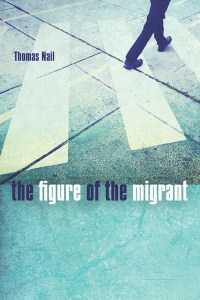
Thomas Nail, The Figure of the Migrant – now published from Stanford University Press (and sample to download)

Thomas Nail, The Figure of the Migrant – is now published from Stanford University Press. I provide one of the endorsements. Twenty pages are available to download at academia.edu

pid_23425

This book offers a much-needed new political theory of an old phenomenon. The last decade alone has marked the highest number of migrations in recorded history. Constrained by environmental, economic, and political instability, scores of people are on the move. But other sorts of changes—from global tourism to undocumented labor—have led to the fact that to some extent, we are all becoming migrants. The migrant has become the political figure of our time.

Rather than viewing migration as the exception to the rule of political fixity and citizenship, Thomas Nail reinterprets the history of political power from the perspective of the movement that defines the migrant in the first place. Applying his “kinopolitics” to several major historical conditions (territorial, political, juridical, and economic) and figures of migration (the nomad, the barbarian, the vagabond, and the proletariat), he provides fresh tools for the analysis of contemporary migration.

“In this powerful book, Thomas Nail forces us to think migration from the perspective of movement and so builds both a theoretical argument and a political intervention. A bold and provocative engagement with one of the world’s most pressing contemporary issues.”

—Stuart Elden, University of Warwick

“Hardly a day goes by without some reference in the media to the “problem” of migration. In offering a theoretical account of the figure of the migrant throughout history, Thomas Nail’s book thus performs an important service for the interdisciplinary study of one of the most important subjects of our century. Carefully argued, well informed, hugely ambitious, and analytically precise, it will become a standard reference for years to come.”

—Tim Cresswell, Northeastern University

Posted in Uncategorized | 4 Comments

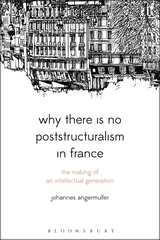
Johannes Angermuller, Why There Is No Poststructuralism in France – now out with Bloomsbury (and free download of introduction)

Johannes Angermuller, Why There Is No Poststructuralism in France – now out with Bloomsbury (and free download of introduction).

9781474226301

French thinkers such as Lacan and Derrida are often labelled as representatives of ‘poststructuralism’ in the Anglophone world. However in France, where their work originated, they use no such category; this group of theorists – ‘the poststructuralists’ – were never perceived as a coherent intellectual group or movement.

Outlining the institutional contexts, affinities, and rivalries of, among others, Althusser, Barthes, Foucault, Irigaray, and Kristeva, Angermuller – drawing from Bourdieu’s concepts of cultural capital and the cademic field – insightfully explores post-structuralism as a phenomenon. By tracing the evolution of the French intellectual field after the war, Why There is No Poststructuralism in France places French Theory both in the specific material conditions of its production and the social and historical contexts of its reception, accounting for a particularly creative moment in French intellectual life which continues to inform the theoretical imaginary of our time.

Posted in Louis Althusser, Michel Foucault, Pierre Bourdieu | Tagged | 1 Comment

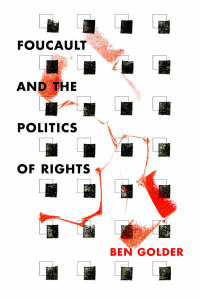
Foucault and the Politics of Rights (2015)

Ben Golder’s book on Foucault and the Politics of Rights is now out.

Clare O'Farrell's avatarFoucault News

golder2Ben Golder, Foucault and the Politics of Rights, Stanford University Press, 2015, Now available.
Publisher’s page

This book focuses on Michel Foucault’s late work on rights in order to address broader questions about the politics of rights in the contemporary era. As several commentators have observed, something quite remarkable happens in this late work. In his early career, Foucault had been a great critic of the liberal discourse of rights. Suddenly, from about 1976 onward, he makes increasing appeals to rights in his philosophical writings, political statements, interviews, and journalism. He not only defends their importance; he argues for rights new and as-yet-unrecognized. Does Foucault simply revise his former positions and endorse a liberal politics of rights? Ben Golder proposes an answer to this puzzle, which is that Foucault approaches rights in a spirit of creative and critical appropriation. He uses rights strategically for a range of political…

View original post 76 more words

Posted in Uncategorized | 1 Comment

How We Write

Michael Collins discusses his role in the creation of the How We Write collection.

Michael Collins's avatarThe page “Newfoundland Literature” does not exist

Putting a piece of writing out into the world is a bit like tossing a pebble down a mountainside. Usually it clatters down alone, bouncing a bit off this outcrop or that. It eventually loses momentum, settles in with other older pebbles, mostly forgotten. But sometimes, the pebble will bounce in such a way that it triggers other pebbles, and a little landslide ensues. Larger chunks of rock start to break loose and fall, and there the metaphor breaks down.

My blog post from a few months ago, Wilderness Group Tour, ended up being just such a pebble. It is far and away the most visited entry I’ve posted on this blog. It was shared quite a bit on Facebook, and several long, involved, thoughtful, rewarding discussions grew around it. One of these discussions grew into a twinned pair of blog posts by Professors Suzanne Conklin Akbari and Alexandra…

View original post 434 more words

Posted in Uncategorized | Leave a comment

Infrastructuring Aid: A Photo Essay by Kevin Donovan

A new photo essay at the Society and Space open site, on humanitarian aid in Kenya by Kevin Donovan.

Posted in Uncategorized | 1 Comment

New Perspectives online – first issue available with three open access pieces

The first issue of New Perspectives – the successor to the journal Perspectives, with a focus on central and Eastern Europe  – is now available online. Three pieces are open access: Johan van der Walt’s ‘The Literary Exception: Reflections on Agamben’s “Liberal Democratic” Political Theology and the Religious Destabilisation of the Political in our Time’, Ulrich Kühn on a need for a new strategy for NATO, and Benjamin Tallis’s editorial. More details here.

Posted in Uncategorized | Leave a comment

‘The Territories and Majesty of King John’ – talk to University of Warwick’s ‘Sidelights on Shakespeare’ seminar series, 3 November 2015

I’ll be giving a talk to University of Warwick’s ‘Sidelights on Shakespeare‘ seminar series, 3 November 2015, 4pm [Update: and also at UCL on 23 November 2015, 6pm, Common Ground (room in South Wing of Wilkins building), Institute of Advanced Study, University College London]. Here’s the abstract:

The Territories and Majesty of King John

This lecture will discuss Shakespeare’s play King John around two themes – the question of majesty and that of territories. Majesty is a continual concern throughout the play, described as ‘borrowed’, ‘banished’, ‘resembling’, ‘dangerous’ or ‘the bare-picked bone’. John is seen as a usurping monarch, denying Arthur his rightful inheritance, but by the end of the play majesty has been so diminished by events it is perhaps worth very little. But what is that majesty over? Among other things, it is the lands of the kingdom. King John is one of only a handful of Shakespeare’s plays in which the word ‘territories’ appears. There is one mention in the opening scene, and one in the final act. The first of these had caused editors much confusion, because it is used with a definite article – ‘the territories’ – rather than a possessive ‘his’, ‘her’, ‘its’ or ‘their’ territories. What might this mean, and what might it indicate? Thinking about these questions of majesty, land, and territories, the talk will discuss how King John and contemporary play The Troublesome Reign of King John anticipate the dual themes of domestic disorder and foreign conquest found in Shakespeare’s other history plays.

Posted in Shakespearean Territories, William Shakespeare | 1 Comment