After Neil Smith Tribute

Videos and report from the recent Neil Smith event held in Barcelona.

asevillab's avatarmultipliciudades

The webpage of the Espais Crítics collective has now links to the set of presentations of the conference in tribute to the late Neil Smith. It was a remarkable and yet kind of sad occasion, given Neil’s absence in what would have otherwise been a festive celebration of his contribution to critical geography and urban studies — as I mentioned in a previous post the conference was organized to coincide with the publication of the book on Smith by Luz Marina García Herrera and Fernando Sabaté Bel, who were working on the manuscript before he passed away. In any case, the event was rich and deep enough to resuscitate his spirit in Barcelona and the final visits and activities with social movements in Raval (see some photographs here) were perfectly attuned to Neil’s wise balance between powerful theoretical production and the solidarity and engagement with concrete struggles on the…

View original post 98 more words

Posted in Uncategorized | Leave a comment

AND THE URBAN EXPLODED: OPERATIONAL LANDSCAPES, AN EXHIBITION BY NEIL BRENNER AND THE URBAN THEORY LAB AT THE MELBOURNE SCHOOL OF DESIGN

Neil Brenner/Urban Theory Lab’s recent exhibition at the Melbourne School of Design reviewed at the Society and Space open site by Louise Dorignon – an English version of a piece which first appeared in French.

Posted in Uncategorized | 1 Comment

Top posts on Progressive Geographies this week

Posted in Uncategorized | Leave a comment

Dominique Janicaud, Heidegger in France – forthcoming in October from Indiana University Press

Dominique Janicaud’s important book Heidegger in France is forthcoming in English translation in October from Indiana University Press, translated by François Raffoul and David Pettigrew.

9780253017734_med

Dominique Janicaud claimed that every French intellectual movement—from existentialism to psychoanalysis—was influenced by Martin Heidegger. This translation of Janicaud’s landmark work, Heidegger en France, details Heidegger’s reception in philosophy and other humanistic and social science disciplines. Interviews with key French thinkers such as Françoise Dastur, Jacques Derrida, Élaine Escoubas, Jean Greisch, Philippe Lacoue-Labarthe, Jean-Luc Marion, and Jean-Luc Nancy are included and provide further reflection on Heidegger’s relationship to French philosophy. An intellectual undertaking of authoritative scope, this work furnishes a thorough history of the French reception of Heidegger’s thought.

From the ‘table of contents’ it looks like the first volume of Janicaud’s study is included, but the second volume of interviews seems to only be included in part – only 7 of 18 interviews are listed. That’s a shame, though I suppose understandable if the aim was to make one large volume out of the two. But there is an irony in the front cover picture showing Heidegger with Kostas Axelos, Jacques Lacan, Jean Beaufret, Sylvie Bataille and Elfriede Heidegger when the interview with Axelos isn’t included inside. (the photo and the people are briefly discussed here.) Axelos was Heidegger’s interpreter at important events, and translated some of his work into French, so he didn’t play a minor role in the story…

Posted in Kostas Axelos, Martin Heidegger | Tagged , , , | Leave a comment

Geographica Helvetica forum on Heidegger, critical geography and the ‘black notebooks’ – call for further contributions

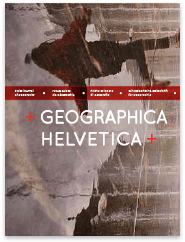
graphic_gh_cover_homepageThe multi-lingual journal “Geographica Helvetica” (Swiss Journal of Geography), an open access journal, has recently launched a discussion forum on “Heidegger and critical geography”.

In the discussion forum, contributors discuss the question how we should engage Heidegger’s thought after and beyond the publication of his diaries, the “Schwarze Hefte” (Black Notebooks). This has been a controversial discussion in philosophical circles, and we think that as many geographers have engaged Heidegger’s thought and still do so, a debate on whether or not we have to re-think our engagement post-“Schwarze Hefte” is somewhat warranted.

We have already a few contributions published – you’ll find them here:

More contributions are promised by Claude Raffestin, Geneva, Florian Grosser, St Gallen and Julia Verne, Frankfurt.

We would like to encourage more critical geographers to take part in this debate!

As always in Geographica Helvetica, this is a multi-lingual forum, so you can submit contributions in three (out of four) Swiss languages (German, French, Italian) as well as in English.

Anybody interested to participate with a contribution or to suggest potential interested scholars to contribute, please contact Benedikt Korf.

Posted in Geographica Helvetica, Martin Heidegger | Leave a comment

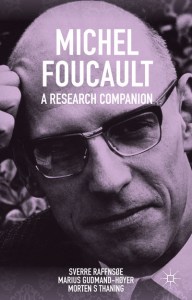
Michel Foucault: A Research Companion – forthcoming in November from Sverre Raffnsøe, Morten S Thaning, Marius Gudmand-Hoyer

Michel Foucault: A Research Companion – forthcoming in November 2015 from Sverre Raffnsøe, Morten S Thaning, Marius Gudmand-Hoyer.

9781137351029

Michel Foucault continues to be hugely influential. His diagnoses challenge us to rethink crucial phenomena such as madness, discipline, the human sciences, the state, neoliberalism, sexuality and subject formation. Based on his work in its entirety, and with special emphasis on his many recently published lecture series, this book provides an updated, comprehensive and original account of his thought. By reading Foucault as a philosopher, it offers an extensive systematic assessment and discussion of his unique conception of philosophical practice and brings a unifying trajectory in his work to light.

Along with several other people I provided an endorsement for the cover. At the moment only an expensive hardback and e-book is listed – given the usefulness of this as a resource for students, I really hope it’s available in more affordable form soon.

Posted in Michel Foucault | 1 Comment

Foucault: The Birth of Power Update 3 – Théories et institutions pénales and activist work on health and asylums

FBP update 3Since the last update, I’ve been working on two aspects of this project.

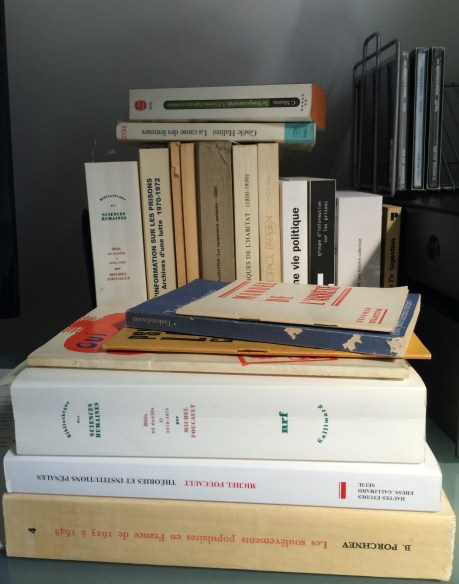
The first was on the 1971-72 course Théories et institutions pénales, for Chapter Two. There are two main parts of the course, on the Nu-Pieds revolts of the mid-seventeenth century and then the birth of the monarchical state and the medieval rebirth of the inquiry. I spoke about the second in Nottingham earlier this month (a few thoughts here); and will be speaking about the first at the Historical Materialism conference in London in November. In working on these I took a look at some of Foucault’s sources, helped by the course’s editorial notes, but also by Foucault’s own reading notes archived in Paris. In particular, for the London event I’ll be talking about Foucault’s use of Boris Porshnev’s work. I say a bit more about the key text here, and appeal for help with his texts on feudalism here.

The second was on some of Foucault’s activism in the early 1970s. Although I will of course discuss the Groupe d’information sur les prisons (GIP), I was already fairly familiar with their material, and the story there is reasonably well-known. I will return to that group at some later stage. Much less clear is the story of Foucault’s contacts with two other groups on the model of the GIP – the Groupe Information Santé (GIS) and the Groupe Information Asiles (GIA). Foucault was actively involved in the former in its early stages, but only attended a single meeting of the latter, apparently leaving without any contribution. Both groups have interesting histories. While the archives of the GIP are in IMEC, and many documents have been published in France (an English translation of a lot of the material is forthcoming), with the GIS and the GIA the traces are harder to find. In his biography of Foucault David Macey suggests that the GIS “has left few documentary traces of its existence”, but that’s not entirely true.

I plan to go back to IMEC at some point, and I think they have some material from the GIS, but a bit of hunting around online bookstores earlier this year helped me find copies of two of the key texts – the GIS’s Oui, nous avortons and the GIA’s Psychiatrie: La peur change de camp, though the latter is also available online. I have a copy of a second GIS report, La médecine desordonnée, on order. Foucault and some doctors in the GIS published a brief manifesto in 1973 – strangely not in Dits et écrits or most English bibliographies. I have a copy, but am trying to get hold of the original journal issue it was printed in so I can take a look at the surrounding texts. The archives of the GIS are deposited at the Centre des Archives du Féminisme at the University of Angers. This archive is catalogued by Lucy Halliday, “Fonds GIS (Groupe Information Santé); Fonds Sylvie Rosenberg-Reiner” – online here. I’m not sure that a special visit to Angers is needed, given Foucault’s involvement was only at the very start, and there may be enough at IMEC, but this remains a possibility.

The GIA still exists, though in quite a different form, and has a website here. An open-access archive of all the issues of its journal Tankonalasanté is available here, and I was able to pick up a copy of a selection of its texts fairly easily, published by Maspero in 1975. The journal is fascinating as an insight into the concerns of the group and a wider network, including the GIS, and the production style and possibilities of activist texts at the time. Foucault’s role in the GIS is not always clear, and I don’t want to put someone else’s words into his mouth, so I am trying to discuss the groups in themselves without over-emphasising his involvement. That’s obviously even more important in terms of the GIA. But all three groups are part of the wider context in which his publications and courses are situated, and the plan at the moment is the activist work on asylums, prisons and health is discussed in the separate chapters on those themes (chapters Four to Six) rather than together, but this might change. I’ve written about 3000 words on the GIS, and can imagine doing that or more for the GIP. I don’t think there is much to say about the GIA, so it may be that I treat that more briefly alongside the GIS.

The next task is to go back and try to complete drafts of Chapters One and Two, which I’m hoping to do over the next few weeks.

You can read more about these books, along with links to previous updates, here. And, as a reminder, a lot of resources I produced while writing Foucault’s Last Decade are available here. It includes a list of audio files, a bibliography of collaborative projects, a list of short pieces which did not appear in Dits et écrits, comparison of variant forms of texts, a few short translations, and so on.

Posted in Foucault: The Birth of Power, Michel Foucault | 2 Comments

The Birth of Territory reviewed in Politička misao by Višeslav Raos (in Croatian)

The Birth of Territory has been reviewed in Politička misao by Višeslav Raos (in Croatian). The review is open access, and is the second review in a Croatian journal (see also the one in Croatian International Relations Review by Daniel Šaric – also open access).

Many thanks to Krešimir Petković for letting me know about the new review, for saying that it is ‘unambiguously positive’, and for providing this translation of some of the conclusion:

A book like this is rare. Elden shows a genuine renaissance spirit, showcasing deep knowledge of ancient, medieval and renaissance political thought, as well as histories of language and theatre, which inevitably follow the conceptual relations between the spatial and the political…

Posted in The Birth of Territory | 1 Comment

How We Write – the open access collection reviewed and highlighted

How-We-Write-cover-E-216x346How We Write – the open access collection edited by Suzanne Conklin Akbari, which includes thirteen short pieces on academic writing – has been getting  a bit of attention already. It was chosen as a highlighted title on open access site Unglue.it and has been reviewed in French at Ludite! Jeffrey Jerome Cohen also talks about his piece here.

As I said when I announced the book’s publication, while free to download, it was not free to produce. It is also available to buy in paperback, or you can leave a donation when you download the book. This is a book that does not seek to give advice, but to show how a range of people do things in a number of different ways. Please share widely…

Posted in Publishing, Writing | 1 Comment

Talk on Foucault’s collaborative projects, 10 November at the LSE

I’ve just agreed to give a talk on Foucault’s collaborative projects in November at the LSE. This is part of the seminar series on ‘Cities, Space & Development’, so I’ll talk about the work on urban infrastructure, hospitals and public health, conducted with CERFI, CORDA and his Collège de France seminar. This leads directly into the plan for Chapter Six of Foucault: The Birth of Power.

“Foucault’s Collaborative Projects: Hospitals, Habitat, Public Infrastructure”, 4.30pm, 10 November 2015, Department of Geography & Environment, London School of Economics.

Details of all forthcoming talks – at present deliberately kept to a specific focus and limited travel – are here.

Posted in Foucault: The Birth of Power, Uncategorized | 1 Comment