Call for Papers “The Politics of Paper in the Early Modern World” Groningen, The Netherlands, 9-10 June 2016. Full details here.
Paper is today so ubiquitous that we often overlook it. Yet paper was once a brand-new communications technology and political tool that fundamentally influenced early modern political life in myriad ways. The revolutionary effects of paper on European politics and political communications are strikingly visible from the late fifteenth and early sixteenth centuries onwards.
Although scholars of early modern politics and political communications depend upon paper as a building-block of their craft, we still know too little about the paper upon which early modern princes, statesmen, diplomats, secretaries, archivists, informers, spies, smugglers, couriers, postmasters, stationers, or newswriters depended. To paraphrase paperwork ethnologist Ben Kafka, historians have tended to look through paper, at how it can be used to reconstruct events or epistemic processes, but rarely at it, as a material artifact and communications technology around which coherent historical practices developed.
This two-day conference seeks to bring together scholars and paper experts working across a range of disciplines and geographic areas who are interested in the ways in which paper supported, shaped, or otherwise influenced practices of politics and political communications in the period ca.1350-ca.1800. It aims to sketch a more integral picture of the ways in which paper permitted early modern politics and political communications to unfold.
 Graduated Open Access at Punctum Books –
 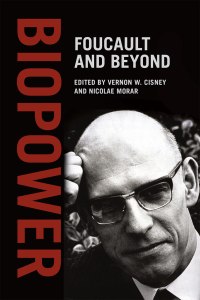 Michel Foucault’s notion of “biopower” has been a highly fertile concept in recent theory, influencing thinkers worldwide across a variety of disciplines and concerns. In The History of Sexuality: An Introduction, Foucault famously employed the term to describe “a power bent on generating forces, making them grow, and ordering them, rather than one dedicated to impeding them, making them submit, or destroying them.” With this volume, Vernon W. Cisney and Nicolae Morar bring together leading contemporary scholars to explore the many theoretical possibilities that the concept of biopower has enabled while at the same time pinpointing their most important shared resonances.
 My review essay on Foucault’s