The Barbican’s production of Hamlet, with Benedict Cumberbatch

HamletLast Friday I went to see the Barbican’s production of Hamlet, directed by Lyndsey Turner, and starring Benedict Cumberbatch, Ciarán Hinds, Anastasia Hille, and Siân Brooke. Tickets sold out very quickly, but occasionally returns become available and a bit of persistence paid off. There are some available on the day, and I saw quite a few people pick up returns. It’s also being broadcast live-to-cinema on 15 October.

When I’ve talked about Hamlet for the Shakespeare project, I’ve said that one of the reasons I like the Kenneth Branagh film is its ability to give a sense of the much broader scale of the story, outside the claustrophobic court of Elsinore. This is so often sacrificed in stage productions, because of the difficulty in portraying some of those concerns. I said a bit more about that in a brief review of the Classic Stage Company version starring Peter Sarsgaard I saw in New York earlier this year.

As many reviews have noted, Cumberbatch himself was excellent, and I’m very pleased I saw it. The production of Hamlet though has had some criticisms. I didn’t find these a major distraction, and was intrigued by the staging. The Barbican doesn’t have a curtain, but a shutter. The scene opens on a single small room for the opening scene of Hamlet and Horatio (the appearance of the ghost just implied by a ‘who’s there?’), but then the back wall lifted up to open onto a huge set of a palace interior, but with a balcony and stairs down; and doorways to larger spaces beyond. I’ve seen productions at the Barbican before, but never felt the size of the stage in this way. After the interval, the shutter opened but to the same scene covered in rubble, dust and ashes. For the initial scene of the second half – Fortinbras’s camp and Hamlet’s encounter with the soldier as he is led away to England – this worked well. Without mass of numbers, it did give the sense of an army on the move. It was convincing, and must be quite a job to unload all this and then clean it up again during and after performances. The only downside was that there was clearly foam or something similar underneath the bigger piles, and so the cast moved a bit up-and-down on the spongy bits.

For the rest of the play though, the devastated landscape remained, and of course, much of the action is back in the castle or palace. It worked well for the burial scene, but less well for other parts, and they had to clear a path for the fencing bout. Fortinbras’s return right at the end worked nicely though, as the devastated court now matched the war outside as he clambered down the rubble to take the crown. The back-story of the King Hamlet-King Fortinbras duel, on the day of Hamlet’s birth, was quite substantially cut in this version, but enough was provided to make sense of the wider framing of the events. (That’s my focus in the reading I’m developing, so of course I’m especially interested in that aspect.)

Overall I thought it was very good, and I’d be going to see the live-to-cinema version too, if it didn’t clash with a Franco Moretti lecture at Queen Mary, but perhaps there will be encore screenings. The clash is ironic, in that Moretti’s analysis of Hamlet was one of the first things of his read.

Earlier last week I’d seen Christopher Marlowe’s Tamburlaine the Great at the small Tristan Bates theatre, and there they had managed to portray the vast geopolitical scale of the events with lighting, choreography and music. Heavily cut – the two plays in just over two hours – but well done. Tickets for that are still available, and much cheaper, though it’s only on for another few days.
Posted in Franco Moretti, Shakespearean Territories, William Shakespeare | Tagged , , | 4 Comments

Books received – Tawney, The ‘Katrina Effect’, La politique de l’espace parisien, Shakespeare

unnamed

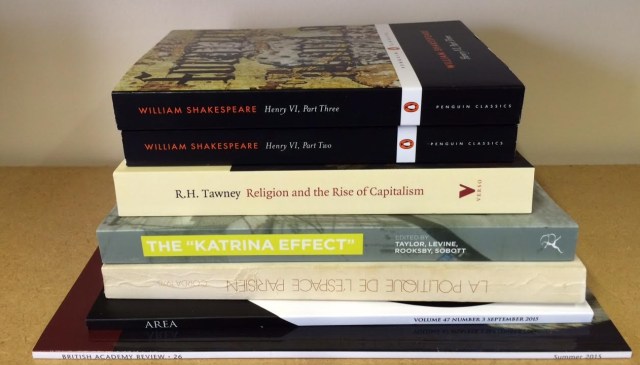
A couple of recent Penguin Shakespeare plays, the reissue of Tawney, Religion and the Rise of Capitalism (in recompense for review work), The ‘Katrina Effect’ (from the publisher), a couple of journal issues, and a copy of La politique de l’espace parisien. The last is a collaborative project which developed out of one Foucault led – there is no Foucault in this book, but it’s an interesting volume nonetheless.

Posted in Michel Foucault, William Shakespeare | Tagged | Leave a comment

The World Post interview with Peter Sloterdijk – ‘Man And Machine Will Fuse Into One Being’

55e47c0c1d00002f001465eaThe World Post interview with Peter Sloterdijk – ‘Man And Machine Will Fuse Into One Being‘.

Posted in Peter Sloterdijk | 1 Comment

Governmentality, Neoliberalism, Economy: strategies for critiques of power (7 – 9 December 2015) | CBS – Copenhagen Business School

News of an interesting PhD workshop to be held in Copenhagen in December. Unfortunately, due to a mix-up over dates, I will not be presenting at this event.

Clare O'Farrell's avatarFoucault News

Governmentality, Neoliberalism, Economy: strategies for critiques of power
(7 – 9 December 2015)
CBS – Copenhagen Business School, Denmark

PhD School
Doctoral School of Organisation and Management Studies
Department of Management, Politics and Philosophy

Faculty

Mitchell Dean, Professor of Public Governance, CBS
Stuart Elden, Professor, Monash University
Ute Tellmann, Fakultät Wirtschafts- und Sozialwissenschaften, Universität Hamburg
Kaspar Villadsen, Professor (mso), Department of Management, Politics & Philosophy, CBS, Denmark
Marius Gudmand-Høyer, Post.Doc. Scholar, Department of Management, Politics & Philosophy, CBS, Denmark

Course coordinator
Kaspar Villadsen and Mitchell Dean

Prerequisites

Only PhD students can participate in the course.

The course requires the submission of a short paper that deals with conceptual problems or analytical designs in relation to Foucauldian inspired/governmentality studies. Furthermore, papers that apply Foucauldian concepts to empirical problems in a variety of domains are welcomed. The paper should state the theme and the analytical strategy of the PhD project and it…

View original post 738 more words

Posted in Uncategorized | 1 Comment

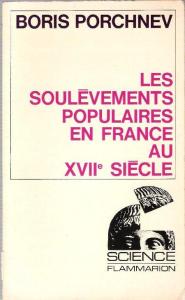
Boris Porshnev – the two editions of Les soulèvements populaires en France: a book by one of Foucault’s key sources in Théories et institutions pénales

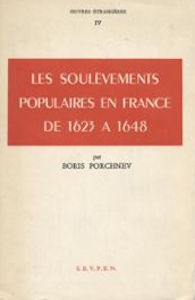
PorchnevRussian historian Boris Porshnev is one of Foucault’s key sources for the discussion of the Nu-Pieds revolts of 1639-40 in Théories et institutions pénales. Following my regular practice of reading Foucault’s sources as well as his own work using them, I bought a copy of Porchnev’s book Les soulèvements populaires en France au XVIIe siècle. I recently turned to the book to begin the work of going beyond Foucault’s own lectures – in this case it is especially useful, since Foucault’s course is edited on the basis of his manuscript, which is fragmentary and note-like, rather than a transcript of what he actually said. I’ll be speaking about Foucault and Porshnev in November at the Historical Materialism conference (abstract here).
(Incidentally, Porchnev seems to be the French rendering of his name; Porshnev the English one.)

But on turning to Porshnev’s book, I was surprised to discover there is nothing about the Nu-Pieds in it. Part 1 is on revolts between 1620-30 and 1640-50; Part 2 is on the Fronde (1648-53). But Porshnev’s book was the subject of a strong critique by Roland Mousnier in 1958 (based on the German translation), which was reprinted in 1970. Foucault uses Mousnier’s critique, as well as his own work on the revolts, and that of his students, in his analysis.

Porchnev-Boris-Les-Soulevements-Populaires-En-France-De-1623-A-1648-Livre-251106879_MLThe reason for the absence is quite simple – I’d picked up a copy of the 1972 reedition of Porshnev’s text from Flammarion, whereas Foucault used the 1963 original edition from SEVPEN. And the 1963 edition has three parts. Parts I and III appear to be exactly the same as the 1972 version; Part II is on the Nu-Pieds. So, even though the reading of the Nu-Pieds was the subject of the key Francophone debate about his work, it is the part which is excised in the pocket re-edition. A chronology and bibliography are also missing; as are an ‘Avant-Propos’ and a preface to the French edition. (The Russian preface appears in both.) The original edition has a slightly different title: Les soulèvements populaires en France de 1623 à 1648So, the original, which includes more, has the more specific title.

It misled me, since online bibliographies suggested it was a simple reprint with a slightly amended title. And the one I bought was appealing especially because the 1963 edition is quite a bit more expensive from online book stores than the 1972 one. I’ve taken a look at the 1963 version in the British Library, but have now ordered a copy from an online second-hand book store too. I’m writing this because there doesn’t seem to an online resource that explains the difference between the two editions, and especially with Foucault’s use of this work, interest in Porshnev might increase again.

Posted in Boris Porshnev, Michel Foucault | 5 Comments

Top posts on Progressive Geographies this week

Posted in Uncategorized | 1 Comment

Review forum on The Birth of Territory with Legg, Heffernan, McDonagh, Cohen, Sassen, Elden in Journal of Historical Geography (o/a link)

S03057488A review forum on The Birth of Territory is forthcoming in Journal of Historical Geography – Stephen Legg, Mike Heffernan, Briony McDonagh, Jeffrey Jerome Cohen, Saskia Sassen and a response by me. Steve has posted the preprint on academia.edu

Lots of nice things said, lots of thoughtful comments, suggestions, supplements, and criticisms. I try to address some the best I can within limited words in the response. But for now I’m just going to enjoy the opening lines of Mike’s comments:

Stuart Elden’s The Birth of Territory is a brilliant book – exhilarating, intimidating and occasionally exhausting. Although its scope transcends any particular discipline, it bears comparison with the best works on the history of geography and is arguably the most accomplished work in this field since Clarence Glacken’s Traces on the Rhodian Shore, a book with which it has much in common in terms of its intellectual ambition, historical range, and scholarly depth.

Posted in Uncategorized | 3 Comments

Explorations of Style – a really useful writing resource, now with ‘how to use this blog’ page

Explorations of Style is a really useful writing resource, and now has a comprehensive ‘how to use this blog‘ page which serves as a kind of table of contents or index.

Posted in Publishing, Writing | 1 Comment

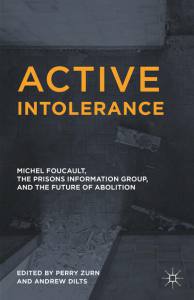
Active Intolerance: Michel Foucault, the Prisons Information Group, and the Future of Abolition (2015)

An important collection available to pre-order – I wrote one of the endorsements.

Clare O'Farrell's avatarFoucault News

zurn-diltsActive Intolerance: Michel Foucault, the Prisons Information Group, and the Future of Abolition
Edited by Perry Zurn, Andrew Dilts
Palgrave Macmillan:November 2015

This book is an interdisciplinary collection of essays on Le Groupe d’information sur les prisons (The Prisons Information Group, the GIP). The GIP was a radical activist group, extant between 1970 and 1973, in which Michel Foucault was heavily involved. It aimed to facilitate the circulation of information about living conditions in French prisons and, over time, it catalyzed several revolts and instigated minor reforms. In Foucault’s words, the GIP sought to identify what was ‘intolerable’ about the prison system and then to produce ‘an active intolerance’ of that same intolerable reality. To do this, the GIP ‘gave prisoners the floor,’ so as to hear from prisoners themselves what to resist and how. The essays collected here explore the GIP’s resources both for Foucault studies and for prison…

View original post 2 more words

Posted in Uncategorized | 1 Comment

‘Foucault, Porshnev and the Revolt of the Nu-pieds’, Historical Materialism conference, London, 5-8 November 2015

c9d71a6be7I’ll be speaking about ‘Foucault, Porshnev and the Revolt of the Nu-pieds’, at the Historical Materialism conference, to be held in London between 5-8 November 2015. Here’s the abstract:

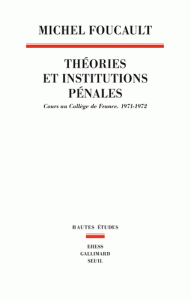
In his recently published lecture course from 1971-72, Théories et institutions pénales, Michel Foucault provides a two-part analysis. The second half of the course is his most detailed examination of medieval legal codes, examining practices of punishment, ordeal, confession and inquiry. It is a rich and nuanced analysis which will be invaluable in tracking his preoccupations. But it is in the first half of the course that we have the greatest surprise. Foucault spends seven lectures examining the Nu-pieds [bare feet] revolts of 1639-40 in Normandy, and the repression that followed. In his reading of these revolts, Foucault makes extensive use of Boris Porshnev’s 1948 study, translated into French in 1963 as Les soulèvements populaires en France de 1623 à 1648. At the time of the lectures, Porshnev’s Marxist account had been subjected to stinging critique by Roland Mousnier. Foucault steers a course between these two positions, though I would suggest he is closer to Porshnev politically and to Mousnier historical-conceptually. It is also interesting given the proximity of Foucault to Maoism at this time, that his choice of focus is a peasant, rather than worker’s, uprising. Given Foucault is often criticized for talking of the positive, productive side of power, but rarely examining it outside of antiquity; or of never showing how resistance takes place or is even possible, this analysis provides an important corrective.

Between this talk and the forthcoming one in Nottingham, which also looks at Théories et institutions pénales, I’m planning on covering most of the material destined for Chapter Two of Foucault: The Birth of Power. A good example of what I mean with talks that move the writing forward (‘my sabbatical rules‘ #6)…

Posted in Conferences, Foucault: The Birth of Power, Michel Foucault | 2 Comments