Publishing in Top Academic Journals – Notes From the Masterclass With Claudia Aradau

Publishing in Top Academic Journals – Notes From the Masterclass With Claudia Aradau.

Last week, the journal New Perspectives and the Centre for European Security of the Institute of International Relations had the pleasure to host two exiting events featuring Dr. Claudia Aradau, a Reader in International Politics in the Department of War Studies at King’s College London and the Editor of Security Dialogue. In the first of the new seminar series ‘New Perspectives on European Security’ Dr Aradau discussed her cutting edge work on the politics of research methods in Critical Security Studies – which will be discussed in a forthcoming blog post. In this post we are happy to share some of Claudia Aradau’s top tips on publishing, writing and editing.

Some very good advice here – useful for a range of disciplines.

Posted in Publishing, Writing | 2 Comments

Chronicles from an eternal present. A review of “Critiquer Foucault”, edited by Daniel Zamora

michel-foucault-demonstrationChronicles from an eternal present. A review of “Critiquer Foucault”, edited by Daniel Zamora – part I, part II.

Posted in Uncategorized | 1 Comment

Foucault’s 1983 seminar at Berkeley – tracing the people in the ‘cowboy hat’ photograph

In Didier Eribon’s biography of Foucault, there is a picture of Foucault in a cowboy hat, together with Paul Rabinow and some students at Berkeley. The hat was a gift from the students. This group met in parallel with the seminar on parrēsia that produced the book Fearless Speech.

Eribon book photos - Berkeley2left to right – Mark Maslan; Eric Johnson; Thomas Zummer (part-hidden); Stephen Kotkin; Kent Gerard (crouching); Michel Foucault; David Levin (seated); Keith Gandal; Jonathan Simon; Arturo Escobar; Paul Rabinow; Jerome (Jerry) Wakefield.

If anyone can identify the unknown person, who was apparently an undergraduate, perhaps in history, please contact me.

The photograph was taken by David Horn, at the house of Kotkin and Gandal. This is a black and white reproduction of a picture originally in colour, though I have yet to see that. A second unpublished colour photo which I have seen was taken by Gandal with Horn in his place.

In the course of the research for my Foucault books, I’ve met Simon, spoken to Gandal by phone, and had email exchanges with Horn, Maslan, Levin, Escobar, Wakefield and Rabinow. Unfortunately I cannot trace Gerard or Johnson and have yet to speak to Zummer and Kotkin.

What’s extraordinary is what this group went on to do – professors at Chicago, UC Berkeley, Princeton, City College of New York, Ohio State, North Carolina, UC Santa Barbara, NYU and the European Graduate School. Rabinow was of course already well known and still works at Berkeley. Cathy Kudlick (San Francisco State) and Jacqueline Urla (UMass) were also involved in discussions.

Horn, Kotkin and Gandal all published books that developed out of their collaborative work with Foucault – respectively Social Bodies: Science, Reproduction, and Italian Modernity, Princeton University Press, 1994; Magnetic Mountain: Stalinism as a Civilization, University of California Press, 1995; and The Gun and the Pen: Hemingway, Fitzgerald, Faulkner, and the Fiction of Mobilization, Oxford University Press, 2008. This collaborative project was planned to be on ‘New Arts of Government in the Great War and Post-War Periods” with the US, USSR, France and Italy as the countries examined. The idea was that this work would continue in fall 1984. The IMEC archive has a description of the project by Gandal, and History of the Present No 1 contains more information in a piece by Gandal and Kotkin.

A footnote to Foucault’s career, but it seems in Berkeley he was on the verge of establishing the kind of collaborative working seminar he kept saying he wanted to have at the Collège de France. Of course, Foucault never lived to conduct his own work on France, or indeed to return to Berkeley, but the books Horn, Kotkin and Gandal published cover the other three countries. Escobar also told me that his Encountering Development book was greatly influenced by conversations with Foucault, and several of the others have published on Foucault or were also inspired by his work.

[updated on 10 June 2015, with Eric Johnson identified by Richard Dienst]

Posted in Foucault's Last Decade, Jonathan Simon, Michel Foucault | Tagged , , , , , , , , | 7 Comments

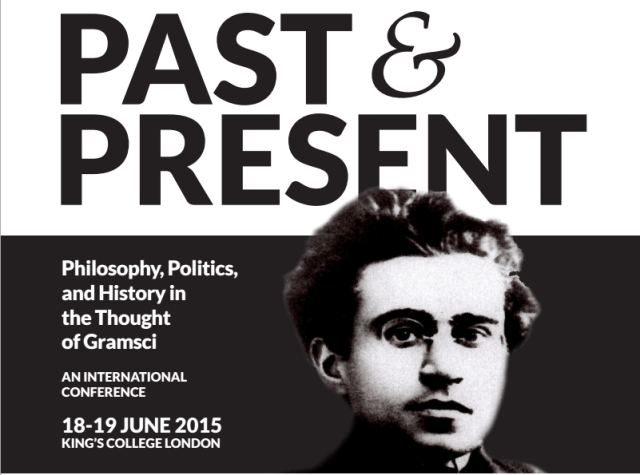
Philosophy, Politics, and History in the Thought of Gramsci, 18-19 June 2015. King’s College London

Screen Shot 2015-06-05 at 14.24.53Philosophy, Politics, and History in the Thought of Gramsci, 18-19 June 2015. King’s College London.

Posted in Antonio Gramsci | Leave a comment

Babette Babich, “Heidegger’s Black Night: The Nachlass & its Wirkungsgeschichte” on academia.edu

Babette Babich, “Heidegger’s Black Night: The Nachlass & its Wirkungsgeschichte” on academia.edu – another essay from the forthcoming collection Ingo Farin and Jeff Malpas, eds., Reading Heidegger’s Black Notebooks 1931-1941 (Cambridge, Mass: MIT Press, 2016).

Posted in Martin Heidegger, Publishing | Leave a comment

The Anomie of the Earth: Philosophy, Politics, and Autonomy in Europe and the Americas

The Anomie of the Earth: Philosophy, Politics, and Autonomy in Europe and the Americas – new collection from Duke University Press. Includes essays by Sandro Mezzadra, Walter  D. Mignolo, Benjamin Noys and others.

978-0-8223-5893-0_pr

The contributors to The Anomie of the Earth explore the convergences and resonances between Autonomist Marxism and decolonial thinking. In discussing and rejecting Carl Schmitt’s formulation of the nomos—a conceptualization of world order based on the Western tenets of law and property—the authors question the assumption of universal political subjects and look towards politics of the commons divorced from European notions of sovereignty. They contrast European Autonomism with North and South American decolonial and indigenous conceptions of autonomy, discuss the legacies of each, and examine social movements in the Americas and Europe. Beyond orthodox Marxism, their transatlantic exchanges point to the emerging categories disclosed by the collapse of the colonial and capitalist frameworks of Western modernity.

Posted in Uncategorized | 1 Comment

Martin Heidegger’s 1934-35 course Hölderlin’s Hymns “Germania” and “The Rhine” reviewed at NDPR by Richard Polt

9780253014214_medThe translation of Martin Heidegger’s 1934-35 lecture course Hölderlin’s Hymns “Germania” and “The Rhine”, is reviewed at NDPR by Richard Polt. The translators are William McNeill and Julia Ireland, also responsible for the translation of Heidegger’s course on Hölderlin’s Hymn ‘The Ister’Polt confronts the political issues with Heidegger directly in his review, and Julia Ireland’s article ‘Naming Φύσις and the “Inner Truth of National Socialism”: A New Archival Discovery’ which is referred to in the review, is available open access here.

Posted in Martin Heidegger | Leave a comment

Reviews of Foucault’s first three Collège de France courses, and other pieces at Berfrois

1024px-Sebastiaan_Vrancx_studio_-_A_landscape_with_travellers_ambushed_outside_a_small_town-725x450The piece I published yesterday was on Foucault’s second lecture course at the Collège de France. I have also published reviews of the first and third, which form an initial triptych on the linked themes of measure, inquiry and examination.

Update September 2025: the Berfrois site is now closed and the archive has been removed. My piece can now be found at the updated links below. All my pieces are listed here.

Power, Nietzsche and the Greeks: Foucault’s Leçons sur la volonté de savoir(1970-71).

Peasant Revolts, Germanic Law and the Medieval Inquiry” on Théories et institutions pénales (1971-72).

“Discipline, Punish, Examine and Produce: Foucault’s La société punitive” (1972-73).

These three courses will be a major focus of the second of the books I’m currently writing on Foucault, The Birth of Power.

With Berfrois I have also published a piece on the 1979-80 course at the Collège, On the Government of the Living, and the  1981 course at Louvain, Wrong-Doing, Truth-Telling: Confession, Flesh, Power and Truth.

And finally I’ve also written for them on Kant’s Natural Science and Ralph Fiennes’s film of Shakespeare’s Coriolanus.

Posted in Uncategorized | 1 Comment

Thinking Spatial Practices with & against law – Birkbeck, 19 June 2015

Thinking Spatial Practices with & against law

An Interdisciplinary Workshop Funded by: Birkbeck Institute for Social Research

Birkbeck School of Law, University of London, 19th June 2015

Birkbeck College, Malet Street│Room 414

Across various disciplines, a resurgent interest in questions of spatial justice is prompted by a diverse range of developments such as the Arab Spring and occupy movements, drone warfare, the criminalisation of squatting in Europe, restriction of the uses of public space under securitisation, surveillance and disciplinary architecture, the housing crisis in the UK and elsewhere.

This interdisciplinary colloquium explores the specific role of law, not only in terms of its functions of disciplining, ordering and controlling, but also in terms of the possibilities it offers for critical spatial practices. Law holds a special relationship to spatiality as the latter is ingrained in its historical formation and logics of ordering and control.

At the intersection with approaches that focus predominantly on the so-called negative effects of legal spatial ordering and control, and posit themselves as working against the law, we would like to also consider what positive markers may be offered in the law and with the law in such modalities of spatial practice and thought. And this not only in the sense of legal doctrinal possibilities and established jurisprudence, but crucially so in terms of encountering the creative force of the (legal, political and architectural) imagination.

PLEASE REGISTER HERE:

Programme and Abstracts here:

Posted in Uncategorized | Leave a comment

Notes toward a critical history of cartography, part 1

Jeremy Crampton on an interesting teaching/research project on the history of cartography.

Jeremy's avatarOpen Geography

In the past few months I’ve agreed to develop a course called “A Critical History of Cartography” for our department’s new Masters and Certificate in Digital Mapping. This initiative, which we call New Maps Plus, will offer interested students the ability to earn a Certificate or a Masters of Science from the University of Kentucky in subjects covering digital mapping, GIS, the geoweb, and programming for online maps.

One of the things I proposed for this course was to develop a Reader in Critical Cartography, which would collect in one place, with short commentary, the people, events, maps and theory that had a profound influence on the way we think about maps, or conversely, the way maps may have made us see the world in new ways. This book would then be the assigned reading for the course but would also I hope be of interest to a wider…

View original post 801 more words

Posted in Uncategorized | 1 Comment