
David Harvey, Wendy Brown and Étienne Balibar discuss neoliberalism, capitalism and Marx – here.

Q&A @ http://backdoorbroadcasting.net/2015/07/london-critical-theory-summer-school-2015-friday-debate-i/
David Harvey, Wendy Brown and Étienne Balibar discuss neoliberalism, capitalism and Marx – here.
Q&A @ http://backdoorbroadcasting.net/2015/07/london-critical-theory-summer-school-2015-friday-debate-i/
Installing Social Order shared this video about Foucault. I think it’s Alain de Botton speaking. The animation is very good, but the script could have used some serious work.
I attended and spoke at three workshops last week. First, at the Monash University study centre in Prato, Italy, on modern reappropriations of Hellenistic Ethics. I ran a reading seminar on Foucault’s reading of Artemidorus. The other sessions were by Susan James and Aurelia Armstrong on Spinoza’s Ethics; Daniel Conway and Keith Ansell-Pearson on Nietzsche’s reading of Epicurus; and John Sellars and Matthew Sharpe on two translations in progress of essays by Pierre Hadot. It was a tremendous privilege to hear the other discussions, especially – for me – Keith and Dan on Nietzsche, and Matt on Hadot.
The day of reading sessions was between two workshops with formal papers, only small parts of which I was able to attend. Initially the seminar was supposed to be just a discussion session – of the first chapters of History of Sexuality Vol III and the chapters on sexual dreams from the Onirocritica – but prompted by the way the other sessions were designed, and how those discussions went, I ended up giving a short presentation at the beginning (audio recording here). The discussion was lively, but quite quickly turned from the specifics of Foucault’s reading of Artemidorus to his work as a whole – I ended up saying quite a bit that drew on my work for the Foucault’s Last Decade book. Immediately after the session I was interviewed for the Prospects for an Ethics of Self-Cultivation project website. It was on Foucault’s work in relation to this project. I’ll provide a link as soon as it’s available.
On Friday I was up in Nottingham for a workshop on ‘Conceptual History and Political Ideology‘, at which I gave a brief talk on ‘Earth’. This paper is the most theoretical part of a longer draft manuscript, of which I’ve given different pieces as talks over the past few years. This time I cut some of the theoretical development at the end and added some more discussion of Shakespeare’s Richard II and King Lear. You can listen to a recording here. There were several other interesting talks, especially by Michael Freeden and Rahul Rao.
In his concluding remarks Freeden made some very interesting comments about what he called ‘undiscipline’ – the emergence of a challenge to disciplines and interdisciplinarity. This raised issues of ‘messiness’ and the vulnerability of disciplines. He was also trying to think the notion of layer, not just in a Reinhard Koselleck-inspired temporal sense, but as something that brings in questions of spatiality too.
It was good to meet Ben Holland, Michael Freeden, Chris Pierson, Vanessa Pupavac and others, and to see some of my friends from the Nottingham School of Geography – Mike Heffernan, Stephen Legg and Alex Vasudevan. And it was the first time I’d seen Eloise Harding – now a lecturer at Southampton – since I taught her as an undergraduate during my first stint at Warwick back in the early 2000s.
On Saturday, I was back in London. I spoke about ‘Foucault and Shakespeare: Theatre, Ceremony, Politics’ at the ‘Theatre, Performance, Foucault!’ Workshop at King’s College (abstract here). I didn’t know anyone at this event, and it was really good to talk to people from English, theatre, art history and other disciplines in which I have an interest, but no background. Although I spoke briefly at the beginning about Foucault’s early engagement with Shakespeare and madness, my principal focus was on the lectures of the 1970s and their examination of forms of political power and the drama of the coup d’état and ceremony. I discussed several plays briefly, including King Lear, Hamlet and Macbeth, but mainly focused on King John. As a post on this blog indicated earlier this month, King John has been on my mind recently, and it was good to have a chance to talk about it, especially with the kind of audience that would have some familiarity with this less well-known play. I’m hoping to have a chance to develop this talk for a future presentation, and from there into a fuller manuscript, and have a few ideas of how to do this, so won’t share the recording at this stage.
That’s it for conferences for a couple of months, and I’m trying – not always successfully – to restrict the number of talks I give in 2015-16 when I’ll be on research leave. I want to spend as much of that year as possible on writing the second book on Foucault and hopefully the work on Shakespeare. So as far as possible I’m only agreeing to talks with minimal travel in which I can discuss elements of those ongoing projects. For now it’s back to the Foucault’s Last Decade manuscript – the very final stages of the work.
My colleague Charlotte Heath-Kelly has a thoughtful piece entitled ‘How 7/7 changed the way Britain mourns victims of terrorism’ in The Conversation.
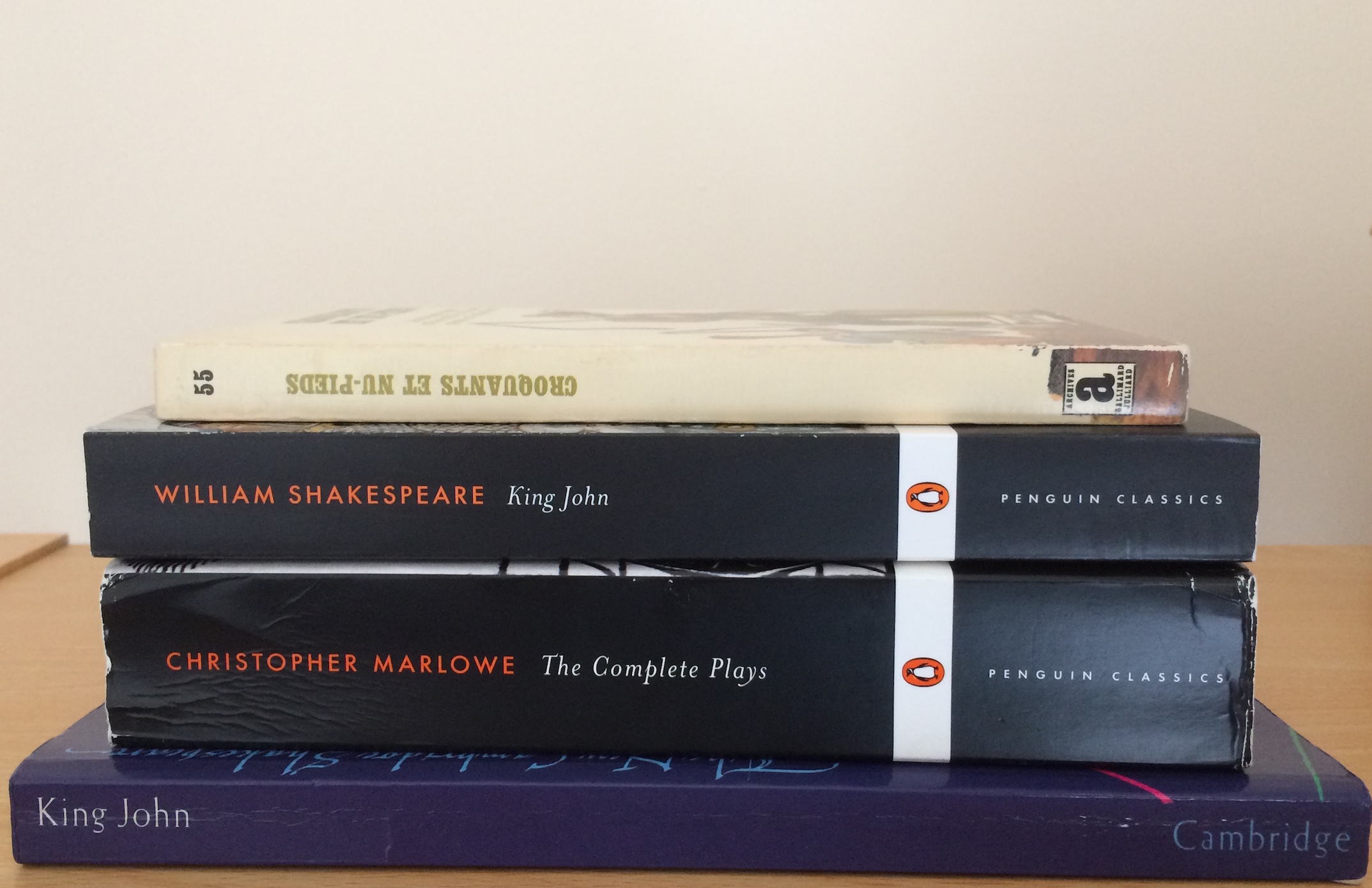 Some second-hand copies recently bought – two editions of Shakespeare’s King John, the complete plays of Christopher Marlowe, and Yves-Marie Bercé’s Croquants et nu-pieds: Les soulèvements paysans en France du XVIe au XIXe siècle. The last is important background for what Foucault does on this topic in Théories et institutions pénales – it came out a couple of years after Foucault’s course, but will help understand the context of the debate, as well of course as the material itself.
“Let UK universities do what they do best – teaching and research” – Letter from 121 professors in The Guardian. Here’s the first paragraph:
The UK’s universities can justifiably claim an outstanding international reputation, generating multiple direct and indirect benefits for society, and underpinning our core professions through training and education. Yet these attributes are being undermined and degraded from within and without, with innovation, creativity, originality and critical thought, as well as notions of social justice, being threatened by forces of marketisation demanding “competitiveness” and “efficiency” in teaching and research. This generates continuous pressures to standardise, conform, obey and duplicate in order to be “transparent” to measurement.
William Cronon British Academy lecture, Royal Geographical Society, London, 7 July 2015 – ‘ Who reads Geography or History anymore?‘
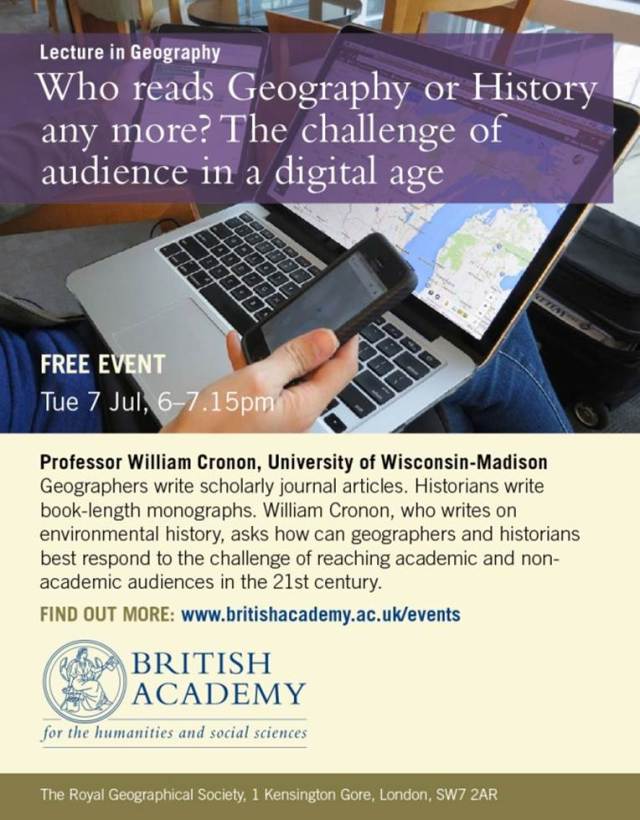 I was looking forward to this, but now have a conflicting appointment.
The sixteenth annual meeting of the Foucault Circle will be held in Sydney, Australia, June 29-July 2, 2016 (hosted by the University of New South Wales).
The Foucault Circle at UNSW will be held immediately before the Australasian Association of Philosophy Conference which in 2016 is being hosted by Monash University at the Caulfield campus. AAP Dates are: Sunday 3rd July – Thursday 7th July 2016. Scholars planning to attend the Foucault Circle may also wish to attend the AAP. Full details before or here.
We invite individual papers and roundtable proposals (4-5 panelists) on any aspect of Foucault’s work. Studies, critiques, and applications of Foucauldian thinking are all welcome. We will aim for a diversity of topics and perspectives.
Abstracts should be prepared for anonymous review, and are to be submitted to the program committee chair, Richard A. Lynch, by email (lynchricharda@sau.edu) on/before Friday, Nov. 20, 2015. Please indicate “Foucault Circle submission” in the subject heading, and include the abstract as a “.docx” attachment.
Individual paper submissions require an abstract of no more than 750 words; roundtable submissions require a 500-word abstract describing the theme and 150-word summaries of each panelist’s talking points.
Program decisions will be announced in December.
Each speaker will have approximately 35 minutes for paper presentation and discussion combined—papers should be a maximum of 3000 words (15-20 minutes reading time). Roundtables will have approximately 50 minutes total for presentation and discussion combined; individual panelists should plan to speak for no more than 5-7 minutes. In addition to paper and roundtable sessions, the conference will also feature a “reading group” discussion session (texts TBA) open to all participants.
Logistical information about lodging, transportation, and other arrangements will be available after the program has been announced.
For more information about the Foucault Circle, please see our website:
A review of an intriguing Russian book, at the Society and Space open site.
 Jeffrey Jerome Cohen has a draft of his contribution to a collection on writing with which I am also involved: ‘Creativity, Routine, Writing Lockdowns, and the Necessity of Ignoring Those Who Offer Themselves as Example‘. (A little more on my contribution here.)
Jeffrey’s piece is in part an account of how he came to write his remarkable book Stone: An Ecology of the Inhuman, which I have just read. Given how harrowing the account of its writing seems, it’s remarkable how the book bears so little trace of it. The book will be useful as and when I return to my work on earth, terrain, fossils, and related questions.

