Exiled in the United States during the Second World War, linguist Roman Jakobson gave a series of lectures at the École Libre des Hautes Études in New York. These classes – attended among others by Claude Lévi-Strauss – had a major impact on contemporary human sciences. This book reconstructs and analyzes this momentous corpus. It also contains a critical edition of four previously unpublished lectures given by Jakobson in 1942–1943.
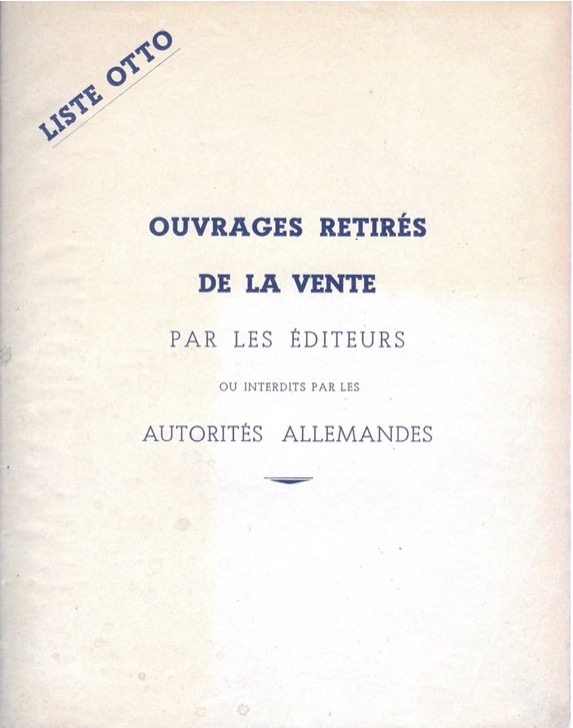
The “Liste Otto” was named after Otto Abetz, German ambassador to France under the Occupation, from August 1940 until the Liberation. The list indicated which books had to be removed from sale, with existing copies destroyed, after the German invasion of France. The September 1940 version replaced an earlier “Liste Bernhard”, and it was followed by a supplement, and two later versions in 1942 and 1943. The original version had the title “Ouvrages retirés de la vente par les éditeurs ou interdits par les autorités allemandes [Works withdrawn from sale by publishers or banned by the German authorities]”. One of the reasons some French presses pre-emptively removed books from their lists was in the hope they would be allowed to continue selling other works. In 1942 the list had the bilingual title “Unerwuenschte Franzoesische Literatur/Ouvrages Littéraires Français non désirables”, in 1943 “Unerwuenschte Literatur in Frankreich/Ouvrages Littéraires non désirables en France”.
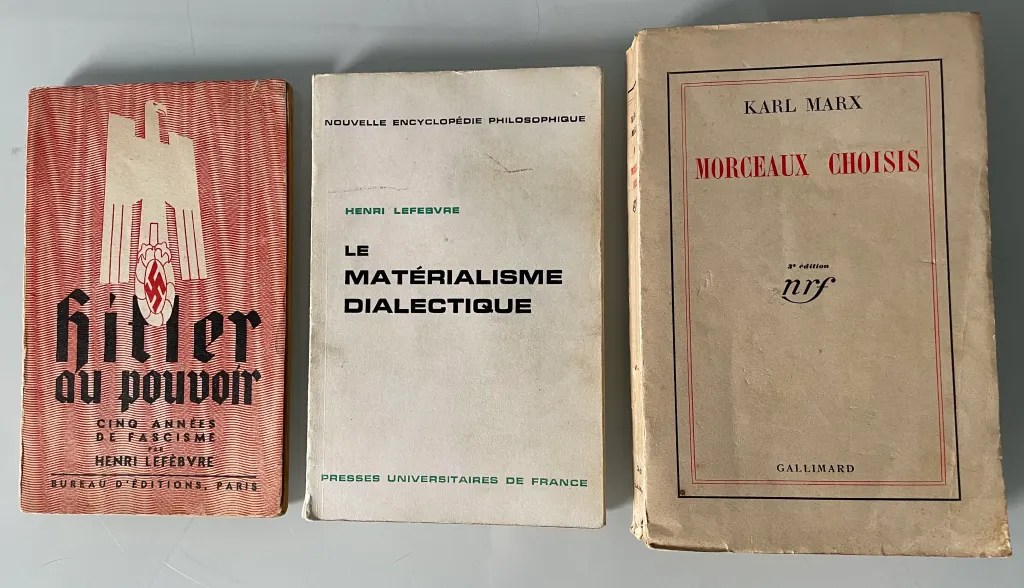
The September 1940 list includes, unsurprisingly, Henri Lefebvre’s book Hitler au pouvoir, published in 1938. The Hitler book was a critical, Marxist assessment of five years of fascism in Germany. Its inclusion in a prohibited list was hardly surprising, but is only one aspect of the censorship of Lefebvre’s work. The list also includes Cahiers de Lénine sur la dialectique de Hegel (1938) and Karl Marx’s Morceaux choisis (1934), both of which Lefebvre had edited with Norbert Guterman.
Three books that were on the list – Le matérialisme dialectique shown here is a later reprint
Guterman was Jewish, so this alone would have been enough for inclusion on this list. But Lefebvre’s 1939 book on Nietzsche, his Le Nationalisme contre les Nations (1937) and the collection of texts he and Guterman had edited by Hegel (1938) are not on the lists, and neither is their co-authored book La conscience mystifiée (1936). In the third edition of the list in 1943, Lefebvre’s book Le Matérialisme dialectique (1940) was added.
three books that were not included on the lists
There is therefore something of an arbitrary nature of the list – there are obviously reasons why the Nazi occupiers would object to those books they did include, but those reasons would also seem to apply to ones they did not. The Nietzsche book, for example, is very much written as a challenge to the fascist appropriation.
After Le Matérialisme dialectique in 1940, Lefebvre did not publish another book until L’Existentialisme in 1946. For someone who usually published a book or two a year, this was quite a long break – the only comparable disruption to his regular publishing rhythm came when he was having difficulties with Communist Party censors in the late 1940s and early 1950s. He was clearly storing up ideas during the war, as in 1947 he published five books – two on Marx, the first volume of his Critique de la vie quotidienne(Critique of Everyday Life), a study of Descartes and Logique formelle, logique dialectique.
During the war, Lefebvre moved back to the Pyrenees, working with the resistance – although the exact nature of his role is debated – and doing the research for what turned into his doctoral thesis in 1954. The primary thesis was on peasant communities and was published posthumously (Les Communautés paysannes Pyrénéennes); the second thesis was a historical and geographical study of one small area, La vallée du Campan, part of which is included in the On the Ruralcollection I co-edited with Adam David Morton in 2022.
One indication of the censorship Lefebvre experienced in the war comes in the original 1947 edition of Critique de la vie quotidienne. On the page ‘Du même auteur’, Lefebvre lists his previous publications. There he distinguishes three ways his books were suppressed:
seized and destroyed in October 1939 by order of the Daladier government
seized and destroyed at the beginning of 1940 by the publisher
seized and destroyed at the end of 1940 by the occupying authority, Liste ‘Otto’
Interestingly, he says Le Nationalismecontre les Nations was in the first category; Hitler and Nietzsche both in the second; Le matérialisme dialectique and the collections on Lenin and Hegel in the third. From the lists discussed above, this isn’t entirely correct, but it explains why the Nietzsche book was indeed removed from sale shortly after publication, and why copies are so hard to find today. The ‘Liste Otto’ did however usually list books withdrawn from sale by publishers, as well as ones the Germans banned.
Getting hold of some of these books can be challenging. They were often printed in limited numbers, and at least some copies were destroyed. While some have been reissued, the Hitler one never has been, and it was the last of Lefebvre’s books I was finally able to buy. The most easily accessible version is the Italian translation from 13 years ago – Hitler al potere. Cinque anni di nazismo in Germania. I first read the French book in the New York Public Library in 2002, since I don’t know of a copy in the UK, before getting the Italian translation and a photocopy of the French. I then later found an original copy in a second-hand bookshop. I say a bit more about the book here.
Le nationalisme contre les nations had a second edition in 1988; the Nietzsche book was reissued in 2003; Le materialisme dialectique has gone through multiple editions and was translated into English by John Sturrock. The Hegel collection is still in print, whereas the Marx collection was superseded by a two-volume collection of Oeuvres chosis edited by Lefebvre and Guterman in the 1960s.
The list of books by Lefebvre ‘En préparation’ in the Critique de la vie quotidienne list is also interesting – only a few of these were ever published. A full account of that is another story, involving censorship from the French Communist Party. Logique formelle, logique dialectique was supposed to be the first of an eight-volume series, under the working title of Traité du Matérialisme dialectique. The second volume, entitled Méthodologie des sciences, was written in the late 1940s but only published in 2002. In Logique formelle, logique dialectique Lefebvre gives an indication of six further volumes (pp. 11-12; see Elden, Understanding Henri Lefebvre, 27-28).
In the Critique de la vie quotidienne list the titles are different:
Théorie de la Connaissance: logique et méthodologie
Matérialisme historique
Dialectique dans l’étude du Capital et de l’Etat
L’humanisme
Psychologie et théorie de l’individualité
Esthétique
Lefebvre published on the state, aesthetics and history at later points in his career, but only his Contribution à l’esthétique, written in the late 40s and published in 1953, comes close to the plan of this series. Lefebvre also mentions as forthcoming a history of rural France with Albert Soboul; La Conscience privée: étude sur l’histoire et la structure sociale de l’individualité; and L’Homme et le Soldat. A fragment of La Conscience privée was included in the third edition of La Conscience mystifiée, but neither of the others appeared. Adam David Morton and I briefly mention the planned project with Soboul in the Introduction to On the Rural (p. xiii).
The other side of the books that were banned is the story of those that were published during the war. That probably deserves another post, but in my project on Indo-European Thought in France, there are some authors who continued to publish under the Occupation, working with presses who were submitting their titles to censorship. Some intellectuals refused those constraints; others continued. Some presses worked closely with the authorities, a murky history well told in, for example, accounts of Abetz by Martin Mauthner and Barbara Lambauer. There was also the question of paper shortages, which continued for some time after the war, introducing another limit, since not all presses had access to supplies, and those that did had to be even more selective in what they published. There is therefore a politics and political economy of publishing in this period, of which the story has, I think, best been told by Pascal Fouché, in L’Édition française sous l’Occupation 1940-1944 and Gisèle Sapiro, The French Writers’ War, 1940-1953.
Jean-François Dubos, “La « liste Otto » : guerre aux livres”, Revue historique des armées 307, 2022, 123-28.
Stuart Elden, Understanding Henri Lefebvre: Theory and the Possible, London: Continuum, 2004.
Stuart Elden, “Some Are Born Posthumously: The French Afterlife of Henri Lefebvre”, Historical Materialism14 (4), 2006, 185-202 (originally published as “Certains naissent de façon posthume: La survie d’Henri Lefebvre”, trans. Élise Charron and Vincent Charbonnier, Actuel Marx 36, 2004, 181-98).
Pascal Fouché, L’Édition française sous l’Occupation 1940-1944, Paris: Bibliothèque de Littérature française contemporaine, two volumes, 1987.
G.W.F. Hegel, Morceaux choisis, trans. and ed. Henri Lefebvre and N. Guterman, Paris: Gallimard, 1939.
Henri Lefebvre, Le Nationalisme contre les Nations, Paris: Editions Sociales Internationales, 1937; second edition, Paris: Méridiens Klincksieck, 1988.
Henri Lefebvre, Hitler au pouvoir: Les enseignements de cinq années de fascisme, Paris: Bureau d’Éditions, 1938; trans. Cristiano Casalini, Hitler al potere. Cinque anni di nazismo in Germania, Milano: Medusa, 2012.
Henri Lefebvre, Nietzsche, Paris: Editions Sociales Internationales, 1939; second edition, Paris: Éditions Syllepse, 2003.
Henri Lefebvre, Le Matérialisme dialectique, Paris: PUF, 1940; Dialectical Materialism, trans. John Sturrock, Minneapolis: University of Minnesota Press, 2009 [1968].
Henri Lefebvre, Critique de la vie quotidienne (Introduction), Paris: Éditions Bernard Grasset, 1947; reedition in 1958 with new introduction; Critique of Everyday Life,trans. John Moore, London: Verso, 1991.
Henri Lefebvre, Logique formelle, logique dialectique, Paris: Anthropos, second edition, 1969 [1947].
Henri Lefebvre, La vallée du Campan: Étude de sociologie rurale, Paris: PUF, 1963.
Henri Lefebvre, L’Existentialisme, second edition, Paris: Anthropos, 2001 [1946].
Henri Lefebvre, Contribution à l’esthétique, Paris: Anthropos, second edition, 2001 [1953].
Henri Lefebvre, Méthodologie des sciences: Un inédit, Paris: Anthropos, 2002 [c. 1947].
Henri Lefebvre, Les Communautés paysannes Pyrénéennes: Thèse soutenue en Sorbonne en 1954, Navarrenx: Cercle Historique de l’Arribère, 2014.
Henri Lefebvre and Norbert Guterman, La Conscience mystifiée, third edition, Paris: Éditions Syllepse, 1999 [1936].
Henri Lefebvre, On the Rural: Economy, Sociology, Geography, eds. Stuart Elden and Adam David Morton, trans. Robert Bononno et. al., Minneapolis: University of Minnesota Press, 2022.
Barbara Lambauer, Otto Abetz, ou l’envers de la collaboration, Paris: Fayard, 2001.
V.I. Lenin, Cahiers de Lénine sur la dialectique de Hegel, Paris: Gallimard, 1938, revised edition Paris: Gallimard, 1967.
Karl Marx, Morceaux choisis, ed. Henri Lefebvre and N. Guterman, Paris: Gallimard, 1934.
Martin Mauthner, Otto Abetz and his Paris Acolytes: French Writers who Flirted with Fascism, 1930-1945, Brighton: Sussex Academic Press, 2017.
Gisèle Sapiro, La Guerre des écrivains 1940-1953, Paris: Fayard, 1999; The French Writers’ War, 1940-1953, trans. Vanessa Doriott Anderson and Dorrit Cohn, Durham, NC: Duke University Press, 2014.
Liste Bernhard and Liste Otto versions
All reproduced in Fouché, L’Édition française sous l’Occupation 1940-1944, Vol I, 287-340.
As an earlier version of this story from July 2023 indicated, I am correcting a mistake I’d made twenty years ago. I had said Lefebvre’s 1939 book Nietzsche was one of the books prohibited under the German Occupation (Understanding Henri Lefebvre, p. 8; “Some Are Born Posthumously”, p. 190), but as the account above shows, it is not one of the books on the “Liste Otto”. Understanding Henri Lefebvre has long been available as print-on-demand only, and keeps going up in price. Someone has uploaded a version here though. I hope what I’ve reported in this post is now accurate, but happy to receive additions or corrections.
This is the twenty-fifth post of a weekly series, where I post short essays with some indications of further reading and sources, but which are not as formal as something I’d try to publish more conventionally. They are usually tangential to my main writing focus, a home for spare ideas, asides, dead-ends and possible futures. I hope there is some interest in them. They are provisional and suggestions are welcome.
I’ve shared news of the book before, but there is now a New Books discussion with Second Cold War Observatory (Jessica DiCarlo and Seth Schindler). Thanks to dmf for this link.
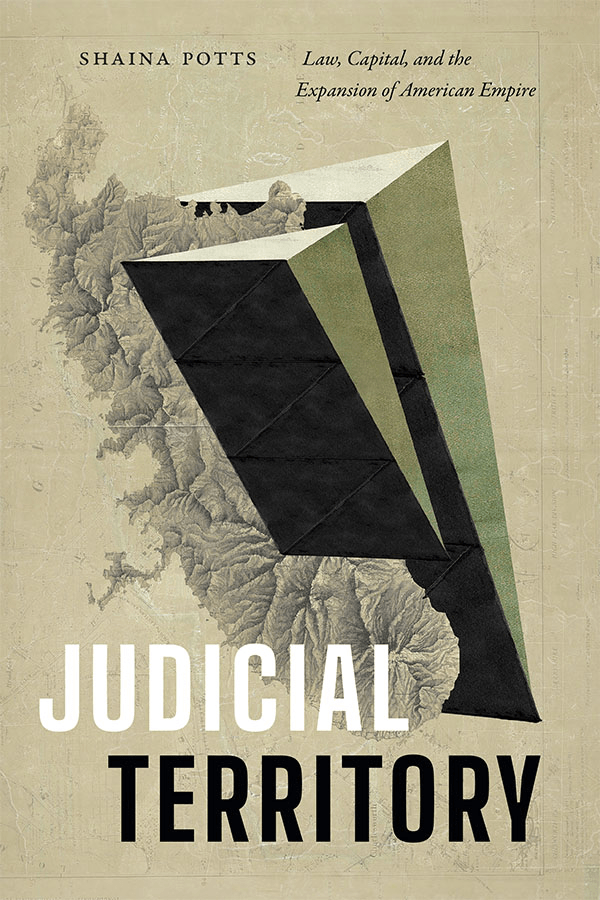
In Judicial Territory, Shaina Potts reveals how the American empire has benefited from the post-World War II expansion of United States judicial authority over the economic decisions of postcolonial governments. Introducing the term “judicial territory” to refer to the increasingly transnational space over which US courts wield authority, Potts argues that law is an essential tool for US geopolitical and economic interests. Through close examination of cases involving private US companies, on the one hand, and foreign state-owned enterprises, nationalizations, and sovereign debt, on the other, she shows that technical changes relating to the treatment of foreign sovereigns in domestic US law allowed the United States to extend its purview over global financial and economic relations, including many economic decisions of foreign governments. Throughout, Potts argues, US law has not become divorced from territoriality but instead actively remapped it; it has not merely responded to globalization, but actively produced it—making the whole world part of US economic space in the process.
This book provides interdisciplinary perspectives on the work of the Japanese writer Haruki Murakami, with a particular focus on the conceptual material of his work. It seeks to answer the following questions: Is there any philosophic material or concepts in the work of Haruki Murakami? If so, why are they important? Does philosophic engagement add anything to the Murakami research field? Equally, does Murakami’s fiction present us with anything valuable for the field of philosophy?
The volume uniquely develops the field of Murakami studies through acting as a forum for interdisciplinary researchers to share their perspective on his work. Importantly, it furthers the conversation on Murakami’s philosophic value and through doing so, is a must-read not only for those interested in Japanese literature or culture, but also for those interested in the productive space existing at the intersection of philosophy, literature, and psychoanalysis.
A decisive analytic critique of US foreign policy by one of America’s greatest historians
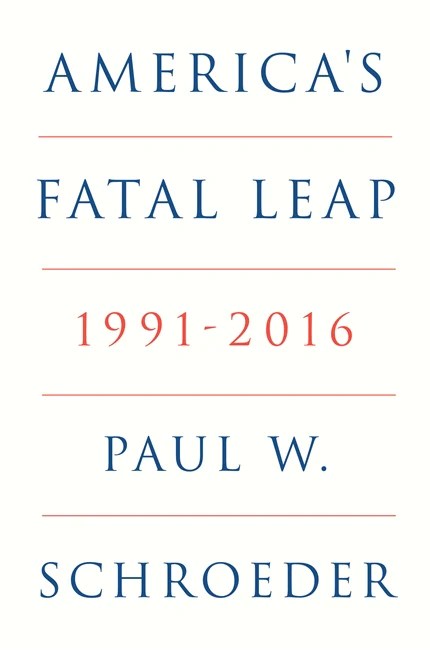
America’s Fatal Leap deconstructs US geopolitics after the end of the Cold War, informed by its author’s unsurpassed command of modern history. Paul W. Schroeder, an acclaimed historian of international diplomacy, was a conservative and a natural supporter of American leadership in the world. But he wrote scathing op-eds for the National Interest and the American Conservative about the hubris and moral failings of the War on Terror, warning of damaging long-range effects on the international system. Schroeder compared 9/11 to the assassination in Sarajevo that sparked the First World War, insisting that a great power should never give terrorists a war they wanted. He wrote with extraordinary prescience – months before the US launched its attack on the Taliban – of the ‘risks of victory’ in Afghanistan, characterised the war in Iraq as a failed bid for informal empire, and called for ‘disimperialism’ in the Middle East.
America’s Fatal Leap collects Schroeder’s remarkable interventions on America’s adventurism in the Middle East, from the 1991 Gulf War to the Surge of 2007. It includes an Introduction by Perry Anderson, author of US Foreign Policy and Its Thinkers and Ever Closer Union?
Stand-out theoretical and empirical explanation of the origins of the First World War by one of the great historians of international diplomacy
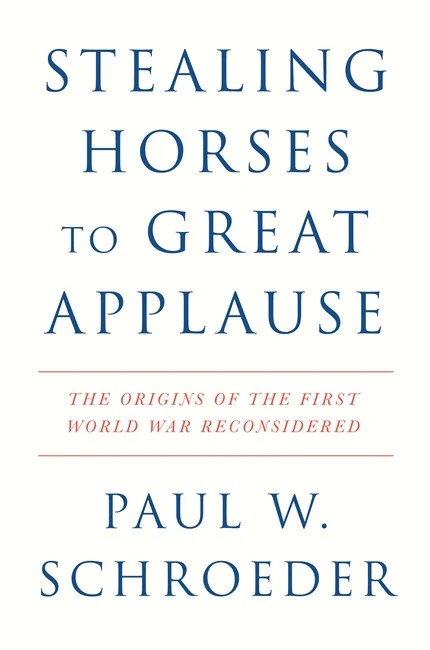
Stealing Horses presents arguably the finest considerations yet of the origins of the First World War. Breaking with accounts which focus on the actions of a single state or the final countdown to hostilities, Paul W. Schroeder describes the systemic crisis engulfing the Great Powers. They were more interested in colonial plunder overseas (‘stealing horses to great applause’, in the old Spanish adage) than the traditional statecraft of European peace-making. Preserving the balance of power required preserving all the essential actors in it, including a tottering Austria-Hungary. This the British in particular failed to recognise. The Central Powers may have started the War but that does not mean they in any real sense caused it. In the end Schroeder recalls the verdict of Shakespeare’s Romeo and Juliet: ‘All are punished’.
Stealing Horses includes appraisals of Niall Ferguson and A. J. P. Taylor, and an extensive unpublished final paper re-thinking the First World War as ‘the last 18th-century war’.
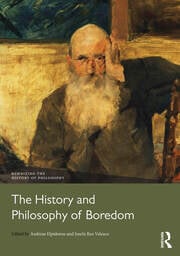
From Lucretius’s horror loci and Buddhist drowsiness to the religious boredom of acedia and the philosophical explorations of Kant, Schopenhauer, Kierkegaard, and Heidegger, boredom has long been a subject of philosophical fascination. Its story, unfolding through millennia, encompasses apathy, weariness, disaffection, melancholy, ennui, tedium, and monotony. Today, boredom assumes new forms: the drudgery of precarious work, the alienation of neoliberalism, the emptiness of leisure, and the overstimulation of our hyperconnected, technologically saturated lives.
The History and Philosophy of Boredom is an outstanding collection, exploring boredom’s intellectual history from its early origins in classical thought to its contemporary manifestations. Containing eighteen specially commissioned chapters by an international team of contributors, the volume is organized into four thematic parts:
Ancient Philosophical Perspectives
Religious and Medieval Explorations
Modern Philosophical Investigations
Critical and Interdisciplinary Approaches
Topics include boredom in Socratic dialogue, Daoist and Buddhist traditions, Stoicism, and Cynicism; the religious significance of boredom in Judaism and early Christianity; boredom’s role in the works of Kant, Kierkegaard, Schopenhauer, Mill, and Nietzsche; philosophical pessimism; phenomenological approaches; boredom as a political phenomenon; and boredom’s intersections with capitalism, socialism, racial identity, and transhumanism.
The History and Philosophy of Boredom is indispensable for students and researchers in the history of philosophy, emotion studies, phenomenology, and moral psychology. It will also interest scholars in religion, classics, sociology, and the history of psychology.
Henry Somers-Hall and Jeffrey A. Bell (eds.), The Deleuzian Mind – Routledge, May 2025
Gilles Deleuze was one of the most influential philosophers of the second half of the twentieth century. As with other French philosophers of his generation, such as Jacques Derrida and Michel Foucault, Deleuze’s work and his collaboration with Félix Guattari has also had huge influence in other disciplines, particularly literature, film studies, architecture, and science and mathematics.
The Deleuzian Mind is an outstanding collection that explores the full extent and significance of Deleuze’s work, its reception and its legacy. Comprising 38 chapters written by an international and interdisciplinary team of contributors, the volume is divided into eight clear parts:
Situating Deleuze
A New History of Philosophy. Deleuze’s Precursors
Encounters Critical and Clinical
The Early Philosophy. A Logic of Sense
The Later Philosophy. The Wasp and the Orchid
Art and Literature
Deleuze, Maths and Science
Deleuze and Politics.
With its wide-ranging exploration of Deleuze’s thought and the huge influence it continues to have within the theoretical humanities and social sciences, The Deleuzian Mind is invaluable reading for students, researchers and scholars in philosophy, literature, film studies and political theory.
Josué V. Harari plays a small but important role in the story of Foucault in the United States. A PhD researcher at the University at Buffalo when Foucault visited in the early 1970s, he went on to edit a 1979 volume of essays, Textual Strategies: Perspectives in Post-Structuralist Criticism, in which Foucault’s essay “What is an Author?” appeared. Although it claims to be the lecture Foucault gave in Buffalo in 1970, it is rather an edited version of the 1969 Paris version of that lecture, with some Buffalo material added at the end (see here). The full version of the Buffalo text has been found, both Foucault’s notes and a transcription of a recording, and is due to be published. Textual Strategies also includes essays by Barthes, de Man, Derrida, Girard, Said, Serres and others. Out of print, it is easily available online. While less significant than, for example, The Structuralist Controversy a decade before,it was certainly a moment in the North American reception of “French Theory”. Harari was also one of the editors, with David F. Bell, of the original English selection of Michel Serres’s essays, Hermes: Literature, Science, Philosophy, in 1982.
In 1971, Harari had also published an 82-page reading guide, Structuralists and Structuralisms: A Selected Bibliography of French Contemporary Thought (1960-1970). It was dedicated to Eugenio Donato and René Girard, and appeared as a separate publication by the important Diacritics journal. It does not seem to be available online and is long out of print. But it’s easy to get a copy second-hand, and it’s in quite a few libraries, suggesting it circulated quite widely. As a guide rather than a text itself, it’s hard to track its influence through citations, since it is more likely to have been used to indicate other texts to read or reference. But in a pre-internet age, guides like this would likely have been invaluable. It has 1275 entries, across a wide range of disciplines, including reviews, and a useful author and periodical index. Harari says of the guide:
Thus this bibliography is introductory rather than definitive, analytical and selective rather than encyclopedic. It offers the best works of French contemporary thought in the humanities, philosophy and the sciences of man. We hope it will be useful to the specialist as well as to the beginner, to the scholar as well as to the student (p. 3).
As Jonathan Culler indicates (“1980: Structuralism and Poststructuralism”, pp. 80-81), most of the authors discussed by Harari as structuralists in 1971 reappear as poststructuralists in his 1979 collection – an indicator of the fluidity of the terms, and the changing work of the key figures involved, but also that what was called “poststructuralism” was largely a US-invention (see also Angermuller, Why There is no Poststructuralism in France).
The other point at which Harari is important to the story of Foucault is that the Foucault’s two-part Buffalo lecture on the Marquis de Sade, published in La Grande étrangère, was transcribed by Harari from a recording, and sent to Foucault. The typescript was found in Foucault’s papers after his death, included in the French collection, and translated in Language, Madness and Desire. As I’ve indicated here, and will discuss in more detail in a forthcoming piece in Foucault Studies,the two Sade lectures were part of a course Foucault delivered at Buffalo in 1970. Given in French, the course was advertised in English as “The desire for knowledge or the phantasms of knowledge in French literature in the nineteenth and twentieth centuries”. It also included lectures on Balzac, Flaubert, and possibly Jules Verne, Bataille and Blanchot. (The Balzac and Flaubert manuscripts are included in Madness, Language, Literature.) Outside the French focus, one or two Nietzsche lectures given in Buffalo were also part of the course. The introductory lecture and the first of the Sade lectures exist as audio recordings in the Buffalo archives. Given the transcription, it seems at least the second Sade lecture was also recorded, but if it still exists, I do not know where that is. My guess, unfortunately, is that the tapes – much more expensive in those days – were reused.
Interestingly, Harari’s PhD thesis was on Sade, submitted in December 1973. It’s a short text entitled Les métamorphoses du désir dans l’oeuvre de Sade. It was not easy to find a copy (Worldcat suggests just three libraries have it). Eventually I was able to get the microfilm version by inter-library loan while I was visiting New York University.
Textual Strategies, Structuralists and Structuralisms, Les métamorphoses du désir dans l’oeuvre de Sade
Chapter 2 of the thesis was translated by Hélène Pellegrin and published that same year in MLN (Modern Language Notes). While a close reading of texts by Sade, around incest and exogamy, it discusses broader philosophical questions, with references to Barthes, Bataille, Clastres, Deleuze, Girard, Mauss and, especially, Lévi-Strauss, among others. There is no mention of Foucault, but the article does contain a striking formulation, especially given the topic of Foucault’s Buffalo course:
In Western intellectual history, de Sade was the first to address himself to the notion that desire and knowledge, far from being mutually exclusive, are indissolubly linked; for him, there cannot be any real knowledge without desire (p. 1214).
Indeed, the thesis itself has a note on the final page which acknowledges how important Foucault was to his approach, and especially the Buffalo lecture Harari had taken the trouble to transcribe for Foucault.
Nous empruntons la trame générale de l’argumentation qui va suivre à Michel Foucault. Dans une très belle conférence inédite à ce jour, Michel Foucault avait cherché à montrer les rapports complexes entre l’existence irrégulière du libertin et le principle quadruple d’une quadruple inexistence—celle de Dieu, la loi, la nature et l’âme—que le libertin pose à chaque Instant dans tous ses discours et à partir de laquelle il se définit (p. 125 n. 28).
We borrow from Michel Foucault the general framework of the following argument. In a very beautiful and still unpublished lecture, Michel Foucault aimed to show the complex relationship between the irregular existence of the libertine and the quadruple principle of a quadruple inexistence—that of God, the law, nature and the soul—which the libertine poses at every moment in all his discourse and from which he defines himself.
The MLN article led to an exchange with Jane Gallop in 1974, who published her own book on Sade, read through Georges Bataille, Maurice Blanchot, and Pierre Klossowski, in 1980.
Harari taught at Stanford during his PhD, then in Romance Studies at Cornell University, at Johns Hopkins University, and finally at Emory University. He was chair of French at Johns Hopkins before moving to Emory, where he chaired the French and Italian department. In 1979 Harari published a study of the French Enlightenment, Scenarios of the Imaginary. In that book he says that “the master thinkers of contemporary theory—Derrida, de Man, Lacan, Foucault—appear only in the margins of my work” (p. 36 n. 20).
A decade after his thesis, Harari wrote an article on Sade again, but also published on another book Foucault covered in his 1970 Buffalo course, Balzac’s Quest for the Absolute. In a note to his essay, “The Pleasures of Science and the Pains of Philosophy”, Harari says: “I am borrowing here from remarks made by Michel Foucault during a seminar on the nature of the relationship between desire and knowledge from Sade to Nietzsche” (p. 154 n. 27). As well as corroborating the claim that Nietzsche was part of this course, it shows the impact Foucault’s teaching in Buffalo had on at least one of his auditors. Harari planned to write a book on Balzac’s Études philosophiques, one of the major divisions of his Comédie humaine,but it seems this was never completed.
Harari’s Balzac essay was published in the year of Foucault’s death, 1984. When Foucault visited Buffalo in 1970 it was his first visit to the United States, when little of his work was translated into English. His election to the Collège de France took place during his first visit. By 1984 he was a thinker of international stature. Harari; Foucault’s main host in Buffalo, John K. Simon, commentators including Edward Said, his early translators, and, a bit later, Hubert Dreyfus and Paul Rabinow, Richard Rorty, Richard Sennett and others, are crucial figures in the shaping of an American Foucault.
(A future post will discuss the short career of Eugenio Donato. Update July 2025: here)
References
Johannes Angermuller, Why There is no Poststructuralism in France: The Making of an Intellectual Generation, London: Bloomsbury, 2015.
Jonathan Culler, “1980: Structuralism and Poststructuralism”, Ex-position 40, 2018, 79-94.
Stuart Elden, “Foucault at Buffalo in 1970 and 1972: The Desire for Knowledge; The Criminal in Literature; and The History of Truth”, Foucault Studies, forthcoming 2025.
Michel Foucault, “What is an Author?”, in J.V. Harari ed., Textual Strategies: Perspectives in Post-Structuralist Criticism, Ithaca: Cornell University Press, 1979, 141-60.
Michel Foucault, La Grande étrangère: À propos de littérature, ed. Philippe Artières, Jean-François Bert, Mathieu Potte-Bonneville and Judith Revel, Paris: Éditions EHESS, 2013; Language, Madness, Desire: On Literature, trans. Robert Bononno, Minneapolis: University of Minnesota Press, 2015.
Michel Foucault, Folie, langage, littérature, ed. Henri-Paul Fruchaud, Daniele Lorenzini and Judith Revel, Paris: Vrin, 2019; Madness, Language, Literature, trans. Robert Bononno, Chicago: University of Chicago Press, 2023.
Michel Foucault, “La connaissance et le désir: Cours donné à l’université de Buffalo (mars-avril 1970)”, Nietzsche, Cours, conférences et travaux, ed. Bernard Harcourt, Paris: Gallimard/Seuil/EHESS, 2024, 109-32.
Jane Gallop, “The Critic’s Exchange [Josué V. Harari, “Exogamy and Incest”], MLN 89 (6), 1974, 1041-45.
Jane Gallop, Intersections: A Reading of Sade with Bataille, Blanchot, and Klossowski, Lincoln: University of Nebraska Press, 1980.
Josué V. Harari, Structuralists and Structuralisms: A Selected Bibliography of French Contemporary Thought (1960-1970), Ithaca: Diacritics, 1971.
Josué V. Harari, Les métamorphoses du désir dans l’oeuvre de Sade, unpublished PhD thesis, State University of New York at Buffalo, 1973.
Josué V. Harari, “Exogamy and Incest: De Sade’s Structures of Kinship”, trans. Hélène Pellegrin, MLN 88 (6), 1973, 1212-37.
Josué V. Harari, “Reply to Ms. Jane Gallop”, MLN 89 (6), 1974, 1046-48.
Josué V. Harari, Scenarios of the Imaginary: Theorizing the French Enlightenment, Ithaca: Cornell University Press, 1979.
J.V. Harari ed., Textual Strategies: Perspectives in Post-Structuralist Criticism, Ithaca: Cornell University Press, 1979.
Josué Harari, “Sade’s Discourse on Method: Rudiments for a Theory of Fantasy”, MLN 99 (5), 1984, 1057-71.
Josué Harari, “The Pleasures of Science and the Pains of Philosophy: Balzac’s Quest for the Absolute”, Yale French Studies 67, 1984, 135-63.
Richard Macksey and Eugenio Donato (eds.), The Structuralist Controversy: The Languages of Criticism and the Sciences of Man, Baltimore: Johns Hopkins University Press, 1972 [1970. Originally published with title and subtitle reversed].
Michel Serres, Hermes: Literature, Science, Philosophy, eds. Josué V. Harari and David F. Bell, Baltimore: Johns Hopkins University Press, 1982.
Archives
University at Buffalo special collections – material relating to Foucault’s 1970 and 1972 visits, including audio files (see fuller references here)
Johns Hopkins University, Office of Public Information/News and Information records, RG-10-020, box 12-1a, Josué Harari
This is the twenty-fourth post of a weekly series, where I post short essays with some indications of further reading and sources, but which are not as formal as something I’d try to publish more conventionally. They are usually tangential to my main writing focus, a home for spare ideas, asides, dead-ends and possible futures. I hope there is some interest in them. They are provisional and suggestions are welcome.