An interdisciplinary seminar on structuralism was held in France in September 1970. Attended by a wide range of speakers, it was an interesting moment in the French reception of this trend in ‘French theory’. Back in October 2022 I posted a short account of this event, and said I was looking for more information. What follows is a revised and expanded account of this event, based on the sources I’ve been able to identify since.
I wrote about the much more famous 18-21 October 1966 Baltimore conference on structuralism in a previous piece in this series.
Founded after the Second World War, the Institut collégial européen organised a series of events, most of which were reported in their annual Bulletin. The literary historian Gilbert Gadoffre led the Institut, which was initially based at the Royaumont abbey north of Paris – a place which hosted a lot of philosophy colloquia among other events. In the immediate aftermath of the Second World War, it played an important role in bringing academics across Europe back together in scholarly discussion. Much later, the Institut was described as operating “on the margins of official institutions” and “less concerned with the conservation of a heritage than towards the breaking down of barriers between disciplines, cultures and traditions” (La Culture comme projet de société, p. 5). M.A. Screech’s obituary of Gadoffre, who died in 1995, or Derek Robbin’s longer tribute from 2024, give a sense of an extraordinary life. He was injured and captured in the Battle for France, briefly a prisoner of war, before playing an active role as a resistance fighter. He worked in the French zone of occupied Austria after the Allied victory. From 1947 to 1954 Gadoffre spent about half of each year at Royaumont organising courses and events.
Gadoffre had taught at the University of Manchester before the war, and returned there in 1954, before a few years at Berkeley in the mid-1960s, and then returning to Manchester for a third time as Professor of French in 1967. He was an inveterate organiser and editor, continuing the work begun at Royaumont. In September 1970, jointly with the Collège de France’s Séminaire interdisciplinaire, the Institut organised this event on structuralism. Alongside Gadoffre the other organisers of this event were André Lichnerowicz, who held a chair in mathematical physics at the Collège de France from 1952, and the economist François Perroux, who also had a chair at the Collège de France.
The structuralism event was held at the Institut national des sciences et techniques nucléaires in Saclay, about 20 km southwest of Paris. The event had some funding from the Ministre de l’Education nationale, with Lichnerowicz requesting 10,000 francs on 28 March 1969 to organise the event. The Archives Nationales records for this indicate that the working title for the event was “Le structuralisme devant la sciences”.
The event was attended by a range of interesting people including Suzanne Bachelard, Pierre Bourdieu, Georges Canguilhem, Michel Foucault, André Martinet, Jacques Monod, Clémence Ramnoux, Michel Serres, Gilbert Simondon and René Thom. As the list of names indicates, it was a genuinely interdisciplinary event, with mathematicians, physicists, and biologists alongside the social scientists, philosophers and humanities scholars. But the names invited are not just those of the obvious ‘structuralists’, and several of those associated with this notional movement were not there, including Louis Althuser, Jacques Lacan and Claude Lévi-Strauss. Roland Barthes was invited but according to Gadoffre, after dithering for a while, declined (Gilbert Gadoffre, un humaniste révolutionnaire, p. 147).
The Bibliothèque nationale de France has a collection of the Institut collégial européen Bulletins, and the catalogue says they have 1966-1982 inclusive, but the sequence actually runs 1966-1969, 1971-1974, 1976-1982. There is no bulletin for 1970 in the Bibliothèque nationale collection, and I’ve not been able to find a copy elsewhere. It appears that no bulletin was published for that year. The bulletins were generally reproduced typescripts, not formal books, so it is possible one did appear which I’ve been unable to locate. (The Arsenal library listing has 1972-1976, though I’ve not checked there if they have one for 1975.)
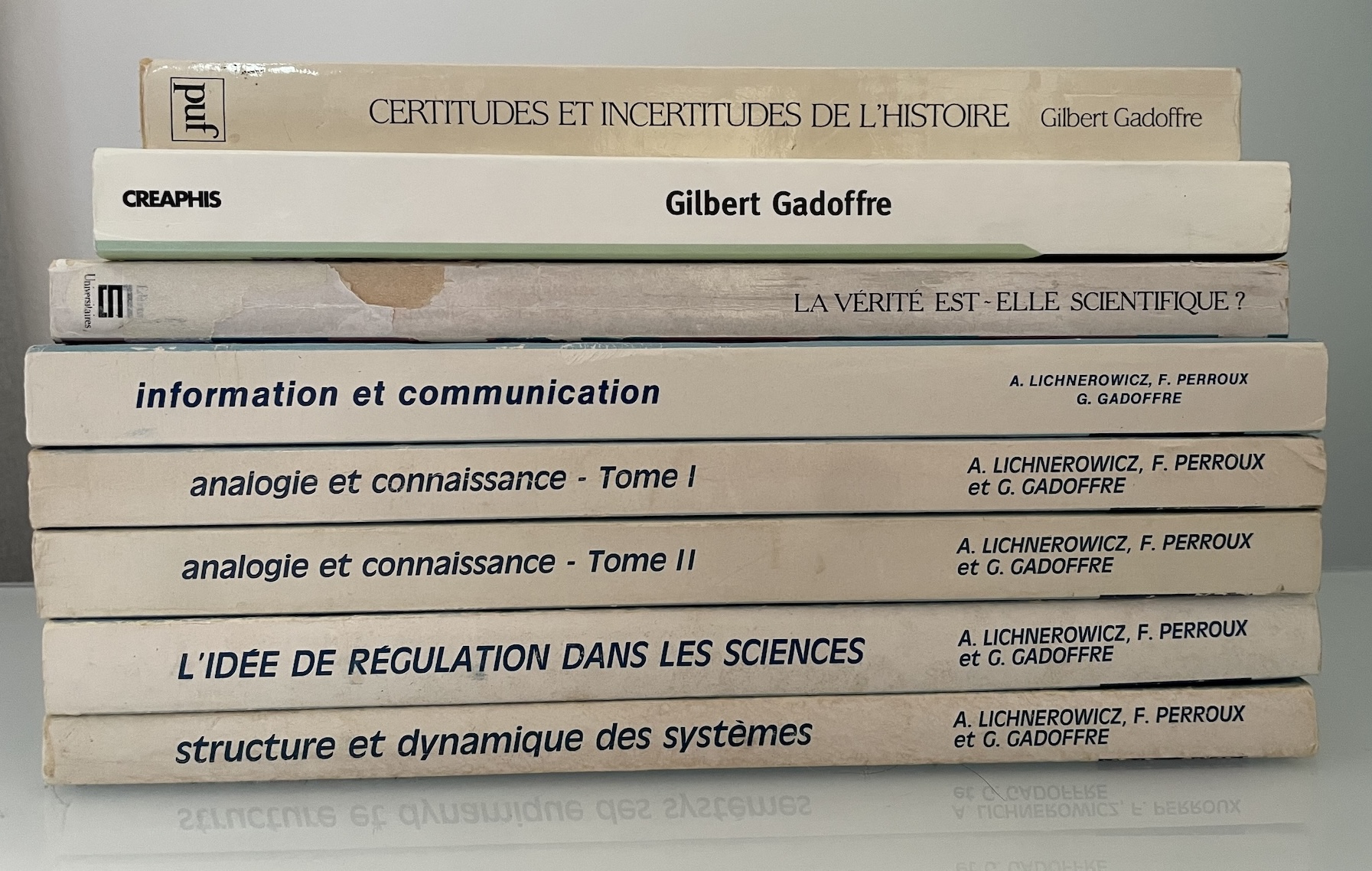
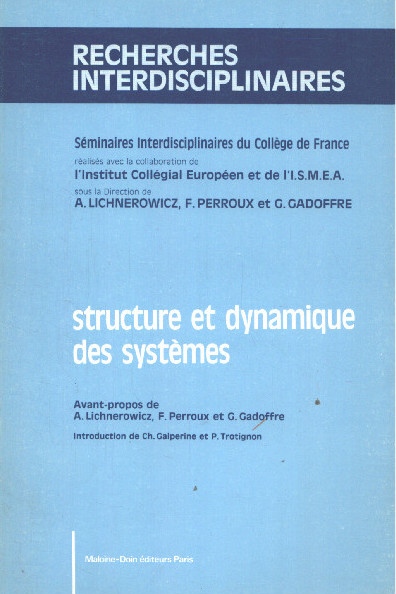
The 1970 event was discussed in Le Monde by Gadoffre on 29 October 1970. The event was used to launch a series of conversations on the question of structuralism, some papers of which were published in an edited volume on Structure et dynamique des systèmes in 1976. This volume is not hard to find second-hand, as are several of the subsequent books in the Recherches Interdisciplinaires series, which report on ongoing conversations. There were ones on L’idée de régulation dans les sciences, Analogie et connaissance, Information et communication, and Projet et programmation, among others. Pierre Delattre had published his own study Système, structure, fonction, évolution in the series in 1971, with a preface by Lichnerowicz.
Structure et dynamique des systèmes includes a summary of the 1970 event on structuralism, made by André Malan, but not most of the papers from that event. Malan’s summary gives the title “Sciences, Structures, Structuralisme”. There are also some papers which may be from the event in the volume, notably ones from André Martinet and René Thom. Malan however gives a good survey of what happened. He summarises the way structure is understood by mathematicians, physical scientists, and biologists, based on presentations at the event, before summarising how it is understood across the exact sciences. He then moves to the way that the history of sciences might complicate the present-day understandings being presented. He then shifts to ‘structuralism’ in the human sciences, linguistics, sociology, anthropology, economics, mythology, and modern literature.
From the way Malan reports Foucault’s contribution (pp. 177-78), it seems it was very close to a part of lecture he gave at Keio University in Tokyo in October 1970, which was published in Japan in 1972 and is included in Dits et écrits as “Révenir à l’histoire” (also available online) and translated in Essential Works as “Return to History”. There is a manuscript which looks like this lecture in Foucault’s archive at the Bibliothèque nationale de France (NAF28730, box 70, folder 2). In the Japanese version of the lecture, Foucault discusses both the Annales school, particularly Pierre and Huguette Chaunu’s mammoth Séville et l’Atlantique, and Georges Dumézil. Foucault suggests there are parallelsbetween a structuralist analysis of change and “historical analyses of types of events and types of duration” (“Révenir à l’histoire”, 280; “Return to History”, 430). He adds that what is called structuralism and contemporary debates in history provide “theoretical instruments by means of which one can – contrary to the old idea of continuity – really grasp both the discontinuity of events and the transformation of societies” (“Révenir à l’histoire” 280-81; “Return to History”, 430-31).
From Malan’s report it is clear that Foucault mainly spoke about the work of Dumézil at Saclay, which I have discussed before, especially in “Foucault and Dumézil on Antiquity”. Foucault takes as his example Dumézil’s 1942 book Horace et les Curiaces, which examines the Roman legend of the fight between three Horatii and three Curiatii. (The main classical sources are Livy, Ab urbe condita, Book 1, 24-26 and Dionysius of Halicarnassus, Roman Antiquities, III, 14-22.)Dumézil examines parallels between this story and other mythic traditions, particularly the story of Cú Chulainn in Ireland. Foucault is particularly interested in the way that Dumézil does not just look at resemblances between myths, as the older comparative mythology did, but rather analyses them within a “system of differences”. Foucault, as reported by Malan, suggests that this approach to myth is “much more rigorous than that used by Jung in his research on archetypes” (p. 177). This is for two reasons – Dumézil works with a corpus defined in advance, whereas Jung is less limited in his comparison; and Jung works with the external discipline of psychoanalysis, whereas Dumézil is working internally with the elements in the ensemble itself (pp. 177-78).
Malan also reports on André Martinet’s contribution to the Saclay event. He indicates that the use of the term ‘structure’ in several other disciplines is due to its technical usage in linguistics, which he traces from Saussure to the phonological manifesto of Nikolai Trubetzkoy and Roman Jakobson in 1928, as part of the work of the Prague Linguistic Circle. But the different sense of the term ‘structure’ can also be found in linguistics itself. He stresses linguistics sees both a “functional and structural” role in language, with a balance between function, which in language is primarily communication, and the structure, which sets the other elements in relation – experience, state of mind, and speaker. “This conception is structural, because for phonologists, language is a structured system in which everything fits together” (p. 178). Martinet then moved to discuss Louis Hjelmslev’s attempt to eliminate diachrony, though he considers this a failed project. Martinet recognises that the American story of structuralism in linguistics, from Bloomfield to Chomsky, runs on a different trajectory (pp. 179-80).
The discussions moved to sociology, presented by Bourdieu (pp. 180-81), the way Lévi-Strauss brought a linguistic model into anthropology for the study of kinship, and later myths (pp. 181-82) and the use of models in economics (pp. 182-84). The discussion of mythology here seems to have been informed by contributions by Ramnoux (who I write about here) and the anthropologist and ethnologist Jean Guiart (pp. 185-86). Interestingly, the example Ramnoux gives is not from Greek myth, but Dumézil’s analysis of the five Pandava brothers from the Mahabharata, which he argues, following a reading by Stig Wikander, are semi-historicised versions of five deities. With literature, the example is Jakobson and Lévi-Strauss’s analysis of Baudelaire’s “Les Chats”. Malan adds:
One could respond with Umberto Eco that it is necessary to distinguish here several types of structuralism: a methodological structuralism, practiced by scholars; an ontological structuralism, based on faith in a transcendental model, excluding diachrony; and finally, a genetic structuralism, accepting the diachronic dimension for either political (Marxism) or cultural reasons (p. 186).
Gadoffre brough in the example of Jean Starobinski’s analyses of stylistics, and the relation between an analysis he calls a “dry criticism”, where the model used to analyse the work distances itself from it, and “a more nuanced criticism, which does not allow the work to be reduced to the models used to explain it” (p. 186).
Georges Canguilhem provided some conclusions to the event. In my 2024 article “Canguilhem, Dumézil, Hyppolite” I discuss this.
[Canguilhem] notes that it is important to distinguish uses of the term structuralism, from a popular term “which few academics would claim, not even Michel Foucault”; from some “serious, methodological research carried out within universities (Dumézil, Lévi-Strauss, Martinet)”, and its use in contexts “outside the university, sometimes anti-university, expressed in literary journals and used as a polemical weapon”. Canguilhem recognises that it is “opposed to the primacy of the subject”, but qualifies its relation to history, suggesting that for Foucault at least there is “a historical succession, but with ruptures”. Most importantly, perhaps, he distinguishes between determinism and structuralism. It is clear that Canguilhem finds some affinities between this way of understanding structuralism – in part in relation to Foucault, but also to Dumézil, Lévi-Strauss and Martinet – and his own work. Foucault’s complicated relation to structuralism is becoming clearer in the light of newly available sources; Canguilhem’s perhaps remains to be fully explored (p. 44; the quotes are from Malan, “Colloque de Saclay”, p. 188).
Lichnerowicz’s conclusions to the seminar suggest that it is important to distinguish between mathematical structures and what he calls “(non-naïve) structures concerning fields of the real” (Malan, p. 189). Lichnerowicz also marked the ways that linguistics made a distinction between structure (i.e. the synchronic) and the diachronic. He thought a distinction needed to be made between “scientific structuralism” and “a marginal structuralism endowed with a disturbing emotional power (this involves both a fashionable factor and a form of pseudo-scientific terrorism)”. In thinking about the “scientific approach within the humanities”, this raised for this mathematician some important considerations:
At the same time, we must affirm the unity of the ambition of scientific thought. There is a serious danger in taking refuge between the specificity of empirical facts and historical differences between disciplines. The human sciences are not unique simply because they deal with humanity, which does not preclude the existence of particular obstacles. No one is obliged to claim to be a scientist, but whoever does must recognise its unity and accept its imperatives (p. 190).
It is regrettable that we only have Malan’s summary of the event, and that the words may not be what was said at the time. But it is an interesting insight into a debate in which these different disciplines were at least trying to speak to each other.
Since I wrote “Canguilhem, Dumézil, Hyppolite” and “Foucault and Dumézil on Antiquity”, Daniele Lorenzini asked me to write a piece on “Foucault and Structuralism”, for The Foucauldian Mind collection he edited. My analysis there builds on the work I did for my series of books on Foucault, especially The Archaeology of Foucault. The Saclay event is interesting for this story because it is one of the few times Foucault was willing to be associated with debates around structuralism. Later that year, in early December, in his inaugural lecture to the Collège de France, Foucault had outlined his own project and then said: “And now let those with limited vocabularies, the aphasiacs of theory, say – if they prefer its sound to its meaning – that this is structuralism” (Leçon inaugurale, p. 32). Perhaps recognising the inappropriateness of the metaphor, the more widely circulated Gallimard version of this text, L’Ordre du discours, removes the line about aphasia (p. 72). Foucault’s comment in the English preface to The Order of Things about the ignorance of associating him with structuralism is well-known and dates from the same year (p. xiv). I say a bit more about how Foucault responded to J.M. Pelorson on this point here.
The interdisciplinary seminar series is discussed in a dialogue between Gadoffre and his wife Alice Gadoffre-Staath (Gilbert Gadoffre, un humaniste révolutionnaire, pp. 144-49). That led me to her own De la résistance à l’Europe, where in Chapter XI she discusses the Institut – after a substantial first part on her Resistance activities. Other sources are not as useful as I’d initially hoped. Gadoffre published a collection of papers from three events on history held by the Institut collégial européen, Certitudes et incertitudes de l’histoire. I read the subtitle as histories of the Institut, but these are less interdisciplinary than other volumes and more a set of reflections on history and historiography. There are contributions by Philippe Ariès, Emmanuel Le Roy Ladurie, and Arnaldo Momigliano, and a preface by Pierre Chaunu. A better source for the history is the Festschrift for Gadoffre, edited by Yves Bonnefoy, Lichnérowicz and M.-P. Schützenberger (eds.), Vérité poétique et verité scientifique: Offert à Gilbert Gadoffre. This has a series of short pieces in the first part on the history of the Institut. This volume includes a bibliography of Gadoffre’s work, but it doesn’t indicate the reports of the Institut collégial européen. In the edited works it mentions Certitudes et incertitudes de l’histoire, but not the interdisciplinary seminars produced from their events.
References
Yves Bonnefoy, André Lichnerowicz, and M.-P. Schützenberger (eds.), Vérité poétique et verité scientifique: Offert à Gilbert Gadoffre, Paris: Presses Universitaires de France, 1989.
Pierre and Huguette Chaunu, Séville et l’Atlantique (1504–1650), Paris: SEVPEN, 12 volumes, 1955-60.
Pierre Delattre, Système, structure, fonction, évolution: Essai d’analyse épistémologique, Paris: Maloine-Doine, 1971.
Georges Dumézil, Horace et les curiaces, Paris: Gallimard, 1942.
Stuart Elden, The Archaeology of Foucault, Cambridge: Polity, 2023.
Stuart Elden, “Canguilhem, Dumézil, Hyppolite: Georges Canguilhem and his Contemporaries,” Revue internationale de philosophie 307, 2024, 27-48.
Stuart Elden, “Foucault and Dumézil on Antiquity”, Journal of the History of Ideas 85 (3), 2024, 571-600.
Stuart Elden, “Foucault and Structuralism”, The Foucauldian Mind, ed. Daniele Lorenzini, London: Routledge, forthcoming 2026.
Michel Foucault, “Foreword to the English Edition”, The Order of Things: An Archaeology of the Human Sciences, New York: Pantheon, 1970, ix-xiv.
Michel Foucault, Leçon inaugurale faite le Mercredi 2 décembre 1970, Paris: Collège de France, 1971; revised version as L’Ordre du discours, Paris: Gallimard, 1971. (On the differences, see here.)
Michel Foucault, “Révenir à l’histoire”, in Dits et écrits, eds. Daniel Defert and François Ewald, Paris: Gallimard, 1994, Vol II, 268-81; “Return to History”, trans. Robert Hurley, in Essential Works Volume Two: Aesthetics, Method, and Epistemology, ed. James D. Faubion, New York: The New Press, 1998, 419-32.
Gilbert Gadoffre (ed.) Certitudes et incertitudes de l’Histoire: trois colloques sur l’Histoire de l’Institut collégial européen, Paris: Presses Universitaires de France, 1987.
Gilbert Gadoffre (ed.) La Culture comme projet de société: Un colloque interdisciplinaire, Loches: Éditions Universitaires, 1991.
Gilbert Gadoffre and Alice Gadoffre-Staath, Gilbert Gadoffre, un humaniste révolutionnaire: Entretiens avec Alice Gadoffre-Staath, Grâne/Paris: Créaphis, 2002.
Alice Gadoffre-Staath, De la resistance à l’Europe, Montpellier: Éditions Espaces, 1994.
André Lichnerowicz and Gilbert Gadoffre (eds.), La Vérité est-elle scientifique? Séminaire interdisciplinaire du Collège de France, [Paris]: Editions Universitaires, 1991.
A. Lichnerowicz, F. Perroux and G. Gadoffre eds. Structure et dynamique des systèmes, Paris: Maloine, 1976.
A. Lichnerowicz et al, L’idee de regulation dans les sciences, Paris: Maloine, 1977.
A. Lichnerowicz, F. Perroux and G. Gadoffre eds. Information et communication, Paris: Maloine, 1983.
A. Lichnerowicz, F. Perroux and G. Gadoffre, Analogie et connaissance: séminaires interdisciplinaires, Paris: Maloine, two volumes (“Aspects historiques” and “De la poésie à la science”), 1980-81.
A. Lichnerowicz, F. Perroux and G. Gadoffre eds. Projet et programmation, Paris: Maloine, 1986.
Daniele Lorenzini ed. The Foucauldian Mind, London: Routledge, forthcoming 2026.
André Malan, “Colloque de Saclay”, in Structure et dynamique des systèmes, ed. A. Lichnerowicz, F. Perroux and G. Gadoffre, Paris: Maloine, 1976, 165-90.
Derek Robbins, “Gilbert Gadoffre: Institutionalising Cultural Reproduction”, in Stuart Jones (ed.), Manchester Minds: A University History of Ideas, Manchester: Manchester University Press, 2024, 279-296.
M. A. Screech, “Obituary: Professor Gilbert Gadoffre”, The Independent, 25 March 1995, https://www.independent.co.uk/news/people/obituary-professor-gilbert-gadoffre-1612725.html
Archives
Archives nationales, Education nationale: Mission des relations internationales (1973), Institut collégial européen, 19770555/3, F.17 bis 18582
Bulletin – Institut collégial européen, 1966-1969, 1971-1974, 1976-1982, https://catalogue.bnf.fr/ark:/12148/cb34415955s
Fonds Gilbert Gadoffre, Université Gustave Eiffel, https://cipen.univ-gustave-eiffel.fr/fonds-gadoffre
Fonds Michel Foucault, NAF 28730, Bibliothèque nationale de France
This is the 61st post of a weekly series, posted every Sunday throughout 2025, and so far each week in 2026. The posts are short essays with indications of further reading and sources. They are not as formal as something I’d try to publish more conventionally, but are hopefully worthwhile as short sketches of histories and ideas. They are usually tangential to my main writing focus, a home for spare parts, asides, dead-ends and possible futures. I hope there is some interest in them. They are provisional and suggestions are welcome. A few, usually shorter, pieces in a similar style have been posted mid-week. I’m not sure I’ll keep to a weekly rhythm in 2026, but there will be at least a few more pieces.
The full chronological list of ‘Sunday histories’ is here, with a thematic organisation here.
[post above updated to correct the misspelling of Simondon’s name.]