
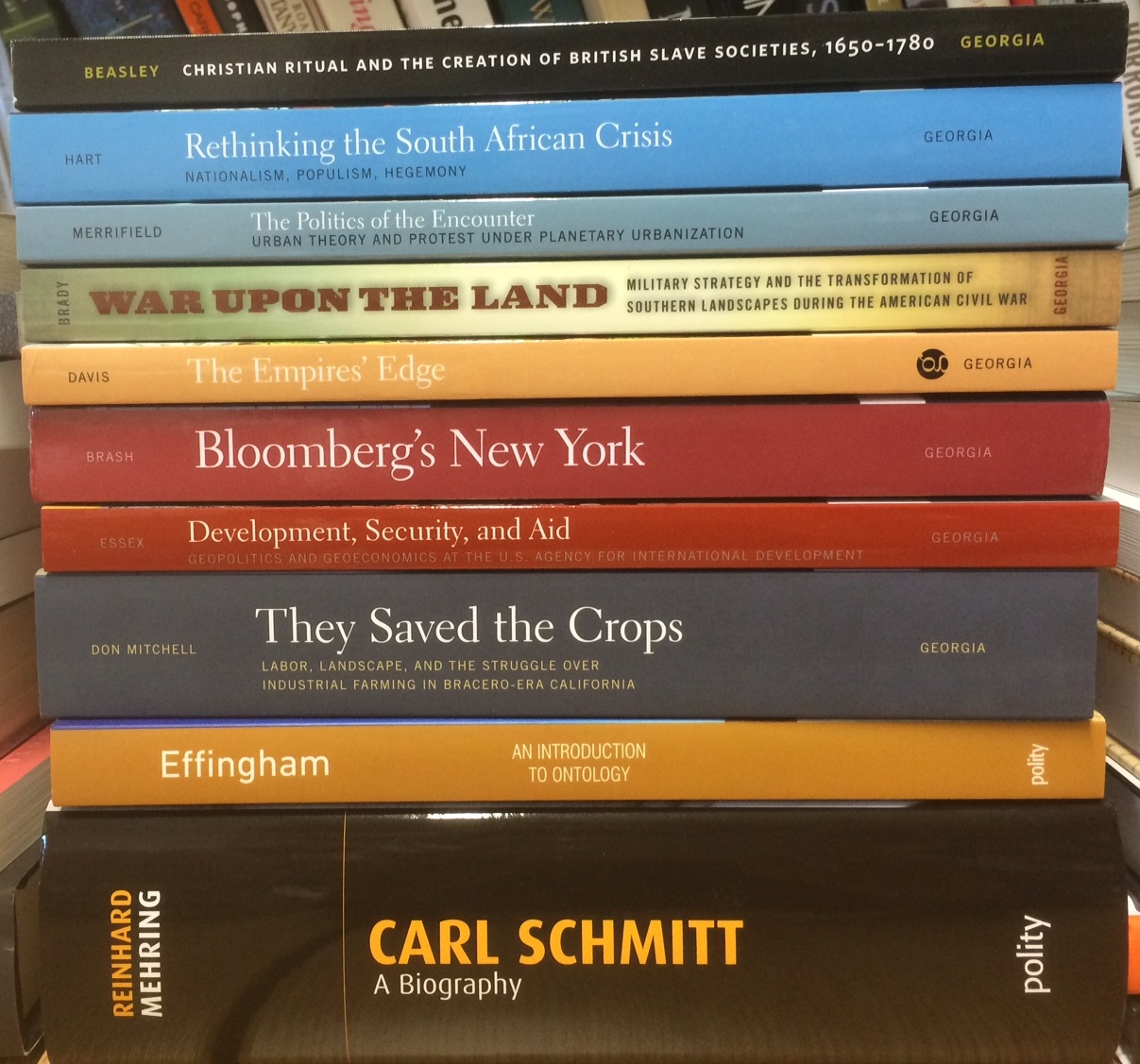
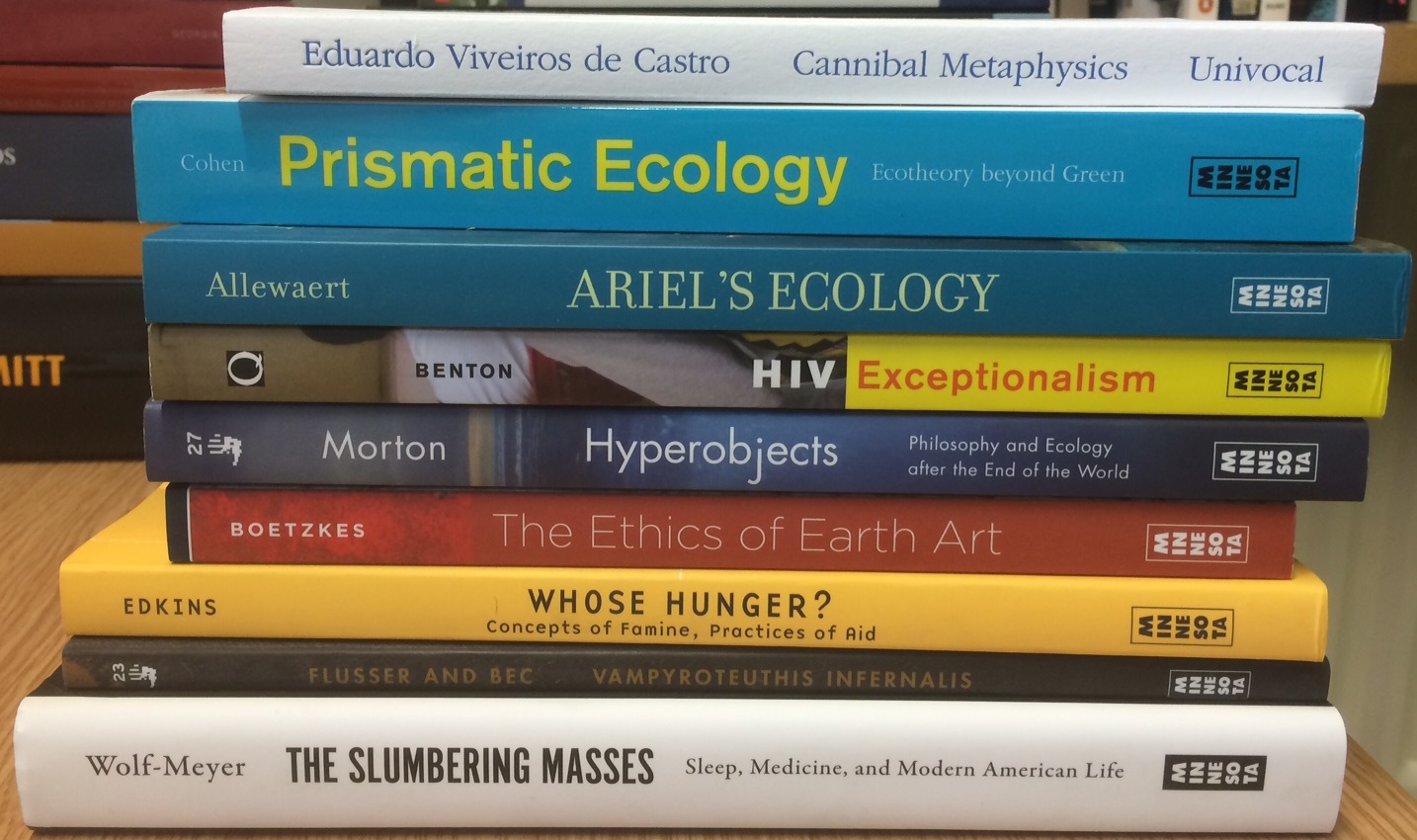
 I did a lot of review work for presses while I was away, and these are the books received in recompense. These tend to be books for future projects – especially here the Shakespearean Territories one – and for general interest.
I did a lot of review work for presses while I was away, and these are the books received in recompense. These tend to be books for future projects – especially here the Shakespearean Territories one – and for general interest.
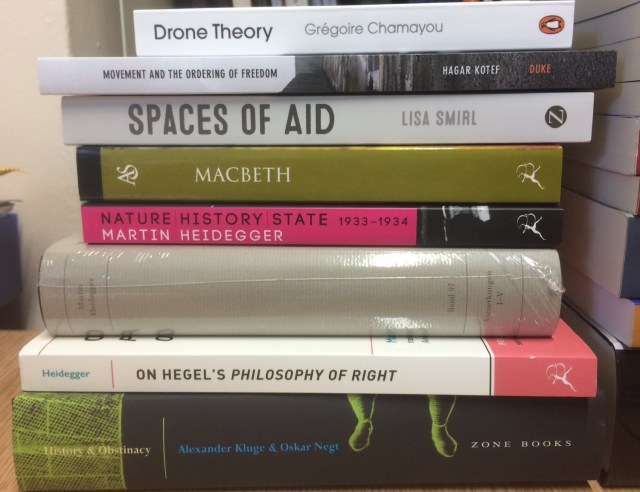
Some more books – these are ones I bought, with the exception of Hagar Kotef’s Movement and the Ordering of Freedom: On Liberal Governances of Mobility, which was sent by the publisher. The others include Lisa Smirl’s posthumous Spaces of Aid, Kluge and Negt, History & Obstinacy, Chamayou’s Drone Theory, the Arden third series edition of Macbeth, and three by Heidegger – two seminars from 1934-35, and the next volume of the ‘Black Notebooks’.
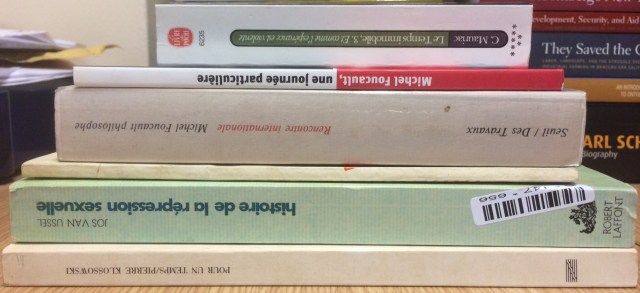

Some more books for the Foucault work, including some for reference which I’ve read before, but also some others that came out recently.
 Archive of a Radical Geographer: Neil Smith’s Papers – interview with Don Mitchell by Zoltán Glück from 2014.
ZOLTÁN GLÜCK: I’d like to start by asking about what you’ve been doing here at CUNY this year. What is happening with Neil Smith’s papers? And what is in the archive?
DON MITCHELL: The main thing that I’ve been doing, as you know, is sorting through Neil’s papers and whatever else he happened to leave behind. I started last May, helping Deb Cowen clear out their flat in Jackson Heights, and we boxed up lots of books and papers and sent them here to the Grad Center. First, they just sat here for the summer, and now I’ve just spent the year going through all that he left behind.
Thanks to Tom Slater for the link.
Open Letter to Meric Gertler, president of University of Toronto from Geography and Planning Community.
If you would like to add your signature to this letter, please email geogforcupe@gmail.com
Signatories are in alphabetical order, and more are being added.
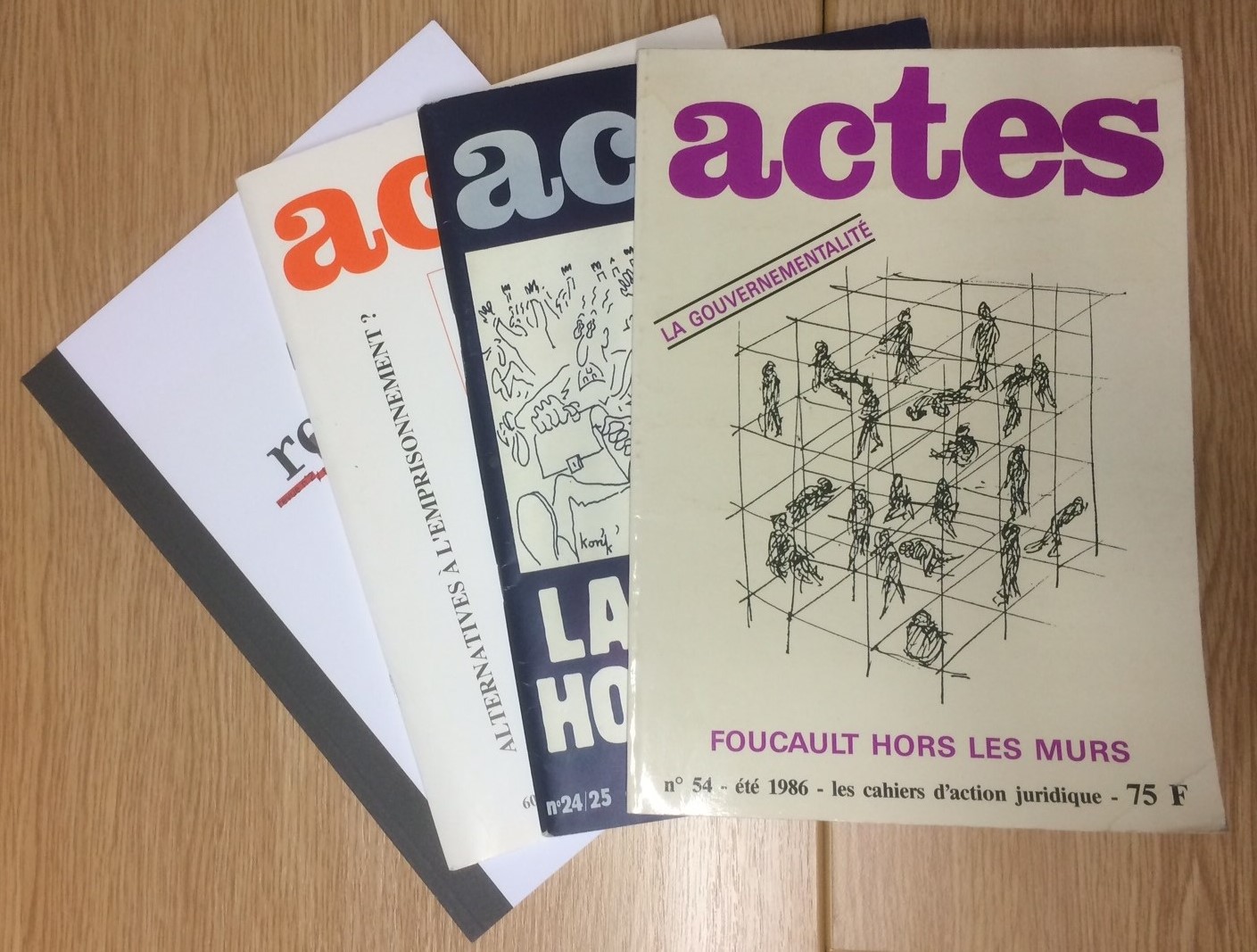 Three issues of the journal Actes – all relating to Foucault: Nos 24-25, 54 and 73; along with the issue of Revue Rodéo from 2013 which has the previously largely-unknown 1979 interview between Foucault and Farès Sassine. That interview, originally published in Arabic, was not included in Dits et écrits or the Afary and Anderson book on Foucault and the Iranian Revolution. While the interview and Sassine’s commentary are available online (linked in a previous post), this issue includes some commentaries as well.
I’ve been sent copies of Henri Lefebvre’s Rhythmanalysis, which has been translated into Persian by Aidin Torkameh. As I understand it, it’s a translation of the English edition which Gerald Moore and I translated, rather than directly from the French, and it also includes my introductory essay. The same process was followed for the Korean translation.

Tom Sparrow’s Plastic Bodies: Rebuilding Sensation After Phenomenology, with a preface by Catherine Malabou, is available in print or as an open access e-book (via Object-Orientated Philosophy).

Sensation is a concept with a conflicted philosophical history. It has found as many allies as enemies in nearly every camp from empiricism to poststructuralism. Polyvalent, with an uncertain referent, and often overshadowed by intuition, perception, or cognition, sensation invites as much metaphysical speculation as it does dismissive criticism.
The promise of sensation has certainly not been lost on the phenomenologists who have sought to ‘rehabilitate’ the concept. In Plastic Bodies, Tom Sparrow argues that the phenomenologists have not gone far enough, however. Alongside close readings of Merleau-Ponty and Levinas, he digs into an array of ancient, modern, and contemporary texts in search of the resources needed to rebuild the concept of sensation after phenomenology. He begins to assemble a speculative aesthetics that is at once a realist theory of sensation and a philosophy of embodiment that breaks the form of the ‘lived’ body. Maintaining that the body is fundamentally plastic and that corporeal identity is constituted by a conspiracy of sensations, he pursues the question of how the body fits into/fails to fit into its aesthetic environment and what must be done to increase the body’s power to act and exist.
As previously mentioned, Umberto Eco’s 1977 book How to Write a Thesis now out in translation from MIT Press – it is reviewed in The Times Higher Education by Robert Eaglestone – thanks to Dean Bond for the link. Here’s the concluding part.

How to Write a Thesis is really: how to be an academic.
This is part of the answer to those who think that focusing on research makes us bad teachers: at their very deepest roots, both research and teaching in universities rely not only on subject knowledge but on the virtues of sincerity and accuracy, taught through research. But there’s more: the paradox – brought into sharp focus by How to Write a Thesis – that even with a PhD, you never properly qualify. Even eminent professors remain, in a way, students for ever, with more to research, more to explore just over there. And the surprising fact is that the people who remember daily the experience of doing research, who know that despite their degrees, titles and fancy hats, they, too, are really only students: these are the best people to teach other students. Whisper it – it’s not politic to say it aloud – but that’s what makes universities special places. Our graduate students intuit this, so help them scale the tower’s walls (so as to toil in the incongruously situated groves) by giving them this book.

