Foucault on Parrhesia – translation of a 1982 lecture forthcoming in Critical Inquiry

PREVIEW (1)A lecture by Foucault in 1982 at Université de Grenoble, on “Parrēsia” was first published in French in 2012 in the journal AnabasesAnother lecture from this same trip, “Rêver de ses plaisirs”, was published in 1983, and is a variant of the first chapter of Le souci de soi/The Use of Pleasures. I outline and discuss the differences here.

The French version of the “Parrēsia” article will be available online in October 2015. A translation by Graham Burchell is forthcoming in Critical Inquiry in early 2015 [update: now available here]. For the moment, that journal has just posted the first two paragraphs:

Thank you very much for inviting me. I am here, as you know, as a supplicant. What I mean is that, until four or five years ago, my field, at any rate the domain of my work, had scarcely anything to do with ancient philosophy; and then, following a number of zigzags, detours, or steps back in time, I began to say to myself that, after all, it was very interesting.  So I come to ancient philosophy as part of the work I am doing.  One day, when I was asking him some questions, telling him about my problems, Henri Joly was kind enough to say that you might agree to discuss my work with me, in its present imperfect state.  It is some material, some references to texts, some indications; what I am going to sketch out to you is therefore incomplete, and, if you were willing, it would be very good of you, first, to call out if you can’t hear me, stop me if you do not understand or if it’s not clear, and then anyway, at the end, tell me what you think.

So, to start with, this is how I came to be asking myself this set of questions.  What I had been studying for really quite a long time was the question of the obligation to tell the truth:  what is this ethical structure internal to truth-telling, this bond that, beyond necessities having to do with the structure or reference of discourse, means that at a given moment someone is obliged to tell the truth?  And I tried to pose this question, or rather I encountered this question of the obligation to tell the truth, of, if you like, the ethical foundation of truth-telling, with regard to truth-telling about oneself.  In actual fact it seems to me that I encountered it several times.  First of all in medical and psychiatric practice since, from a given moment, which is moreover quite precise and can be pinpointed at the beginning of the nineteenth century, we see the obligation to tell the truth about oneself becoming part of the great ritual of psychiatry.  Obviously we come across this problem of truth-telling about oneself in judicial practice and more especially in penal practice.  And, finally, I came across it for the third time with regard to, let’s say, problems of sexuality and more precisely of concupiscence and the flesh in Christianity.


Posted in Conferences, Michel Foucault, Publishing | 2 Comments

Adam Kuper on Anthropologists and Anthropology, forty years on

9780415736343Adam Kuper has an interesting piece on his book Anthropologists and Anthropology, forty years on and in an updated new edition (with a reversed title). It’s a survey of British Anthropology as a discipline – almost an anthropology of anthropology. Kuper taught me briefly as an undergraduate, when I took a survey social science course at Brunel (or ‘dead white men with beards’ as it was known). After Darwin, Marx, Weber, Freud, Kuper taught Durkheim.

Posted in Uncategorized | 1 Comment

The Lancet on IMF reforms and the West African Ebola crisis

Screenshot 2014-12-23 14.36.05

Writing today in the journal Lancet Global Health, researchers from Cambridge University’s Department of Sociology examine the links between the International Monetary Fund (IMF) and the Ebola outbreak in West Africa.

According to the authors, joined by colleagues from Oxford University and the London School of Hygiene and Tropical Medicine, IMF programs over the years have imposed heavy constraints on the development of effective health systems of Guinea, Liberia and Sierra Leone – the cradle of the Ebola outbreak that has killed more than 6,800 since March this year.

The researchers say that economic policy reforms advocated by the IMF have undermined the capacity of health systems in these three nations – systems already fragile from legacies of conflict and state failure – to cope with infectious disease outbreaks and other such emergencies. – See more here.

A long reading list on Ebola, which I updated regularly between October and November 2014, is available on this site.

Posted in Ebola, Politics | Leave a comment

Foucault and Iran (and Ernst Bloch) – an August 1979 interview newly available in French

Thanks to a reader who wishes to remain anonymous for sending me these details of an interview with Foucault about Iran conducted in August 1979, which was first published in French in 2013.

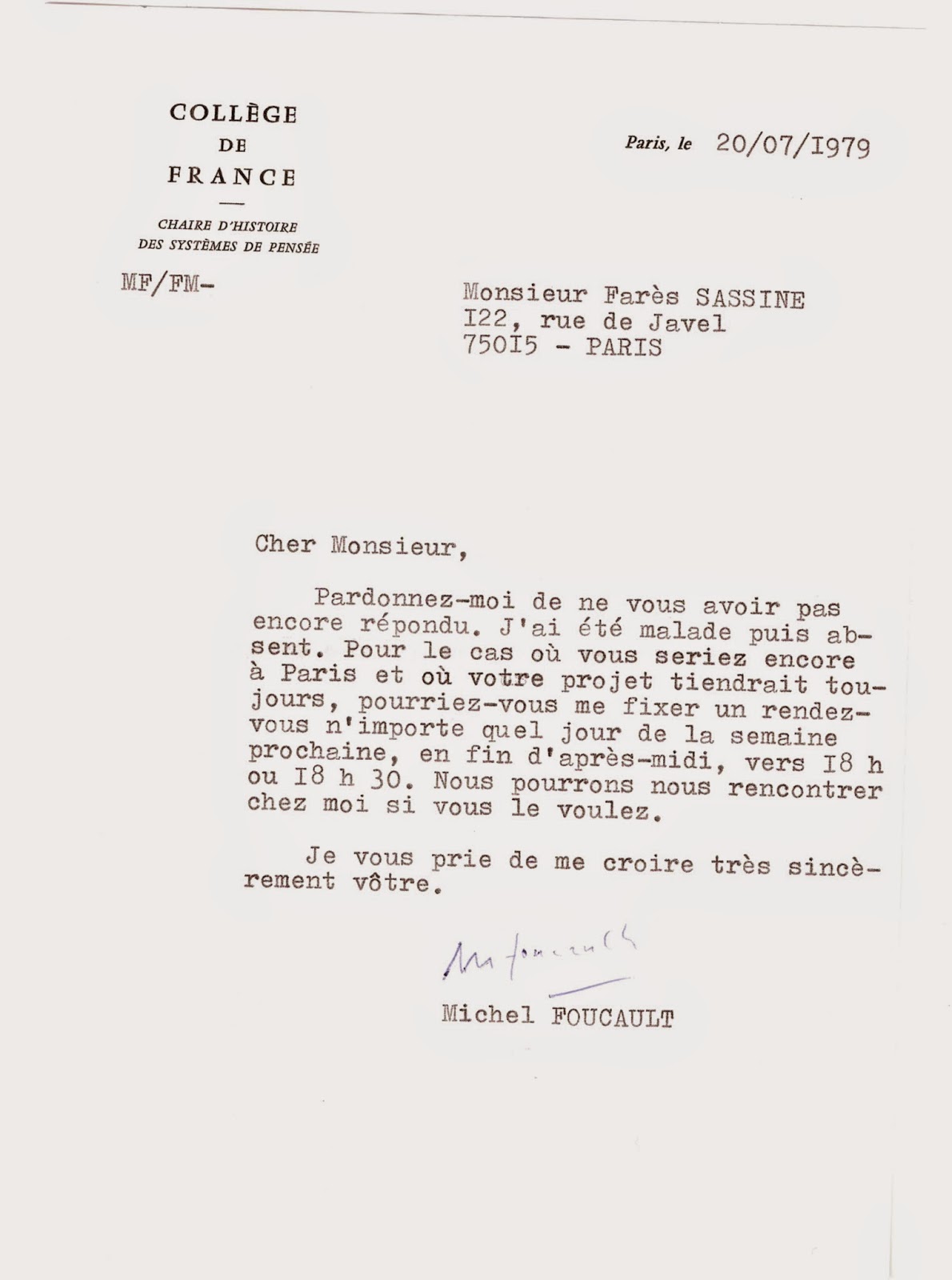
PHOTO 3 N3DI’ve stumbled upon an interview with Foucault from this era that has up until recently remained completely uncommented by Foucault scholarship, unreferenced even in Afary-Anderson [Foucault and the Iranian Revolution – SE]. I have no doubt that you will find it interesting. The interview was conducted in August ’79 with Farès Sassine from the Paris paper An-Nahar al-`Arabi wa‘d-Duwali, in which extracts were published in ’79. translated into Arabic from the French. The original article, in Arabic, can be found here. It wasn’t until last year, however, that a full transcription of the interview in French was published in the somewhat obscure Revue Rodéo (no. 2) with an accompanying piece by Farès Sassine himself. This, also, alas, has been impossible for me to track down, but luckily, just this August, 35 years after the interview, Mr. Sassine posted the transcript on his blog along with some editorial remarks.

LETTRE 2I’ve found the interview to be very informative, and at least very pertinent to several contemporary discussions around the notion of political spirituality (which actually was inspired by Bloch’s Principle of Hope!), Foucault’s relationship the nouvelles philosophes, and perhaps (thereby) also a correction to the ongoing reframing of Foucault as a neoliberal in leftist clothing. It’s also a very pleasant read, seeing a very amicable atmosphere between the two, and a very welcoming Foucault, despite sickness and fatigue.

entretien JPEGThe whole interview in French can be read here.

This interview is significant for multiple reasons, not least because it postdates the other texts on this topic – I think the last one, before this, was ‘Inutile de se soulever [Is it useless to revolt]?’ published in Le monde on 11-12 May 1979. As well as the initial mention of Ernst Bloch, it also discusses some of his contemporaries and their work, and it’s also the only place I know where Foucault mentions Edward Said.

I’m very grateful for the details and the message, which is posted with permission. The images come from Farès Sassine’s commentary – clicking on each will take you to the page with the larger image.

Posted in Edward Said, Michel Foucault, Politics | Tagged | 6 Comments

Foucault and Simeon Wade – and the elusive ‘Chez Foucault’ publication

Last week I posted about Time magazine’s profile of Foucault from 1981. The piece included this photograph:

Michel, Simeon and Michael

James Miller‘s biography of Foucault says that this picture was of Simeon Wade, and Wade’s friend ‘Michael’ (The Passion of Michel Foucault, pp. 437-8 n. 1). Who is Simeon Wade? Well he’s an interesting figure in Foucault’s California story, because he was the author of an unpublished “121 page typescript”, ‘Foucault in California’, which recounts Foucault’s 1975 LSD trip in Death Valley. Miller discusses this in Chapter 8 of his book. I’m somewhat sceptical about this story and what has been made of it. I discuss it briefly in a 2005 piece that was a kind of prelude to the work I am now doing in much more detail – I am not sure if that particular discussion will make it into the book.

[Update 2017: Wade is interviewed by Heather Dundas in Boom California – see also my comments here]

But Wade is also interesting for another reason: he interviewed Foucault in 1976 in a piece which was first published in 1978 in a publication he edited – Chez Foucault, Los Angeles: Circabook, 1978, pp. 4-22. This text is translated into French for Dits et écrits (online here). My practice with texts originally published in English, and for which the Dits et écrits version is already once removed, is to try to find the original. This is often challenging, but in this case, it’s proved impossible. Dits et écrits describes the publication this way – “The Circabook is a sort of campus polycopié” – a handout or pamphlet, a mimeograph. I’ve been told by a reliable source that it was effectively a fanzine. I can find no library that has a copy.

So, has anyone ever seen this in the original? I’ve been unable to find contact details for Wade. Any information gratefully received.

Update: 21 Feb 2015 – I now have a scanned copy of this rare document, which can be downloaded here.

Posted in Foucault's Last Decade, Michel Foucault | 16 Comments

Theories and counter-theories of the drone

Derek Gregory rounds up some pieces on drones, including a complete list of his posts about Chamayou’s Theory of the Drone, due for English publication very soon.

Derek Gregory's avatargeographical imaginations

CROGAN Gameplay modeI expect many readers will know Patrick Crogan‘s Gameplay mode: war, simulation and technoculture (Minnesota, 2011).  He has now uploaded what I think is a draft of Drones and global technicity: automation and (dis)individuation at academia.  Here’s the extended abstract:

This paper (for General Organology conference [held last month at the University of Kent]) will explore the expansion of military drone usage by Western powers in the “war on terror” over the last decade or so in relation to Bernard Stiegler’s organological approach to questions concerning human historical, cultural and technological becoming.. Theorists approaching drones from different fields such as Grégoire Chamayou, Derek Gregory and Eyal Weizman have argued that the systematic and growing deployment of unmanned aerial vehicles should be understood as the “avant-garde” of a general movement toward remote and increasingly autonomous robotic systems by all branches of the armed forces of the U.S…

View original post 1,175 more words

Posted in Uncategorized | Leave a comment

Foucault’s Last Decade – Update 16

update 16

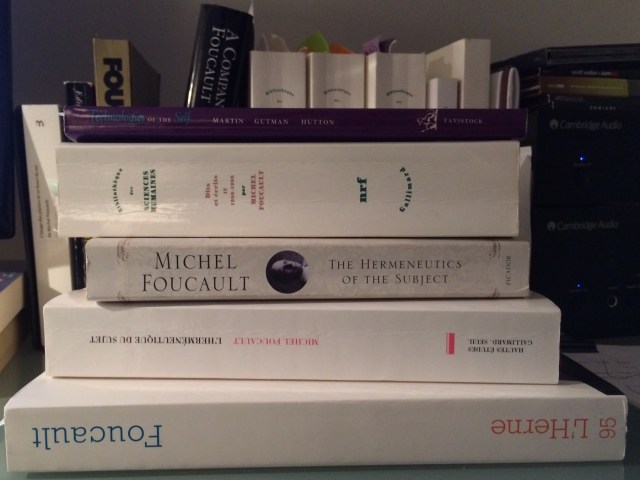
I have now a complete draft of Chapter Eight, but this has partly been achieved by moving discussion of the final two volumes of the History of Sexuality into the next chapter. The main thing I’ve accomplished is typing up my notes on The Hermeneutic of the Subject and reorganizing these into a couple of sections. I also went through the various interviews and short publications of the 1980-1982 period, including the three interviews conducted at Louvain, collected in Wrong-Doing, Truth-Telling.

There are some very interesting pieces from this period, including the interview and lectures in the Technologies of the Self volume, which came from a visit Foucault made to the University of Vermont in 1982. The book was not published until 1988, after Foucault’s death. As the editors note, Foucault did not edit the texts himself, and so they were transcribed (I don’t think the recordings are available). But he authorized their publication, because they appear, translated into French, in Dits et écrits. Indeed, they are the last three texts in that volume, out of only a handful there that appeared after his death. Perhaps giving these texts the same kind of treatment that the 1980 Dartmouth lectures recently received – L’origine de l’herméneutique de soi: Conférences prononcées à Dartmouth College, 1980 (Vrin 2013) would be in welcome. That volume is due to appear in English with University of Chicago Press in 2015. While most of its components have been available in English for some time (as I discuss here), there is much value in the editorial apparatus. That the Vermont texts did appear in Dits et écrits, though, will presumably rule out a similar treatment. It’s worth noting that the Dits et écrits translations include editorial notes that do not appear in the English original; the seminar transcripts in Essential Works: Ethics are amended, the lecture in Power is not. These notes do provide some helpful bibliographic orientations, but linking these seminars to Paris lectures might be worthwhile.

In reading the short pieces from this time I was also struck by two issues of dating. One is that the famous ‘The Subject and Power’ afterword to the Dreyfus and Rabinow book wasn’t all written at the same time – the first half is clearly from the early 1980s, but the second is probably from the late 1970s. Arnold Davidson has pointed this out before, and it’s also mentioned by Colin Koopman in his Genealogy as Critique. Though not mentioned in the reprint in Essential Works: Power, the first part ‘Why Study Power’ was written in English by Foucault; the second part ‘How is Power Exercised?’ (and subsequent subdivisions) was translated by Leslie Sawyer for the Dreyfus and Rabinow book (see the note in the original, p. 208). [Update 24.12.14 – the original French of the second part is in the Berkeley archive as text 1.14; the French edition of the Dreyfus and Rabinow text Michel Foucault : Un parcours philosophiques says there are ‘deux essais’ included.] All this would lend support to the idea of different datings. I did find one other clue – in the Technologies of the Self volume a note in the editors’ introduction (p. 8 n. 3) suggests that the first part was the text from his contribution to an October 1981 conference at University of South California. From a contemporary report, this would make sense –

A few of the cognoscenti complained afterwards that Foucault had directed his remarks to the great unwashed. And, in fact, Foucault did opt for a less esoteric paper when he learned the size of the crowd he was to address – a sort of outline of what he sees as the trajectory of his own theoretical and political project over the last 15 years or so. Be that as it may, the talk had the virtue of relative clarity, free of the maddening jargon that had characterized a few of the earlier talks (p. 195).

(Incidentally, the version in Essential Works: Power promotes some subsections in the second half to the level of sections – the original is in two sections, with four subsections/questions in the second half. The French version in Dits et écrits numbers these questions.)

The other was the various versions of the introduction to the second volume of the History of Sexuality, which I analyse in detail here. That throws up some really interesting issues. I also worked through the differences between “Rêver de ses plaisirs” – an article first published in 1983, based on a 1982 lecture, and reprinted in Dits et écrits text 332 – and the first chapter of the third volume, but the differences are minimal (which is itself revealing) aside from right at the end. My working notes on this are here.

I also spent a bit of time ordering the list of Foucault’s audio and video recordings on this site, and listened to a few of the ones from the early 1980s. It’s interesting listening to the lecture and reading the French transcription in the Collège de France volumes at the same time – while I found nothing to disagree with the editorial work, there is quite a lot of smoothing of style and grammar. A slavish rendition would be awful to read, but it does add something of a distance from the spoken word, and again makes these appear as more polished texts – as ‘books’ – than they really are. This reinforces some of the thoughts I made in response to some recent discussion of Foucault’s relation to neoliberalism – something of a distraction and also retreading material I thought I had finished with. There are some lively exchanges in the comments on the post.

So, a complete draft of Chapter Eight is now in place. Chapter Nine will begin with the discussion of the actually published volumes II and III, and related pieces, and then move to the two final lecture courses in Paris. That’s a lot to cover in a single chapter, and the book is already well over contracted word length. Editing, cutting and perhaps renegotiation will come later.

You can read more about the Foucault’s Last Decade project, along with links to previous updates, here.

Posted in Foucault's Last Decade, Michel Foucault, Writing | 3 Comments

Étienne Balibar discusses Foucault’s La société punitive, with a response from Judith Butler

Étienne Balibar discusses Foucault’s La société punitive and his relation to Marx, with a response from Judith Butler. Audio files available here, via Multipliciudades.

For his lecture “Foucault and Marx: A Disjunctive Synthesis?”, Étienne Balibar discusses connections and disjunctions between Michel Foucault and Karl Marx, using Foucault’s 1972 Collège de France lectures on La société punitive as an alternative lens for the question of “reproduction” and its relationship to class struggles. With Foucault and Marx as a starting point for a new confrontation, he also reconsiders the idea of “communism” today. Response by Judith Butler, Professor of Comparative Literature, UC Berkeley.

Posted in Conferences, Etienne Balibar, Judith Butler, Karl Marx, Michel Foucault, Politics | 4 Comments

Marijn Nieuwenhuis, ‘The Terror in the Air’ at Open Democracy

5890920 (1)_2My Warwick colleague Marijn Nieuwenhuis has a new piece entitled ‘The Terror in the Air‘ at Open Democracy. The ranges from Beijing pollution to tear gas, and Eric Garner to Peter Sloterdijk.

Posted in Uncategorized | 1 Comment

Michel Foucault: The Late Lectures (2014)

A panel discussion with Seyla Benhabib, François Ewald, Bernard E. Harcourt, George Kateb, and Emmanuelle Saada on Foucault’s late lectures.

Clare O'Farrell's avatarFoucault News

Michel Foucault: The Late Lectures

Columbia Maison Française

November 7, 2014, a panel discussion with Seyla Benhabib, François Ewald, Bernard E. Harcourt, George Kateb, and Emmanuelle Saada.

In his late Collège de France lectures, Michel Foucault opened up new paths for research, what he so often referred to as “des pistes de recherche,” many of which have only come to light now as a result of the recent publication of the lectures. Ranging from the concept of security to the notion of truth-telling, to the relationship between veridiction and juridiction, to the arts of governing, the hermeneutics of the self, and the notion of “voluntary inservitude,” the late lectures represent a font of new material to allow us to think with Foucault. At the same time, they offer a new lens through which to reread the earlier published works, from the History of Madness, though Discipline and Punish, to…

View original post 166 more words

Posted in Uncategorized | Leave a comment