Jean-Luc Nancy defends Black Notebooks editor in Faust

A discussion of Heidegger’s ‘Black Notebooks’.

Peter Gratton's avatarPHILOSOPHY IN A TIME OF ERROR

There has been something of a dust-up where the editor of the Black Notebooks has been attacked by Friedrich Wilhelm von Herrmann, Heidegger’s last private assistant and chief editor of the Gesamtausgabe. Peter Trawny last year published Heidegger und der Mythos der jüdischen Weltverschwörung (2014), which is anything but an anti-Heideggerian screed. Hermman claims Trawney is merely attacking Heidegger as part of the times–rather than, you know, reacting to some rather horrific prose. Nancy had previously discussed the Black Notebooks last summer here (thanks to Marie-Eve Morin and others on FB for the links) and in this piece (German on top; French original [with some errors] below) defends Trawney against the claim that he is unphilosophical, etc.
View original post

Posted in Uncategorized | 1 Comment

Martijn Konings, The Emotional Logic of Capitalism

Now out, an intriguing new book on capitalism – Martijn Konings, The Emotional Logic of Capitalism.

pid_25513

The capitalist market, progressives bemoan, is a cold monster: it disrupts social bonds, erodes emotional attachments, and imposes an abstract utilitarian rationality. But what if such hallowed critiques are completely misleading? This book argues that the production of new sources of faith and enchantment is crucial to the dynamics of the capitalist economy. Distinctively secular patterns of attraction and attachment give modern institutions a binding force that was not available to more traditional forms of rule. Elaborating his alternative approach through an engagement with the semiotics of money and the genealogy of economy, Martijn Konings uncovers capitalism’s emotional and theological content in order to understand the paradoxical sources of cohesion and legitimacy that it commands. In developing this perspective, he draws on pragmatist thought to rework and revitalize the Marxist critique of capitalism.

Thanks to Adam David Morton for the link.

Posted in Books, Politics | 2 Comments

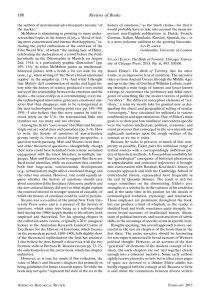
Matthew Hannah reviews The Birth of Territory for The American Historical Review

Matthew Hannah reviews The Birth of Territory for The American Historical Review (requires subscription).

188.extractThere are some quite sharp criticisms, but the overall take is fairly positive. I resisted attempts to tie periods where the historical record is patchy into too much of a “coherent narrative”, which risked, I felt, the over-interpretation which is quite common. That decision is criticised here, and there are some more general comments about the way the argument fits together. I’m puzzled that the reason for the space devoted to Augustine is unclear, since he’s so often looked at as the key political thinker of the Middle Ages, is a key bridge between antiquity and the medieval (as problematic as those labels are), and as I tried to show, provides a basis for later ways in which politics is thought – the theological and secular sources of power, and their relation to space, for example. But I appreciate the engagement and it’s certainly good to be reviewed in a History journal.

Here’s the first and last paragraph. Happy to share the whole review if you email me.

Stuart Elden’s The Birth of Territory, like his other works, is an impressive feat of erudition. The narrative takes us from Ancient Greece through the Middle Ages and up to the time of Gottfried Wilhelm Leibniz, trawling through a wide range of famous and lesser-known writings to reconstruct the prehistory and fitful emergence of something like the modern notion of political “territory.” The different conceptual elements of “territory,” a term we mostly take for granted now as designating the object and geographical setting of secular “sovereignty,” have circulated for millennia in various combinations and approximations. One of Elden’s main goals is to show just how nonlinear and context-specific were the various intellectual, political, economic, and social processes that converged in the seventeenth and eighteenth centuries upon the rough outlines of the concept as we use it today…

What Elden has not done with this book is to engage current debates on territory from the range of theoretical perspectives available to him. In addition to his historical erudition, Elden is also very widely read in current critical theories of power. To a significant extent, the explicit engagement takes place in his Terror and Territory: The Spatial Extent of Sovereignty (2009), which should be seen as a kind of companion volume. Between the two works, the interested reader receives a one-stop overview of the concept of territory unlikely to be matched anytime soon.

Posted in Politics, Territory, Terror and Territory, The Birth of Territory | 1 Comment

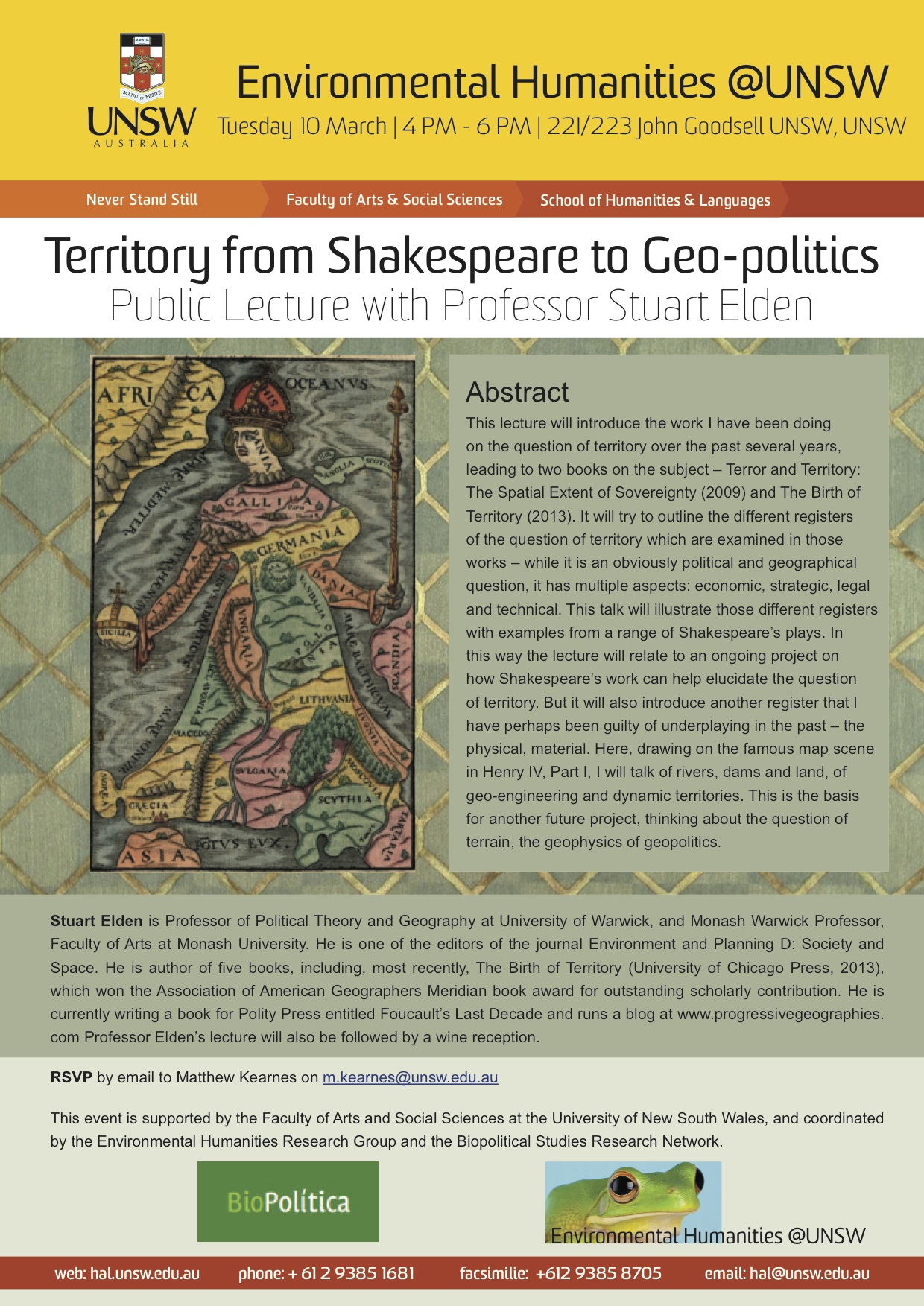
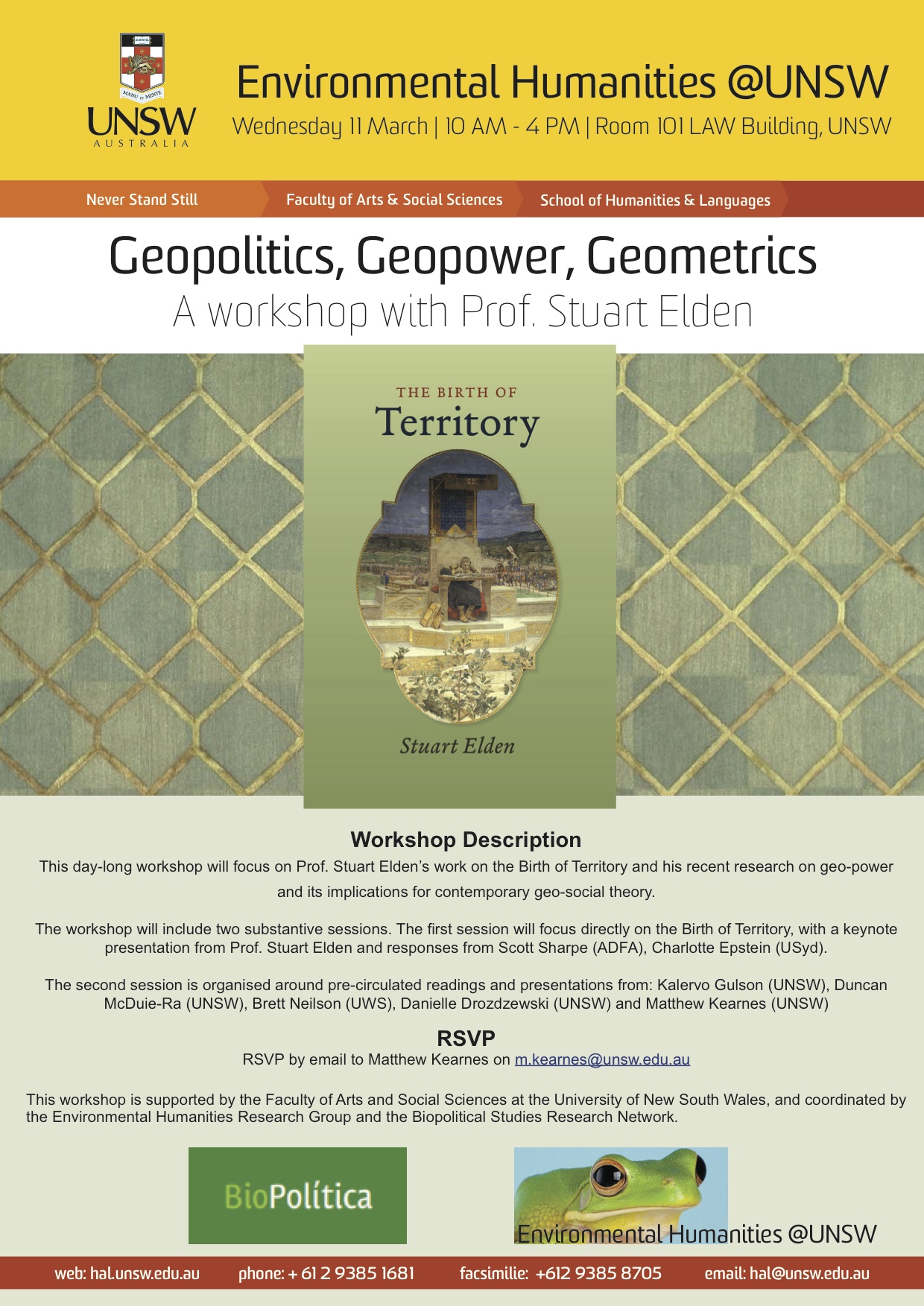
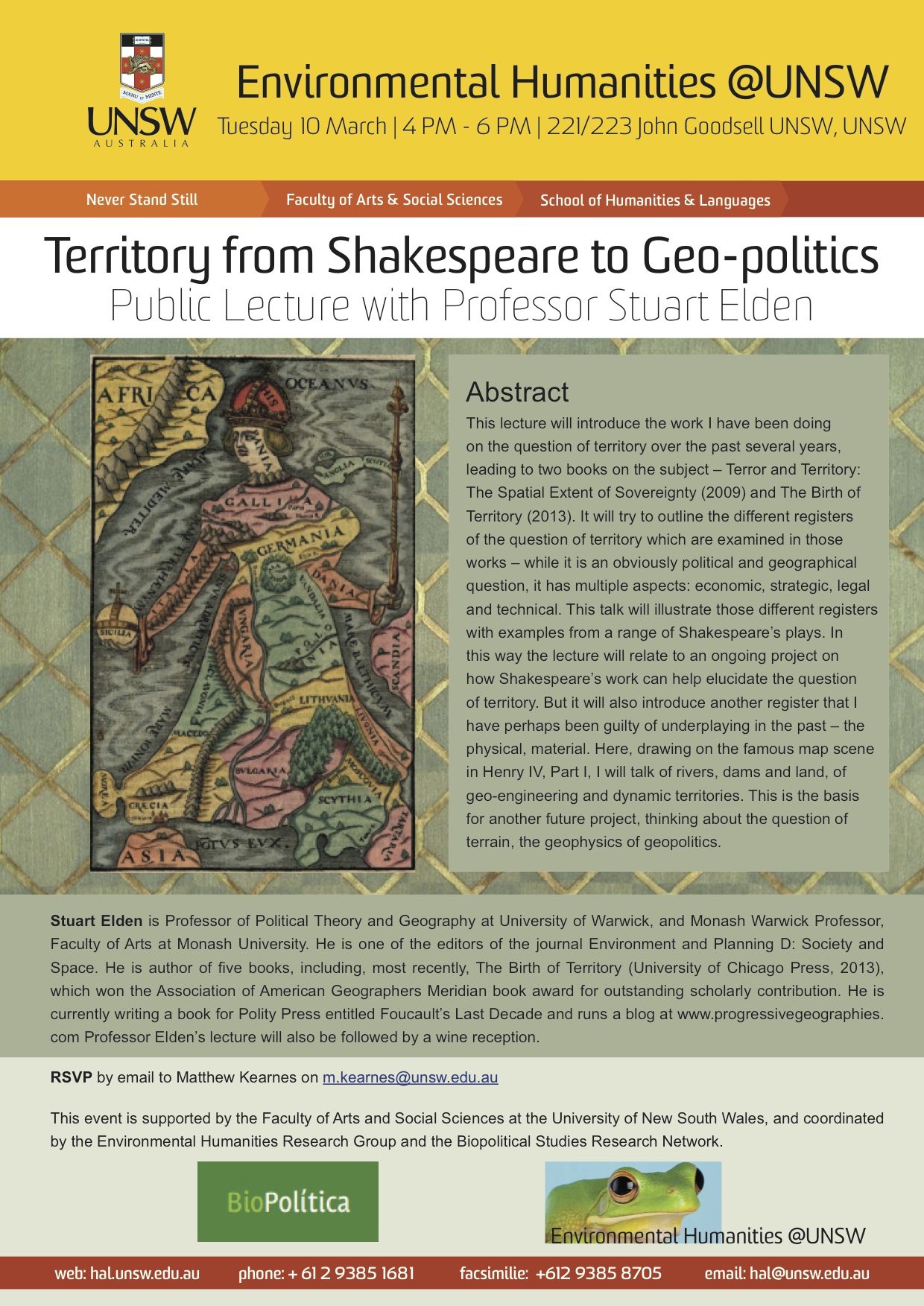
Posters and further details for UNSW lecture and workshop

Territory from Shakespeare to Geo-politics10 March, 4pm, “Territory from Shakespeare to Geo-politics”, School of Humanities and Languages, John Goodsell 221/223, University of New South Wales (website; poster)

Geometric Workshop11 March, 10-4pm, “Geopolitics, Geopower, Geometrics”, workshop, Room 101 LAW Building, University of New South Wales (website; poster).

Posted in Conferences, Politics, Territory, The Birth of Territory | Leave a comment

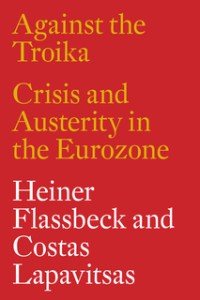
Against the Troika: Crisis and Austerity in the Eurozone – A Verso instant book

Against the Troika: Crisis and Austerity in the Eurozone – A Verso instant book, available online at a reduced price.

Against_the_Troika-max_221-6b91e23baf0c5205ff22a1b461656abf

On the 25th January 2015 the Greek people voted in an election of historic importance – not just for Greece but potentially all of Europe. The radical party Syriza was elected and austerity and the neoliberal agenda is being challenged. Suddenly it seems as if there is an alternative. But what?

The Eurozone is in a deep and prolonged crisis. It is now clear that monetary union is a historic failure, beyond repair—and certainly not in the interests of Europe’s working people.

Building on the economic analysis of two of Europe’s leading thinkers, Heiner Flassbeck and Costas Lapavitsas (a candidate standing for election on Syriza’s list), Against the Troika is the first book to propose a strategic left-wing plan for how peripheral countries could exit the euro. With a change in government in Greece, and looming political transformations in countries such as Spain, this major intervention lays out a radical, anti-capitalist programme at a critical juncture for Europe. The final three chapters offer a detailed postmortem of the Greek catastrophe, explain what can be learned from it – and provide a possible alternative.

Against the Troika is a practical blueprint for real change in a continent wracked by crisis and austerity.

Posted in Politics, Publishing | Leave a comment

Contesting the Arctic: Rethinking Politics in the Circumpolar North by Philip E. Steinberg, Jeremy Tasch, Hannes Gerhardt

Contesting the Arctic: Rethinking Politics in the Circumpolar North by Philip E. Steinberg, Jeremy Tasch and Hannes Gerhardt has been published by I.B. Tauris.

9781780761480.ashx

As climate change makes the Arctic a region of key political interest, so questions of sovereignty are once more drawing international attention. The promise of new sources of mineral wealth and energy, and of new transportation routes, has seen countries expand their sovereignty claims. Increasingly, interested parties from both within and beyond the region, including states, indigenous groups, corporate organizations, and NGOs and are pursuing their visions for the Arctic. What form of political organization should prevail? Contesting the Arctic provides a map of potential governance options for the Arctic and addresses and evaluates the ways in which Arctic stakeholders throughout the region are seeking to pursue them.

‘Contesting the Arctic is a sophisticated analysis of how contemporary discourses and performances are caught up in older colonial and Cold War legacies of knowledge production and geopolitics. It is a reminder to us all that we need to be ever vigilant in terms of how vast and complex spaces such as the “Arctic” are constituted and reproduced in political and popular cultures. As global attention grows towards the Arctic, this book reminds us that the Arctic is also a homeland and not an “empty space” to be scrambled over.’
Klaus Dodds, Professor of Geopolitics, Royal Holloway, University of London

Posted in Books, Boundaries, Philip Steinberg, Politics, Territory | Leave a comment

Redlined Comparison Of The Eurogroup Draft Varoufakis Was Ready To Sign, And The Draft He Rejected

Interesting – the power of words…

E's avatarGreek Left Review

by Tyler Durden’s published at http://www.zerohedge.com

Just like last week, the reason for the bitterly acrimonious collapse of today’s Eurogroup attempt to resolve the Greek crisis, was in the wording of the proposed final Eurogroup draft. And, just like last week, while the Greek FinMin was initially willing to sign a specific draft (in this case penned by Moscovici), it was subsequently revised to a draft which Varoufakis threw up all over, leading to a premature end of today’s discussions, one which for the second time in a week prevented the Eurogroup from even issuing a joint statement.

So what exactly was the reason for the Greek disagreement?

Now that both the acceptable, pre-revision (source), and rejected, post-revision (source) texts are available, we can find precisely which inserted and deleted words resulted in a surge in the Greek’s blood pressure.

Presenting: the red-line (or rather blue-line) comparison between the two drafts…

View original post 170 more words

Posted in Uncategorized | 1 Comment

Political Geography Specialty Group AAG Preconference Preliminary Schedule

If you’re going to the Association of American Geographers conference in Chicago, this may be of interest:

The PGSG 28th Annual Preconference schedule is now posted here (preliminary). You will find more details about the conference venue, etc. here.

Posted in Conferences | Leave a comment

History of the Present – the Berkeley newsletter on Foucault’s work online

[Update September 2023 – thanks to a comment below for saying these are available via the Wayback Machine: 1; 2; 3; 4

Update Nov 2018 – these links appear to be dead. Please comment if they become live again or you know of another source]

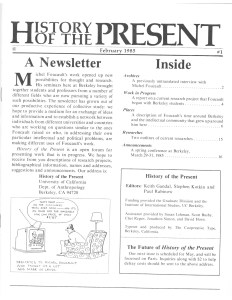
History of the Present, the newsletter devoted to Foucault’s work published by Paul Rabinow and edited by him and other people at Berkeley is available online. I’d been looking for copies in libraries, and the online version took a little while to find, so I hope others will find it helpful.

History of the Present no 1– February 1985 Issue (pdf)

– Spring 1986 Issue (pdf)

– Fall 1987 Issue (pdf)

– Spring 1988 Issue (pdf)

They include translations of interviews with Foucault, at least one of which is not available elsewhere, an interview with Deleuze, reviews, pieces by researchers using Foucault’s ideas, and so on. I’m intrigued by the stage performance of History of Sexuality…

These, and many other publications, are listed on the webpage of Paul Rabinow’s Anthropos Lab.

I’ve also added these to the list of uncollected notes, lectures and interviews on this site.

Posted in Foucault's Last Decade, Gilles Deleuze, Michel Foucault, Publishing | 6 Comments

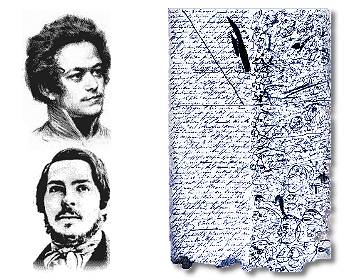
“The German Ideology Never Took Place”: Terrell Carver

A fascinating piece on the manuscripts which were collected as The German Ideology, from Terrell Carver.

xb's avatar

The German Ideology (Die Deutsche Ideologie) by Karl Marx and Friedrich (or Frederick) Engels has a very well established scholarly and interpretive reception. However, this dates from long after the authors’ deaths (in 1883 and 1895, respectively), and began with the archival and editorial work of D.B. Ryazanov in the early 1920s, the initial publication of the ‘chapter’ ‘I. Feuerbach’ in Russian (1924) and German (1926), and the first ‘complete’ publication as a single volume in 1932. Since that time there have been numerous further editions and translations, the latest of which is in Marx-Engels Jahrbuch 2003, edited by Inge Taubert and Hans Pelger.[2] Currently a new edition is planned as MEGA2 I-5 in the ongoing scholarly publication of the complete works of Marx and Engels.[3]

       While The German Ideology is well known to have been editorially constructed from uncorrected manuscripts, which are…

View original post 9,703 more words

Posted in Uncategorized | 1 Comment