Michel Foucault’s ‘apology’ for neoliberalism (2014)

A useful, thoughtful and judicious discussion of this question by Mitchell Dean.

Clare O'Farrell's avatarFoucault News

Mitchell Dean, Michel Foucault’s ‘apology’ for neoliberalism. Lecture delivered at the British Library on the 30th anniversary of the death of Michel Foucault, June 25, 2014, Journal of Political Power, Volume 7, Issue 3, 2014, pages 433-442

Further info

Abstract
This lecture evaluates the claim made by one of his closest followers, François Ewald, that Foucault offered an apology for neoliberalism, particularly of the American school represented by Gary Becker. It draws on exchanges between Ewald and Becker in 2012 and 2013 at the University of Chicago shortly before the latter’s death. It places Foucault in relation to the then emergent Second Left in France, the critique of the welfare state, and, more broadly, the late-twentieth-century social-democratic take-up of neoliberal thought. It indicates three limitations of his thought: the problem of state ‘veridiction’; the question of inequality; and the concept of the economy. It also indicates how these might…

View original post 9 more words

Posted in Uncategorized | 1 Comment

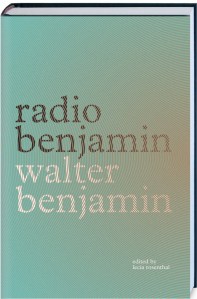
Radio Benjamin – Walter Benjamin’s radio transcripts reviewed in Berfrois by David Beer


Radio Benjamin is reviewed by David Beer in Berfrois. Here’s the opening two paragraphs:

unnamed

Writing at sometime around 1930 or 1931, Walter Benjamin (p.364) suggested that the voice on the radio is a like a visitor in the home, as such it is “assessed just as quickly and sharply” as any other houseguest. Unfortunately, as far as we are aware, there are no existing audio tapes with which to assess our sympathies for Walter Benjamin’s radio voice. Yet the newly translated collection of the scripts from his various radio broadcasts, gathered in the recently published volume Radio Benjamin, provides us with some insights into what he might have sounded like.

There is an undoubtable audio texture to these printed passages, the grain of his voice and the style of his speech find their way into the prose. But this selection of his radio outputs does more than simply allow us to listen to his imagined voice; these pieces also reveal something of his writing, his working practices and the emergence and formation of some of his key ideas. Far from being an unwelcome and maybe even annoying distraction from his work, as Benjamin himself would have us believe, it would seem, that these broadcasts became an important part of the development of his thinking and writing (as has been briefly suggested by Gilloch, 2002: 170 and Brodersen, 1996: 193).

Posted in Books, Walter Benjamin | 2 Comments

Reflections on Agamben’s Homo Sacer: The Last Act (L’Uso dei Corpi)

Stelios-Faitakis12At Critical Legal Thinking, Flavio Michele Ceci discusses ‘Homo Sacer: The Last Act’ – the recent publication of Giorgio Agamben’s L’uso dei Corpi — forthcoming in English translation as The Use (or Usage?) of Bodies.

Here’s the first paragraph:

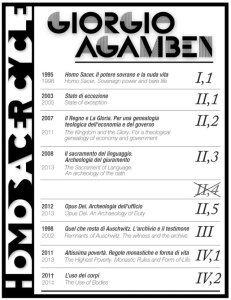
Giorgio Agamben has abandoned Homo sacer. By his own admission in the foreword to his book, and having so acknowledged in the first lecture of his 2014 seminar at the European Graduate School, his latest L’uso dei Corpi—forthcoming in English translation as The Usage of Bodies—will be the last chapter of his 20-​year-​long research. Abandoned, he said and wrote, because every demanding philosophical effort cannot be pushed to an end, it cannot be concluded. HomoSacer800In these words, there is already a sort of declaration, a signal from the place he belongs and toward the place he currently occupies in western philosophy. Homo sacer ends with a book gathering his writings and ideas over a span of 20 years, reworking the texture of a lifetime’s thought by recollecting its latest inheritance, but mostly — and more importantly — advancing something on the future.

A schema of the whole Homo Sacer series can be found here.


Posted in Books, Giorgio Agamben | 1 Comment

Geographica Helvetica – open access from 1 January 2015

graphic_gh_cover_homepageThis is good news – Geographica Helvetica will be open access for both new work and all the archives from 1st January 2015. I’ve been on the board of this journal for the past few years and it’s published some interesting and important work. In it’s own words it “publishes contributions in all fields of geography as well as in related neighbouring disciplines. It is a multi-lingual journal, accepting articles in the three Swiss languages, German, French and Italian, as well as in English. It invites theoretical as well as empirical contributions”. It’s now part of an important shift in publishing patterns – an established and reputable journal moving to open access.

Posted in Geographica Helvetica, Publishing | 1 Comment

Rethinking possibilism for an Anthropocenic geopolitics – cfp for RGS-IBG 2015

Philip Conway has put together a call for papers for a session or sessions on ‘Rethinking possibilism for an Anthropocenic geopolitics’ for the 2015 RGS-IBG conference. RGS-IBG Conference on ‘Geographies of the Anthropocene’, 1st – 4th September 2015, University of Exeter – full details here.

Posted in Conferences | Leave a comment

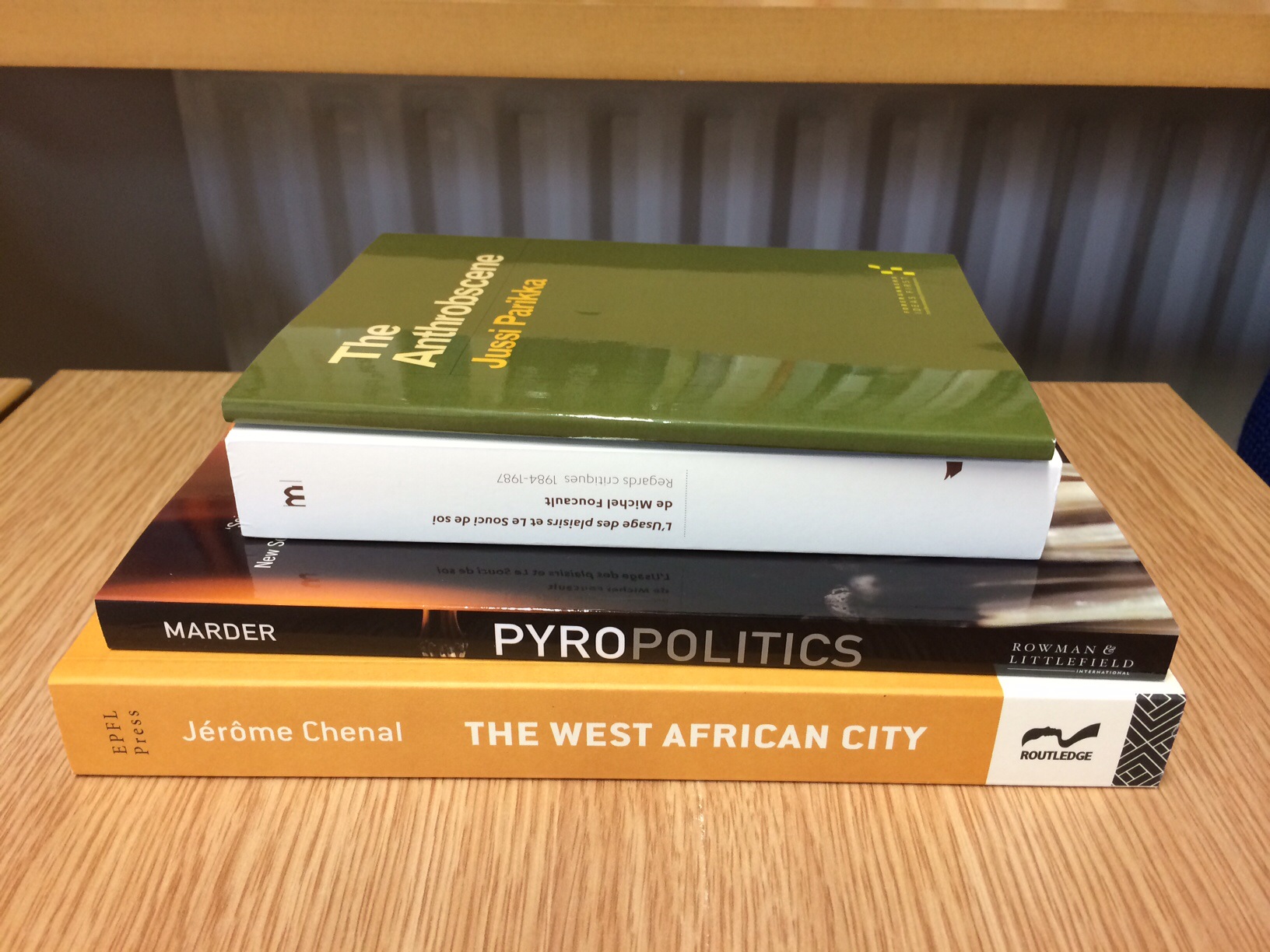
Books received – Parikka, Foucault, Marder, Chenal

Jussi Parikka’s The Anthrobscene; a collection of contemporary reviews and discussions of the second and third volumes of Foucault’s History of Sexuality; Michael Marder’s Pyropolitics and Jérôme Chenal’s The West African City.

/home/wpcom/public_html/wp-content/blogs.dir/669/13404410/files/2014/12/img_0029.jpg

Posted in Uncategorized | 1 Comment

Stuart Elden on Foucault and Neoliberalism

Peter Gratton links to my previous post and adds some useful comments of his own.

Peter Gratton's avatarPHILOSOPHY IN A TIME OF ERROR

Here. I had been rounding up a post on this but never got around to it, and Stuart makes excellent and helpful points (with the modesty to suggest his views are revisable once the book referenced in the Zamora interview is published). Daniel Zamora’s original interview at Jacobin got picked up quickly by two “libertarian” sources at Reasonand at, of all places least likely to see a reference to Foucault, the Washington Post in the form of Daniel Drezner’s piece on “Why Michel Foucault is the libertarian’s best friend.” First, from Stuart Elden:

Foucault’s mode of reading texts often makes it look like he is agreeing with arguments, when he is really trying to reconstruct them, to understand their logic, and so on. To suggest there is some sympathy to neoliberalism is one thing, to claim he was a neoliberal/libertarian or other labels is quite another. Compare these…

View original post 282 more words

Posted in Uncategorized | 1 Comment

Foucault and Neoliberalism – a few thoughts in response to the Zamora piece in Jacobin

FoucaultI’ve been away, but several people have been sending me links to a recent string of articles on Foucault’s supposed sympathies to neoliberalism. The start of the debate – in English at least – was the translation of an interview with Daniel Zamora at Jacobin. The interview relates to a book entitled Critiquer Foucault: Les années 1980 et la tentation néolibérale which has just been published. Clare O’Farrell rounds up the key pieces at Foucault News.

The book is a collective work, edited by Zamora. I’ve not read it yet, and suspect that very few of those commenting on it have either. Anything said now is necessarily provisional.

The first thing that struck me was the question – is this news? Foucault’s 1979 lectures on neoliberalism – the misnamed The Birth of Biopolitics – have been widely available for a decade. They were first published in French in 2004, and translated into English in 2008. Some people – Thomas Lemke being the standout example – were discussing them before then on the basis of the archived tape recordings.

Others have made the suggestion that Foucault had some sympathy to neoliberalism as well – Paul Patton, for example. Plenty of others have discussed Foucault in relation to neoliberalism and what it has become – Jamie Peck and Nick Gane immediately come to mind. Clive Barnett offers some thoughts here, building on earlier pieces in 2011 and 2013. So, again, this is not really news. To assess the validity of the claims people should really read or re-read Foucault’s lectures – as far as I can tell, the ‘revelations’ are not based on any new material. Zamora mentions some other material, but says it is all available.

The real revelation would be a reading of a text Foucault drafted sometime around 1980-81, entitled “libéralisme comme art de gouverner” and mentioned by Michel Sennellart in his notes to The Birth of Biopolitics and On the Government of the Living. This text is not published. It’s notable that after the 1979 lectures all of Foucault’s courses are on antiquity or the early Church, though he ran his seminar in 1980 on liberalism in the 19th century, and sponsored seminars run by François Ewald on the sociology and philosophy of law in 1981 and 1982. Those seminars – some of which were apparently taped – would provide some interesting supplementary material. Incidentally, I am puzzled by how Foucault can be somehow tainted by what Ewald has gone on to do. Ewald has been described as a ‘right-Foucauldian’ – but his work and politics is hardly a revelation. (That this might be seen as news to anglophones is maybe a side-product of something I’ve remarked on before – that few people read the work of Foucault’s colleagues and collaborators, much of which isn’t available in English.)

Another immediate reaction to the initial piece was that there is a risk that we take Foucault’s lectures as they are now presented to us, as ‘books’. But they are obviously not of the same status as the books he published himself, over which he spent years of work, nor are they are of the same standing as the countless shorter works he published in his lifetime – some based on lectures, certainly, but also articles, interviews, petitions, etc. to which he put his name. It is fairly shocking that we lack a complete English translation of Dits et écrits (which collects nearly all of these)- twenty years after it appeared in French. The Anglophone ‘Essential Works‘ is badly misnamed – at best it is a poor substitute for the richness of the French.

One of the implications of this is that Foucault’s verbal proclamations should be taken as that – provisional, of the moment, only part scripted (compare Lectures on the Will to Know to get an indication of what Foucault’s notes look like, without the supplement of the tape-recordings). Valuable, fascinating and revealing certainly, but to be used with caution. There is a remark in one of the lectures (10th March 1982, second hour) where Foucault asks his audience if they have recordings of his lectures of the past few years they could share with him –

I understand that there are some people recording the lectures. Very well, you are obviously within your rights. The lectures here are public. It’s just that maybe you have the impression that all my lectures are written. But they are less so than they seem to be, and I do not have any transcripts or even recordings. Now it happens that I need them. So, if by chance there is anyone who has (or knows someone who has) either recordings – I believe there is someone called Monsieur [Jacques] Legrange – or obviously transcripts, would you be kind enough to tell me, it could help me. It is especially for the last four or five years (The Hermeneutic of the Subject pp. 378/395-6).

The four or five years refers to all or most of Foucault’s post-sabbatical lectures, but certainly including The Birth of Biopolitics.

Foucault, in these 1979 lectures, undoubtedly found neoliberalism interesting and worthy of his devoting substantial attention. But aside for historical and contextual reasons for why this might be the case (which I cannot address here) this was a very early ‘neoliberalism’ – the lectures were delivered before Reagan or Thatcher were elected. And this course is unusual in being the only one of the Paris courses that was directed toward the twentieth-century. Foucault’s mode of reading texts often makes it look like he is agreeing with arguments, when he is really trying to reconstruct them, to understand their logic, and so on. To suggest there is some sympathy to neoliberalism is one thing, to claim he was a neoliberal/libertarian or other labels is quite another. Compare these lectures’ tone to those on early Christianity and late antiquity in the next two courses – does this mean Foucault was also a Christian and a stoic?

Also, the title of the interview is ridiculous – of course we can criticise Foucault. There are critiques everywhere – far too many to list and link. Even people who find his work invaluable criticise him. In the book I’m currently writing on Foucault I’m largely taking a synthetic and exegetical tone, but see what I’ve said about Foucault and territory for a different approach

I hope Zamora’s edited book itself (despite its title) will be a good deal more nuanced and interesting than the publicity so far. It has certainly succeeded in getting mainstream media attention in a way few books on Foucault have. Perhaps I’ll say more when I’ve read it. I hesitated about giving this even more attention by writing up these few thoughts, but enough people contacted me by email, twitter or facebook that I thought it was worth saying something.

Posted in Foucault's Last Decade, Michel Foucault, Politics | 50 Comments

Heidegger Gesamtausgabe app with links to available translations

An app linking to available translations of volumes of Heidegger’s Gesamtausgabe is available here – requires free registration. A webpage listing (not needing registration) is here.

Posted in Books, Martin Heidegger, Publishing | Leave a comment

# THE FUNAMBULIST PAPERS 58 /// Corpographies: Making Sense of Modern War by Derek Gregory

Derek Gregory writes about corpographies in The Funambulist papers series.

Léopold Lambert's avatarThe Funambulist

Stills from the film Diary of an Unknown Soldier by Peter Watkins (1959) / See past article

The second series of The Funambulist Papers, dedicated to the bodies is almost over (four more texts soon forthcoming), and the book that collects its essays is currently being edited. Today, we have the chance to read a text written by Derek Gregory (see our past conversation on Archipelago) about the concept of corpography, which attempts to give a reading of the war based on bodily experience. The relation between the First World War’s soldiers and the mud (see Peter Watkins’s first and fascinating film above) is one instance, but Derek particularly insists on the sonic aspect of the war: the sound of the guns and the bombs being simultaneously terrifying as an affect (see the descriptions by Mohammed Omer about last summer’s bombing of Gaza as a Wagner dreadful symphony), but also…

View original post 4,085 more words

Posted in Uncategorized | Leave a comment