 I spent some more time on the collaborative projects part of Chapter Six – especially on the report Généalogie des équipements de normalisation: Les équipements sanitaires which has some very interesting material. I say a bit more about this here. I also drew together all the information I know about the collaborative projects from this era here – a resource I hope is helpful and for which I’d welcome additions or corrections.
The last thing, at this stage of drafting, I wanted to complete in Chapter Six was the material on Iran. I reread all the material, and ended up feeling I had little to say. The treatment in Afary and Anderson’s Foucault and the Iranian Revolution is very partial, but they do provide a useful appendix of texts by Foucault and some of his critics, including one that was not published in Dits et écrits. Marcelo Hoffman’s Foucault and Power provides a good balance. I’m not sufficiently interested in this work to want to devote much time to it here – its key link to his major concerns is around the notion of ‘political spirituality’ on which I do say a little.
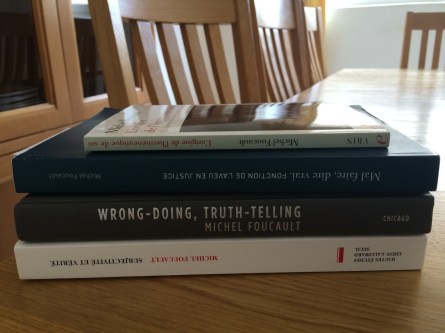
Onto Chapter Seven… Aside from October 1979 Tanner lectures, which recapitulate much of the 1978 course Security, Territory, Population, until recently there was quite a gap between the 1979 course The Birth of Biopolitics and the next one available – 1982’s The Hermeneutic of the Subject. That gap has now been filled, not just by two Collège de France courses – 1980’s Du gouvernement des vivants and 1981’s Subjectivité et vérité – but also the 1981 Louvain lectures Wrong Doing, Truth Telling. (As always, I use French titles when English translations are not yet published; English when they are.) We also have the small book of Foucault’s US lectures of late 1980, L’origine de l’herméneutique de soi with familiar lectures translated into French, but also with some valuable material not available in English. I’ve written on the English sources on this site before.
I spent much longer on these US lectures than I imagined – they are intriguing for all sorts of reasons, especially in the light of the fuller treatments of the material before and after these dates. But they are really Foucault at the moment of transition between Christianity and antiquity. Before that time, antiquity was only really the focus of the 1970-71 course; after that time it would be the main focus of all his courses. I also spent some time going back to some of Foucault’s source material and reading what he’d read – a step that I think is missing from too much work on him.
The key question, for this book, is how to organize chapter divisions to make sense of this new material in relation to Foucault’s late books. In the course summary of Subjectivité et vérité Foucault says that he will dispense with a long assessment, since the course will be the product of a forthcoming publication, and there is a lot of material there that is used in the second and third volume of the History of Sexuality, though these did not appear for a few years. My thinking at the moment is that this course should therefore be treated alongside those books, in Chapter Eight. Du gouvernement des vivants can, I think, be plausibly seen as the third course on governmentality, but also as the first of a sequence of courses, lasting until Foucault’s death, where antiquity – in this case, the early Church – is the predominant focus. It has important links through to Subjectivité et vérité, and beyond, in that some of the claims Foucault makes about pagan ethics in his discussion of Christianity are deepened and more finely nuanced in subsequent courses. But equally, much of Du gouvernement des vivants is a development of claims made in Security, Territory, Population, and, further back, a reworking of claims first elaborated in The Abnormals. In some ways it flows better into Wrong Doing, Truth Telling than Subjectivité et vérité, despite the dates. The question of confession, as I’ve stressed before, is the key both to the original, thematic plan of the History of Sexuality and the later, historical plan. But in both versions, the explicit treatment of confession is missing – the projected second volume of the original plan was drafted but unpublished and at least partly destroyed; the fourth volume of the later, final plan was written but its final version was left unedited at Foucault’s death and remains unpublished. Du gouvernement des vivants and Wrong Doing, Truth Telling fill in some detail.
I have agreed to write a review essay of On the Government of the Living and Wrong Doing, Truth Telling for Berfrois, which I will begin when the former actually appears in print – it has been much delayed. I may also need to revisit the order of material after I’ve worked on the later chapters. But Chapter Seven now exists in a draft form of how I currently envision it. Chapter Eight will begin with Subjectivité et vérité, move onto Hermeneutic of the Subject and then the second and third volumes of the History of Sexuality.
I now need to put this manuscript to one side for a while as I work on some forthcoming talks and then prepare for teaching. I’ll be teaching the Geopolitics Today MA class again, and a European Political Theory seminar.
You can read more about the Foucault’s Last Decade project, along with links to previous updates, here.


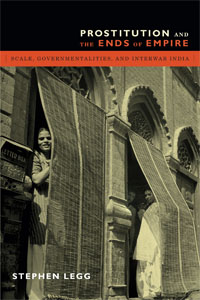 ned to red-light districts, brothels in British India were tolerated until the 1920s. Yet, by this time, prostitution reform campaigns led by Indian, imperial, and international bodies were combining the social scientific insights of sexology and hygiene with the moral condemnations of sexual slavery and human trafficking. These reformers identified the brothel as exacerbating rather than containing “corrupting prostitutes” and the threat of venereal diseases, and therefore encouraged the suppression of brothels rather than their urban segregation. In this book, Stephen Legg tracks the complex spatial politics surrounding brothels in the interwar period at multiple scales, including the local, regional, national, imperial, and global. Campaigns and state policies against brothels did not just operate at different scales but made scales themselves, forging new urban, provincial, colonial, and international formations. In so doing, they also remade the boundary between the state and the social, through which the prostitute was, Legg concludes, “civilly abandoned.”