Graham and McFarlane (eds.) Infrastructural Lives: Urban Infrastructure in Context

A new collection edited by two former colleagues – Stephen Graham and Colin McFarlane.

9780415748537

Infrastructural Lives is the first book to describe the everyday experience and politics of urban infrastructures. It focuses on a range of infrastructures in both the global South and North. The book examines how day-to-day experience and perception of infrastructure provides a new and powerful lens to view urban sustainability, politics, economics, cultures and ecologies. An interdisciplinary group of leading and emerging urban researchers examine critical questions about urban infrastructure in different global contexts.

The chapters address water, sanitation, and waste politics in Mumbai, Kampala and Tyneside, analyse the use of infrastructure in the dispossession of Palestinian communities, explore the pacification of Rio’s favelas in the run-up to the 2014 World Cup, describe how people’s bodies and lives effectively operate as ‘infrastructure’ in many major cities, and also explores tentative experiments with low-carbon infrastructures.

These diverse cases and perspectives are connected by a shared sense of infrastructure not just as a ‘thing’, a ‘system’, or an ‘output,’ but as a complex social and technological process that enables – or disables – particular kinds of action in the city. Infrastructural Lives is crucial reading for academics, researchers, students and practitioners in urban studies globally.
Posted in Politics, Stephen Graham, urban/urbanisation | Tagged , | 3 Comments

Foucault Studies 18 now published – includes two translations of Foucault, all open access

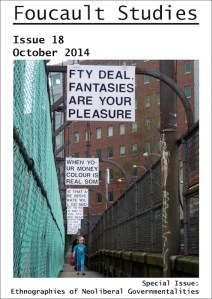
cover_issue_568_en_US (1)Foucault Studies 18 is now published. A wide range of contents including a theme section on ‘Ethnographies of Neoliberal Governmentalities’; translations of Foucault’s 1979 version of ‘Politics of Health in the Eighteenth Century‘ and his review of Jacques Ruffié, De la biologie à la culture under the title of ‘Bio‐history and bio‐politics‘; and a review forum on Colin Koopman’s Genealogy as Critique. As ever, all articles are open access.

Posted in Michel Foucault | 2 Comments

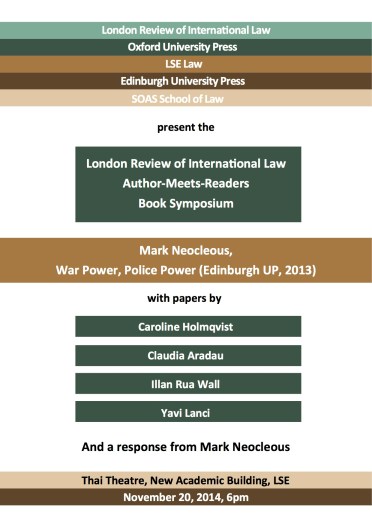
Symposium on Mark Neocleous, War Power, Police Power – LSE, 20 November 2014

lril symposium flyer_a4 copy

Details of a book symposium on Mark Neocleous’s latest – War Power, Police Power.

Posted in Books, Mark Neocleous, Politics | Leave a comment

Henri Lefebvre, Vers une architecture de la jouissance

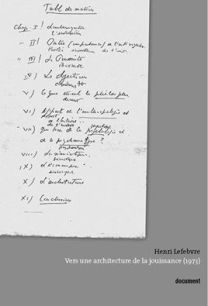
criticat14cover210690034_387393451417965_7363263115971561396_nWhile there is a published translation into English, Henri Lefebvre’s 1973 manuscript Vers une architecture de la jouissance has, until now, not been available in French. Now an excerpt has been published in Criticat, and a full edition may be forthcoming. This issue of the journal also includes an analysis by Łukasz Stanek, editor of the English edition.


Posted in Henri Lefebvre, Uncategorized | 1 Comment

David Campbell, Politics without Principle – free 1993 book online

Politics-without-Principle

David Campbell has made his 1993 book Politics without Principle: Sovereignty, Ethics and the Narratives of the Gulf War available online as a pdf. He says something about the book here.

Posted in Books, David Campbell, Politics | 1 Comment

More additions to the Ebola reading list

I’ve made some more additions to the Ebola reading list. A really useful resource is Ebola Deeply, which is an aggregating news source (see discussion of project here; and also @Eboladeeply). Thanks to David Campbell for this link.


Posted in Ebola | Leave a comment

Grégoire Chamayou, ‘What is Necroethics?’, King’s College London, 29 October 2014

Posted on behalf of Paul Gilroy:

Hosted by the Capture Seminar, Grégoire Chamayou – author of Manhunts: A Philosophical History [Princeton, 2012] and Théorie du drone [La Fabrique, 2013] – will be joining us at King’s to give a presentation  “What is necroethics? A sketch of a critical definition” on Weds 29th of October. His talk will be in K2.31 (on the 2nd floor of the King’s building–accessed from The Strand) 6-8pm.

Posted in Conferences, Grégoire Chamayou | 1 Comment

Ethnofiction: Augé’s No Fixed Abode reviewed

Marc Augé’s No Fixed Abode reviewed at the Society and Space open site.

Posted in Uncategorized | 1 Comment

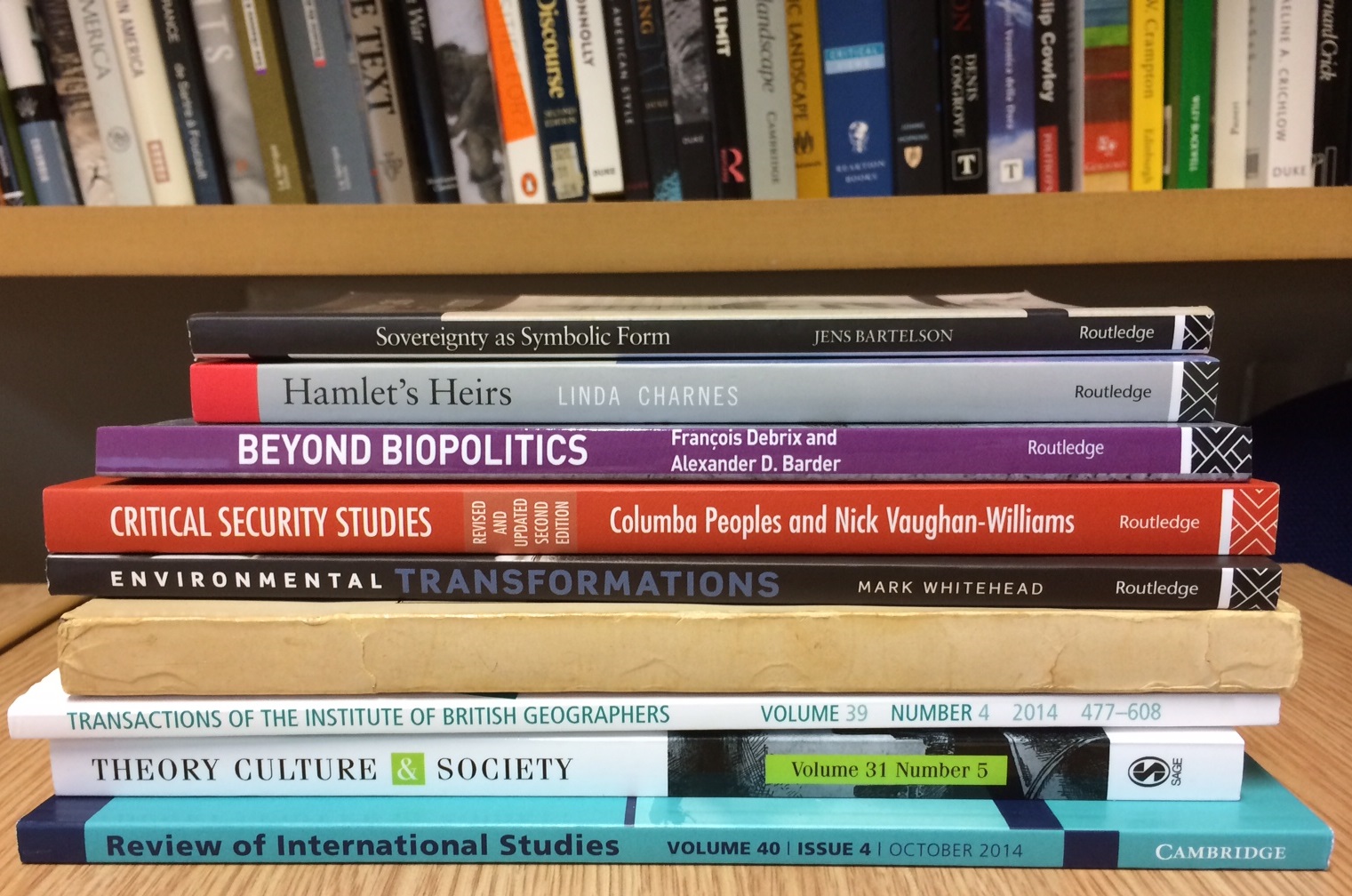
Books received – Bartleson, Charnes, Debrix & Barder, Peoples & Vaughan Williams, Whitehead, Foucault et. al, and journals

photo (2)photo

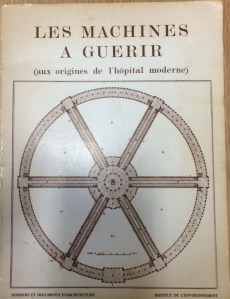
A few books from Routledge in recompense for review work, new issues of Transactions, Review of International Studies and Theory, Culture and Society, and a first edition (1976) of the Foucault-led Les machines á guerir. As I discuss in the page on Foucault’s collaborative projects, this is very different from the 1979 version.

Posted in Books, Foucault's Last Decade | 1 Comment

Conflicts without borders

Derek Gregory provides some slides from his recent presentation – some very good maps here (and linked from here).

Derek Gregory's avatargeographical imaginations

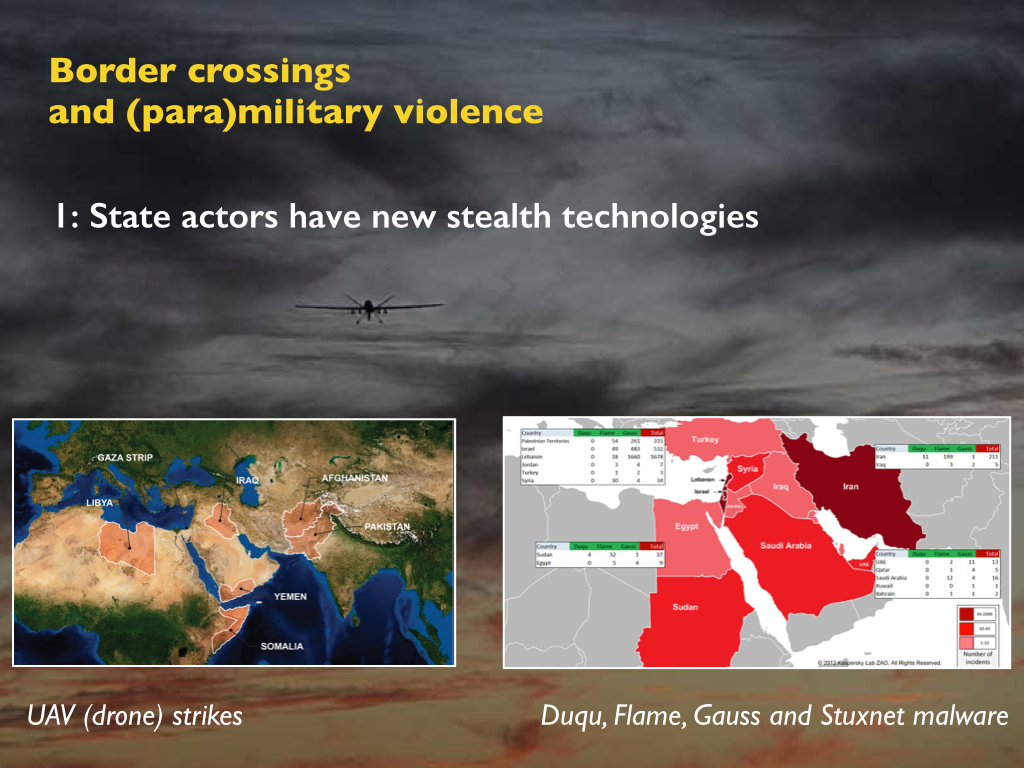
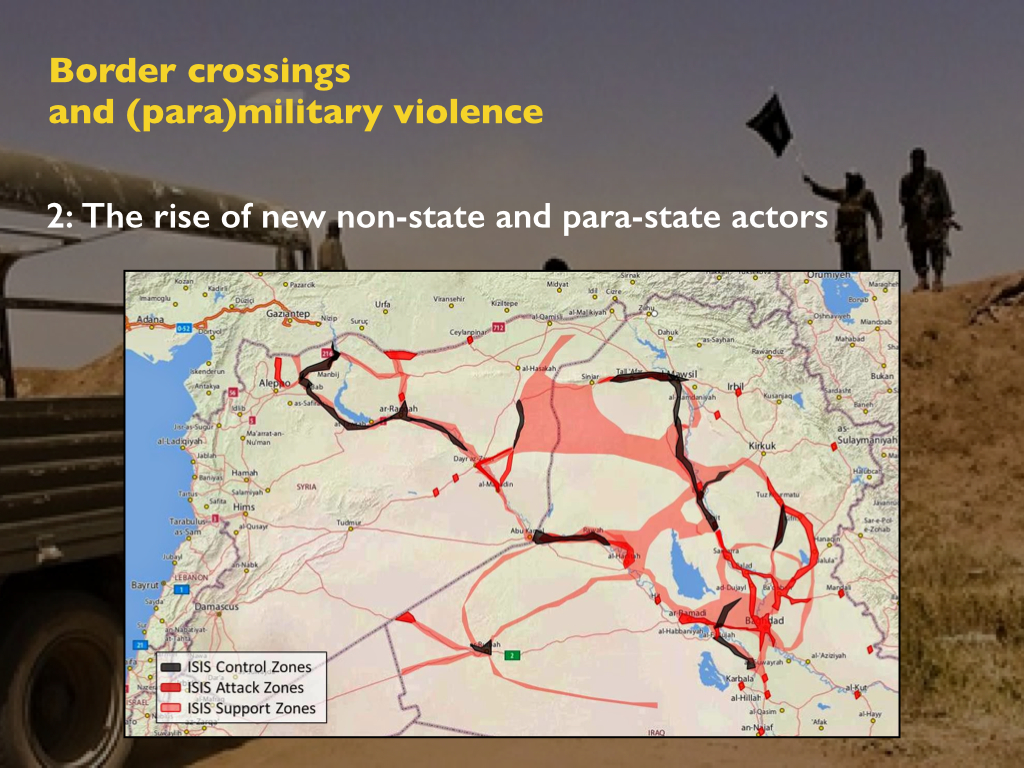
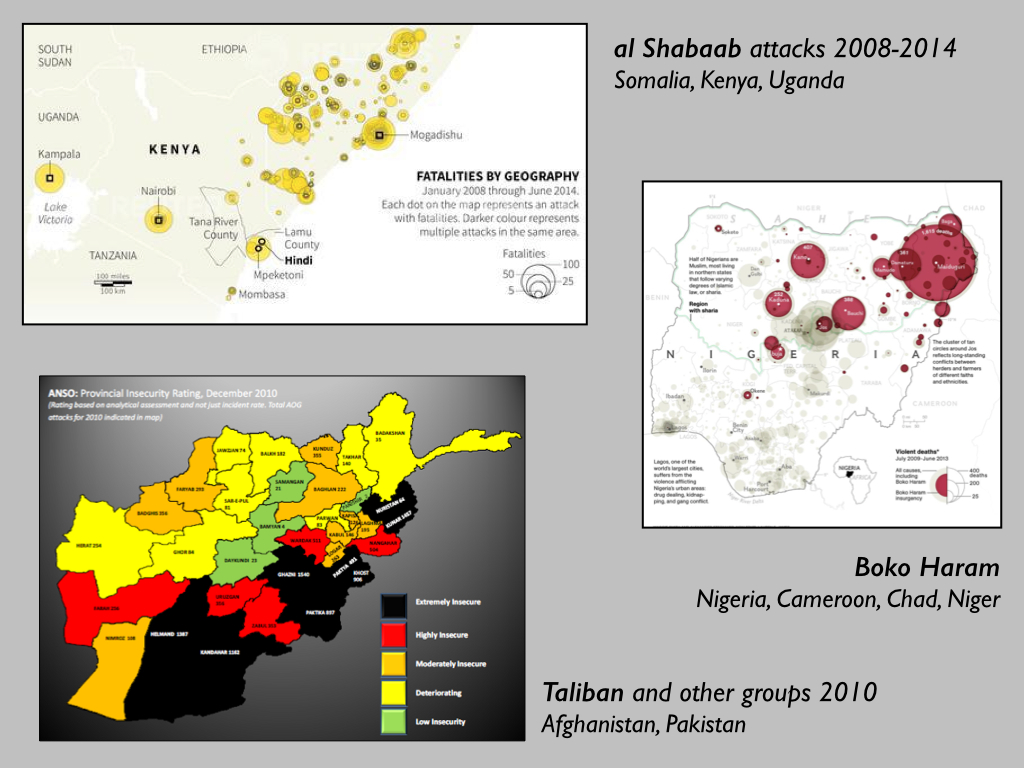
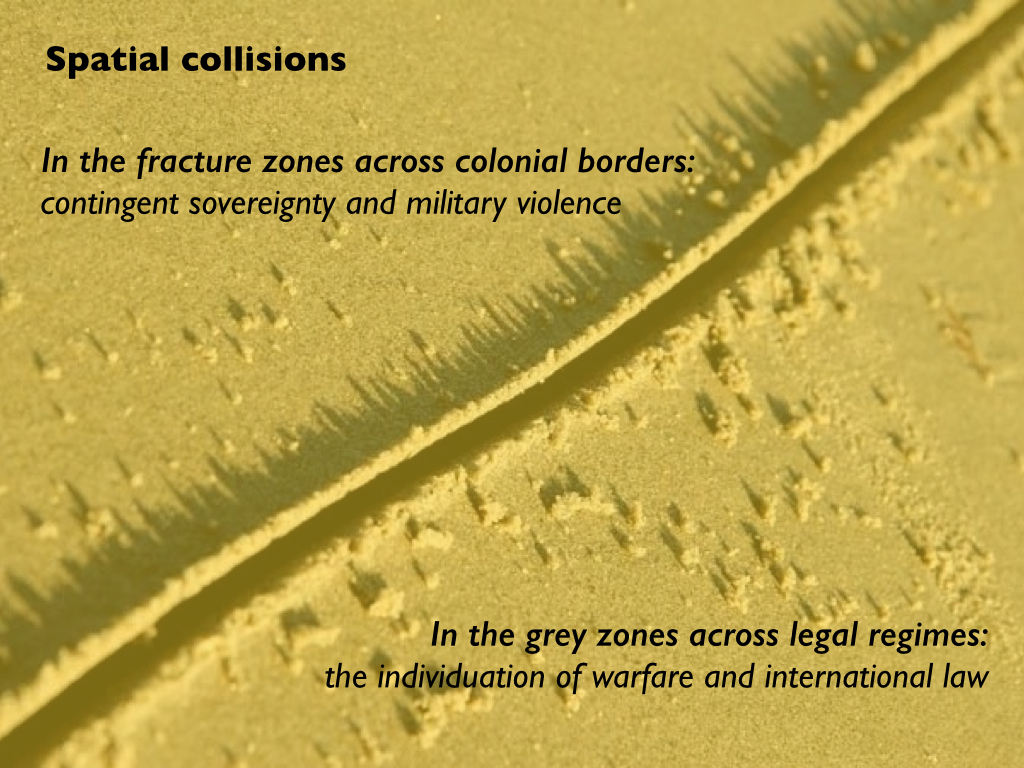
In Finland last month I gave a presentation on Law, violence and b/ordering, in which I began by making two preliminary points about border crossings and (para)military violence: trans-border incursions and transgressions have been facilitated by (i) new stealth technologies deployed by state actors and (ii)  the rise of new non-state and para-state actors.  Here are the relevant slides:

GREGORY 2 Law, violence and b:ordering.001

GREGORY 2 Law, violence and b:ordering.002

GREGORY 2 Law, violence and b:ordering.003

GREGORY Law, violence and b:ordering.003

I derived the map showing the advance of IS(IS)/ISIL from the Institute for the Study of War; say what you like about their politics (this is the Kagans we are talking about), their maps and summaries are extremely helpful.

Now Public Intelligence has just published a series of (unclassified) maps of Iraq, Syria, Lebanon and Jordan produced by the Humanitarian Information Unit of the US State Department called Conflicts Without Borders:

‘Conflicts Without Borders refers to a conflict in one country that draws in other governments and non-state actors…

View original post 125 more words

Posted in Uncategorized | 2 Comments