This groundbreaking work presents a transformative perspective on political theory. This text is not just an introduction to political theory, it’s a call to broaden the discipline’s horizons, making it more globally aware and methodologically diverse.
The authors introduce a novel approach to political theory that expands the scope of the discipline beyond traditional philosophical texts and Eurocentric perspectives. The text integrates canonical Western texts with diverse sources of political thought from a wide range of times and places – spanning the Vedas to the Quran, the Upanishads to the Popol Vuh. This is the first introductory text to incorporate such a variety of texts and authors with each thinker (whether Plato or Laozi, Du Bois or Confucius) introduced in a way that’s both accessible and relevant today.
The text also demonstrates the possibilities for comparison and connections in teaching political theory. Cross-cutting themes of gender, race and colonialism connect disparate ideas across time periods and geographies, forging a comprehensive network of political thought.
This pioneering textbook reshapes the way political theory is taught and understood and is an essential companion for all undergraduate and postgraduate students of political theory as much as it will be for anyone interested in global political thought. This text is a must-read for anyone looking to understand the full spectrum of political thought and its application in today’s interconnected world.
On the occasion of the publication of the second volume of Bataille’s Critical Essays, which collects previously untranslated texts by George Bataille, Jared Bly interviewed its editors, Benjamin Noys and Alberto Toscano. The interview covers Bataille’s complex relationship with fascism, the relationship between heteronormativity and the sciences in his work, the status of the “lacerating image” in a mediatized world, and the significance of thinking through the “instant” in the context of predominant future-oriented thinking.
This has been online first for a while, but has now appeared in an issue. Available open access.
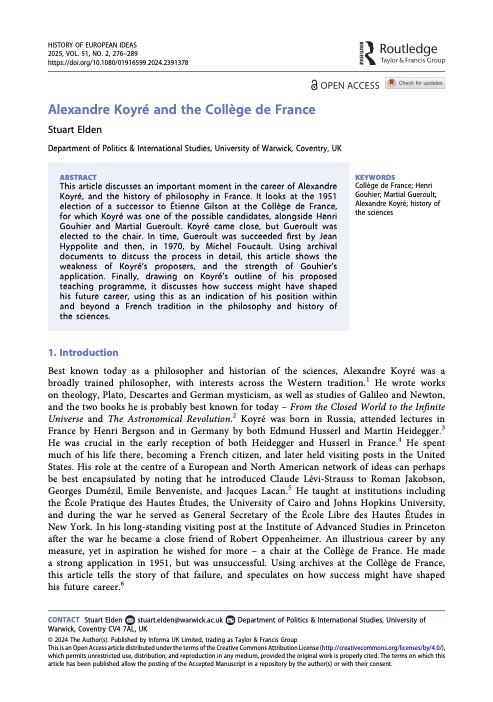
This article discusses an important moment in the career of Alexandre Koyré, and the history of philosophy in France. It looks at the 1951 election of a successor to Étienne Gilson at the Collège de France, for which Koyré was one of the possible candidates, alongside Henri Gouhier and Martial Gueroult. Koyré came close, but Gueroult was elected to the chair. In time, Gueroult was succeeded first by Jean Hyppolite and then, in 1970, by Michel Foucault. Using archival documents to discuss the process in detail, this article shows the weakness of Koyré’s proposers, and the strength of Gouhier’s application. Finally, drawing on Koyré’s outline of his proposed teaching programme, it discusses how success might have shaped his future career, using this as an indication of his position within and beyond a French tradition in the philosophy and history of the sciences.
This is very interesting – the discovery of typescript versions of Foucault’s History of Madness and introduction and translation of Kant’s Anthropology, annotated by Foucault –
(open access, in French; some good images of pages)
Folie et déraison. Histoire de l’expérience de la folie à l’âge classique, M. Foucault, Paris, Thèse principale de doctorat en Lettres, 1961. Page de titre. BU Henri-Piéron. Cote : FP TH 124 (1). Cliché : Colas Rosset
When I was researching The Early Foucault, I was curious about the early versions of Folie et déraison, but there was no typescript of this kind in Foucault’s own archive, or in Canguilhem’s. I did manage to see a copy of the printed text bound for the defence, which was the same as the 1961 Plon version except for the cover and endpapers. The history of the book’s printing and variants still causes confusion – there is a list of the different versions here. The version discussed in the above article obviously precedes all of these printed versions – a fascinating addition to the story of this text.
Henri Lefebvre and Patrick Tort, “The Lukács Question”, translated by Federico Testa, edited and introduced by Stuart Elden and Adam David Morton, Historical Materialism. Now available online first and open access.
This developed out of the work that went into Henri Lefebvre, On the Rural: Economy, Sociology, Geography, edited by Stuart Elden and Adam David Morton, translated by Robert Bononno with Matthew Dennis and Sîan Rosa Hunter Dodsworth, Minneapolis: University of Minnesota Press, 2022.
This piece obviously doesn’t fit that theme, but connects in particular to some of the work Adam and colleagues have been doing on Lukács in recent years – discussed and linked at the Progress in Political Economy site.
In the 1920s, the Gulf of Naples was a magnet for European intellectuals in search of places as yet untouched by modernity. Among the revolutionaries, artists, and thinkers drawn to Naples were numerous scholars at a formative stage in their journeys: Walter Benjamin, Siegfried Kracauer, Alfred Sohn‑Rethel, Asja Lacis, Theodor W. Adorno, and many others. While all were indelibly shaped by the volcanic Neapolitan landscape, it was Benjamin who first probed the relationship between the porous landscape and the local culture. But Adorno went further, transforming his surroundings into a radical new philosophy—one that became a turning point in the modern history of the discipline.
In this ingenious book, Martin Mittelmeier reveals the Gulf of Naples as the true birthplace of the Frankfurt School. From the majestic crater rim of Mount Vesuvius to the soft volcanic rock that Neapolitans used to build their city, Mittelmeier follows Adorno’s and his fellow thinkers’ footsteps through the cities along the gulf, demonstrating how their observations and encounters surface again and again in their writings for decades to come, and serve as the structuring principle of Critical Theory.
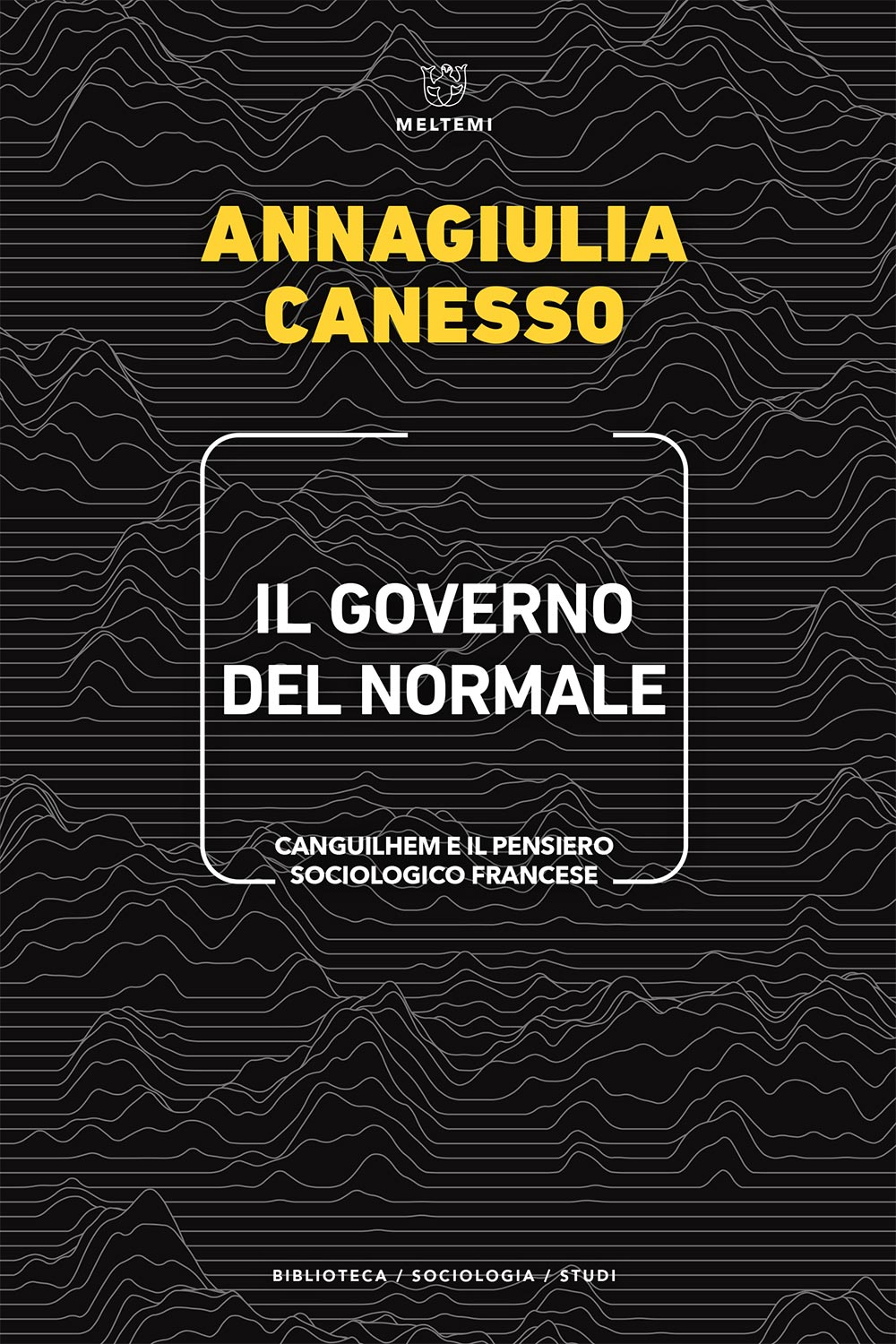
Il volume affronta la concezione del normale e del patologico nel pensiero sociologico francese, in particolare in Auguste Comte, Émile Durkheim e Maurice Halbwachs, attraverso la prospettiva di Georges Canguilhem.
Annagiulia Canesso prova a dare una risposta ad alcuni interrogativi che caratterizzano l’odierno agone politico, servendosi dei ragionamenti dei filosofi di riferimento: quali sono le categorie concettuali cui facciamo riferimento per interpretare la società? Da quale tradizione di pensiero provengono? E quali poste in gioco racchiudono? In che modo incrociano tanto le scienze della vita quanto le scienze della società?
Quella dell’autrice è una lettura filosofica che propone di sondare le principali questioni epistemologiche, politiche e storico-concettuali contenute nel richiamo al normale e al patologico da parte della sociologia, che si istituisce come scienza della società e, contempora-neamente, come sua prassi trasformativa. La definizione di un “governo del normale” appare così come una problematizzazione della modernità che, ancora oggi, informa e plasma la nostra esperienza della politica.
Although they both studied in Germany, and were among those who attended Heidegger’s lecture courses in the 1920s, Hannah Arendt and Alexandre Koyré didn’t meet at that time. (Arendt attended lectures in 1924-26 in Marburg; Koyré in 1928-29 in Freiburg.) Their first contact seems to have been after Arendt had left Germany in 1933, when she moved to Paris where Koyré was teaching at the École Pratique des Hautes Études. Teaching records of the EPHE show that Arendt’s husband at the time, Günter Stern (Anders), attended Koyré’s classes. Their friendship, though, seems to have really developed only after Arendt moved to the United States. Hannah Arendt’s biographer Elisabeth Young-Bruehl describes Alexandre Koyré as “a close friend” (p.117).
Koyré spent much of the Second World War in the USA, teaching at the New School and the École Libre des Hautes Études, and then was a frequent visitor afterwards, holding visiting positions at several US institutions including University of Chicago, Johns Hopkins University, and the Institute for Advanced Study in Princeton. Although Arendt taught at both Chicago and the New School, that was from 1963-67 and 1967-75, and Koyré died in 1964, so they did not overlap. But throughout the 1950s and early 1960s they would meet in both the US and when Arendt was in Europe. Young-Bruehl says that Arendt was invited by Koyré and Jean Wahl to speak to the Collège Philosophique in Paris after the war, but she found the social side of these visits too much (p. 245; citing a letter from Arendt to Hilde Fränkel on 3 December 1949). Arendt was pretty critical about French intellectuals generally, and some of her letters to her second husband Heinrich Blücher are often rude about them. But she seems to have genuinely liked Koyré and his wife.
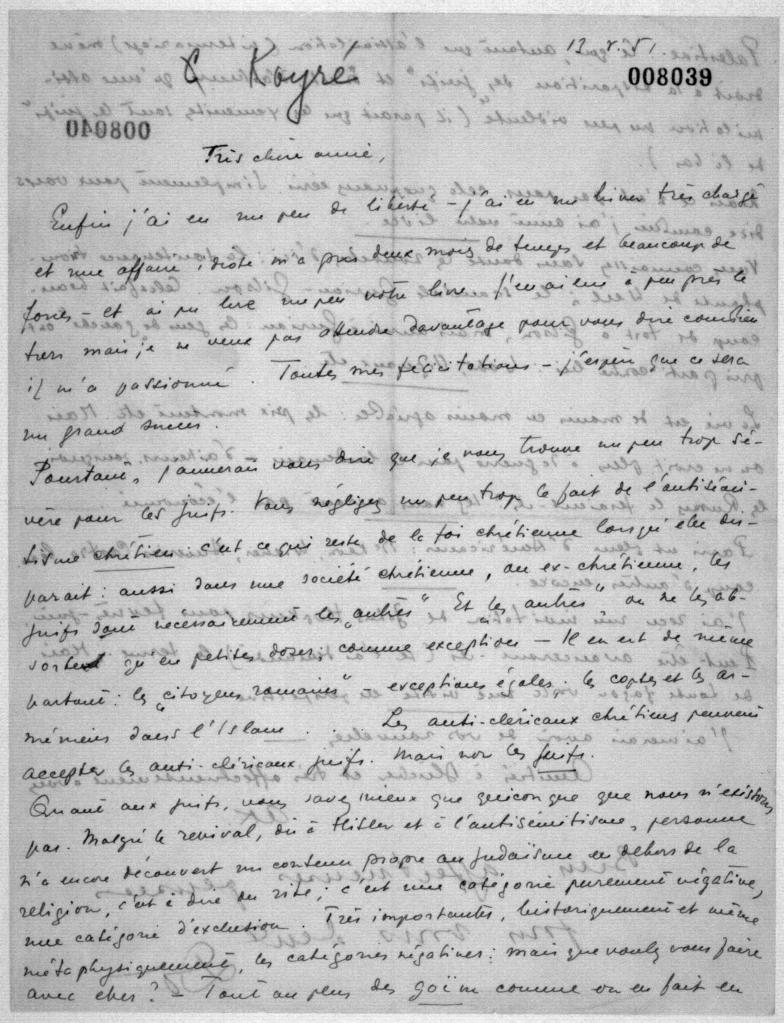
What survives of the Arendt-Koyré correspondence is interesting – it is available as a scan online at the Library of Congress, which holds Arendt’s archives; and was published by Paola Zambelli, Koyré’s biographer, in 1997. But it only covers the years 1951-63, and what survives are only Koyré’s letters to Arendt. As I’ve said before, I understand there is little correspondence in Koyré’s archives. Zambelli provides a useful introduction to the letters. Koyré wrote to Arendt in French – one of their shared languages. (Koyré corresponded with another German-born US philosopher, Horace M. Kallen, in English, and he knew German well.) An English translation of the Koyré-Arendt letters would be worthwhile, I think; perhaps also an edition of the Koyré-Kallen letters.
A page of one of Koyré’s letters to Arendt
Here, though, I won’t discuss the Koyré letters to Arendt, or Zambelli’s useful introduction, but just mention a few other traces of their friendship I know. Arendt tells Gershom Scholem that she had arranged for copies of Scholem’s Major Trends in Jewish Scholarship to go to a range of contacts in France, based on a list that Koyré had put together (19 March 1947). One of those copies was to Koyré himself, and Arendt tells Scholem on 30 September 1947, that:
I just had a long talk with Koyré, who just arrived to give lectures at Chicago University. – (By the way, I like him very much.) About reviews of your book in France: Koyré himself is writing one for the Revue Philosophique.
I don’t think that review ever appeared. Arendt’s marked-up copy of Scholem’s book is available online from Bard College. In a letter to Karl Jaspers, Arendt writes of her delight that Koyré has contacted her on 4 October 1950: “Koyré called out of nowhere this morning; great glee”.
There are some potentially interesting thematic links between their work. One would be the political lie, on which both Koyré and Arendt wrote. This is work which has been revisited in more recent times, including the reprint of Koyré’s text in October in 2017, and the renewed attention to Arendt’s work on totalitarianism. Jacques Derrida discussed both Koyré and Arendt in his lecture “History of the Lie: Prolegomena”, which exists in a few different forms including in Without Alibi. (A version of this lecture was, incidentally, one of the two times I heard Derrida speak.)
Another shared interest would be technology and spatiality. Arendt’s copy of Koyré’s 1957 book From the Closed World to the Infinite Universe is preserved as part of her library, and the marked-up pages have been made available online. Arendt cites the work in The Human Condition, published the following year, and on their shared understandings the best sources I know are essays by Waseem Yaqoob and Bernard Debarbieux.
I am beginning work on Koyré’s other correspondence, and have found few mentions of Arendt. But he does tell a friend in 1959 he is looking forward to Arendt visiting Princeton, where she will be the “first woman professor” (see the report in Princetonia). There are few other traces of the friendship with Koyré in the correspondence of Arendt, at least in that which I have seen. Arendt told Jaspers of Koyré’s death in 1964, which she had learned of though Anne Weil.
Annchen wrote that Koyré had died. I don’t know whether you knew him. An old friend of ours. Sad. I saw him a year ago in Paris after he’d had a stroke that aged him a lot. Then, Annchen wrote, he had bone cancer. So—thank God.
Anne Weil was a childhood friend of Arendt, who was married to the philosopher Éric Weil. Weil dedicated his Logique de la philosophie to Koyré, and they are mentioned in Koyré’s letters to Arendt. Éric Weil was also a co-editor of Critique with Georges Bataille. More connections and networks to explore.
References
Hannah Arendt, The Human Condition, Chicago: University of Chicago Press, 1958.
Hannah Arendt, Crises of the Republic: Lying in Politics; Civil Disobedience; On Violence; Thoughts on Politics and Revolution, New York: Harcourt Brace Jovanovich, 1972.
Hannah Arendt and Heinrich Blücher, Within Four Walls: The Correspondence between Hannah Arendt and Heinrich Blücher, ed. Lotte Kohler, trans. Peter Constantine, New York: Harcourt, Inc., 1996.
Hannah Arendt and Karl Jaspers, Correspondence 1926-1969, eds. Lotte Kohler and Hans Saner, trans. Robert and Rita Kimber, San Diego: Harcourt Brace & Company, 1992.
The Correspondence of Hannah Arendt and Gershom Scholem, ed. Marie Luise Knott, trans. Anthony David, Chicago: University of Chicago Press, 2017.
Bernard Debarbieux, “Les Spatialités dans l’œuvre d’Hannah Arendt”, Cybergeo : revue européenne de géographie, 2014, https://doi.org/10.4000/cybergeo.26277
Jacques Derrida, “History of the Lie: Prolegomena”, Without Alibi, trans. Peggy Kamuf, Stanford: Stanford University Press, 2002, 28-70.
Alexandre Koyré, “Réflexions sur le mensonge”, Renaissance I, 1943, 95-111; revised version as “The Political Function of the Modern Lie”, Contemporary Jewish Record 8 (3), 1945, 290-300; reprinted in October 160, 2017, 143-51.
Alexandre Koyré, From the Closed World to the Infinite Universe, Baltimore: The Johns Hopkins University Press, 1957.
Alexandre Koyré, “Lettres à Hannah Arendt (1951-1963)”, ed. Paola Zambelli, Nouvelles de la république des lettres 13 (1), 1997, 137-56; introduced by Paola Zambelli, “Koyré, Hannah Arendt et Jaspers”, 131-37.
Waseem Yaqoob, “The Archimedean Point: Science and Technology in the Thought of Hannah Arendt, 1951-1963”, Journal of European Studies 44 (3), 2014, 199-224.
Elisabeth Young-Bruehl, Hannah Arendt: For Love of the World, New Haven: Yale University Press, 2ndedition, 2004 [1982].
Paola Zambelli, Alexande Koyré in Incognito, Firenze: Leo S. Olschki, 2016; trans. Irène Imbart, Alexandre Koyré, un juif errant? Firenze: Musée Galileo, 2021.
Archives
Hannah Arendt Papers. Library of Congress: Correspondence, 1938-1976; General, 1938-1976
Fonds Alexandre Koyré, École des Hautes Études en Sciences Sociales archives, Humathèque Condorcet, https://cak.ehess.fr
This is the ninth post of an occasional series, where I try to post short essays with some indications of further reading and sources, but which are not as formal as something I’d try to publish more conventionally. They are usually tangential to my main writing focus, a home for spare ideas, asides, dead-ends and possible futures. I hope there is some interest in them. They are provisional and suggestions are welcome. The other posts so far are:
A new history of Futurism and its fraught ideological ambitions, centered on sculptural experimentation
As the first comprehensive avant-garde of the twentieth century, Italian Futurism sought to integrate modern life with every imaginable aesthetic medium. The detached materiality of sculpture offered a singular proving ground for the drive to merge art and existence. Sculpture’s theory and practice offers a distillation of Futurism’s larger aims and frustrations: a will to mechanize haunted by the tradition of craft; the liberation of flight burdened by mass and gravity; the lyrical mutiny of form chastened by the exigencies of design; and a dream of totality splintered by the contingency of the fragment.
Centered on avant-garde sculpture in Italy and other European countries between the world wars, Fragments of Totality ventures a new history of Futurism and its fraught ideological ambitions. Illuminating understudied works by prominent artists like Giacomo Balla, Enrico Prampolini, Fortunato Depero, and Bruno Munari alongside the efforts of many lesser-known figures, this first major study of Futurist sculpture opens onto wider questions: from labor and leftist Futurism, to the politics of aesthetic autonomy, to the intersections between race, imperialism, and materials. The medium—and the idea—of sculpture sets into relief the demands of any project of modern cultural totality. Futurism’s shifting definitions of “plasticity” underscore the volatile political economy not only of interwar Italy, but also perhaps of a wider Western epoch.
How did the research universities of the Enlightenment come into being? And what debt do they owe to scholars of the previous era? Focusing on the career of German polymath Johann Daniel Major (1634–93), Curating the Enlightenment uncovers how late seventeenth-century scholars crafted the research university as a haven for critical inquiry in defiance of political and economic pressures. Abandoning the surety of established intellectual practice, this ‘experimental century’ saw Major and his peers reshaping fragments of knowledge into new perspectives. Across new disciplines, from experimental philosophy to archaeology and museology, they reexamined what knowledge was, who it was for, and how it was to be stored, managed, accessed, judged, and transformed. Although later typecast as Baroque obstacles to be overcome by the Enlightenment, these academics arranged knowledge in dynamic infrastructures that encouraged its further advancement in later generations, including our own. This study examines these seventeenth-century practices as part of a continuous intellectual tradition and reconceptualizes our understanding of the Enlightenment.