
The audio recording of Badiou’s recent lecture ‘The Althusserian Definition of Theory’ is available here.
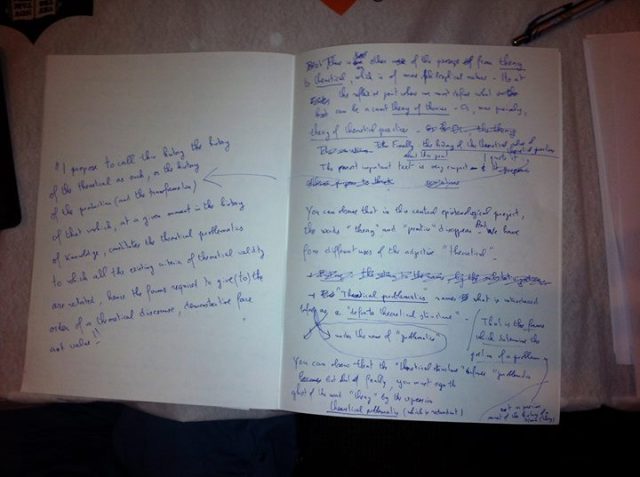
The audio recording of Badiou’s recent lecture ‘The Althusserian Definition of Theory’ is available here.
MIT Press are publishing a book of Žižek’s Jokes.

“A serious and good philosophical work could be written consisting entirely of jokes.”—Ludwig Wittgenstein
The good news is that this book offers an entertaining but enlightening compilation of Žižekisms. Unlike any other book by Slavoj Žižek, this compact arrangement of jokes culled from his writings provides an index to certain philosophical, political, and sexual themes that preoccupy him. Žižek’s Jokes contains the set-ups and punch lines—as well as the offenses and insults—that Žižek is famous for, all in less than 200 pages.
So what’s the bad news? There is no bad news. There’s just the inimitable Slavoj Žižek, disguised as an impossibly erudite, politically incorrect uncle, beginning a sentence, “There is an old Jewish joke, loved by Derrida . . .“ For Žižek, jokes are amusing stories that offer a shortcut to philosophical insight. He illustrates the logic of the Hegelian triad, for example, with three variations of the “Not tonight, dear, I have a headache” classic: first the wife claims a migraine; then the husband does; then the wife exclaims, “Darling, I have a terrible migraine, so let’s have some sex to refresh me!” A punch line about a beer bottle provides a Lacanian lesson about one signifier. And a “truly obscene” version of the famous “aristocrats” joke has the family offering a short course in Hegelian thought rather than a display of unspeakables.Žižek’s Jokes contains every joke cited, paraphrased, or narrated in Žižek’s work in English (including some in unpublished manuscripts), including different versions of the same joke that make different points in different contexts. The larger point being that comedy is central to Žižek’s seriousness.
Thanks to critical-theory.com for the link. [Update: thanks to Scu in comments for linking to this review.]
Jeremy Crampton reflects on contemporary debates around resilience.
Interesting alternatives if not contradictions in understanding “resilience” in recent publications.
Stephanie Wakefield & Bruce Braun understand resilience as a Foucauldian dispositif (apparatus):
we understand resilience as a mode of governing the ‘ecological’ city.
In Resilient Life, a new book by Brad Evans and Julian Reid, they also think of it as a mode of governing:
‘resilience’ … is becoming a key term of art for governing planetary life in the 21st Century…
But the book is then blurbed as follows:
Resilience, they argue, is a neo-liberal deceit that works by disempowering endangered populations of autonomous agency.
My interest here is not so much whether this is an accurate summation of their book (which is not yet out) but that the discourse of resilience is framed as disempowering (the word used is “nihilistic”).
I wrote about this last year here, in the context of Neocleous’ piece in
View original post 459 more words
Terminator II using Shakespearean texts:
Thanks to Volha Piotukh for sending this to me.

Out soon with Polity Press
What does it mean to live dangerously? This is not just a philosophical question or an ethical call to reflect upon our own individual recklessness. It is a deeply political issue, fundamental to the new doctrine of ‘resilience’ that is becoming a key term of art for governing planetary life in the 21st Century. No longer should we think in terms of evading the possibility of traumatic experiences. Catastrophic events, we are told, are not just inevitable but learning experiences from which we have to grow and prosper, collectively and individually. Vulnerability to threat, injury and loss has to be accepted as a reality of human existence.
In this original and compelling text, Brad Evans and Julian Reid explore the political and philosophical stakes of the resilience turn in security and governmental thinking. Resilience, they argue, is a neo-liberal deceit that works by disempowering endangered populations of autonomous agency. Its consequences represent a profound assault on the human subject whose meaning and sole purpose is reduced to survivability. Not only does this reveal the nihilistic qualities of a liberal project that is coming to terms with its political demise. All life now enters into lasting crises that are catastrophic unto the end.
In memory of Stuart Hall: a special programme paying tribute to the leading cultural theorist and former director of the Birmingham Centre for Cultural Studies. A pioneer of ‘multiculturalism’, he documented the changing character of ‘post Imperial’ British society. Laurie Taylor is joined by Caspar Melville, Lecturer in Global Creative and Cultural Industries at SOAS, Baroness Lola Young and Jeremy Gilbert, editor of the journal, New Formations. They explore Stuart Hall’s life, influence and legacy.
Listen to it here (thanks to beechnick for the link). I’ve updated the list of tributes and obituaries here.
Intriguing new book series focusing on Kant
Some useful notes situating Agamben’s theory of destituent power – a Society and Space article and a shorter lecture with linked themes.
A useful resource on Foucault and education at Foucault News.
I have just finished (more or less) compiling a list of English language works on Foucault and education for my M.Ed (Master of Education) students. I thought this might also be of use to others so I have set up a permanent page for it here at Foucault News.
Large as it is, the bibliography is by no means comprehensive, and you are invited to post any missing items, corrections or other additions in the comments section on the page for the bibliography for inclusion in the main document. As such, the bibliography will remain a work in progress.
With thanks to Megan Kimber for assistance in finding many of the journal articles.
Additional open site pieces to go with the Society and Space theme section.


