Global terrorism

Derek Gregory links to a project that maps non-state terrorism.

Derek Gregory's avatargeographical imaginations

With all the usual caveats about the notoriously contentious definition(s) of ‘terrorism’,  the National Consortium for the Study of Terrorism and Responses to Terrorism (START), which has been up and running at the University of Maryland since 2005, has now geocoded its Global Terrorism Database – at least for 2012 – and from its list of more than 8,400 terrorist attacks that killed over  15,400 people its has produce this map of terrorist attacks last year:

START Terrorist attacks 2012

‘Although terrorism touched 85 countries in 2012, just three – Pakistan, Iraq and Afghanistan – suffered more than half of 2012’s attacks (54%) and fatalities (58%)… The next five most frequently targeted countries were India, Nigeria, Somalia, Yemen and Thailand.’

You can download a hi-res and zoomable version here, and you can find out more about START here.

Of course, it’s a moving map:

‘In the 1970s, most attacks occurred…

View original post 73 more words

Posted in Uncategorized | Leave a comment

Confronting the Anxiety of Academic Writing

A good piece on academic writing and the problem of making time for it.

Rachael Cayley's avatarExplorations of Style

Last week I gave a webinar for the Text and Academic Authors Association on confronting the anxiety of academic writing. While these topics were on my mind, I thought I would use this post to elaborate on its key points.

I began the presentation by discussing the key dilemma of academic writing: although writing can be the decisive factor in professional academic success, we often lack both training in the act of writing and time to complete the necessary writing tasks. As a result, we often dislike our own writing or find the process of creating acceptable writing unduly onerous. To make matters worse, these problems are often compounded by the sense that our difficulties are illegitimate, that we should already know how to write. Since we often aren’t expert writers, especially early in our academic careers, we tend to think of ourselves as bad writers. People…

View original post 1,077 more words

Posted in Uncategorized | Leave a comment

Geographies of War & Peace RGS-IBG CFP

Very interesting call for papers for next year’s RGS-IBG conference.

jonescraig's avatarWar Law Space

Please see the below call for papers for the RGS-IBG conference in London in August 2014.


RGS-IBG 2014

Paper Session Proposal

The geography of war and peace

Conveners: Derek Gregory (UBC), Craig Jones (UBC), Benedikt Korf (University of Zurich), Timothy Raeymaekers (University of Zurich)

Research Group Affiliation: Political Geography Research Group (PolGRG):

Abstract:

“War and peace – what’s the difference?” asked David Keen (2000) some time ago. And indeed, war is a slippery concept. Where does war end and peace start? What is war and what is “only” a riot, violence, struggle or uprising? And what does war tell us about peace? Or politics? It was Michel Foucault who once asked the question: isn’t politics the continuation of war by other means – putting Clausewitz on his head (or on his feet). Foucault alerts us to the entanglement of state making and war making (Tilly) and to the many facets of political power, violence and…

View original post 222 more words

Posted in Uncategorized | Leave a comment

Orientalism and Musical Mission reviewed

Nadim Khoury reviews Rachel Beckles Willson’s Orientalism and Musical Mission.

Posted in Uncategorized | Leave a comment

Franck Billé – Territorial phantom pains (and other cartographic anxieties)

Forthcoming in Society and Space, Franck Billé’s “Territorial phantom pains (and other cartographic anxieties)” (requires subscription).

Posted in Uncategorized | Leave a comment

Michel Foucault : éthique et vérité (1980-1984)

Interesting looking collection on the late Foucault.

Clare O'Farrell's avatarFoucault News

Michel Foucault éthique et vérité (1980-1984)
Daniele Lorenzini, Ariane Revel & Arianna Sforzini (eds.)

Michel Foucault : éthique et vérité (1980-1984), Paris, Vrin, coll. « Problèmes & Controverses », 2013

Les recherches menées par Foucault au cours des années quatre-vingt demeurent, à beaucoup d’égards, indécidables. Doit-on parler, à leur propos, d’un retour aux questions classiques du sujet, de la morale, de la liberté ? D’un abandon de la mise en perspective politique ? D’un dandysme esthétisant ? Les contemporains furent profondément déconcertés par des analyses qui, en se concentrant sur les modalités du rapport à soi et à la vérité dans l’Antiquité ou le christianisme primitif, paraissaient brouiller l’image d’un Foucault attaché à décrire et dénoncer les formes du pouvoir moderne.

Le présent ouvrage se propose de relever le défi posé par ce dernier moment, aussi fécond que provocateur, de la pensée foucaldienne, d’en dégager les enjeux théoriques et pratiques, et de se donner les…

View original post 269 more words

Posted in Uncategorized | Leave a comment

An interesting analysis of Twitter

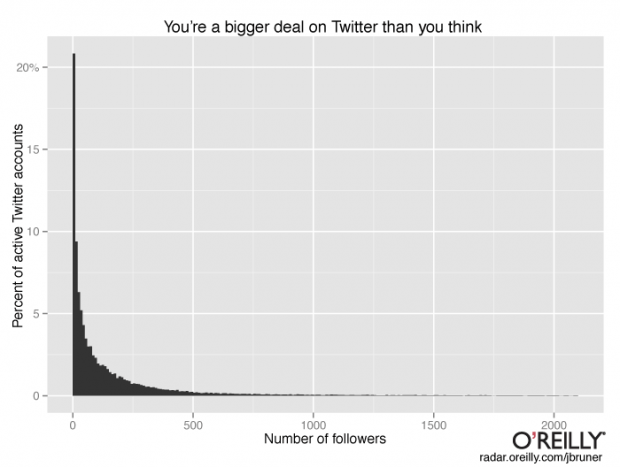
An interesting analysis of Twitter:

number_of_followers_histogram-620x467

Writers who cover Twitter find the grandiose irresistible: nearly every article about the service’s IPO this fall mentioned the heroes of the Arab Spring who toppled dictators with 140-character stabs, or the size of Lady Gaga’s readership, which is larger than the population of Argentina.

But the bulk of the service is decidedly smaller-scale–a low murmur with an occasional celebrity shouting on top of it. In comparative terms, almost nobody on Twitter is somebody: the median Twitter account has a single follower. Among the much smaller subset of accounts that have posted in the last 30 days, the median account has just 61 followers. If you’ve got a thousand followers, you’re at the 96th percentile of active Twitter users. (I write “active users” to refer to publicly-viewable accounts that have posted at least once in the last 30 days; Twitter uses a more generous definition of that term, including anyone who has logged into the service.)

Posted in Uncategorized | Leave a comment

Verso spring 2014 catalogue

Verso’s catalogue for Spring 2014 is now available – many interesting looking books, including Roudinesco’s Lacan; Gros’s A Philosophy of Walking; Lefebvre’s Critique of Everyday Life (three volumes in one); Liberti’s Land-Grabbing (in paperback); Wilson’s Jeffrey Sachs; Kojève’s The Notion of Authority; and Rancière’s Aisthesis.

Posted in Uncategorized | 1 Comment

James Glickman reviews Joss Whedon’s Much Ado About Nothing @Berfrois

James Glickman reviews Joss Whedon’s film Much Ado About Nothing on the Berfrois website. A really good and interesting review, situating the film within the wider context of filming Shakespeare. I enjoyed the review more than the film, to be honest.

Posted in Uncategorized | Leave a comment

Drone Survival Guide –

dsgThe guide contains tactics for hiding from drones and interfering with the drones’ sensors, collected from various online sources. Health Ranger’s intelligence analysis of military drones: payloads, countermeasures and more’, by Mike Adams and‘The Al-Qaida Papers – Drones’, Associated Press, Feb 2013. To keep this document widely available it can be downloaded in .pdf or .doc format. Send a new translation to us and receive a free printed Drone Survival Guide. All translations will be shared here. The Drone Survival Guide is collected and translated as a form of civil initiative, not for profit and without government or commercial funding and/or support.

Thanks to Sławek Królak for the alert.

Posted in Politics | 1 Comment