Theory of the drone 12: ‘Killing well’?

Derek Gregory continues his series of posts on Chamayou.

Derek Gregory's avatargeographical imaginations

This is the 12th in a series of extended posts on Grégoire Chamayou‘s Théorie du drone and covers the final chapter in Part III: Necro-ethics, called ‘Précisions’; in French the singular means accuracy, as you might expect, but the plural means ‘details’ – which is, of course, where the devil is to be found…

One of the most common claims advanced by those who defend the use of armed drones is that they reduce ‘collateral damage’ because they are so precise.  Following directly from his previous critique of Bradley Jay Strawser, Chamayou cites him again here: ‘Drones, for all their current and potential misuse, have the potential for tremendous moral improvement over the aerial bombardments of earlier eras.’  But he dismisses this as a misleading comparison: if Dresden or Hiroshima are taken as the yardstick against which accuracy is to be measured – or, for that matter, as…

View original post 3,076 more words
Posted in Uncategorized | Leave a comment

Semiotext(e) Nietzsche’s Return and Schizo-Culture – open access

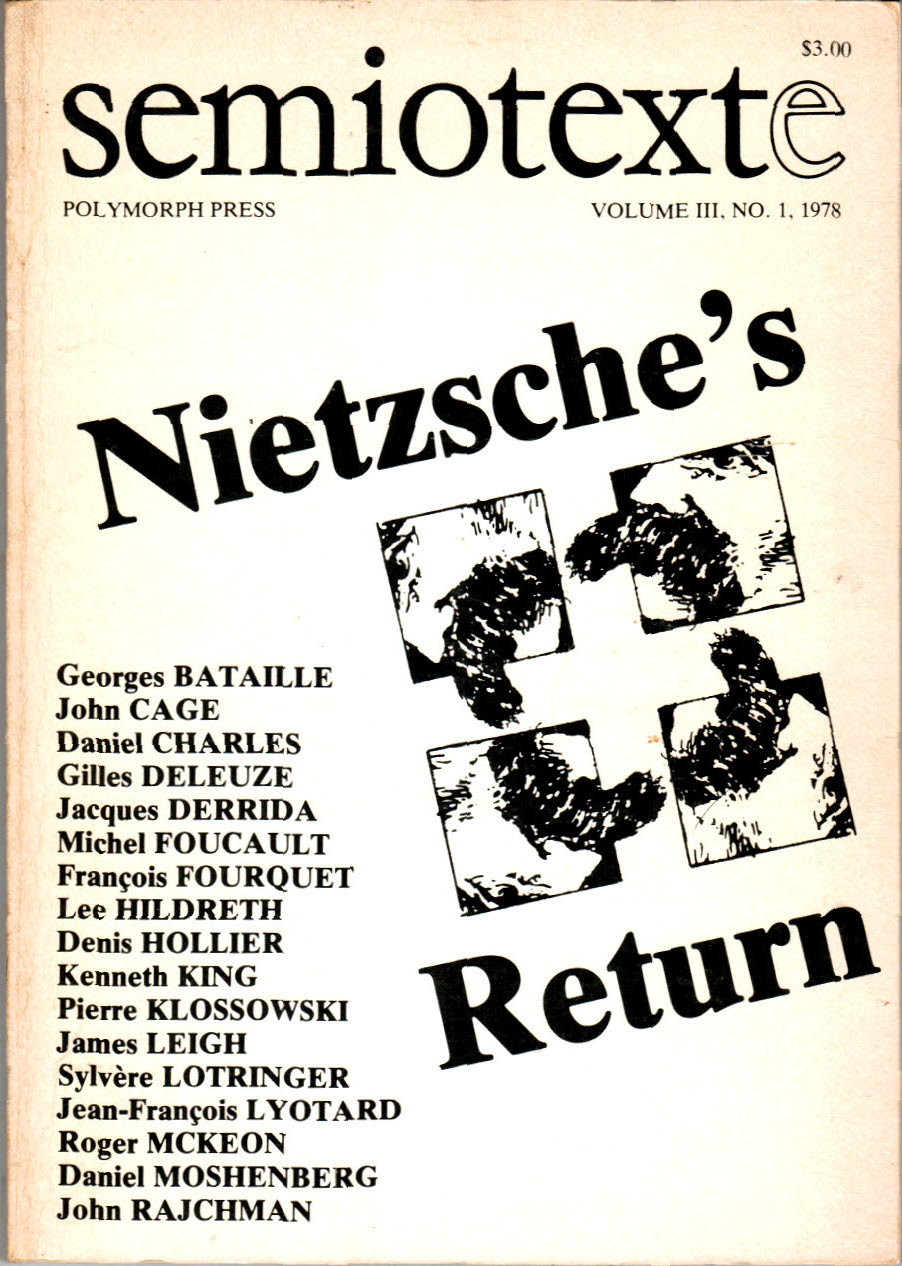
Semiotexte_Vol_3_No_1_Nietzsches_ReturnSemiotext(e) Vol. 3, No. 1: Nietzsche’s Return and Semiotext(e), Vol 3, No 2: Schizo-Culture (both 1978) are available open access.

The first has contributions from Georges Bataille, John Cage, Daniel Charles, Gilles Deleuze, Jacques Derrida, Michel Foucault, François Fourquet, Lee Hildreth, Denis Hollier, Kenneth King, Pierre Klossowski, James Leigh, Sylvère Lotringer, Jean-François Lyotard, Roger McKeon, Daniel Moshenberg and John Rajchman. The second has contributions from Kathy Acker, Lee Breuer, William Burroughs, John Cage, David Cooper, Gilles Deleuze, Douglas Dunn, Richard Foreman, Michel Foucault, John Giorno, Phil Glass, Christopher Knowles, Jean-Francois Lyotard, Ulrike Meinhof, Jack Smith, Robert Wilson, and more…

Thanks to Babette Babich for the link.

Posted in Uncategorized | 1 Comment

Intervention – ‘Removing the Monument to Overcoming Walls: Reflections on Contemporary Border Walls and the Politics of De-bordering’

Antipode intervention on borders and walls.

Antipode Editorial Office's avatarAntipodeFoundation.org

Removing the Monument to Overcoming Walls: Reflections on Contemporary Border Walls and the Politics of De-bordering

by Olivia Mena, London School of Economics and Political Science

On a snowy morning in early March 2013, under the cover of darkness and protection of 250 police officers, construction workers began to take down several segments of the last standing, 1.3-km stretch of the Berlin Wall to make way for luxury high-rise apartments (Birnbaum 2013; The Guardian 2013). Just a week before I had made my first pilgrimage to the remains of the Wall, walking with other tourists along the East Side Gallery, as it’s known, photographing the murals by artists from all over the world that capture the significance, history, and meaning of the Berlin Wall and project alternative visions of a more convivial world without walls. The stretch of cinderblock and the preserved empty dead-zone behind it became the most…

View original post 2,087 more words

Posted in Uncategorized | Leave a comment

Back issues of Symposium available open access

Past issues of the journal Symposium: Canadian Journal of Continental Philosophy from 1997 to 2011 (volumes 1 to 15) are now freely available online. All articles are available for download in pdf format. It is also possible to browse through the different issues and search the archive by keyword, author or title. Throughout the years, Symposium published special issues on Derrida, Deleuze, Gadamer, Habermas, Badiou, Rancière, interviews with Paul Ricoeur, Gianni Vattimo, Richard Kearney, Charles Taylor, translations of texts by Gadamer, Habermas, Ugo Perrone, Vittorio Hösle, Bernhard Waldenfels, and many other texts, including of course dozens of articles, critical notices and book reviews.

Thanks to Peter Gratton for the link.

Posted in Uncategorized | Leave a comment

Kant’s Lectures on Anthropology reviewed at NDPR

9780521771610Immanuel Kant, Lectures on Anthropology, edited and translated by Allen W. Wood and Robert B. Louden is reviewed at NDPR.

Posted in Uncategorized | 1 Comment

Architecture in the Anthropocene – open access book


architecture-in-the-anthropocene_cover_150x225

Architecture in the Anthropocene: Encounters Among Design, Deep Time, Science and Philosophy, edited by Etienne Turpin – open access from Open Humanities Press.


Posted in Publishing | 3 Comments

Justin E.H. Smith on his plans for the next ten years of research

I’ve mentioned Justin E.H. Smith on this blog before, mainly in relation to his excellent book on Leibniz, Divine Machines. In this post he talks about his various future book projects, including several under contract, and some translations.

Will be of interest to people working on animals, world philosophy, Aristotle, Leibniz, Kant, race, etc. It’s both inspiring and humbling.

Posted in Books, Publishing | 3 Comments

FBI vs. Orwell vs. Foucault

An intriguing question of whether Orwell read Bentham. I don’t know, but it’s worth considering that Bentham’s work on the Panopticon was not especially well known – I think I’m correct in saying that until the Verso edition of 1995, the previous English edition was from the late 18th century. Foucault did a lot to recover interest in the texts, and was involved in the French edition of the writings in the mid 1970s. So it’s possible, even if Orwell knew Bentham, he did not know of this text.

Jeremy's avatarOpen Geography

This image attracted a lot of attention around the web today:

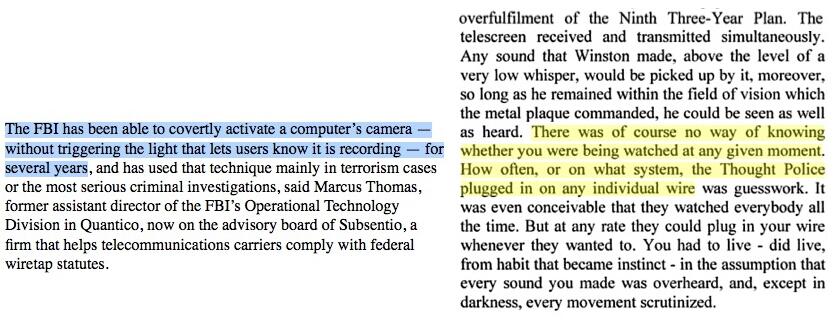
The text on the left is from a story in the Washington Post which discusses the FBI’s ability to exploit laptop cameras without enabling the indicator light.  The text on the right is from Orwell’s novel Nineteen Eighty-Four discussing the dystopian state’s capability to view any given citizen unknowingly through their telescreen. (The comparison was tweeted out by @tinyrevolution.)

To which we can add:

Foucault DP

Michel Foucault, Discipline and Punish, page 201.

This was originally published (in French) in 1975, well after Orwell’s book. So Orwell was first with the idea? Not so fast! Foucault is discussing the ideas of the social reformer Jeremy Bentham, who proposed the idea of the “panopticon” (all-seeing) in the late 18th century. According to one history, there are at least 300 prisons worldwide built on panoptic principles. You can see a classic illustration

View original post 138 more words

Posted in Uncategorized | 1 Comment

Richard Sennett on Foucault (1979)

Some comments from Richard Sennett on Foucault’s initial plans for the History of Sexuality.

Jeremy's avatarOpen Geography

Capture

Some of Richard Sennett’s book review of Foucault from 1979, indicating the original 6-volume plan of the History of Sexuality series.

From the New Yorker, July 16, 1979 issue.

View original post

Posted in Uncategorized | 1 Comment

A new Crystal Palace?

Interesting piece on the proposal to rebuild the Crystal Palace.

Charlotte Mathieson's avatarDr Charlotte Mathieson

It’s a couple of months now since the first press release announcing plans to rebuild the Crystal Palace. My initial response was amazement that it may be possible in coming years to see the rebuilding of one of the most important buildings of the nineteenth century; but as further details unfurl I, like many others, am increasingly ambivalent about the project, which would see a £500 million investment by a private Chinese corporation into the building and surrounding parkland. While the regeneration of the park seems long-overdue and supported by the local community, the corporation currently have an exclusivity agreement with the local council that prevents other proposals for the site’s development to be submitted until February 2015; during this time there is a call for the community to express their feedback on the scheme but it seems this has come rather late in discussions and from what I’ve read of…

View original post 1,250 more words

Posted in Uncategorized | Leave a comment