
Natasha Piano, Democratic Elitism: The Founding Myth of American Political Science – Harvard University Press, April 2025

Natasha Piano, Democratic Elitism: The Founding Myth of American Political Science – Harvard University Press, April 2025
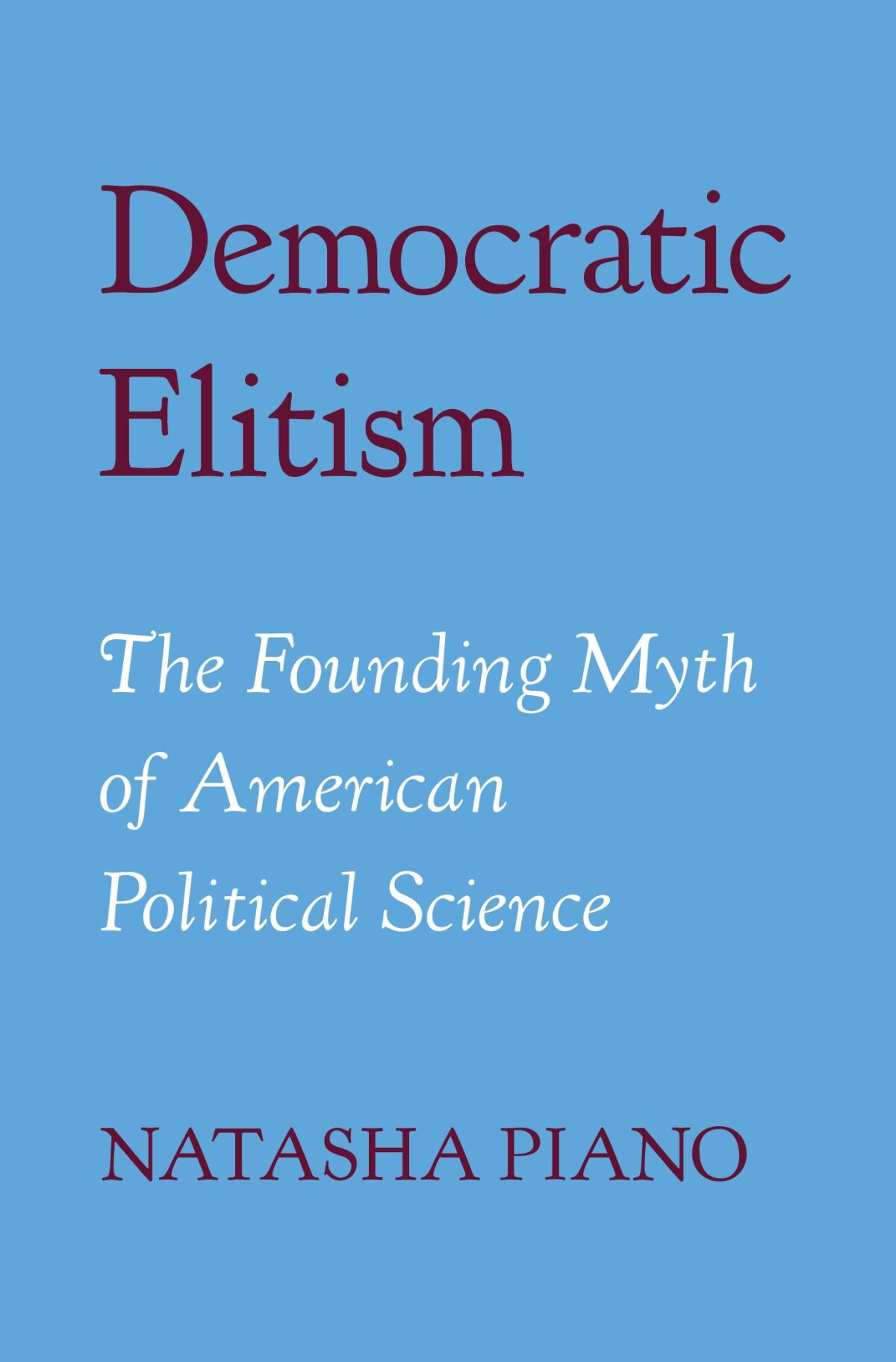
A searing argument—and work of meticulous scholarship—about how American political scientists misinterpreted the elite theory of democracy and in so doing made our political system vulnerable to oligarchic takeover.

Do competitive elections secure democracy, or might they undermine it by breeding popular disillusionment with liberal norms and procedures? The so-called Italian School of Elitism, comprising Vilfredo Pareto, Gaetano Mosca, and Robert Michels, voiced this very concern. They feared that defining democracy exclusively through representative practices creates unrealistic expectations of what elections can achieve, generating mass demoralization and disillusionment with popular government.

The Italian School’s concern has gone unheeded, even as their elite theory has been foundational for political science in the United States. Democratic Elitism argues that scholars have misinterpreted the Italians as conservative, antidemocratic figures who championed the equation of democracy with representative practices to restrain popular participation in politics. Natasha Piano contends not only that the Italian School’s thought has been distorted but also that theorists have ignored its main objective: to contain demagogues and plutocrats who prey on the cynicism of the masses. We ought to view these thinkers not as elite theorists of democracy but as democratic theorists of elitism.

The Italian School’s original writings do not reject electoral politics; they emphasize the power and promise of democracy beyond the ballot. Elections undoubtedly are an essential component of functioning democracies, but in order to preserve their legitimacy we must understand their true capacities and limitations. It is past time to dispel the delusion that we need only elections to solve political crises, or else mass publics, dissatisfied with the status quo, will fall deeper into the arms of authoritarians who capture and pervert formal democratic institutions to serve their own ends.
Posted in Uncategorized | 1 Comment

Stephen D’Arcy, Frege and Fascism – Routledge, December 2024

Stephen D’Arcy, Frege and Fascism – Routledge, December 2024

This book is the first to examine in minutiae the politics of Gottlob Frege (1848–1925), and his connections with various traditions of far-right and fascist thought.

Frege was a philosopher of logic, language, and mathematics. But he also believed that one could reconcile the politics of the far right with a firm commitment to reason-guided inquiry and scientific objectivity. The fundamental claim of the text is that Gottlob Frege was, from the early 1890s to the mid-1920s, an anti-democratic, nationalist political thinker and that his political thought eventually took on a fascist character. This book makes no attempt to vilify or demonize Gottlob Frege, nor does it try to rescue him from criticism. It simply seeks to tell the truth about Frege’s descent into fascism: to document it in hitherto unprecedented detail; to situate it in the context of intellectual and political debates in early Weimar-era Germany; and to explain how it could have happened that someone so intelligent and so manifestly devoted to reason and logic could have embraced fascism with such unreserved enthusiasm.

Frege and Fascism will be of interest to scholars of analytic philosophy, intellectual history, fascism, and anti-democratic thought.

Posted in Uncategorized | Leave a comment

Recordings of the British Academy Conference “Futures of Critique in a Pluricentric World” (July 12-13, 2024)

I am pleased to say that the recordings for the British Academy conference “Futures of Critique in a Pluricentric World” (July 12-13, 2024) are now available on the YouTube channel of the Centre for Philosophy and Critical Thought at Goldsmiths:


Posted in Uncategorized | Leave a comment

Updated: Bibliography of Foucault’s shorter works in English translation (2024)

Foucault News update: Bibliography of Foucault’s shorter works in English translation (2024)

The Bibliography of Foucault’s shorter works in English translation which is maintained by Daniele Lorenzini and hosted on this site [Foucault News] has been updated.

As always if you notice anything missing please either post in the comments on the page or email Daniele Lorenzini directly.

Posted in Uncategorized | Leave a comment

Florian Illies, The Magic of Silence: Caspar David Friedrich’s Journey Through Time, trans. Tony Crawford, Polity, November 2024

Florian Illies, The Magic of Silence: Caspar David Friedrich’s Journey Through Time, trans. Tony Crawford, Polity, November 2024

No German painter evokes such strong emotions as Caspar David Friedrich: his evening skies remain icons of longing, his mountain vistas testaments to the grandeur of nature.  He inspired Samuel Beckett to write Waiting for Godot and Walt Disney to create Bambi. Goethe, however, was so enraged by the enigmatic melancholy of Friedrich’s paintings that he wanted to smash them on the edge of a table.

In a sweeping journey through time, bestselling author Florian Illies tells the story of Friedrich’s paintings and their impact on subsequent generations.  Many of his most beautiful paintings were burned, first in his birthplace and then in World War II; others, like the Chalk Cliffs on Rügen, emerge from the mists of history a hundred years after Friedrich’s death. Illies recounts the story of how Friedrich’s paintings ended up at the Russian czar’s court, others among a pile of winter tires in a Mafia car repair shop, and others still in the kitchen of a German social housing apartment.  Adored by Hitler and Rainer Maria Rilke, despised by Stalin and by the generation of 68, this compelling narrative dances through 250 years of history as seen through Friedrich’s art and life. As a result, the man himself becomes flesh and blood before our very eyes.

Posted in Uncategorized | Leave a comment

Noam Leshem, Edges of Care: Living and Dying in No Man’s Land – University of Chicago Press, January 2025

Noam Leshem, Edges of Care: Living and Dying in No Man’s Land – University of Chicago Press, January 2025

A firsthand look at the lives of those who reside in no man’s land—the violence they endure and their immense resilience.
 
“No man’s land” invokes stretches of barren landscape, twisted barbed wire, desolation, and the devastation of war. But this is not always the reality. According to Noam Leshem in Edges of Care, the term also reveals radical abandonment by the state. From the Northern Sahara to the Amazon rainforests, people around the world find themselves in places that have been stripped of sovereign care. Leshem is committed to defining these spaces and providing a more intimate understanding of this urgent political reality.
 
Based on nearly a decade of research in some of the world’s most challenging conflict zones, Edges of Care offers a profound account of abandoned lives and lands, and how they endure and sometimes thrive once left to fend for themselves. Leshem interrogates no man’s land as a site of radical uncaring: abandoned by a sovereign power in a relinquishment of responsibility for the space or anyone inside it. To understand the ramifications of such uncaring, Leshem takes readers through a diverse series of abandoned places, including areas in Palestine, Syria, Colombia, Sudan, and Cyprus. He shows that no man’s land is not empty of life, but almost always inhabited and, in fact, often generative of new modes of being. Beautifully written and evocative, Edges of Care reveals the unexamined complexities and political dynamics hidden within and around places governed by callous indifference.

Posted in Boundaries, terrain, Territory | Leave a comment

Daniel Wortel-London, The Menace of Prosperity: New York City and the Struggle for Economic Development, 1865–1981 – University of Chicago Press, July 2025

Daniel Wortel-London, The Menace of Prosperity: New York City and the Struggle for Economic Development, 1865–1981 – University of Chicago Press, July 2025

Upends entrenched thinking about cities, demonstrating how urban economies are defined—or constrained—by the fiscal imagination of policymakers, activists, and residents.
 
Many local policymakers make decisions based on a deep-seated belief: what’s good for the rich is good for cities. Convinced that local finances depend on attracting wealthy firms and residents, municipal governments lavish public subsidies on their behalf. Whatever form this strategy takes—tax-exempt apartments, corporate incentives, debt-financed mega projects—its rationale remains consistent and assumed to be true. But this wasn’t always the case. Between the 1870s and the 1970s, a wide range of activists, citizens, and intellectuals in New York City connected local fiscal crises to the greed and waste of the rich. These figures saw other routes to development, possibilities rooted in alternate ideas about what was fiscally viable.
 
In The Menace of Prosperity, Daniel Wortel-London argues that urban economics and politics are shaped by what he terms the “fiscal imagination” of policymakers, activists, advocates, and other figures. His survey of New York City during a period of explosive growth shows how residents went beyond the limits of redistributive liberalism to imagine how their communities could become economically viable without the largesse of the wealthy. Their strategies—which included cooperatives, public housing, land-value taxation, public utilities, and more—centered the needs and capabilities of ordinary residents as the basis for local economies that were both prosperous and just.
 
Overturning stale axioms about economic policy, The Menace of Prosperity shows that not all growth is productive for cities. Wortel-London’s ambitious history demonstrates the range of options we’ve abandoned and hints at the economic frameworks we could still realize—and the more democratic cities that might result.

Posted in Uncategorized | 1 Comment

Michael Behrent review essay of my Foucault books

Michael Behrent has written a review essay about my Foucault books for Modern Intellectual History. Coincidentally – I didn’t know he was writing this piece – I have a review of his Becoming Foucault forthcoming in Journal of Modern History.

Posted in Uncategorized | Leave a comment

Hannah Arendt, What Remains: Collected Poems, ed. and trans. Samantha Rose Hill, trans. Genese Grill – Liveright, December 2024

Hannah Arendt, What Remains: Collected Poems, ed. and trans. Samantha Rose Hill, trans. Genese Grill – Liveright, December 2024

A landmark literary event, What Remains collects Arendt’s complete poetic oeuvre—never before published in English.

Internationally renowned as one of the twentieth century’s foremost public intellectuals, Hannah Arendt was also intensely private. Though she often acknowledged that the language of poetry—especially that of Dickinson, Goethe, and Lowell—informed her work, only a few people knew that Arendt herself wrote poems.

In fact, between 1923 and 1961, Arendt wrote seventy-four poems, many of them signposts in an otherwise unwritten autobiography. For nearly forty years after her death, these poems remained hidden among the archives of the Library of Congress, until 2011, when they were rediscovered by scholar and translator Samantha Rose Hill. Now, for the first time in English, Hill and Genese Grill present Arendt’s poems in chronological order, taking us from the zenith of the Weimar Republic to the Cold War, and from Marburg, Germany, to New York’s Upper West Side.

Throughout, Arendt uses poetry to mark moments of joy, love, loss, and reflection. In “W. B.,” written in 1942, she remembers Walter Benjamin, who died near the French-Spanish border while attempting to flee the Nazis: “Gentle whispering melodies / Sound from the darkness. / We listen so we can let go.” So, too, she reflects on mutability and transience in 1946: “I know that the houses have fallen. / We entered the world in them, wonderfully sure, that they / were more durable than ourselves.” She tries to understand her place in the world: “Ironically foolish, / I’ve forgotten nothing, / I know the emptiness, / I know the burden, / I dance, I dance / In ironic splendor.”

A gift to all readers of Arendt, this stunning, dual-language edition provides an unparalleled view into the inner sanctum of one of our most original thinkers.

Posted in Hannah Arendt, Uncategorized | Leave a comment

Lieba Faier, The Banality of Good: The UN’s Global Fight against Human Trafficking – Duke University Press, September 2024 (open access)

Lieba Faier, The Banality of Good: The UN’s Global Fight against Human Trafficking – Duke University Press, September 2024 (open access)

In The Banality of Good, Lieba Faier examines why contemporary efforts to curb human trafficking have fallen so spectacularly short of their stated goals despite well-funded campaigns by the United Nations and its member-state governments. Focusing on Japan’s efforts to enact the UN’s counter-trafficking protocol and assist Filipina migrants working in Japan’s sex industry, Faier draws from interviews with NGO caseworkers and government officials to demonstrate how these efforts disregard the needs and perspectives of those they are designed to help. She finds that these campaigns tend to privilege bureaucracies and institutional compliance, resulting in the compromised quality of life, repatriation, and even criminalization of human trafficking survivors. Faier expands on Hannah Arendt’s idea of the “banality of evil” by coining the titular “banality of good” to describe the reality of the UN’s fight against human trafficking. Detailing the protocols that have been put in place and evaluating their enactment, Faier reveals how the continued failure of humanitarian institutions to address structural inequities and colonial history ultimately reinforces the violent status quo they claim to be working to change.

Posted in Uncategorized | Leave a comment