Judith Butler, Dispossession

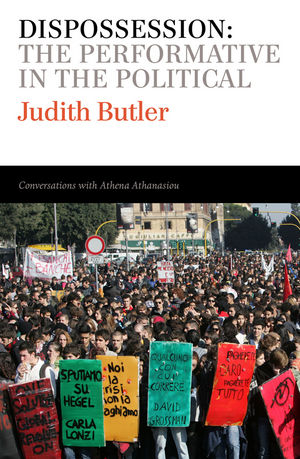
ButlerI’ve mentioned Judith Butler’s recent Parting Ways before, but she has a new book coming out with Polity in the next month or so – Dispossession: The Performative in the Political. I’ve not seen this mentioned before. It’s a series of conversations with  Athena Athanasiou. Here’s the description – but the site also has the table of contents:

Dispossession describes the condition of those who have lost land, citizenship, property, and a broader belonging to the world. This thought-provoking book seeks to elaborate our understanding of dispossession outside of the conventional logic of possession, a hallmark of capitalism, liberalism, and humanism. Can dispossession simultaneously characterize political responses and opposition to the disenfranchisement associated with unjust dispossession of land, economic and political power, and basic conditions for living?

In the context of neoliberal expropriation of labor and livelihood, dispossession opens up a performative condition of being both affected by injustice and prompted to act. From the uprisings in the Middle East and North Africa to the anti-neoliberal gatherings at Puerta del Sol, Syntagma and Zucchotti Park, an alternative political and affective economy of bodies in public is being formed. Bodies on the street are precarious – exposed to police force, they are also standing for, and opposing, their dispossession. These bodies insist upon their collective standing, organize themselves without and against hierarchy, and refuse to become disposable: they demand regard. This book interrogates the agonistic and open-ended corporeality and conviviality of the crowd as it assembles in cities to protest political and economic dispossession through a performative dispossession of the sovereign subject and its propriety.

Posted in Judith Butler, Politics | 2 Comments

Parallel States Project

At Lund University some interesting thinking on the Israel/Palestine situation in a venture called the Parallel States Project. The conference was in 2010 and I’m not sure what has happened since 2011. The site says they are cooperating with faculty from Ben-Gurion University of the Negev and the Al-Mustaqbal Foundation in Ramallah. The idea is in opposition to the two states solution (dividing the territory of Gaza, West Bank and Israel into two somehow), and to the one state solution (undivided territory, unified state of both peoples), through proposing a “scenario with two states, Israel and Palestine, sharing sovereignty over the whole area between the Mediterranean and the Jordan River”. Shades of China Miéville’s The City and the City, perhaps. Difficult to imagine this being taken very seriously, but by removing one of the key elements of the conflict – land and/or territory – from the situation, it does lead to thinking through some of the complexities that are not always discussed. It’s based, it seems, on a fairly crude understanding of the notion of territory, and a belief that the globalised world means that sovereign control of territory is not as important as it used to be. But there are historical resonances of this – the territoriality of law did used to be challenged by personality of law: who you were led to the legal code that applied, not where you were. Utopian perhaps, but maybe a productive way of beginning thinking through some of the associated issues in this complicated situation. Thanks to Jorge Goldfarb for pointing me to this.

Posted in China Mieville, Politics, Territory | 3 Comments

Apparently Space, Knowledge and Power: Foucault and Geography, a book I co-edited with Jeremy Crampton is now available as an e-book. I thought it always was, but perhaps not. Seems the electronic version has a different cover – no idea what the thinking behind that is, unless it’s a rights issue. Thanks to Clare at Foucault News and Variazioni foucaultiane for alerting me to this.

Clare O'Farrell's avatarFoucault News

Jeremy W. Crampton, Stuart Elden (Eds.), Space, Knowledge and Power: Foucault and Geography, London: Ashgate (now Routledge – 2025), November 2012 (E.book, Illustrated edition)
Previous Ed: paperback February 2007; hardback February 2007. I have also uploaded the more attractive original book cover for this post

Michel Foucault’s work is rich with implications and insights concerning spatiality, and has inspired many geographers and social scientists to develop these ideas in their own research. This book, the first to engage Foucault’s geographies in detail from a wide range of perspectives, is framed around his discussions with the French geography journal Hérodote in the mid 1970s. The opening third of the book comprises some of Foucault’s previously untranslated work on questions of space, a range of responses from French and English language commentators, and a newly translated essay by Claude Raffestin, a leading Swiss geographer.The rest of the book presents…

View original post 643 more words

Posted in Uncategorized | Leave a comment

‘How should we do the history of territory?’ – online

My paper ‘How should we do the history of territory?’ is now online – forthcoming in the inaugural issue of the RSA journal Territory, Politics, Governance. The journal requires subscription, so if you can’t easily get hold of it, please let me know. The paper is a reflection on The Birth of Territory, and explores some methodological issues, but it is mainly a critique of Foucault’s discussion of territory in Security, Territory, Population.

This article approaches the question of territory, and its relation to politics and governance, from a historical perspective. The approach here is to interrogate the claims made by Foucault concerning territory in his work on governmentality. Foucault sees territory as crucial to the Middle Ages through to Machiavelli, but as displaced as the object of government by the emerging concept of population. In distinction, this piece argues that territory is not crucial to medieval determinations of rule, but actually emerges around the same time as Foucault’s notion of population, making use of similar techniques of rule. The historical examples relate to the broader book The Birth of Territory. While what he says about territory directly is misleading, Foucault is, however, extremely helpful in thinking about these questions more generally, especially in terms of his historical approach. Thinking more deeply about the history of the emergence of the concept and practice of territory is helpful in understanding contemporary concerns, transformations and disputes.

Posted in Michel Foucault, My Publications, Territory, The Birth of Territory | 2 Comments

Dittmer on Kaplan’s The Revenge of Geography

Jason Dittmer reviews Robert Kaplan’s The Revenge of Geography at The New Inquiry. Thanks to Territorial Masquerades for the link (also points to some discussions of Jarad Diamond’s new book).

Posted in Politics | Leave a comment

Klaus Dodds, The Antarctic – interview

DoddsKlaus Dodds’s The Antarctic: A Very Short Introduction is the focus of an interview at Exploring Geopolitics.

Posted in Politics, Territory | Leave a comment

Neve Gordon on the Israeli election

In diagrams at the London Review of Books blog.

This is the way the results of the elections are being presented in the Israeli press:

Centre Left Bloc                                           Right Bloc

Other, perhaps more accurate ways to present the election results:

Left Bloc                                                         Right Bloc

Non-Jews                                                               Jews

Women                                                                     Men

Willing to take the necessary steps for a two-state solution?

Willing                                                            Unwilling

Posted in Uncategorized | Leave a comment

Allen Scott – A World in Emergence

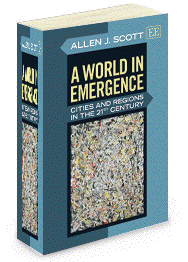
781009307Allen Scott’s book A World in Emergence: Cities and Regions in the 21st Century is now out.

Beginning with the recent history of capitalism and urbanization and moving into a thorough and complex discussion of the modern city, this book outlines the dynamics of what the author calls the third wave of urbanization, characterized by global capitalism’s increasing turn to forms of production revolving around technology-intensive artifacts, financial services, and creative commodities such as film, music, and fashion. The author explores how this shift toward a cognitive and cultural economy has caused dramatic changes in the modern economic landscape in general and in the form and function of world cities in particular. Armed with cutting-edge research and decades of expertise, Allen J. Scott breaks new ground in identifying and explaining how the cities of the past are being reshaped into a complex system of global economic spaces marked by intense relationships of competition and cooperation.

Posted in urban/urbanisation | Leave a comment

A history of the concept of distance?

At Open Geography, Jeremy Crampton reports a conversation:

A colleague recently asked me if geographers have written anything on the history of distance as a concept, especially since the Medieval period and the early modern. (He had in mind Elden’s history of territory.) I must admit I was stumped.

Have we?

So far the only comment is to point to Barnett, Robinson and Rose’s Geographies of Globalisation which “explores the geographies of proximity and distance that shape globalization, and considers the politics of responsibility that it brings”.

In my history of territory, I do discuss distance a bit, particularly in terms of the changing meanings of the notion of spatium. In classical Latin this tends to mean a distance, a stretch or extent, rather than a container. It could relate to a span of time; the spacing between stones in building; or the distance between parts of an army – all those senses are found in Julius Caesar. A lap of a chariot race was sometimes described as a spatium – as it is in Virgil and Juvenal. All of those are instances of distance. In late Scholasticism this term became associated with particular notions of locus, and Descartes transformed the way we understood spatium by relating it to the the notion of extenso – itself related to distance as extension in length, breadth and depth – which makes spatium, space into more of a container. So the relation between space and distance would be one way to look into this question – and I suspect there were be some useful pointers in, for example, Lefebvre’s The Production of Space and Casey’s The Fate of Place.

But the question of distance itself would be a rather different project, even though it would intersect with those other issues. It would need to take into account notions of measure, proximity, etc. Heidegger talks in a few places about how distance and proximity can be understood in relation to concern, and also how distance can be related to time – it’s about five minutes walk, or as long as it takes to smoke a pipe. Technologies are important too – distances could change depending on terrain to be crossed, or the season. I wonder if historians of science have said much about this question – it would be important to all sorts of contemporary questions. I suppose literature on relational spaces would have a lot to say to this too.

It’s a good question, and there might be a worthwhile project in this. Any other thoughts or reading suggestions?

Posted in The Birth of Territory | 7 Comments

An interesting possibility in the Open Access debates.

Posted in Uncategorized | Leave a comment